
Hello! In our last lesson, we focused on the Lorentz force, , which a magnetic field exerts on moving charges. We saw how this leads to a macroscopic force on a current-carrying wire.
Today, we will see that this very same force is the microscopic origin of a profound phenomenon: electromagnetic induction. Specifically, we will explore how simply moving a conductor through a magnetic field can generate a voltage. This is often called "motional EMF" (Electromotive Force) and it's the foundational principle behind electrical generators. Our goal is to explain this physical mechanism from the ground up, starting with the Lorentz force acting on individual charges within the conductor.
1. A Conductor in Motion
Let's begin with the classic scenario: a metal rod of length moving with a constant velocity through a uniform magnetic field . We'll assume the rod's velocity is perpendicular to both its length and the magnetic field, as shown in the diagram below.
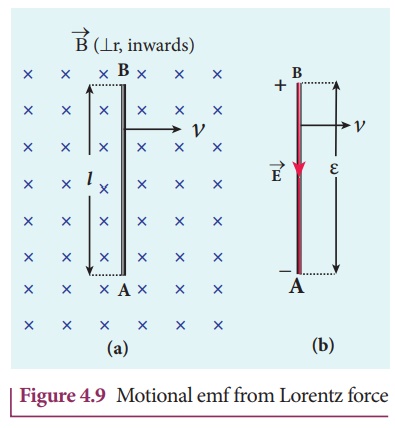
A metal rod contains a vast number of free conduction electrons. As the rod moves, these electrons are carried along with it, so they too are moving with velocity through the magnetic field .
According to the Lorentz force law from our last lesson, each of these electrons experiences a magnetic force. Using the right-hand rule (velocity to the right, field into the page), the force on a positive charge would be upwards. Since electrons have a negative charge (), the force on them is directed downwards, towards the bottom of the rod.
This magnetic force pushes the free electrons, causing them to accumulate at the bottom end of the rod. Consequently, the top end is left with a net positive charge due to a deficit of electrons.
2. The Buildup of an Electric Field
This separation of charge—positive at the top, negative at the bottom—cannot continue indefinitely. Why? Because the separated charges create their own electric field inside the conductor, pointing from the positive end to the negative end (i.e., downwards).
This induced electric field now exerts a new, opposing force on the remaining free electrons: an electric force . Since points downwards, the electric force on the negatively charged electrons is directed upwards.
So we have two competing forces on the electrons:
- Magnetic Force (): Pushes electrons downwards.
- Electric Force (): Pushes electrons upwards.
Charge separation continues until these two forces reach equilibrium and perfectly balance each other. At this point, the net force on the electrons is zero, and the migration of charge stops.
The following video provides an excellent visual and conceptual walkthrough of this entire process.
Part 1 - Why is an EMF induced in a moving rod? | EMI | Physics | Khan Academy
To see how this process unfolds, from the initial force on the electrons to the final establishment of a potential difference, please watch the following video from Khan Academy India. It provides a clear, step-by-step physical explanation.
Watch from 00:36 to 04:51. Focus on how the Lorentz force initiates charge separation (0:36), how this separation creates an opposing electric field (2:32), and how the balance of these two forces leads to the final expression for the induced EMF (4:02).
3. Deriving the Motional EMF
As the video demonstrates, the equilibrium condition is key. When the forces balance, their magnitudes are equal:
Notice the charge cancels out. This gives us the magnitude of the induced electric field inside the conductor:
This internal electric field creates a potential difference between the ends of the rod. This potential difference is the induced electromotive force (EMF), denoted by . For a uniform electric field over a length , the potential difference is simply:
Substituting our expression for , we arrive at the famous formula for motional EMF:
This equation tells us that a voltage is generated across the ends of the moving rod, and its magnitude is directly proportional to the speed of the rod, the strength of the magnetic field, and the length of the rod. If this rod were connected to an external circuit, this EMF would drive a current.
For a more rigorous treatment of this derivation, the following text is very helpful. Given your mathematical background, you will appreciate how it formalizes the equilibrium condition in vector notation.
PPLATO | FLAP | PHYS 4.4: Electromagnetic induction
This excerpt from the 'FLAP' physics module provides a formal analysis connecting the Lorentz force to the induced voltage. It reinforces the concepts from the video with a more mathematical approach.
Read the section titled '5.1 Faraday’s law and the Lorentz force'. Pay close attention to how it establishes the equilibrium condition E + v × B = 0 and uses it to derive the induced voltage, V_ind = vBl.
The key vector relationship derived in that text is . This elegant expression shows that the induced electric field is determined entirely by the motion of the conductor through the magnetic field. The EMF is then the line integral of this field along the conductor's length: .
Test your understanding!
A 1-meter long metal rod is moving at 10 m/s through a magnetic field of 0.5 T, as in the diagram above. Which end of the rod becomes positive, and what is the magnitude of the induced EMF?
Show answer
Direction: Using the right-hand rule, with velocity to the right and the B-field into the page, the force on a positive charge is upwards. Therefore, positive charges are effectively pushed to the top end, making the top end positive.
Magnitude: Using the motional EMF formula:
A 5-volt potential difference is induced across the rod.
4. A Note on Work and the Lorentz Force
In our previous lesson, we established a crucial fact: the magnetic force does no work because it is always perpendicular to a particle's velocity (). This might seem to contradict what we've learned today. After all, if the Lorentz force is creating an EMF (), isn't it doing work?
This is a subtle but important point. The Lorentz force itself does no net work. It acts as an intermediary, redirecting the kinetic energy supplied by the external mechanical force that is pushing the rod.
When the rod is part of a closed circuit and a current flows, that current experiences a magnetic drag force that opposes the motion. To keep the rod moving at a constant velocity , the external agent (e.g., your hand, an engine) must do work against this drag force. It is the work done by this external agent that is converted into electrical energy in the circuit, not the work of the magnetic field itself. The Lorentz force is the mechanism by which this energy conversion happens.
The following short clip discusses this very point.
Part 1 - Why is an EMF induced in a moving rod? | EMI | Physics | Khan Academy
The latter part of the Khan Academy video addresses this apparent paradox about work.
Watch the segment from 05:34 to 07:39. The main takeaway is that the Lorentz force acts as the agent of energy conversion, but the energy itself originates from the mechanical work done to move the conductor against an opposing magnetic force.
Conclusion
Today, we've delved into the fundamental mechanism behind electromagnetic induction. By applying a principle from our last lesson—the Lorentz force—we've seen how motion through a magnetic field can generate a voltage.
Key Takeaways:
- Motional EMF is the voltage induced in a conductor moving through a magnetic field.
- The physical mechanism is the Lorentz force acting on the free charges (electrons) inside the moving conductor.
- This force separates the charges, creating an internal electric field that opposes further separation.
- In equilibrium, the electric and magnetic forces balance, resulting in a potential difference across the conductor given by .
- The Lorentz force acts as the agent of energy conversion, but the energy ultimately comes from the mechanical work done to move the conductor.
Preview of the Next Lesson:
The concept of motional EMF is a specific case of a more general and powerful principle: Faraday's Law of Induction. In the next lesson, we will state Faraday's Law, which relates the induced EMF to the rate of change of magnetic flux. This will allow us to analyze not only motional EMF but also induction in stationary circuits where the magnetic field itself is changing—the principle behind transformers.
Can't find a good explanation? Sign up and we'll make it for you
Sign up