Hello! Welcome back to our module on Game Analysis.
In our last lesson, you learned how to use the Chess.com Game Review report to pinpoint the most critical mistake from one of your losses. You found the "what"—the single move where the game took a decisive turn for the worse. This is like finding a major drop-off point in a marketing funnel; you know where the problem is, but you don't yet know the cause.
Today, we move from "what" to "why." Our goal is to play through the engine's recommended alternative line to understand why it was superior to the move you played. Simply seeing the engine's top move isn't enough. To truly learn and avoid repeating the same error, you must dig deeper and comprehend the tactical or strategic reason behind the engine's suggestion.
1. The Goal: Understanding, Not Just Seeing
The purpose of using a chess engine is not to be told the "correct" answer, but to use it as an infinitely strong sparring partner who can show you the consequences of your moves. Merely glancing at the top recommended move and moving on is one of the most common and least effective ways to analyze.
A Simple 3-Step Process For Analyzing Your Chess Games
Grandmaster Max Illingworth's blog post, 'A Simple 3-Step Process For Analyzing Your Chess Games,' makes a crucial point about this process. Let's look at his second step.
Read 'Step 2: Figure Out What Moves You Needed To See To Play The Best Move'. The key sentence is: 'Just knowing the top line of the engine in a position isn't enough to improve our chess; we need to understand what stopped us from playing that move in a game.'
To achieve this understanding, you need to actively engage with the engine's suggestions. A helpful way to think about this is having a "conversation" with the engine. You ask "Why is this move better?" and the engine answers by showing you the best continuation. You can even ask "What if I tried this instead?" and the engine will show you the refutation.
2. Having a "Conversation" with the Engine
Let's watch a demonstration of this process. The key is to play out the engine's recommended line on the board and observe what happens. Does it win material? Does it lead to checkmate? Does it ruin the opponent's pawn structure?
How to Use Chess Engines to Analyze Your Games (Real Game Examples!)
The video 'How to Use Chess Engines to Analyze Your Games' provides an excellent walkthrough of this 'conversation' process. The presenter shows how to explore different lines to understand the engine's logic.
Please watch the following segments: 03:59 - 04:49: The presenter introduces the concept of using the engine to understand why a logical-looking move is a mistake. 04:49 - 07:04: Pay close attention to how he plays through the engine's suggested line (A6) and his own alternative ideas (Queen A4) to see how Black refutes them. This is the 'conversation' in action. 16:20 - 18:19: Here, he analyzes another position, comparing his own calculated line with an even stronger one found by the engine, highlighting how you can learn about more complex ideas like move order.
The main takeaway is to be interactive. Use the engine as a tool to test hypotheses and discover the tactical realities of the position.
3. Using the 'Analysis' Tab for a Deeper Dive
While the 'Game Review' tab is great for a quick overview, the 'Analysis' tab on Chess.com provides more powerful tools for this kind of deep investigation.
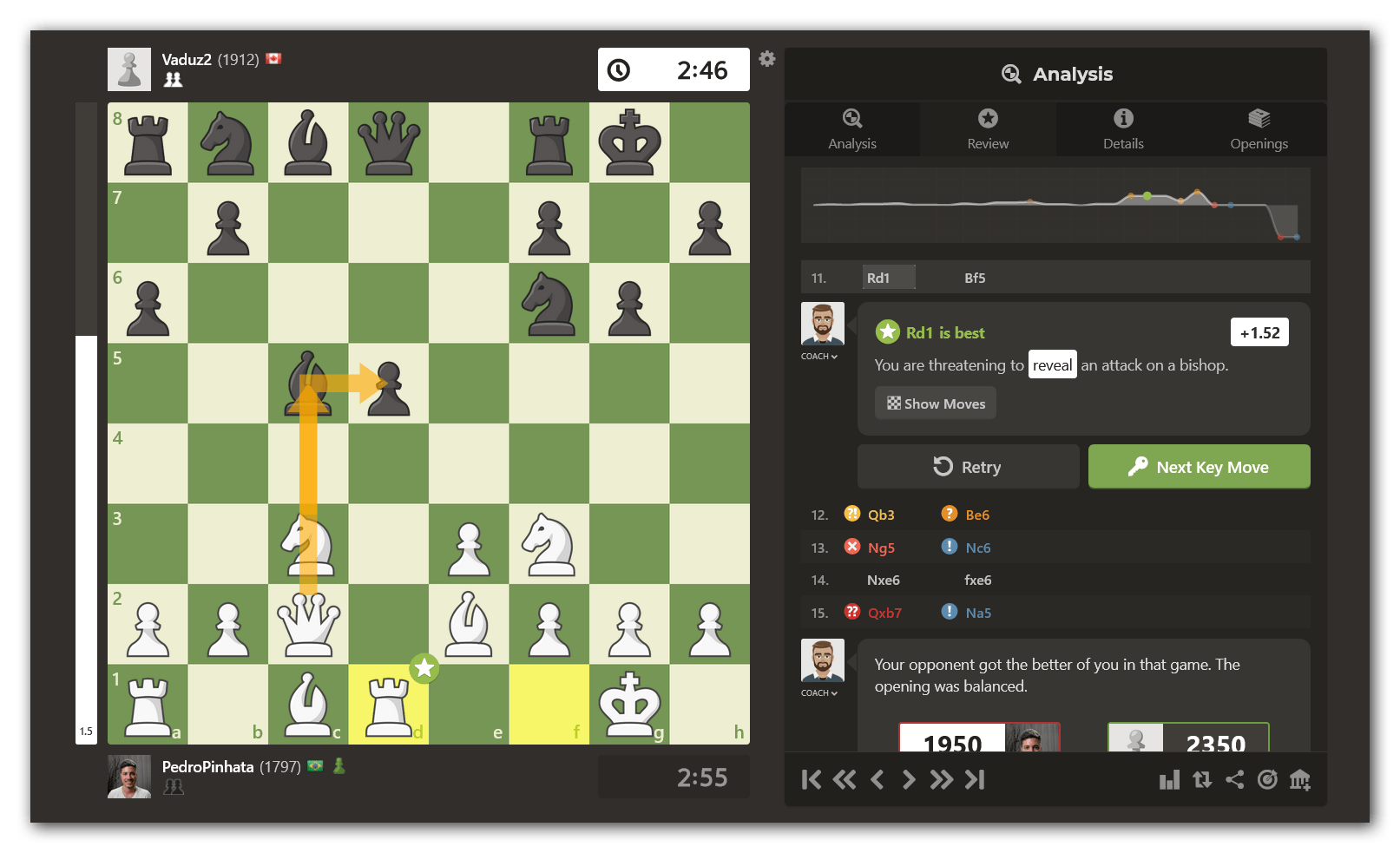
To get the most out of your analysis, you'll want to switch to this tab and configure it to help your investigation.
How To Use 'Game Review' And Analysis Tools (@chess)
The video 'How To Use 'Game Review' And Analysis Tools' clearly explains how to switch to the Analysis tab and use its features.
Please watch these two clips: 09:52 - 12:44: This segment shows how to switch to the 'Analysis' tab and, crucially, how to change the engine settings. For our purposes, setting the 'Number of Lines' to 3 is highly recommended. This allows you to see multiple good options, not just the single best move. 14:03 - 15:51: This is a key segment. It demonstrates exactly how to play out a variation on the board, see how it affects the evaluation bar, and then get back to the main game line. This is the core technical skill for our lesson today.
By using the Analysis tab with multiple lines enabled, you can:
- Play through the top recommended line to see why it's best.
- See other good moves you might have missed.
- Test your own candidate moves from the game and see exactly how the engine would have punished them.
4. Practical Exercise: Uncover the "Why"
Now, let's apply this to your own game.
- Open the same game you analyzed in our previous lesson.
- Navigate to the Analysis tab (next to the 'Game Review' tab).
- Go to the position right before you made your critical mistake.
- In the engine settings (the gear icon), make sure you are showing at least 3 lines.
- Now, instead of making your mistake, play the engine's top recommended move on the board.
- Follow the engine's new top line for the opponent's reply, then your best reply, and so on, for at least 3-4 moves for each side.
- Keep going until the reason for the advantage becomes clear. Ask yourself:
- Do I win a piece?
- Do I win a pawn?
- Do I force a checkmate?
- Do I trade into a winning endgame?
- Do I gain a permanent positional advantage (e.g., a powerful outpost, a ruined enemy pawn structure)?
- Once you understand the idea, go back to the original position (by clicking on the move in the move list) and write down a single sentence explaining why the engine's move was better. For example: "The engine's move,
Nf5, was better because it created an unstoppable attack on the h7 pawn, leading to mate."
Conclusion
You've now moved beyond simply identifying mistakes to actively understanding them. This is the most critical part of the game analysis loop. By having a "conversation" with the engine—playing out its lines and testing your own ideas—you transform a computer evaluation into a practical, memorable lesson.
Key Takeaways:
- The goal of engine analysis is to understand the 'why' behind a move, not just to see the 'what'.
- Treat analysis as an interactive "conversation" with the engine by playing out different variations on the board.
- Use the 'Analysis' tab on Chess.com with multiple lines enabled for a deeper, more controlled investigation.
- When playing through an engine line, continue until the source of the advantage becomes concrete and understandable (e.g., winning material).
Preview of the Next Lesson:
You've now identified your mistake and understood the better alternative. The final step in cementing this knowledge is to articulate it. In the next lesson, you will practice how to verbally explain the reason for your biggest mistake in your own words, turning your analysis into a powerful learning narrative.