
Hello! Welcome back to our course on the Venezuelan crisis.
In our last lesson, we detailed the deep political, economic, and military grievances that led a broad coalition of opposition forces to attempt to overthrow Hugo Chávez in April 2002. We left off as the coup was underway. As you know from history, a failed coup is often more significant than a successful one. Today, we will explore the profound consequences of that failure.
Introduction
Today's Focus: Mapping the Post-Coup Power Shift
This lesson addresses the fifth learning outcome of Module 2: Map the shifts in the Power/Interest Grid of Venezuelan society following the failure of the 2002 coup, noting the consolidation of power by Chávez.
The 48 hours of the coup and its collapse were a pivotal turning point. The opposition played its strongest hand and lost, with dramatic consequences. Chávez returned to power not weakened, but significantly strengthened and emboldened.
To analyze this transformation, we will revisit the Power/Interest Grid, a tool you may have encountered in your civil service work for stakeholder analysis. It helps us map actors based on their level of interest in an issue and their power to affect the outcome. We will use it to visualize how the failed coup radically redrew the political map of Venezuela.
Recap from Last Lesson:
We identified the anti-Chávez coalition: business elites (Fedecámaras), the old guard of the state oil company (PDVSA), the main trade union (CTV), opposition political parties, and a significant faction of the military. Their combined grievances led them to support the April 11th coup. Now, we'll see what happened to them when it failed.
This lesson should take you approximately 60 minutes to complete.
1. The Unraveling of the Coup
The coup government, led by business leader Pedro Carmona, lasted less than 48 hours. Its collapse was swift and was driven by two key factors:
- The Interim Government's Overreach: The "Carmona Decree" dissolved the democratically elected National Assembly, the Supreme Court, and the 1999 Constitution itself. This alienated even some anti-Chávez moderates and was condemned internationally. It looked less like a restoration of democracy and more like a right-wing dictatorship.
- Popular and Military Reaction: Crucially, two groups did not accept Chávez's removal. Hundreds of thousands of his supporters from the poorer barrios of Caracas poured into the streets demanding his return. Simultaneously, key factions of the military who had remained loyal to Chávez—particularly the Presidential Guard and paratroop divisions—moved to retake the presidential palace.
Faced with mass protests and a military division, the coup collapsed. Chávez was brought back from his detention and returned to the presidency, not as a chastened leader, but as a triumphant one who had survived a direct challenge to his rule.
2. A Refresher: The Power/Interest Grid
Before we map the changes, let's quickly recall the Power/Interest Grid. It plots stakeholders on two axes:
- Interest: How much are they affected by the issue? (Low to High)
- Power: How much influence do they have over the outcome? (Low to High)
This creates four quadrants:
- High Power / High Interest (Key Players): Manage them closely. These are the most important actors.
- High Power / Low Interest (Keep Satisfied): Their power means they could become major players if their interest increases.
- Low Power / High Interest (Keep Informed): They care a lot but can't do much. They can, however, form coalitions or influence more powerful actors.
- Low Power / Low Interest (Monitor): Require minimal effort.
Before the coup, the grid was contested. Chávez was a Key Player, but so were the opposition leaders, PDVSA management, and the military high command. After the coup, this changes entirely.
3. The Purge: Removing Opponents from the Grid
The failed coup gave Chávez the justification and political capital to do what he couldn't before: decisively remove his opponents from positions of power.
Activity 1: Neutralizing the Military and PDVSA (Est. 20 minutes)
The two most powerful institutional threats to Chávez were the military and the management of PDVSA. Read the following excerpts to see how he dealt with them in the wake of the coup and the subsequent, related crisis of the 2002-2003 general strike.
-
Venezuela and the Rise of Chavez: A Background ... (The 2002 Coup and its Aftermath)
Focus on: How Chávez used the coup's failure to "purge political opponents in the armed forces and gradually cemented his control over the institution." -
Venezuela and the Rise of Chavez: A Background ... (The 2002-2003 General Strike and PDVSA Control)
Focus on: The opposition's next move—the general strike—and how Chávez responded by sacking 18,000 striking managers and workers at PDVSA, allowing him to "take back control of the company."
Reflection:
Think about these two groups in terms of the Power/Interest Grid.
- The rebel military officers and the PDVSA technocrats were firmly in the High Power / High Interest quadrant before 2002. They had immense power to disrupt the state.
- After the purges, where would you place them? They were effectively removed from the board entirely, their power reduced to zero. They became, at best, a Low Power / High Interest group, now operating from outside the state.
This was a fundamental restructuring of the Venezuelan state, removing two of the most powerful checks on executive authority.
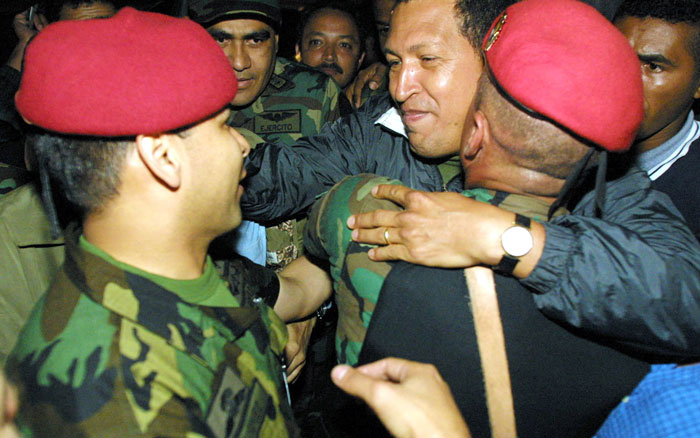
This image shows Hugo Chávez embracing loyalist soldiers after his return to power in April 2002. It visually represents the critical shift: the armed forces were no longer a contested institution but were being remade into a key pillar of personal support for the president.
4. The Consolidation: Strengthening the Bolivarian Project
With his main opponents defeated, Chávez moved to consolidate his power and radicalize his political project. He had survived the ultimate test and now had a clear mandate in the eyes of his supporters.
Activity 2: An Emboldened Leader (Est. 15 minutes)
Read the following resource, which describes the political atmosphere following the coup and how Chávez leveraged his victory.
Focus on:
- How surviving the coup and the subsequent oil strike demonstrated that Chávez "had nothing to lose by turning farther left."
- His decisive victory in the 2004 recall referendum, which served as a final democratic stamp of approval on his rule.
- The moment in 2005 when he felt secure enough to formally proclaim his goal of building "socialism for the twenty-first century."
This period shows Chávez and his movement becoming the undisputed Key Player. The opposition, having failed in a coup, a general strike, and a recall referendum, was demoralized and fragmented. They remained a High Interest group, but their Power was severely diminished.
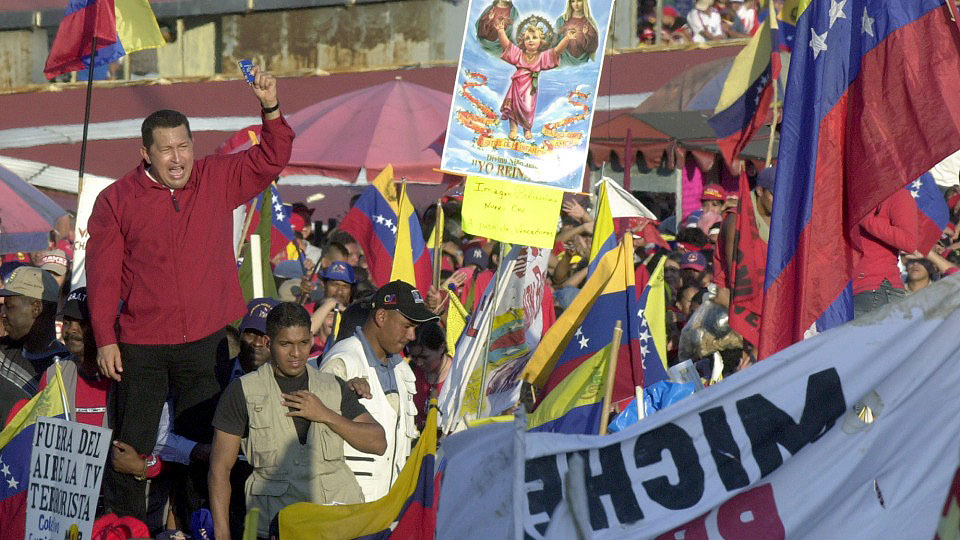
This image of Chávez addressing a massive rally captures the other pillar of his consolidated power: his popular base. The failure of the "elite" coup validated his narrative of a class struggle and reinforced the bond between him and his supporters, who now saw themselves as the guarantors of his presidency.
5. The New Power/Interest Grid (Post-2004)
Let's visualize the dramatic shift.
| Actor / Group | Position Before 2002 Coup | Position After 2004 Referendum | Reason for Shift |
|---|---|---|---|
| Hugo Chávez & Executive | Key Player (Contested) | Key Player (Dominant) | Survived coup, strike, and referendum; consolidated control over state institutions. |
| Loyalist Military | Keep Satisfied | Key Player | Became essential for regime survival; rewarded with power and influence. |
| Rebel Military | Key Player (Faction) | Off the Grid (Eliminated) | Purged from the armed forces after the failed coup. |
| PDVSA Technocrats | Key Player | Off the Grid (Eliminated) | Sacked en masse after the 2002-2003 oil strike. |
| Business/Political Opposition | Key Player | Keep Informed (Marginalized) | Defeated in every major confrontation; lost institutional power and public momentum. |
| Chavista Popular Base | Keep Informed / Keep Satisfied | Keep Satisfied (Empowered) | Role in reversing the coup elevated their importance as a pillar of the regime. |
| Judiciary / Electoral Council | Contested Institutions | Key Players (Controlled by Executive) | Stacked with loyalists, becoming instruments of government control. |
As you can see, the grid was simplified and consolidated. The number of competing "Key Players" shrank dramatically, with power coalescing around Chávez, his loyalist military, and the institutions he now controlled.
Conclusion
Key Takeaways
- The failure of the 2002 coup was a watershed moment that radically altered the balance of power in Venezuela.
- Chávez used the opportunity to conduct sweeping purges of the military and the state oil company (PDVSA), removing his most powerful institutional opponents. On the Power/Interest Grid, these groups moved from 'Key Players' to being off the grid entirely.
- The opposition's subsequent failures in the oil strike and the 2004 recall referendum left them marginalized and fragmented, moving them from 'Key Players' to a 'Keep Informed' status with much-reduced power.
- Conversely, Chávez and his loyalists in the military became the dominant 'Key Players', with their power consolidated and unchecked. His popular base was also empowered, their status elevated as the defenders of the revolution.
- This consolidation of power is what allowed Chávez to radicalize his agenda, leading to the declaration of "socialism for the twenty-first century" and the deeper economic interventions we will study next.
Preview of the Next Lesson
The most significant institutional casualty of this period was PDVSA. In our next lesson, we will focus specifically on this, addressing the learning outcome: "Describe how the role and management of PDVSA, the state oil company, were altered by the Chávez administration after the 2002 oil strike." We will see how Chávez transformed it from a professional, quasi-independent oil company into a direct funding arm for his political project, a decision with long-term consequences for the entire Venezuelan economy.
Can't find a good explanation? Sign up and we'll make it for you
Sign up