
Good to see you again. In the previous lesson, you used CIDR boundaries to determine subnet capacity and avoid overlapping ranges. That was a concrete design constraint: an address plan must support the workload today while leaving room for growth and connectivity later.
AWS architecture involves the same kind of judgment at a broader level. A design is rarely simply “good” or “bad”; it delivers some benefits while consuming money, operational effort, resources, or flexibility. In this lesson, you will use the six AWS Well-Architected pillars as a practical lens for identifying the main trade-off in a simple design. This is an important SAA-C03 skill: question scenarios often present an improvement and expect you to recognize both what it improves and what it costs.
The Well-Architected Framework: a vocabulary for architectural judgment
The AWS Well-Architected Framework is not a service and not a compliance checklist. It is a structured way to evaluate whether a workload is designed and operated appropriately for its business requirements.
The framework uses six pillars:
- Operational Excellence
- Security
- Reliability
- Performance Efficiency
- Cost Optimization
- Sustainability
Watch this short overview first. It introduces the framework as a set of principles for evaluating cloud workloads, then names and briefly characterizes all six pillars.
What is the AWS Well-Architected Framework? (and why you need to learn about it)
In “What is the AWS Well-Architected Framework?” from Tech With Lucy, watch the introduction and pillar overview to establish the framework’s purpose before applying it to design choices.
Watch the framework overview for the purpose of Well-Architected reviews. Then watch the six pillars and listen for the distinct concern each pillar represents. Do not try to memorize every design principle yet; focus on recognizing the categories.
AWS’s own definitions are worth keeping as your authoritative reference. Read the introductory paragraphs and pillar table, then the discussion of business-context trade-offs below it.
Definitions - AWS Well-Architected Framework
Read AWS’s concise definitions of the six pillars and its guidance on making trade-offs. This is the vocabulary closest to how AWS frames architecture questions.
On the “Definitions” page, begin with the opening explanation of the framework and continue through Table 1, “The pillars of the AWS Well-Architected Framework.” Read the framework introduction, then study the full table rather than treating the pillar names as labels to memorize. After the table, find the paragraph beginning “When architecting workloads.” Read the trade-off guidance. Pay particular attention to AWS’s point that engineering priorities derive from business context.
A useful mental model is this:
A pillar is a question you ask of a design, not a feature that a particular AWS service automatically provides.
For example, choosing a larger EC2 instance does not automatically mean you have addressed Performance Efficiency. You must know whether CPU, memory, network throughput, or another constraint was actually limiting the workload. Similarly, deploying an extra component may improve Reliability, but it may increase cost and operational burden.
The six pillars in practical terms
For the Associate exam and early architecture discussions, associate each pillar with its central concern. The details will become more concrete as you learn individual AWS services.
| Pillar | Central question | Examples of evidence or design concerns |
|---|---|---|
| Operational Excellence | Can the team operate, observe, change, and improve the workload effectively? | Monitoring, alarms, automated deployments, runbooks, incident learning |
| Security | Are data, systems, identities, and assets protected? | Least-privilege access, encryption, network controls, logging, detection |
| Reliability | Will the workload perform its intended function correctly and consistently, including through failures? | Fault recovery, backups, tested restoration, scaling, multi-AZ design |
| Performance Efficiency | Does the workload use the right resources and technologies to meet requirements as demand changes? | Appropriate compute type, database choice, caching, measured capacity |
| Cost Optimization | Does the workload provide its required business value without unnecessary spending? | Rightsizing, removing idle resources, appropriate pricing models, cost visibility |
| Sustainability | Can the workload reduce energy and resource use while still meeting requirements? | Higher utilization, managed services, efficient hardware, avoiding waste |
Operational Excellence
Operational Excellence concerns the way the workload is run, not only whether it currently works. A manually configured EC2 instance might serve requests successfully, but it creates risk if no one can reliably reproduce its configuration, monitor it, deploy changes safely, or respond during an incident.
Common indicators include:
- Infrastructure and operational procedures defined as code
- Small, reversible changes rather than large untested releases
- Monitoring and alarms tied to meaningful workload symptoms
- Documented response procedures and lessons learned from incidents
Operational Excellence often reinforces other pillars. Automated deployment can improve reliability by reducing manual configuration errors, while monitoring can reveal both performance bottlenecks and unexpected cost growth.
Security
Security protects data, systems, and assets. In AWS architecture, it includes identity and access management, encryption, network boundaries, logging, and detection.
A key exam habit is to treat security requirements as requirements to satisfy, not optional enhancements to remove simply because another design costs less. For example, an architecture that eliminates encryption to reduce overhead is not an acceptable optimization when sensitive data is involved.
You will explore IAM, encryption, detection, and network controls in later modules. At this stage, recognize phrases such as these as security signals:
- “Least privilege”
- “Only authorized employees”
- “Encrypt data at rest and in transit”
- “Audit API activity”
- “Prevent public access”
- “Detect suspicious behavior”
Reliability
Reliability is the ability of a workload to perform correctly and consistently when it is expected to. It includes the ability to recover from failure, handle changing demand, and test recovery throughout the workload’s lifecycle.
A single server might be sufficient for a low-impact internal tool that can tolerate downtime. It is usually insufficient for a customer-facing workload that must remain available if an underlying host or Availability Zone fails.
Reliability signals in a scenario include:
- Required uptime or availability targets
- Strict recovery time requirements
- A stated tolerance for failure
- Customer-facing or revenue-critical operations
- Automated recovery, redundancy, backups, and recovery testing
Do not equate “reliable” solely with “more servers.” Reliability must be measured against the failure the business actually needs to tolerate.
Performance Efficiency
Performance Efficiency concerns meeting workload requirements efficiently, including as demand and technology change. It is not merely making an application as fast as possible.
A workload may need low latency, high transaction throughput, rapid report generation, or the ability to handle unpredictable traffic bursts. The architect should select services and resource configurations based on evidence and requirements, rather than habit.
Performance signals include:
- Latency targets
- Transactions or requests per second
- Sudden increases in demand
- Database query delays
- CPU, memory, storage IOPS, or network bottlenecks
- Global user populations
A design that improves performance may introduce a new burden. For example, caching can reduce database load and response time, but cached data requires a strategy for refresh and invalidation. Without one, customers might receive outdated information.
Cost Optimization
Cost Optimization means delivering the required business value at the lowest appropriate cost. It does not mean selecting the option with the smallest monthly bill regardless of business impact.
Stopping a production database every night might reduce cost, but it would fail the design if the business requires 24-hour availability. In contrast, stopping a development environment outside working hours may be exactly the right choice if developers do not need it overnight.
Cost signals include:
- A fixed or limited budget
- Idle, oversized, or always-on resources
- Predictable versus variable usage
- Long-term committed usage
- Requests to reduce operating expense
- A requirement to allocate or track spending by team or workload
Cost optimization often competes with Reliability and Performance Efficiency, because redundancy and always-available capacity consume resources. But it can also support Sustainability: removing unused compute reduces both spend and energy use.
Sustainability
Sustainability focuses on reducing the environmental impact of running a workload by using resources efficiently and minimizing unnecessary infrastructure.
In simple SAA-C03 scenarios, sustainability often overlaps with cost optimization, but they are not identical. A lower-cost choice is not automatically the lower-impact choice, and a sustainable decision must still meet security, reliability, and performance requirements.
Sustainability signals include:
- Reducing energy consumption
- Increasing utilization of provisioned resources
- Removing unnecessary capacity
- Choosing more efficient compute where compatible
- Using managed services that can pool and optimize underlying infrastructure
A trade-off is a consequence, not a failure
A trade-off occurs when improving one desirable outcome imposes a meaningful cost, risk, or limitation elsewhere. The architect’s task is not to eliminate every trade-off; that is impossible. The task is to make the trade-off explicit, compare it with requirements, and choose deliberately.
Consider this proposal:
Replace one always-on EC2 instance with an Auto Scaling group spanning two Availability Zones behind a load balancer.
The proposal has a clear reliability benefit: if one instance or one Availability Zone becomes unavailable, the workload can continue serving traffic through healthy capacity elsewhere.
Its main trade-off is usually:
| Improvement | Main cost or consequence |
|---|---|
| Higher Reliability | Higher Cost Optimization pressure because multiple instances and a load balancer consume additional resources |
| Better fault tolerance | More Operational Excellence work because health checks, deployment practices, monitoring, and troubleshooting become more involved |
| Potentially more capacity for traffic | Greater resource use, which can also affect Sustainability |
The design is not “wrong” because it costs more. For a revenue-generating application with a requirement to remain available during an Availability Zone failure, the increased cost may be justified. For a noncritical development environment, it may be unjustified.
The central question is always:
What requirement is important enough to justify this consequence?
Do not use simplistic formulas
You may hear a rule such as “choose any two of cost, performance, and reliability.” It can be a helpful warning that high availability and high performance consume resources, but it is not a law of architecture.
A good change can improve several pillars simultaneously. For example:
- Removing idle development instances can improve Cost Optimization and Sustainability.
- Infrastructure as code can improve Operational Excellence, Security, and Reliability by making configuration reproducible and reviewable.
- A well-designed cache can improve Performance Efficiency and potentially reduce database cost.
The important question is not “which pillar loses?” It is “what meaningful consequence, risk, or new responsibility does this decision create?”
AWS’s performance guidance uses caching as a good example: it can dramatically improve performance, but you must decide how cached data is updated or invalidated so it does not cause incorrect behavior.
PERF01-BP04 Evaluate how trade-offs impact customers ...
Read this AWS Well-Architected performance practice for a concrete example of evaluating an improvement beyond its immediate technical benefit.
Read the opening section, “PERF01-BP04 Evaluate how trade-offs impact customers and architecture efficiency,” beginning with the example about a key-value data store. Read the performance caution. Then continue into “Implementation guidance” and its “Implementation steps.” Read the evaluation process. Focus on the sequence: understand requirements, define evaluation factors, select an architecture, and test uncertain assumptions.
A repeatable method for finding the main trade-off
In an exam question or an architecture review, a scenario can include many pillars at once. Avoid trying to list every possible connection. Identify the main trade-off by following this process.
1. Extract the non-negotiable requirements
Separate requirements from preferences.
For example:
| Statement | Interpretation |
|---|---|
| “The application must continue during an Availability Zone failure.” | Reliability requirement |
| “Users need responses in under 200 milliseconds.” | Performance requirement |
| “The application handles payment information.” | Security requirement |
| “The environment is used only during business hours.” | Cost-optimization opportunity |
| “The team wants the lowest-cost architecture.” | Preference, constrained by all mandatory requirements |
A cheap design that violates a required recovery target is not a valid answer. A fast design that exposes payment data is not a valid answer.
2. Identify the proposed architectural change
Look for the decision being evaluated:
- Add redundant capacity
- Add caching
- Move to a managed service
- Use a smaller instance
- Run resources only on a schedule
- Replicate data to another location
- Automate deployment and recovery
Do not analyze every AWS service mentioned. Focus first on what has changed.
3. State the primary benefit in pillar language
Name the strongest intended improvement:
- “This primarily improves Reliability.”
- “This primarily improves Performance Efficiency.”
- “This primarily reduces unnecessary cost, supporting Cost Optimization.”
- “This primarily improves Operational Excellence through repeatable operations.”
4. State the most important consequence
The consequence may fall under another pillar, or it may be a practical concern that affects one.
Common patterns include:
| Change | Primary benefit | Likely main trade-off |
|---|---|---|
| Multi-AZ or redundant deployment | Reliability | Higher cost and more operational complexity |
| Caching | Performance Efficiency | Cost, cache-management effort, and risk of stale data |
| Smaller or scheduled-off compute | Cost Optimization | Lower available capacity or reduced availability |
| Encryption and fine-grained access controls | Security | Added implementation effort and occasional performance or usability considerations |
| Serverless for irregular traffic | Cost Optimization and Performance Efficiency | Different operational model, service limits, and possible latency considerations |
| More logging and monitoring | Operational Excellence and Security | Storage, processing cost, and alert-management effort |
5. Check whether the consequence is acceptable
Return to the business requirement. An acceptable trade-off is one the business knowingly accepts because the primary benefit matters more in that context.
A concise architecture justification often has this structure:
Decision: Deploy across multiple Availability Zones.
Primary benefit: Improves Reliability by reducing dependence on one Availability Zone.
Main trade-off: Increases ongoing cost and operational complexity.
Why acceptable: The application has a stated requirement to remain available through an Availability Zone disruption.
That is architectural reasoning. It is stronger than simply saying, “Multi-AZ is a best practice.”
Worked example: a reporting application
Suppose a company has an internal SQL reporting portal. Employees use it from 8 a.m. to 6 p.m. on weekdays. Reports may take several seconds to run, and the business accepts occasional downtime outside business hours. The company wants to reduce cloud spending.
A proposed design is to run its nonproduction environment only during working hours and shut it down overnight and on weekends.
Step 1: Identify the important requirements
- It is a nonproduction environment.
- It is used during predictable working hours.
- Downtime outside those hours is acceptable.
- Cost reduction is an explicit goal.
Step 2: Identify the pillar improvement
The design primarily supports Cost Optimization. It removes expenditure for unused compute time.
It also supports Sustainability, since unnecessary running capacity is avoided.
Step 3: Identify the main trade-off
The main trade-off is reduced availability. The environment cannot be used immediately after hours unless the team starts it again.
There may also be an operational consequence: the startup and shutdown schedule must be automated and monitored so that the environment is ready when the workday begins.
Step 4: Decide whether it is acceptable
Yes, if the stated usage pattern is accurate and there is no requirement for after-hours availability. The same choice would likely be inappropriate for a public production application.
The important distinction is:
- “Stop it at night” is not universally cost-optimized.
- It is cost-optimized for this stated business context.
Reading a trade-off graph without overgeneralizing it
The disaster-recovery trade-off graph below illustrates a common architecture pattern: reducing the duration of a service interruption usually requires more implementation cost and complexity. The individual disaster-recovery strategies shown on the graph will be covered later in the course; for now, focus only on how to read the trade-off.
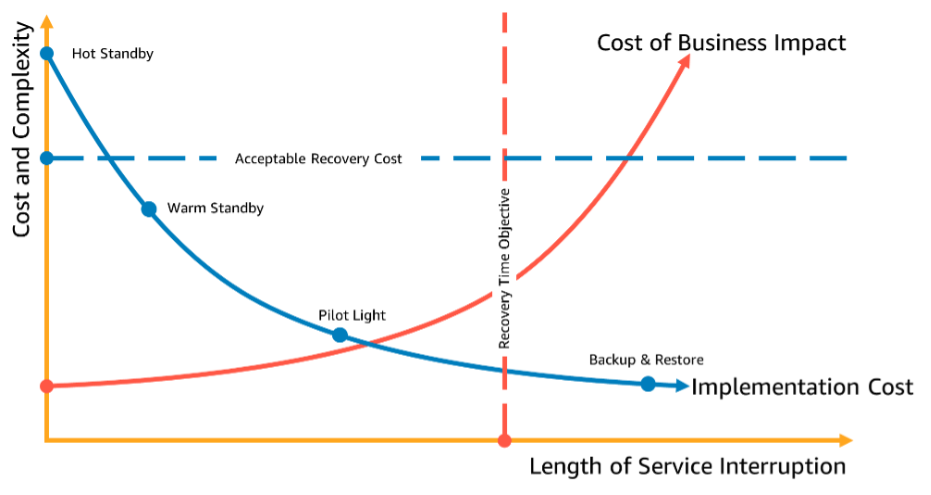
The blue curve represents the cost and complexity of the recovery design. Moving toward shorter interruption times tends to increase that investment. The red curve represents the cost of business impact: longer outages can become increasingly costly to the organization.
The dashed lines represent business constraints:
- An acceptable recovery cost: how much the organization can justify spending on recovery capability.
- A recovery time objective: the longest interruption the organization considers acceptable.
The central trade-off is therefore:
Better Reliability through faster recovery usually requires greater Cost Optimization sacrifice and more Operational Excellence effort.
The graph does not tell you that every workload needs the most expensive option. A low-impact internal application may accept a longer recovery time. A payment system or customer storefront may not. The right design sits where the organization’s recovery requirement and acceptable cost meet.
Fast SAA-C03 reasoning cues
When you see a scenario, use the wording to identify its priority before looking at answer choices.
| Scenario wording | Likely priority |
|---|---|
| “Must survive an Availability Zone failure” | Reliability |
| “Lowest latency,” “high throughput,” or “spiky demand” | Performance Efficiency |
| “Minimize monthly costs,” “unused resources,” or “predictable workload” | Cost Optimization |
| “Sensitive data,” “audit,” “least privilege,” or “prevent exposure” | Security |
| “Reduce manual work,” “repeatable deployment,” or “monitor and respond” | Operational Excellence |
| “Reduce energy use” or “maximize resource utilization” | Sustainability |
Then apply two checks:
- Which answer meets the mandatory requirement?
- Which answer meets it with the least unnecessary cost, complexity, or operational burden?
Be careful with answer choices that are technically capable but excessive. A multi-Region active-active system may offer impressive reliability, but it is not automatically the best answer if the scenario merely requires recovery from a single instance failure. Conversely, a single low-cost instance is not a valid choice if the question explicitly requires fault tolerance.
Key takeaways
The AWS Well-Architected Framework provides six lenses for evaluating designs:
- Operational Excellence: operate, observe, change, and improve effectively.
- Security: protect data, systems, identities, and assets.
- Reliability: perform correctly and recover through failures and change.
- Performance Efficiency: use appropriate resources to meet workload demands.
- Cost Optimization: deliver required value without unnecessary expense.
- Sustainability: reduce resource and energy impact while meeting requirements.
A trade-off is not automatically a design flaw. It is the consequence of a design decision, judged against the business context. To identify the main trade-off, first extract mandatory requirements, identify the proposed change and its primary pillar benefit, then state the most meaningful cost, risk, or operational burden introduced.
In the next lesson, you will make these judgments more concrete by configuring the security baseline of an AWS account: root-user MFA and separate administrative access so the root user is not used for routine work.
Can't find a good explanation? Sign up and we'll make it for you
Sign up