
Introduction
Welcome to a new chapter in our exploration of Colombian mythology. In our last module, we delved into the world of the Kogi people, high in the misty, green mountains of the Sierra Nevada de Santa Marta. We learned about their concept of Aluna and the vital role of the Mamos in maintaining cosmic balance from the 'Heart of the World'.
Today, we journey from those cool, vertical peaks to a dramatically different landscape: the arid, sun-scorched peninsula of La Guajira, at the northernmost tip of South America. This is the ancestral home of the Wayuu people.
Your learning outcome for this lesson is to describe the desert environment and matrilineal society of the Wayuu people. Before we can understand their myths, we must first understand their world—the stage on which their stories unfold. For someone with your background in systems thinking and design, this lesson is about understanding the foundational 'constraints' and 'rules' of a cultural system: how a unique environment shapes a unique social structure.
1. The Land of Sun and Wind: The Guajira Peninsula
The Wayuu inhabit a world that seems, at first glance, inhospitable. La Guajira is a vast semi-desert peninsula, a place of scarce rainfall, dry tropical forests, and constant winds blowing from the Caribbean Sea.
However, to see it only as a desert is to miss its essence. The Wayuu understand their land as a "hydrosocial territory," a space defined by its complex relationship with water. To get a better sense of this unique geography, please read the following introduction.
The Exile of Juyá: Decolonial Geonarratives of Water
This excerpt from 'The Exile of Juyá: Decolonial Geonarratives of Water' describes the geography of La Guajira, highlighting how this semi-desert landscape is paradoxically surrounded and defined by water sources, shaping the Wayuu worldview.
Read the first two paragraphs of the text, starting with 'La Guajira as an Hydrosocial Territory...' and ending with '...the territory of Juyá'. Focus on the description of the peninsula as a meeting point of different geographical formations.
This land of stark contrasts has shaped a resilient and deeply connected culture. The following images give you a glimpse into the environment of the Wayuu.

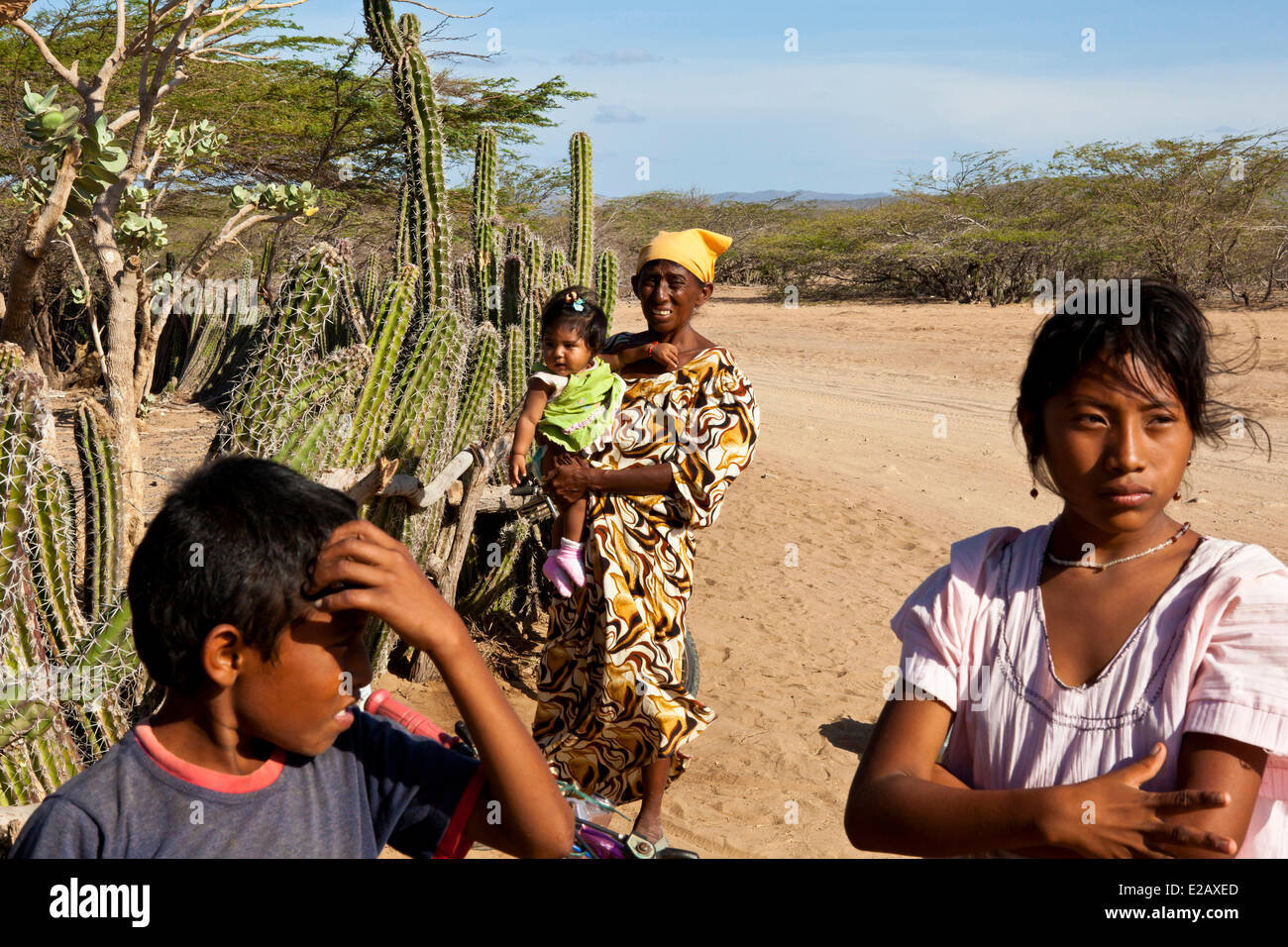
A Deep Knowledge of the Climate
Living in such an environment requires an intimate understanding of its cycles. The Wayuu possess a rich, traditional knowledge of the climate, personifying the rain as a being named Juyá and recognizing its many different forms and moods. This knowledge was once a precise calendar that governed their lives.
The following text, based on the memories of a Wayuu elder, beautifully illustrates this deep environmental wisdom.
The Exile of Juyá: Decolonial Geonarratives of Water
This section from the same article, 'The Exile of Juyá', shares an elder's oral history of the 'Juyá calendar'. It reveals a highly nuanced understanding of different types of rain and their roles throughout the year.
Read the section titled 'Elder Geonarratives (Oralities) and Climate Change in La Guajira'. Focus on the elder's description of the different rains (Patunajanaikai, Karraisi, Iiwa, etc.) and the months in which they would appear. This is a beautiful example of oral tradition as a tool for survival and meaning.
This poetic and practical understanding of the climate is the first key to unlocking the Wayuu worldview. Their myths are not abstract fantasies; they are narratives woven from the realities of sun, wind, rain, and drought.
2. A Society Centered on Women
The second key is understanding the Wayuu's unique social structure. Unlike most Western societies and many other indigenous groups, Wayuu society is matrilineal and matrilocal.
- Matrilineal: Lineage, identity, and inheritance are traced through the mother's line. A person belongs to their mother's clan.
- Matrilocal: Upon marriage, the husband traditionally moves to live with or near his wife's family.
This places women at the absolute center of Wayuu social and territorial life. They are the anchors of the family, the clan, and the land itself.
The following text provides a clear overview of this family structure.
Indigenous Culture in La Guajira, Colombia
This excerpt from 'Indigenous Culture in La Guajira, Colombia' by Vanderbilt University explains the fundamentals of the Wayuu's matrilineal and matrilocal system.
Read the first two paragraphs under the heading 'Family Relations and Gender Issues'. Pay attention to how individuals identify with a clan, the importance of the maternal side of the family, and the description of 'rancherías'.
This social system is not an arbitrary choice; it is a powerful adaptation to their environment. In a world where resources can be scarce and men may need to travel for herding or trade, the women provide a stable, unmoving center. They are the guardians of the ancestral territory, symbolized by the family cemetery, which is the ultimate proof of a clan's ownership of the land.
This connection is beautifully captured in the Wayuu's own symbolic thinking, which links the social order to the natural world.
The Exile of Juyá: Decolonial Geonarratives of Water
This final reading connects the two themes of our lesson: the environment and the social structure. It explains the profound symbolic link between women and the land, and men and the rain.
Read the paragraphs beginning with 'Wayuu society is matrilineal and matrilocal...' and ending with '...reflects Juyá’s eternal travels around the basin.' This passage succinctly explains how women are seen as the embodiment of the earth ('mmakat'), while men's mobility mirrors the travels of the rain-being, Juyá.
This symbolism is incredibly powerful. The woman is the territory, the fixed point around which life revolves. The man, like the essential but transient rain, comes and goes. This worldview is a direct reflection of, and a brilliant adaptation to, the land of La Guajira.
Test your understanding!
From a systems design perspective, why might a matrilineal and matrilocal social structure be a resilient and effective adaptation to a harsh, semi-desert environment where resources are often scarce and unpredictable?
Show answer
A matrilineal and matrilocal system creates a highly resilient social structure in this environment for several reasons:
- Stability and Continuity: By having women as the fixed territorial and lineage anchors, the core of the family and clan remains stable regardless of external conditions. The home base, resource rights, and cultural knowledge are securely maintained.
- Resource Management: It creates a clear and stable system for managing land and resources. The clan's territory, passed down through the maternal line, is unambiguously defined.
- Flexibility and Mobility: It allows men the flexibility to be mobile—for herding livestock, engaging in trade, or seeking work—without disrupting the core social unit. They can travel to find resources knowing that the family's anchor point is secure. This combination of a stable core and a flexible periphery is a hallmark of a resilient system.
Conclusion
In this lesson, we have established the foundational context for understanding Wayuu mythology. We have left the mountains and entered a world of sand, sun, and sea, uncovering the two pillars that support the Wayuu worldview.
Key Takeaways:
- The Wayuu live in the semi-desert environment of the La Guajira peninsula, a "hydrosocial territory" where life is defined by the complex and often scarce presence of water.
- Wayuu society is matrilineal and matrilocal, placing women at the center of the clan, lineage, and territory.
- There is a deep symbolic connection between this social structure and the environment: women represent the stable earth, while men represent the mobile, life-giving rain (Juyá).
Preview of the Next Lesson:
Now that we have a firm grasp of the land and the people, we are ready to explore their cosmology. In our next lesson, we will delve into the Wayuu creation myth featuring the central deity Maleiwa. We will see how this story of origins is born directly from the landscape we've explored today and how it sets the stage for the powerful forces of Juya (rain) and Pulowi (drought).
Can't find a good explanation? Sign up and we'll make it for you
Sign up