
Hello again. In the previous lesson, you learned the performance-marketing operating loop: start from a business outcome, set up measurement, launch carefully, read the data from delivery through business value, and optimize through controlled changes.
This lesson focuses on the decision that makes that loop coherent: translating a business request into a funnel stage, a platform campaign objective, and a primary KPI. By the end, you should be able to look at a brief such as “we need more sales” or “we need to build demand” and make a defensible measurement choice rather than defaulting to clicks or impressions.
One business goal, three connected decisions
These three terms sound similar, but they answer different questions:
| Decision | The question it answers | Example |
|---|---|---|
| Business objective | What commercial change does the company need? | Generate profitable first purchases of a skincare subscription |
| Funnel stage | How ready is this audience to act, and what is the appropriate next step? | Decision / conversion |
| Campaign objective | What action should the ad platform try to generate? | Sales |
| Primary KPI | What single measure will determine whether the campaign is succeeding? | Cost per acquisition (CPA) |
A useful way to hold the distinction is this:
- The business objective belongs to the business.
- The funnel stage describes the customer’s state of readiness.
- The campaign objective gives the platform a delivery instruction.
- The KPI tells the marketer how to judge the result.
If these choices conflict, performance data becomes misleading. For example, choosing a traffic campaign and judging it by cheap clicks does not answer whether an ecommerce business received profitable purchases. The campaign may technically succeed at bringing visitors while failing commercially.
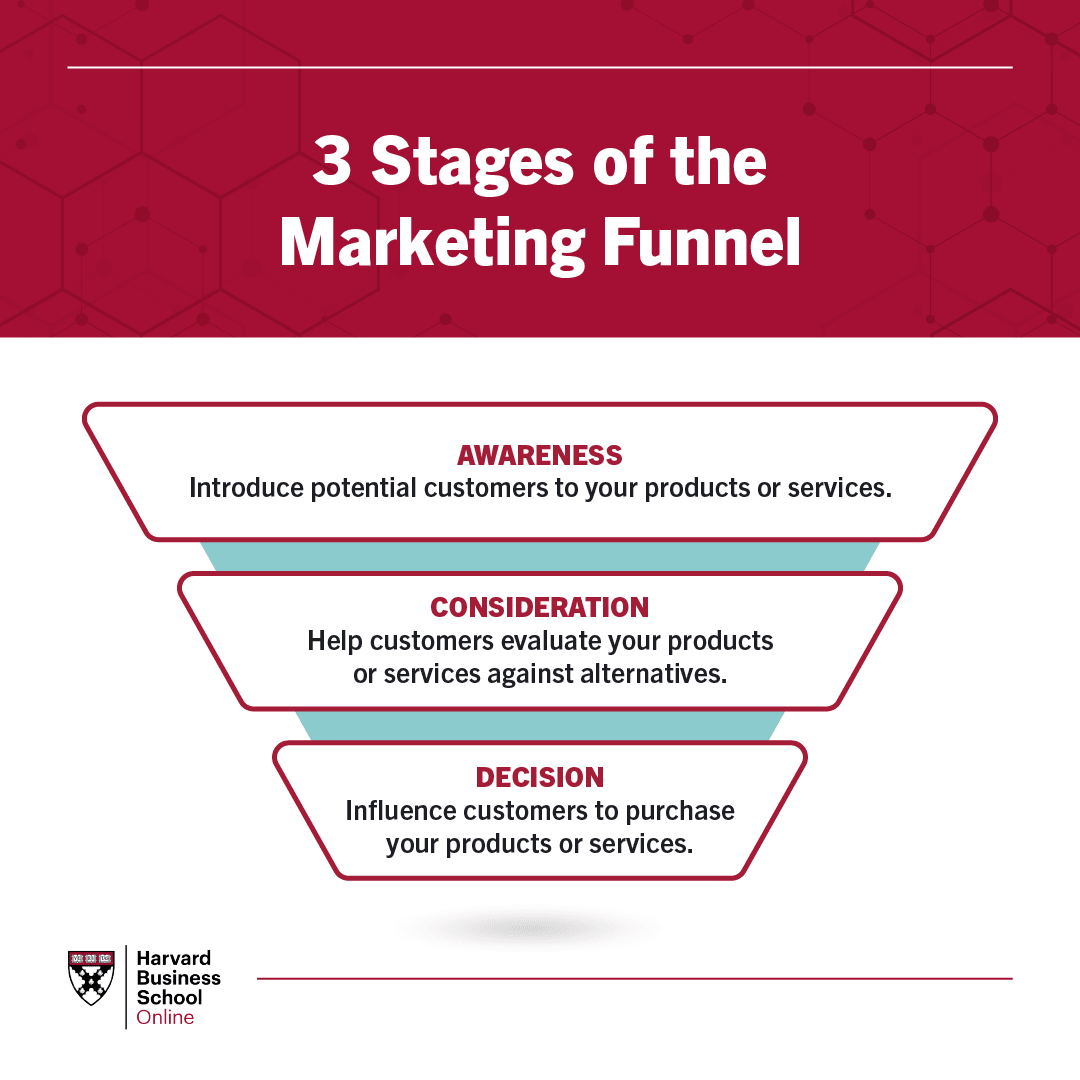
The three-stage model is a practical shorthand. In more detailed models, awareness, interest, consideration, conversion, and loyalty describe the customer journey with greater precision. Awareness and interest are usually grouped as top of funnel; consideration is middle of funnel; conversion is bottom of funnel. Loyalty continues after the initial purchase.
Marketing Funnel Stages | LinkedIn Ads
Read “Marketing Funnel Stages” from LinkedIn Ads for a clear account of the detailed five-stage funnel and the common TOFU, MOFU, and BOFU shorthand. Focus on the customer's changing mindset, not on treating the funnel as a rigid set of platform settings.
In “What Is A Marketing Funnel,” read the core idea. Then, in “What are the Stages of a Marketing Funnel?”, read the five stages and note the goal of each one. Continue to “What is TOFU, MOFU, and BOFU?” and read the shorthand explanation. Finally, in “Measure Performance and Improve With Data,” read the KPI examples. Notice that the metric should reflect what the customer is meant to do at that point in the journey.
Identify the customer’s next meaningful action
A funnel stage is not a label permanently attached to a channel. Google Search, Meta, LinkedIn, email, and display advertising can all serve different funnel roles depending on the audience, message, and landing page.
For instance:
- A broad Meta video introducing an unfamiliar brand to new people is usually awareness.
- A Google search ad for “best project management software for agencies” may reach someone in consideration.
- A search ad for “buy adjustable dumbbells free delivery” is usually decision.
- An email or paid audience campaign aimed at existing customers may support loyalty.
The right question is not, “Is Meta upper funnel or is Google lower funnel?” It is:
What does this audience know already, and what action is reasonable to ask of them now?
| Funnel stage | Customer mindset | Appropriate next action | Example business aim |
|---|---|---|---|
| Awareness | “I have a problem or need, but may not know this brand.” | Notice, watch, visit, learn | Introduce a new meal-kit service to urban professionals |
| Interest / consideration | “I am exploring solutions and comparing options.” | Read a guide, view product details, use a tool, request more information | Help operations managers evaluate a workflow platform |
| Decision / conversion | “I am ready or close to ready to act.” | Purchase, book a demo, submit an enquiry, start a trial | Generate profitable online orders or qualified demo requests |
| Loyalty | “I have bought before; should I continue or recommend?” | Reorder, upgrade, refer, reactivate | Increase repeat purchases from prior customers |
The funnel should influence the offer as well as the metric. A first-time visitor who has never heard of a complex B2B product may reasonably engage with a comparison guide. Asking that same person immediately to “Book a sales call” can work in some high-intent situations, but it is a higher-friction request. Conversely, sending a person who searched “annual accounting software pricing” to a broad educational article may introduce unnecessary distance between their intent and the desired action.
This is called message and journey match: the ad, audience readiness, landing page, and call to action should fit together.
Campaign objectives tell platforms what to optimize for
Once you know the stage and the customer action, select the campaign objective that most closely represents that action.
Platform labels vary:
- Google Ads commonly offers objectives such as Awareness and consideration, Leads, Sales, Website traffic, App promotion, and Local store visits.
- Meta Ads uses objectives such as Awareness, Traffic, Engagement, Leads, App promotion, and Sales.
- LinkedIn Ads also organizes objectives around awareness, consideration, and conversion-oriented actions.
The labels differ, but the principle does not: the platform uses your choice to determine available settings and guide automated delivery. If you choose Sales and optimize for purchases, the system seeks users it predicts are likely to purchase. If you choose Traffic, it will prioritize visitors or landing-page views instead. Those can be very different groups of people.
BEST Google Ads Campaign Objectives for Better Results
Watch the selected parts of Ben Heath - Google Ads’ “BEST Google Ads Campaign Objectives for Better Results.” It gives a practical explanation of why campaign-objective selection affects downstream setup, and why traffic, leads, and sales should not be used interchangeably.
Watch objective setup to see how an objective affects campaign configuration and why optimizing for clicks can be a poor substitute for optimizing for conversions. Then skip ahead to leads or sales. Focus on the distinction between a direct, measurable purchase path and a process that requires a lead and later sales follow-up.
A strong rule of thumb is:
Select the objective and optimization event closest to the commercial outcome that you can measure reliably.
For an ecommerce store with reliable purchase tracking, this is usually a Sales campaign optimized toward Purchase. For a consultancy where a human sales team must qualify and close each prospect, a Leads campaign optimized toward a demo request or qualified enquiry is often more appropriate.
Do not confuse a lead with a customer
A lead-generation campaign can serve different funnel stages:
- A downloadable introductory guide may be a consideration-stage offer, even though the platform objective is Leads because a form submission is being collected.
- A request for a product demo may be a bottom-funnel conversion action, and the platform objective can still be Leads.
The funnel stage describes the prospect’s journey. The campaign objective describes the platform action you want to optimize. They often align, but they are not identical.
Choose one primary KPI that reflects success
A KPI is not simply any number in an ad dashboard. It is the measure used to decide whether the campaign is on track.
The primary KPI should be:
- Relevant to the stated business objective.
- Directly measurable with available tracking.
- Actionable, meaning a change in the KPI would lead to a real decision.
- Economically meaningful, where possible.
For a campaign with a direct-response goal, conversion count alone is often incomplete. Ten purchases are good only if the business could afford the ad cost required to get them. Conversely, an extremely low CPA is not enough if it delivers too few conversions to matter.
The LinkedIn Ads guidance connects broad campaign goals with appropriate groups of metrics.
How to Analyze Your Campaign Performance | LinkedIn Ad Tips
Read LinkedIn Ads’ “How to Analyze Your Campaign Performance” to see a simple three-part mapping between campaign goals, funnel position, and metrics. Its examples are LinkedIn-specific, but the measurement logic applies across paid platforms.
In “1. Choose your objective,” read the goal categories. Then read all of “2. Identify your key metrics based on the campaign goal,” beginning with awareness metrics and continuing from through conversion metrics. As you read, distinguish outcome measures such as conversions or leads from efficiency measures such as cost per lead.
A practical KPI-selection guide
| If the actual business goal is… | Typical campaign objective | Strong primary KPI | Useful diagnostic metrics |
|---|---|---|---|
| Reach a new relevant audience | Awareness / Reach | Reach or qualified impressions | Frequency, CPM, video-view rate, CTR |
| Get people to engage with educational or product-evaluation content | Traffic, Engagement, or Leads, depending on the intended action | Cost per qualified content action | Landing-page views, engagement rate, CTR |
| Capture contact details for future qualification | Leads | Cost per qualified lead | Form completion rate, lead volume, lead-to-opportunity rate |
| Generate ecommerce transactions | Sales | CPA or ROAS | Conversion rate, AOV, CTR, CPC |
| Drive appointments, enquiries, or demos | Leads | Cost per qualified enquiry or booked-demo CPA | Form completion rate, show rate, sales acceptance rate |
| Increase repeat orders from customers | Sales or Engagement, depending on the action | Repeat purchase rate or incremental revenue from the audience | Frequency, unsubscribe rate, average order value |
A few important distinctions:
- Reach measures how many distinct people saw the ads. It is appropriate when the intended result is exposure among a relevant audience.
- CPA measures the cost to acquire one desired action, such as a purchase, lead, booking, or app install. It is particularly useful when each conversion has broadly similar value.
- ROAS compares tracked revenue with advertising spend. It becomes more useful when order values vary substantially, such as an online store selling products at different prices.
- Cost per qualified lead is better than raw cost per lead when a sales team rejects many low-quality submissions.
A KPI also needs a target, but the two are different:
- KPI: cost per purchase
- Target: at or below £35
- Guardrail: refund rate stays below 8%
In practice, a brief may specify both a volume requirement and an efficiency requirement: “Generate at least 50 purchases while keeping CPA at or below £35.” If budget is the binding constraint, CPA is usually the primary KPI. If stock must be cleared or a fixed attendance number is essential, conversion volume may become the primary KPI, with CPA acting as a guardrail.
Worked mappings: from vague request to measurable campaign
Example 1: New direct-to-consumer product launch
Initial request: “Make people aware of our new reusable water bottle.”
This request does not yet imply a sales campaign. If the brand’s immediate aim is to introduce the product to a new audience before a later launch push, the mapping could be:
| Decision | Choice |
|---|---|
| Business objective | Build awareness among environmentally conscious commuters before launch |
| Funnel stage | Awareness |
| Customer action | See and understand the product’s core benefit |
| Campaign objective | Awareness / Reach |
| Primary KPI | Reach within the defined target audience |
| Diagnostics | Frequency, video completion rate, CPM, CTR |
A frequent error would be to make CTR the primary KPI merely because it is visible. A click can be helpful evidence of interest, but the stated goal is broad introduction. If the company instead says, “Sell 500 bottles this month,” then the correct mapping changes to a decision-stage Sales campaign, with CPA or ROAS as the primary KPI.
Example 2: B2B software with a sales team
Initial request: “Get more customers for our HR compliance software.”
A new customer is the ultimate business outcome, but the marketing team may not be able to produce an immediate online sale. Prospects may need a demo, procurement approval, and a sales conversation.
A workable initial mapping is:
| Decision | Choice |
|---|---|
| Business objective | Generate sales-ready opportunities for the B2B sales team |
| Funnel stage | Decision / conversion for high-intent prospects |
| Customer action | Request a demo |
| Campaign objective | Leads |
| Primary KPI | Cost per sales-qualified demo request |
| Diagnostics | Form-completion rate, booked-demo rate, lead acceptance rate |
Notice the phrase sales-qualified. If marketing reports only cheap form submissions while sales rejects most of them, the campaign is not truly succeeding. The best version of this plan sends lead-quality or pipeline information back into reporting, even if it arrives later.
Example 3: Ecommerce brand with variable order values
Initial request: “Increase revenue from our existing product range.”
Suppose the store sells products between £20 and £250. A campaign that produces many low-value orders may appear successful on purchase volume alone, while a campaign with fewer but larger orders may produce more revenue per pound spent.
| Decision | Choice |
|---|---|
| Business objective | Generate profitable ecommerce revenue |
| Funnel stage | Decision / conversion |
| Customer action | Complete a purchase |
| Campaign objective | Sales |
| Primary KPI | ROAS |
| Diagnostics | Purchases, conversion rate, CPA, average order value |
Here, ROAS is a sensible primary KPI because revenue varies by order. It is still not a profit metric: a high-revenue product may have weak margin. Later in the course, you will calculate break-even CPA and break-even ROAS so that these targets reflect actual economics.
Example 4: Gated comparison guide for a B2B audience
Initial request: “Educate target companies about why our analytics platform is better than spreadsheets.”
The audience is evaluating alternatives, not necessarily ready to buy. The company offers a detailed comparison guide in exchange for a work email.
| Decision | Choice |
|---|---|
| Business objective | Create qualified future pipeline among relevant companies |
| Funnel stage | Consideration |
| Customer action | Download comparison guide |
| Campaign objective | Leads |
| Primary KPI | Cost per qualified content lead |
| Diagnostics | Landing-page view rate, form completion rate, lead quality by company type |
This example demonstrates the distinction between stage and platform objective. The prospect is in consideration, but the platform should optimize for a lead because the desired trackable action is a form submission.
A repeatable method for campaign briefs
Use the following sequence whenever you receive a campaign request.
-
Rewrite the request as a business outcome.
Replace “get more traffic” with a result that matters, such as “generate 80 qualified demo requests” or “increase first purchases profitably during the launch period.” -
Identify the audience’s current readiness.
Are they unfamiliar with the brand, comparing options, ready to purchase, or already customers? This identifies the funnel stage. -
Define the next customer action.
Choose one meaningful action: watch a product demonstration, read a comparison page, download a guide, book a consultation, or purchase. -
Check what can be tracked reliably.
Confirm that the action can be recorded accurately. A purchase event, demo request, or qualified lead status is more useful than an unverified assumption. -
Choose the platform objective that supports that action.
Use awareness for reach, traffic for meaningful visits when that is genuinely the desired outcome, leads for contact capture, and sales for direct transactions. Platform names may vary. -
Name one primary KPI and add diagnostic measures.
Use the KPI to judge success. Use metrics such as CTR, CPC, form completion rate, or conversion rate to explain why the KPI is strong or weak. -
Add a target and guardrails.
A target gives the KPI a decision threshold. Guardrails prevent harmful optimization, such as a cheap lead campaign with poor lead quality.
A concise professional recommendation might read:
Objective: Generate qualified demo requests for the HR compliance platform this quarter.
Funnel stage: Decision, targeting prospects actively evaluating a solution.
Campaign objective: Leads, optimized for completed demo-request forms.
Primary KPI: Cost per sales-qualified demo request, with a target of at or below £150.
Diagnostics: CTR, landing-page conversion rate, form completion rate, and lead acceptance rate.
That statement connects commercial intent, platform setup, and measurement in a form that a manager, analyst, or client can review.
Key takeaways
A performance marketer does not begin with “Which ad format should we run?” Begin with the business outcome and make four aligned choices:
- Define the business objective in specific commercial terms.
- Identify the funnel stage from the audience’s readiness and the next sensible action.
- Select the campaign objective that tells the platform to optimize for that action.
- Choose one primary KPI that determines success, then use diagnostic metrics and guardrails to interpret it responsibly.
Remember that a platform objective is not a business strategy, and a high click volume is not proof of business value. When purchase or qualified-lead tracking exists, optimize as close as possible to that meaningful outcome.
Next, you will calculate the core campaign metrics behind these decisions: impressions, CTR, CPC, CPM, conversion rate, CPA, and ROAS.
Can't find a good explanation? Sign up and we'll make it for you
Sign up