Hello! Welcome back to your course on game theory for business.
In our last lesson, we focused on what you should make—choosing a product line like premium doors or cabinets. We saw that this is a strategic decision to find a defensible market gap and avoid head-on competition. Now, we'll tackle the next logical question: how much should you be able to make?
This lesson will help you determine your initial capacity levels by anticipating competitor actions. Your production capacity, which is directly tied to the machinery you buy, isn't just a technical matter of meeting projected sales. In game theory, it's a powerful strategic signal that tells competitors about your intentions and will directly influence how they react to your new business.
Your Capacity is Your Opening Move
Think of your initial capacity choice as your opening move in a chess game. It's a highly visible and often irreversible commitment that sets the tone for all future interactions. Let's start by understanding what your capacity decision signals to other players in the market.
Capacity Decisions and Commitment | Game Theory ...
This guide, 'Capacity Decisions and Commitment', explains why capacity is so strategically important. It lays out how your production volume can be used to deter entry, signal commitment, and influence the market.
Please read these two sections: 'Strategic importance of capacity decisions' 'Role of commitment in capacity' Focus on how capacity can be used to either deter potential entrants or to accommodate existing players. Pay attention to the concept of an 'irreversible investment'.
As the reading highlights, your capacity choice communicates your intent:
-
A Large Initial Capacity: Investing in large, high-output CNC machinery signals that you intend to capture significant market share.
- The Upside: This can be a form of entry deterrence. An established competitor might see your large investment as a credible threat that you are prepared to fight for customers, potentially by lowering prices to keep your machines busy. A potential new competitor might see the market as too crowded and decide not to enter at all.
- The Downside: This is an aggressive posture. It's costly and makes your business less flexible. It might provoke a strong reaction from an established player who feels their core business is threatened, leading to a price war.
-
A Small Initial Capacity: Investing in a smaller, perhaps more specialized machine signals that you intend to serve a niche market.
- The Upside: This is a less threatening posture. An incumbent cabinet maker is less likely to engage in a costly fight over a small segment of the market they may not even serve. This allows you to establish a foothold and build a reputation without inviting immediate, aggressive competition.
- The Downside: You might be leaving money on the table if demand for your niche product is higher than you anticipated. Your growth will be constrained by your output.
For your woodworking business, this is the difference between buying a machine capable of producing 50 cabinet sets a month versus a smaller, high-precision machine that can only produce 10. The first choice says "I'm coming for the mainstream market," while the second says "I'm a specialist focusing on a unique niche."
Modeling Competitor Reactions: The Capacity Game
So, how do you choose? You anticipate your competitor's reaction. Game theory gives us tools to model this. Let's first consider a situation where you and a competitor must commit to your capacity levels at roughly the same time, without knowing for certain what the other will do. We can model this as a simultaneous-move game using a payoff matrix.
Imagine the key established player is "Local Cabinets Inc." Both you ("New Woodworks") and they have two choices: go for a Small Capacity (focus on your respective core customers) or invest in a Large Capacity (try to capture more of the market).
The payoffs could be your estimated monthly profits in thousands of dollars. The matrix below uses the same structure as the one you saw in a previous lesson.

Let's create a hypothetical payoff matrix for your situation:
| Local Cabinets Inc. | ||
|---|---|---|
| Small Capacity | Large Capacity | |
| New Woodworks | ||
| Small Capacity | You: $10k, Them: $50k | You: $5k, Them: $60k |
| Large Capacity | You: $20k, Them: $40k | You: -$5k, Them: $25k |
Let's analyze this step-by-step to find each player's best response:
-
You analyze their moves:
- If Local Cabinets chooses Small Capacity, what is your best move? A Large Capacity gets you $20k, while a Small gets you $10k. You prefer Large.
- If Local Cabinets chooses Large Capacity, what is your best move? A Small Capacity gets you $5k, while a Large leaves you with a loss of -$5k. You prefer Small.
-
They analyze your moves:
- If you choose Small Capacity, what is their best move? A Large Capacity gets them $60k, while a Small gets them $50k. They prefer Large.
- If you choose Large Capacity, what is their best move? A Small Capacity gets them $40k, while a Large gets them only $25k. They prefer Small.
There's no simple dominant strategy here. The outcome depends on what you expect the other to do. This kind of complex interaction is common. Now let's look at a slightly different, classic example.
The document 'Strategic Decision Making' provides a classic 'Capacity Game' that illustrates a slightly different, but very common, dynamic. This will help you understand the concept of a Nash Equilibrium in capacity decisions.
Please read the section titled '1.4.5 The Capacity Game' and the following short section on 'Equilibrium'. As you read, analyze the payoffs for Alpha and Beta. Try to figure out each firm's best response to the other's actions to see why they both end up choosing 'Expand'.
In the game from the reading, both firms deciding to "Expand" is a Nash Equilibrium. Given that the other firm is expanding, your best move is also to expand, even though you would both be better off if you had cooperated and not expanded. This shows how competitive pressures can drive you and your rivals into a low-profit outcome. Your goal is to try and avoid playing this kind of game in the first place, which is why your differentiation strategy from the last lesson is so important.
The New Entrant's Advantage: Moving First
The simultaneous model assumes you both act at the same time. But as a new business entering the market, you often get to move first. Your capacity choice is made, and then the incumbent reacts. This is a sequential-move game.
The Stackelberg Model is perfect for analyzing this leader-follower dynamic.
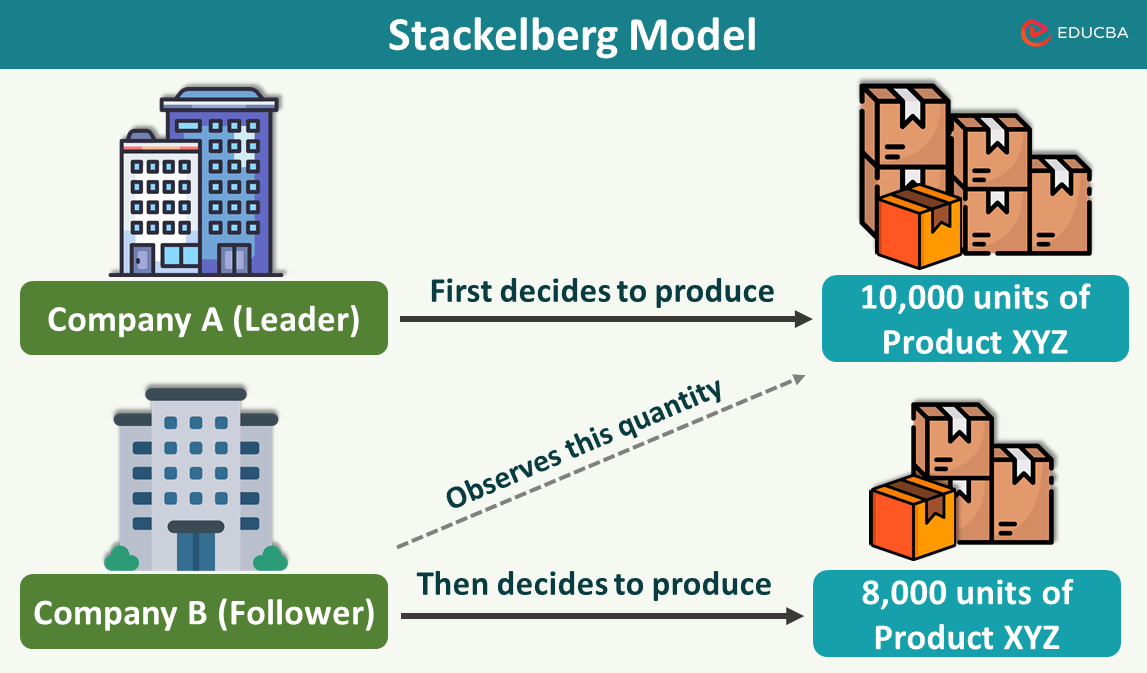
To make your decision, you use one of the most powerful rules in game theory: Look ahead and reason back.
-
Look Ahead: Consider your two main strategic options for capacity:
- Option A: Enter with Small Capacity (e.g., as a niche door specialist). How will Local Cabinets Inc. likely react? Since you're not a direct threat to their core cabinet business, their most profitable response is likely to Accommodate you—that is, ignore you and continue business as usual.
- Option B: Enter with Large Capacity (e.g., as a direct cabinet competitor). How will they react now? You are a direct threat. Their most profitable response may be to Fight by starting a price war or an aggressive ad campaign to defend their market share.
-
Reason Back: Now, compare the outcomes.
- Outcome of Option A: You are Accommodated and operate profitably in your niche. A stable, positive outcome.
- Outcome of Option B: You are Fought and get drawn into a costly battle with a larger, more established player. A potentially disastrous outcome.
By reasoning backward, choosing the Small Capacity appears to be the strategically superior move. You've chosen your initial capacity not based on a simple sales forecast, but on anticipating and influencing your competitor's reaction to secure a more favorable competitive environment.
Test your understanding!
Suppose you discover that Local Cabinets Inc. has old machinery and very high fixed costs, making them unprofitable at lower prices. How might this information change your analysis in the sequential (Stackelberg) game? Would entering with a large capacity become more or less attractive?
Show answer
This information makes entering with a large capacity more attractive. The incumbent's threat to "Fight" with a price war is now less credible. Because of their high costs, a price war would hurt them severely, possibly more than it would hurt you with your new, efficient machinery. Knowing this, they might choose to accommodate your large entry rather than engage in a mutually destructive price war. Your large capacity investment becomes a more credible commitment because their ability to retaliate is weak. This demonstrates how crucial it is to understand your competitor's situation, not just your own.
Conclusion
Today we've seen that setting your initial production capacity is a critical strategic decision. It's one of the most powerful signals you can send as a new business, and it will shape the competitive landscape you operate in.
Key Takeaways:
- Capacity is a Signal: A large capacity signals aggressive intent and can deter some competitors, but it can also provoke a fight from incumbents. A small capacity signals a niche focus and is less threatening.
- Anticipate Reactions with Game Models: You can model your capacity choice as a game to predict competitor responses.
- Simultaneous Games: If competitors are making capacity decisions at the same time, a payoff matrix can help you find the Nash Equilibrium—the likely stable outcome. You've seen that this can sometimes be a mutually damaging outcome (like a price war).
- Sequential Games: As a new entrant, you often move first. Use the "look ahead and reason back" principle to choose the capacity level that elicits the most favorable response from your competitors.
- Strategic Choice: Your initial capacity shouldn't be based solely on a sales forecast. It should be a deliberate choice that considers the trade-offs between commitment, flexibility, and the competitive reactions you want to encourage or avoid.
Preview of the Next Lesson:
We've now connected your machinery investment, your product line, and your capacity level. In the next lesson, we will dive deeper into a crucial trade-off you face when purchasing that machinery: evaluating the strategic value of flexibility versus specialization. This will help you decide whether to buy one machine that does one thing perfectly, or another that can do many different things well—a key decision for a startup that may need to adapt as it grows.