Hello! Welcome back to our sessions on applying game theory to your new business.
In our last lesson, we explored the strategic choice between specialization (depth) and flexibility (width), concluding that for a startup aiming for a premium position, a "specialize first, then expand" approach is often very effective. We framed your machinery investment as a credible commitment to this strategy.
Today, we will build directly on that foundation. This lesson is dedicated to helping you analyze the trade-offs of starting with a narrow versus a broad product line, considering your limited startup resources. This will move us from the high-level strategic concept to a practical decision-making framework. You'll finish this lesson with concrete tools to help you decide whether to launch with just premium doors, or doors and kitchen cabinets.
Defining Your Options: Product Line Breadth vs. Depth
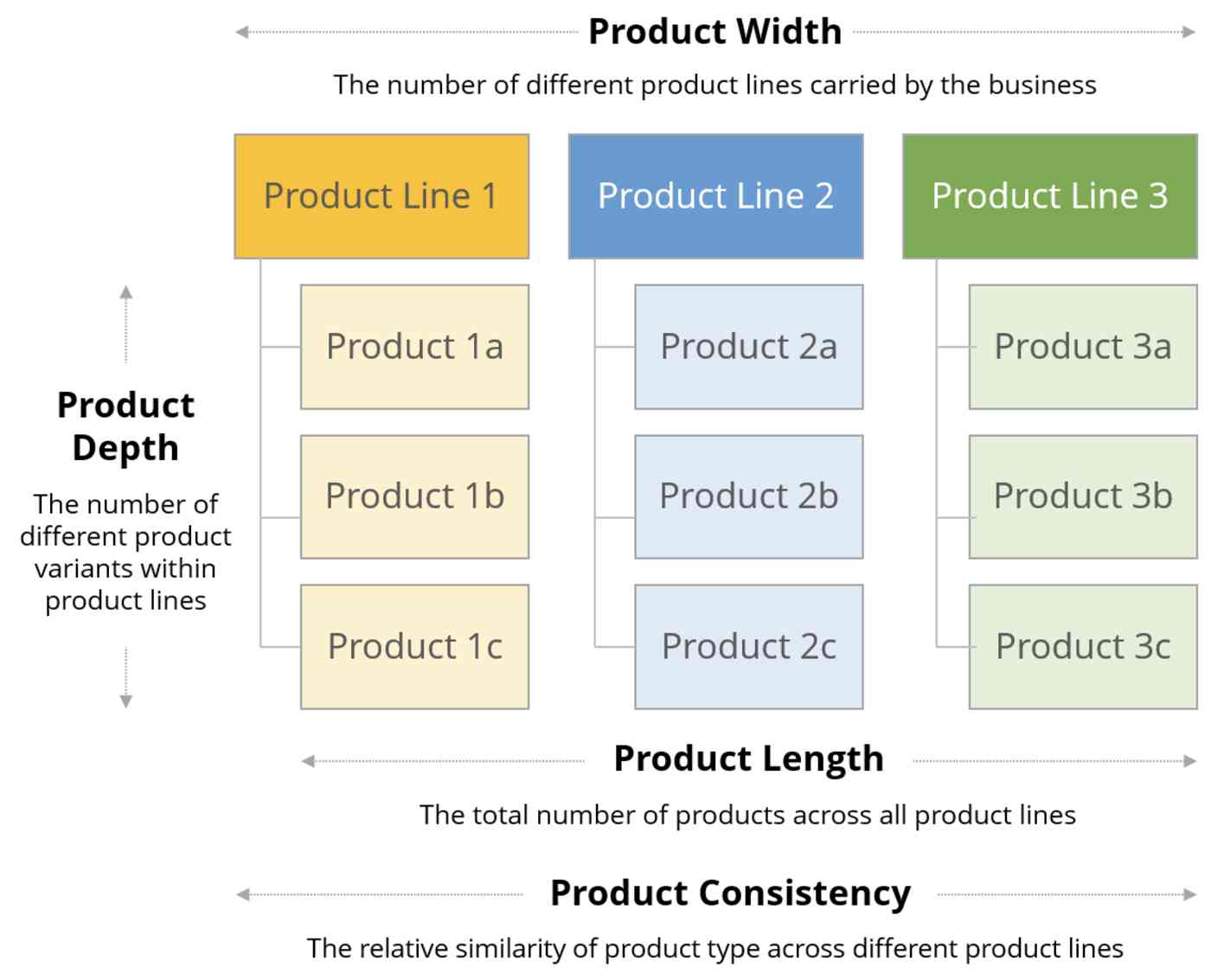
First, let's ensure we have a crystal-clear and shared vocabulary for this decision. The terms "broad" and "narrow" correspond to the marketing concepts of product line "breadth" and "depth."
- Product Line Breadth (or Width): This refers to how many different types of product lines you offer. For you, this is the choice between "doors" (one line) and "doors and cabinets" (two lines). A broad strategy involves more product lines.
- Product Line Depth: This refers to the variety within a single product line. For example, if you decide to make doors, offering them in 10 different wood species and 20 different styles would be a deep product line.
To see these concepts explained with simple examples, watch the first part of the following video.
Product Line Breadth vs Depth Explained
This video from Professor Wolters offers a straightforward explanation of product line breadth and depth.
Please watch from the beginning until the 1:28 mark. Focus on how the examples distinguish between having different types of products (breadth) and more variations of the same product (depth).
The diagram below provides a visual way to think about this. A "narrow" strategy focuses on one column, possibly making it very long (deep). A "broad" strategy adds more columns.
A Strategic Framework for Making the Choice
Deciding on the breadth of your product line isn't just about what you can physically produce; it's a core strategic choice that defines your position in the market. The renowned business strategist Michael Porter provides a powerful framework for this.
Porter argues that successful strategies require making trade-offs. You cannot be the best at everything. You must choose a clear path to avoid getting "stuck in the middle."
This reading from 'Principles Of Management' introduces Porter's Generic Strategies. It provides the 'why' behind choosing a narrow or broad approach.
Please read the sections titled 'Strategy as Trade-Offs', 'Cost Leadership, Differentiation, and Scope', and 'Straddling Positions or Stuck in the Middle?'. As you read, focus on: The idea of competitive scope (broad vs. narrow). How a focus strategy (what we're calling a narrow product line) works. The danger of being 'stuck in the middle'.
As the article explains, your decision on a narrow vs. broad product line maps directly onto Porter's concept of "competitive scope."
-
Narrow Strategy (Focus): By choosing to make only premium doors, you are pursuing a Focused Differentiation strategy. You target a narrow market niche (customers who want high-end custom doors) and aim to be unique and superior within that niche. This is a classic way for a small business to compete with larger, more generalized companies.
-
Broad Strategy (Risk of being "Stuck in the Middle"): If you launch with both doors and cabinets, you're attempting a broader scope. With limited resources, this is risky. You might not have the specialized equipment to make the best doors, nor the production efficiency to compete with large cabinet manufacturers. You risk being "stuck in the middle"—not the best and not the cheapest. For a startup, this is a dangerous position.
Analyzing the Trade-offs for Your Woodworking Business
Your engineering background makes you familiar with optimizing systems based on constraints. Choosing a product line is a similar optimization problem. You're trying to maximize your chance of success given the constraints of your capital, time, and skills.
We can think of this as an efficiency frontier or trade-off curve, a concept from the next reading. For a startup, the key trade-off is often between Market Scope and Brand/Quality Perception.

This chart illustrates a trade-off curve. Imagine the Y-axis is 'Brand Reputation/Quality' and the X-axis is 'Number of Product Lines'. As a startup, you can either achieve a very high reputation in one product line or a medium reputation across several, but you likely lack the resources to achieve a high reputation across many lines from day one.
Let's break down the pros and cons for your business:
| Strategy | Pros | Cons |
|---|---|---|
| Narrow Line (e.g., Premium Doors Only) |
Focuses Resources: Your money, time, and marketing efforts are concentrated, leading to higher impact. | Concentrated Market Risk: If demand for high-end doors slumps, you have no other revenue stream. |
| Builds Expertise: You become "the door guy," creating a strong, premium brand signal. | Smaller Addressable Market: You can't capture a customer who wants a full kitchen remodel (at least not initially). | |
| Simpler Operations: Easier to manage inventory, production workflow, and quality control. | Potential for Missed Opportunities: You might have to turn down profitable work that falls outside your narrow focus. | |
| Broad Line (e.g., Doors & Cabinets) |
Diversifies Revenue: A slow month for doors might be a good month for cabinets, smoothing cash flow. | Spreads Resources Thin: Your marketing budget and your own time are diluted across two distinct products. |
| Larger Project Potential: You can bid on entire kitchen projects, leading to larger individual sales. | Risk of "Stuck in the Middle": You may be perceived as a generalist, making it hard to justify premium prices against specialists. | |
| Market Learning: Exposes you to more customer types and needs, providing valuable data. | Operational Complexity: Managing two production lines, different material inventories, and distinct sales processes is much harder. |
A Concrete Example: The Door Itself
This trade-off analysis applies even within a single product line. Look at these common cabinet door styles. Deciding which to offer is a micro-version of the narrow vs. broad decision.

For a premium brand, starting with just Inset and Full Overlay doors might be a focused strategy, signaling your commitment to quality.
Test your understanding!
You have $100,000 in startup capital. A broad strategy (doors and cabinets) requires you to spend $40,000 on inventory for both product lines, leaving $60,000 for machinery and marketing. A narrow strategy (doors only) requires just $15,000 in inventory, leaving $85,000 for a better door-making machine and more targeted marketing.
Which of Porter's concepts best explains the strategic risk of choosing the broad strategy in this scenario?
Show answer
The concept of being "stuck in the middle" best explains the risk. By spreading your $100,000 capital thinly, you may end up with a machine that isn't specialized enough to produce top-tier doors and a marketing budget that isn't large enough to effectively reach either door or cabinet customers. You risk not being able to compete on quality/differentiation (against door specialists) or on cost (against large cabinet makers), leaving you with no clear competitive advantage.
A Practical Tool for Making the Decision
To move beyond a simple pro/con list, you can use a weighted scoring model. This turns the analysis into a more structured process, which should resonate with your engineering mindset.
Trade-offs in product design: How game theory shapes real ...
This article, 'Trade-offs in product design,' offers excellent practical methods for making decisions like this one. We'll focus on a tool it presents for navigating the 'Features vs. Simplicity' trade-off, which is analogous to your 'Broad vs. Narrow' choice.
Please read the section 'Case 4: Features vs. Simplicity'. Focus on the 'Weighted scoring model' method. You can skim the 'Financial prototyping' part for now.
Here is how you could apply this to your decision. You would list your key success factors, assign a weight based on their importance to you, score each strategy, and see which comes out on top.
| Success Factor | Weight (1-5) | Narrow (Doors) Score (1-10) | Broad (Doors & Cabinets) Score (1-10) | Narrow Weighted Score | Broad Weighted Score |
|---|---|---|---|---|---|
| Building a Premium Brand | 5 | 9 | 5 | 45 | 25 |
| Maximizing Initial ROI | 4 | 7 | 6 | 28 | 24 |
| Operational Simplicity | 3 | 10 | 4 | 30 | 12 |
| Long-term Market Flexibility | 3 | 5 | 9 | 15 | 27 |
| Total | 118 | 88 |
In this hypothetical example, the narrow strategy wins because the factors most important to building a premium business (Brand, ROI, Simplicity) are where it scores highest. I encourage you to create your own version of this table with the factors and weights that matter most to you.
Conclusion
Today we've transformed the abstract idea of a narrow vs. broad strategy into a concrete analytical framework. For a startup with finite resources aiming for a premium position, a focused approach is often strategically superior. It concentrates your strengths where they can have the most impact.
Key Takeaways:
- Strategy is Choice: Following Porter, a successful strategy requires making deliberate trade-offs. Choosing a narrow product line is a "Focus Strategy."
- Avoid Being "Stuck in the Middle": The primary risk of a broad strategy for a startup is spreading resources too thin, resulting in a product that is neither the best nor the cheapest.
- Analyze the Trade-offs: A narrow strategy focuses resources and builds a strong brand but concentrates risk. A broad strategy diversifies revenue but dilutes focus and increases complexity.
- Use Structured Tools: Frameworks like a weighted scoring model can help you make a more objective and confident decision that aligns with your specific goals and resources.
Preview of the Next Lesson:
Now that we have deeply considered what to make, the next critical decision is how to price it. In our next lesson, we will begin Module 6, "Pricing Strategies and Price Wars." We will model your pricing decision as a game and see how your choice of a narrow, premium product line strongly influences your optimal pricing strategy and your ability to avoid destructive price wars with competitors.