Welcome back. In our previous lesson, we established the fundamental mechanics of web tracking, exploring how pixels, SDKs, and cookies work together to send data from a user's browser to a collection server. We touched upon the difference between first-party and third-party cookies as the key mechanism that enables tracking a user's journey across different websites.
This lesson builds directly on that foundation. We will start by formalizing the crucial distinction between first-party and third-party data, a concept that goes beyond just cookies. Then, we will analyze the massive privacy-driven shifts that are reshaping the entire digital marketing landscape. You'll gain a deep, technical understanding of Apple's landmark privacy initiatives—Intelligent Tracking Prevention (ITP) for the web and App Tracking Transparency (ATT) for mobile apps—and their profound impact on the tracking systems we've discussed.
1. The Data Divide: First-Party vs. Third-Party
In our last lesson, we focused on the technical delivery mechanism: the cookie. Now, let's elevate that discussion to the data itself. The source and ownership of data are what truly define its value and the rules that govern its use.
-
First-Party Data is the information you collect directly from your audience through your own assets. This is data from users with whom you have a direct relationship. Examples include:
- Information a user provides in a sign-up form on your website (e.g., email address, name).
- Purchase history from your e-commerce store.
- Behavioral data from how users interact with your website or application (e.g., pages viewed, videos watched), collected under your own domain.
- Data stored in your CRM.
-
Third-Party Data is collected by an entity that does not have a direct relationship with the user. It's often aggregated from numerous websites and sources, packaged, and then sold or shared with other companies for marketing purposes. The cross-site tracking we discussed previously, enabled by third-party cookies, is the primary source of this data.
The video "What Are Cookies and What Happens When You Click 'Accept All'?" uses a fantastic analogy to make this distinction clear.
What Are Cookies and What Happens When You Click "Accept All"?
This video provides a simple yet powerful mental model for differentiating first-party and third-party cookies and the data they collect.
Watch the section from this point, which uses a "coat check ticket" analogy to explain the helpful, user-experience-oriented role of first-party cookies. Then, continue from this segment, where the analogy extends to "invisible strangers" to represent third-party cookies and the cross-site tracking network they enable.
As you can see, first-party data is an asset built from a direct, consensual relationship with a user. Third-party data is based on observing user behavior across the web, often without their explicit awareness of who is watching. For years, the digital advertising ecosystem was built on the latter. That is now fundamentally changing.
2. The Privacy Reckoning: A Timeline of Change
Concerns over the pervasive, opaque nature of third-party tracking led to a major industry shift. While regulators played a part (e.g., GDPR in Europe), the most significant technical disruptions have come from the platform owners themselves, particularly Apple, with other browsers like Firefox and eventually Google's Chrome following suit.
This has unfolded as a cat-and-mouse game where advertisers find workarounds, and platform owners close them, leading to an increasingly restrictive environment for third-party tracking.

This timeline highlights the key initiatives we will now dissect: Apple's ITP, ATT, and Google's eventual deprecation of third-party cookies.
3. Apple's War on Tracking (Part 1): Intelligent Tracking Prevention (ITP)
Apple's Safari browser has been at the forefront of this change. Since 2017, Apple has been incrementally tightening the screws on tracking through a feature built into its WebKit engine called Intelligent Tracking Prevention (ITP).
ITP is not a simple switch; it's a sophisticated, evolving set of heuristics and rules designed to identify domains that track users across sites and limit their ability to do so. Since your background is in development, you'll appreciate the technical nuance of this ongoing battle. The article "What Is Intelligent Tracking Prevention and How Does It Work?" provides an excellent version-by-version breakdown.
What Is Intelligent Tracking Prevention and How Does It Work? [versions 1.0 – 2.3]
This article details the technical evolution of ITP, showing how Apple systematically dismantled common tracking techniques. It's a perfect case study in privacy engineering.
As you read, focus on the "cat-and-mouse" nature of the changes. Start by reading the introduction and the section How ITP Works to grasp the basic premise. Pay attention to the example of a first-party cookie being used for cross-site tracking. Next, review the initial rules in ITP 1.0 and 1.1. Note the concepts of the Machine Learning Classifier and the original 24-hour/30-day windows. Also, read about the workaround advertisers used. Now, see how Apple responded in ITP 2.0. This was a major escalation. Focus on the scrapping of the 24-hour window, the introduction of the Storage Access API, and the specific countermeasures against "first-party bounce trackers" and "tracker collusion." Finally, read through the sections on ITP 2.1, ITP 2.2, and ITP 2.3. Observe how Apple tightens the restrictions further, capping the lifetime of client-side cookies (document.cookie) and even other storage mechanisms like localStorage when they are used for tracking via "link decoration."
The key takeaway from ITP is that Apple is using its control of the browser to algorithmically degrade and destroy the value of cross-site tracking identifiers, forcing the ecosystem to adapt. While third-party cookies were blocked by default, ITP's real innovation was targeting the workarounds that attempted to use first-party cookies and other storage for the same purpose.
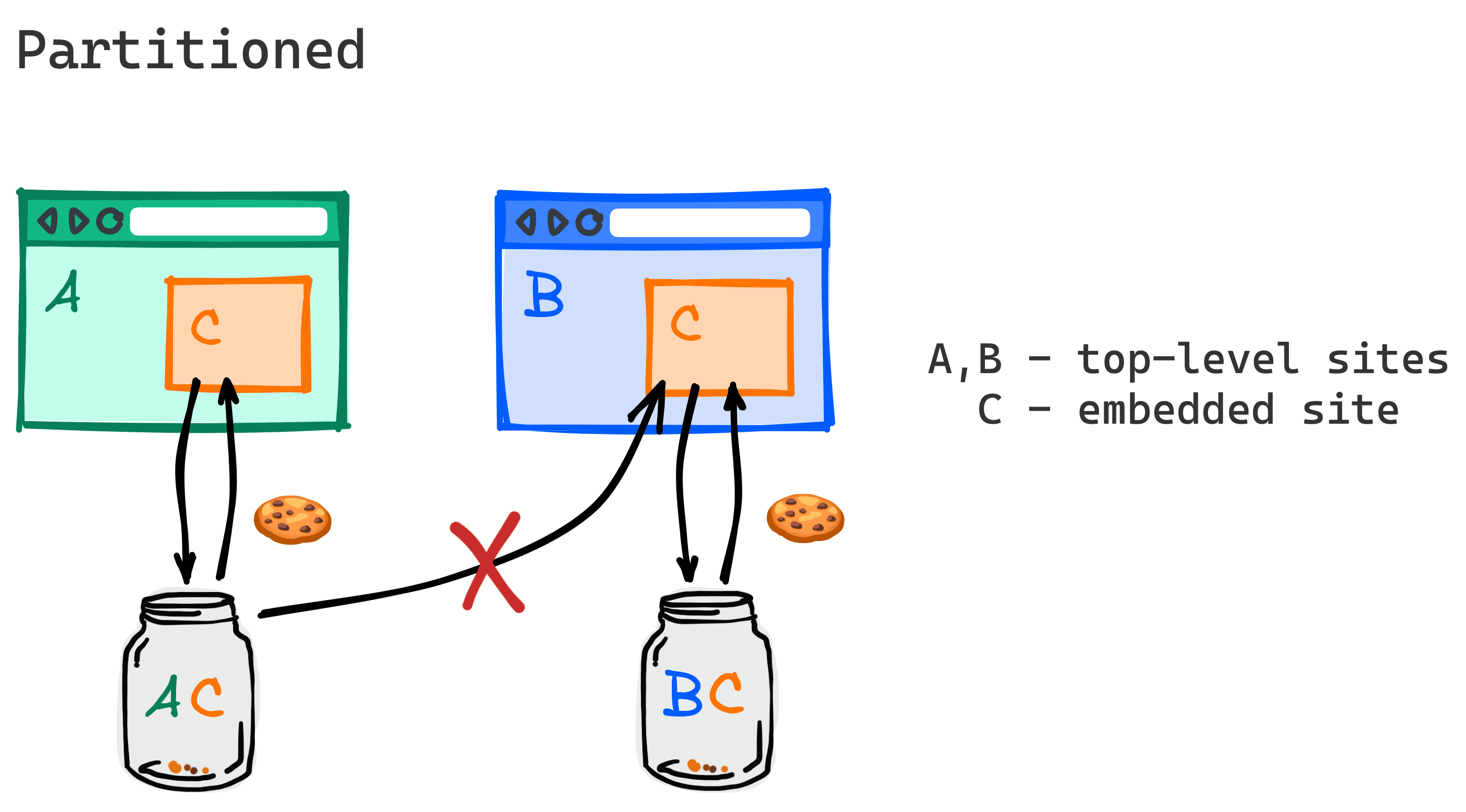
One browser-native solution to this problem is partitioned cookies. Instead of blocking a third-party cookie entirely, the browser isolates it. A cookie set by an embedded service on Site A is stored in a separate "jar" from a cookie set by the same service on Site B, preventing the service from connecting the user's activity between the two sites.
4. Apple's War on Tracking (Part 2): App Tracking Transparency (ATT)
While ITP reshaped the web, Apple's next major move targeted the mobile app ecosystem. In 2021, with iOS 14.5, Apple launched App Tracking Transparency (ATT).
If a third-party cookie was the lynchpin of web tracking, its mobile app equivalent was the Identifier for Advertisers (IDFA). This was a unique, persistent ID assigned to each Apple device that apps could access to track users across different apps. ATT fundamentally changed this by making access to the IDFA an explicit opt-in choice for the user.
The article "iOS App Tracking Transparency Impact: Complete Guide" gives a thorough analysis of the mechanism and its consequences.
Ios App Tracking Transparency Impact: Complete Guide
This article explains the technical underpinnings of ATT and its cascading effects on the entire paid advertising industry.
First, read the section How ATT Works to understand the role of the IDFA, the opt-in prompt, and the limitations of Apple's alternative, SKAdNetwork. Next, read The Cascading Effects. This explains the direct business consequences: attribution gaps (the "dark funnel"), shrinking audiences for retargeting and lookalikes, and the degradation of ad platform algorithms. Finally, review the sections on Platform Responses and Server-Side Tracking. This highlights how platforms like Meta and Google have tried to adapt and introduces the key architectural solution that we will explore later in this course.
The impact of ATT has been seismic. With opt-in rates hovering around 20-25%, the vast majority of iOS users became invisible from a cross-app tracking perspective. This severed the data pipelines that ad platforms relied on for targeting, attribution, and optimization.
5. The New Reality and The Path Forward
The cumulative effect of ITP, ATT, and similar changes from other browsers is the effective dismantling of the third-party tracking ecosystem. The old model of passively observing users across the digital world is no longer viable.
This forces a fundamental shift in strategy and technology, centered on two core principles:
- Embrace First-Party Data: The most valuable and reliable data is now unequivocally the data you collect yourself in a transparent, consensual exchange with your users. Building and enriching your first-party data assets is no longer optional; it's the foundation of a resilient marketing strategy.
- Adopt Server-Side Tracking: As you read, moving data collection from the user's browser (client-side) to your own server (server-side) is the primary technical solution to the unreliability of browser-based tracking. A server-to-server connection is not subject to ITP's cookie restrictions or browser ad blockers, resulting in a much more accurate and complete data signal.
This new reality requires a more robust and sophisticated technical architecture, one that you are now well-equipped to understand.
Conclusion
In this lesson, we've navigated the complex and rapidly evolving landscape of digital privacy. We have moved from a simple understanding of cookies to a deep appreciation for the strategic importance of data ownership and the technical battles being waged by platform owners.
Key Takeaways:
- First-party data is your asset, collected directly from your users. Third-party data is collected by others and is the foundation of cross-site tracking.
- Apple's Intelligent Tracking Prevention (ITP) has systematically dismantled web-based tracking by identifying trackers and imposing strict limits on the lifetime of cookies and other browser storage mechanisms.
- Apple's App Tracking Transparency (ATT) broke mobile cross-app tracking by making the device identifier (IDFA) available only after an explicit user opt-in.
- The consequences are significant: reduced data for ad targeting, broken attribution models, and less efficient algorithmic optimization.
- The strategic response is to build a robust first-party data strategy and the technical solution is to implement server-side tracking.
Now that we have a clear picture of the tracking environment and its challenges, our next lesson will get practical. We will learn how to implement and configure the Meta Pixel, the primary tool for collecting first-party behavioral data from your website, doing so in a way that is effective within this new privacy-centric paradigm.