
Good to see you again. In the previous lesson, you learned to make pronoun references precise: readers should not have to guess who they, it, or this refers to. Commas support that same goal. They do not simply mark where a speaker pauses; they show readers how the parts of a sentence belong together.
In this lesson, you will apply commas in a focused set of high-frequency college-writing patterns: introductory material, compound sentences, lists, coordinate adjectives, and nonessential interrupters. You will also learn when not to add a comma—an essential skill, since an unnecessary comma can split a sentence’s main subject from its verb or create a sentence-boundary error. These patterns will be especially useful in lab reports, nutrition reflections, and academic paragraphs. Plan on about 40 minutes.
Commas begin with sentence structure
Before placing a comma, identify the sentence’s core: its subject and main verb. Then ask whether other words introduce, connect, list, or interrupt the core idea.
Consider these two examples:
After reviewing the food record, the student identified several missing meals.
The student reviewed the food record and identified several missing meals.
The first sentence begins with introductory material, so a comma separates that material from the main clause. The second sentence has one subject, student, doing two actions, reviewed and identified. It does not need a comma before and.
This distinction matters because commas are not placed merely because a sentence is long or because it contains the word and. The grammar determines the punctuation.
A useful foundation is the difference between two kinds of clauses:
- An independent clause has a subject and verb and expresses a complete thought. It can stand as a sentence: The patient reported nausea.
- A dependent clause also has a subject and verb but begins with a word such as because, when, although, if, or while, which makes it incomplete by itself: Because the patient reported nausea.
Watch the first part of Sparkle English’s “Commas and Clauses.” It gives you a clear method for identifying clauses before choosing punctuation.
Commas and Clauses | How to Use Commas with Independent & Dependent Clauses in English
Watch “Commas and Clauses | How to Use Commas with Independent & Dependent Clauses in English” from Sparkle English. It explains the clause patterns behind the most important comma decisions in this lesson.
Begin with clause basics to distinguish independent from dependent clauses. Then watch compound clauses for the comma-before-conjunction rule. Finish with dependent clauses, focusing on how comma use changes when the dependent clause moves from the beginning to the end of a sentence.
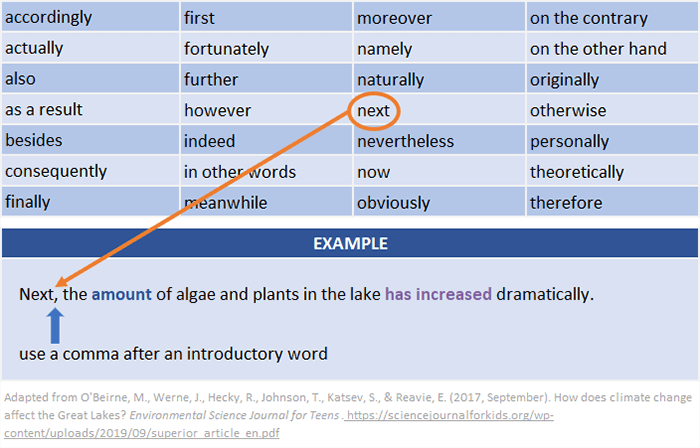
Pattern 1: introductory words, phrases, and clauses
Use a comma after introductory material that prepares the reader for the main clause.
Fortunately, the sample remained uncontaminated.
Before the lab session, students should review the safety procedures.
Because the participant had fasted, the researcher recorded the blood-glucose reading first.
In each example, the main subject and verb come later:
- the sample remained
- students should review
- the researcher recorded
The comma helps the reader locate that main sentence.
A special case is an introductory dependent clause:
When the pulse rate increased, the student repeated the measurement.
If you reverse the order, the comma is generally unnecessary:
The student repeated the measurement when the pulse rate increased.
The meaning is still connected, but the sentence now begins with its independent clause.
Be careful with however, therefore, moreover, and similar transition words. At the beginning of a sentence, they take a comma:
The results were incomplete. However, the team submitted the preliminary report.
They are not coordinating conjunctions. Do not use a comma by itself to join two complete thoughts:
Incorrect: The results were incomplete, however, the team submitted the report.
Correct: The results were incomplete. However, the team submitted the report.
Also correct: The results were incomplete; however, the team submitted the report.
That last issue connects to your earlier work on sentence boundaries: a comma alone cannot join two independent clauses.
The comma before and, but, or, so, and other FANBOYS
The coordinating conjunctions are remembered with FANBOYS:
For, And, Nor, But, Or, Yet, So
Use a comma before a FANBOYS conjunction only when it joins two independent clauses.
The student completed the anatomy diagram, and she labeled the major structures.
The instructions were clear, but the procedure required careful timing.
The patient reported dizziness, so the nurse checked the blood pressure.
Each part on either side of the conjunction can stand alone:
- The student completed the anatomy diagram.
- She labeled the major structures.
Because both are complete thoughts, the comma is needed.
Now compare this sentence:
The student completed the anatomy diagram and labeled the major structures.
There is no comma because the second part, labeled the major structures, lacks its own subject. It is not an independent clause; student is the shared subject for both verbs.
A reliable FANBOYS test
When you see and, but, or, yet, or so, pause before adding a comma.
- Find the words after the conjunction.
- Ask whether they have a subject and a verb.
- Ask whether they can stand alone as a complete thought.
- Use a comma only if the answer is yes.
For example:
The class reviewed the diagram, but did not identify the artery.
The words after but are did not identify the artery. They do not name a subject; the subject class is understood from the first part. In this focused set of rules, do not add a comma:
The class reviewed the diagram but did not identify the artery.
Read the relevant sections of the University of North Carolina Writing Center’s “Commas” guide. It reinforces the distinction between introductory material, genuine compound sentences, lists, and extra information within a sentence.
Read “Commas” from the University of North Carolina Writing Center. The guide uses a practical structure-based approach: identify what kind of material appears in the sentence, then punctuate that relationship.
In Section 1, “Introductory bits (small-medium-large),” read introductory bits. Notice that introductory material cannot stand alone and that the main subject and verb come later. Next, in Section 2, “FANBOYS,” read the FANBOYS rule. Use the guide’s test: read the words after the conjunction by themselves to determine whether they form a complete thought. Then read Section 5, “X,Y, and Z,” including the series guidance, and the short “Describers” discussion, especially the adjective rule. Finish with Section 7, “Interrupters,” and read the interrupter discussion. For each pattern, focus on what remains as the sentence’s core if the added material is removed.
Commas in lists and between coordinating adjectives
Commas clarify a sequence of equal items.
The nutrition log included breakfast, lunch, dinner, and two snacks.
The student measured heart rate, respiratory rate, and blood pressure.
The lab group observed, recorded, and compared the results.
In college writing, using the final comma before and—the Oxford comma—is a strong default:
The diet contained fruits, vegetables, whole grains, and lean proteins.
Some style guides treat this final comma as optional in a simple list. However, it is never wrong in standard academic writing, and it can prevent ambiguity in more complex lists. The most important practice is consistency, unless your instructor specifies a different style.
Coordinate adjectives
Commas can also separate coordinate adjectives: adjectives that describe a noun equally.
The researchers designed a careful, systematic study.
The patient described a sharp, persistent pain.
The microscope revealed large, irregular cells.
A useful test is to insert and between the adjectives:
a careful and systematic study
a sharp and persistent pain
If the phrase still makes sense, a comma is usually appropriate.
However, some adjectives build a single combined description rather than functioning equally:
a small red capsule
several expensive medical devices
Usually, you would not write a small and red capsule or several and expensive medical devices. Therefore, these combinations normally do not need commas.
| Sentence pattern | Correct form | Reason |
|---|---|---|
| Three or more equal items | protein, fat, and carbohydrate | Each item belongs to the same series. |
| Two independent clauses joined by but | The sample was small, but the results were useful. | Both sides are complete thoughts. |
| One subject with two verbs | The student collected and analyzed the data. | The second action has no separate subject. |
| Equal adjectives | a detailed, accurate record | Both adjectives independently describe record. |
| Cumulative adjectives | a new nutrition textbook | New modifies the full phrase nutrition textbook. |
Commas around nonessential information
A comma pair can set off information that adds a side comment but is not essential to the sentence’s core meaning.
The instructor, our anatomy lab coordinator, explained the procedure.
The food record, however, did not include beverages.
The clinic’s new policy, according to the director, begins next month.
Try removing the words between the commas:
The instructor explained the procedure.
The food record did not include beverages.
The clinic’s new policy begins next month.
Each remaining sentence is still complete and clear. The removed material adds useful detail, but it is not required for the basic sentence to work.
This is why the commas come in pairs when the extra information appears in the middle:
Incorrect: The instructor, our anatomy lab coordinator explained the procedure.
Correct: The instructor, our anatomy lab coordinator, explained the procedure.
Think of the two commas as matching boundaries around an interruption. If you open the interruption with a comma, close it with another comma—unless the interruption occurs at the end of the sentence.
The group recorded several variables, including sleep duration.
Here, the added phrase occurs at the end, so it needs only the comma before it.
Avoid the “comma by pause” habit
A short pause in speech does not automatically justify a comma. In particular, do not separate a basic subject from its verb:
Incorrect: The results of the nutrition survey, suggest a need for more education.
Correct: The results of the nutrition survey suggest a need for more education.
The subject is the full noun phrase The results of the nutrition survey. Its verb is suggest. No comma belongs between them.
Likewise, do not separate a verb from its object:
Incorrect: The student measured, the patient’s blood pressure.
Correct: The student measured the patient’s blood pressure.
When uncertain, first locate the basic subject–verb–object structure. Then decide whether you are adding one of the specific comma patterns from this lesson.
A focused comma-editing routine
When proofreading a paragraph, make one separate pass just for commas. This is more reliable than trying to notice every error while also revising ideas, grammar, and wording.
-
Circle introductory starters. Look for words such as however, therefore, fortunately, and phrases beginning with when, if, because, although, or before. If the introductory material comes before the main clause, check for a comma after it.
-
Underline each and, but, or, yet, and so. Determine whether the conjunction joins two complete thoughts. Add a comma only when it does.
-
Box lists. In a series of three or more equivalent items, separate the items with commas. Use the Oxford comma as your default unless your class requires another approach.
-
Check adjective strings. Use the and test to distinguish coordinate adjectives from cumulative adjectives.
-
Bracket extra information. If a phrase is a removable interruption, place commas on both sides when it appears in the middle of the sentence.
-
Protect the core sentence. Never insert a comma between a subject and its verb or between a verb and its object simply because the sentence is long.
This routine gives you a decision process rather than a vague instruction to “put commas where you pause.”
Key takeaways
Commas make sentence structure visible. In this lesson’s most useful patterns:
- Put a comma after an introductory word, phrase, or dependent clause.
- Put a comma before a FANBOYS conjunction only when it joins two independent clauses.
- Use commas to separate three or more items in a series.
- Use commas between adjectives only when the adjectives coordinate equally.
- Use paired commas around nonessential information that interrupts the main sentence.
- Do not use commas simply because you pause while reading, and never use a comma alone to join two complete thoughts.
Next, you will bring together the sentence-level skills from this module—sentence boundaries, agreement, tense, pronouns, and commas—by editing a short passage systematically.
Can't find a good explanation? Sign up and we'll make it for you
Sign up