
Welcome back. In the previous lesson, you practiced commas as signals of sentence structure: after introductory material, between items in a series, around nonessential information, and before a coordinating conjunction only when it joins two complete sentences.
This lesson brings together the sentence-level skills from the whole module. You will use a repeatable process to edit a short passage for sentence boundaries, subject–verb agreement, verb tense, pronouns, and commas. Rather than trying to notice every possible mistake in one rushed read, you will make focused editing passes—one purpose at a time. This is the approach to use before submitting a discussion post, reflection, lab report, or academic paragraph.
Edit in passes, not all at once
Editing is different from drafting. When drafting, the main task is to get ideas onto the page. When editing, the ideas are already there; now you make the sentences accurate, clear, and readable.
It helps to distinguish two late stages of writing:
- Copy editing checks grammar and sentence construction: fragments, run-ons, agreement, tense, pronouns, and word-level clarity.
- Proofreading is the final check for smaller surface errors, such as missing punctuation, spelling, capitalization, and formatting consistency.
Do not begin by randomly adding commas or changing words that “sound wrong.” Instead, read the passage several times with a single target during each pass. A focused pass reduces missed errors because your attention has one job.
Read Shelly Rodrigue’s “Editing and Proofreading” for a concise explanation of these two stages and several useful final-check strategies.
Editing and Proofreading – Writing Rhetorically: Framing First Year Writing
Read “Editing and Proofreading” by Shelly Rodrigue. It distinguishes copy editing from proofreading and gives a practical checklist that matches the process you will use in this lesson.
Under “The Steps of Editing and Proofreading,” begin with the paragraph that starts copy editing guidance. Notice that fragments, run-ons, agreement, tense, and pronoun consistency are checked after larger organizational decisions have already been made. Then continue to the proofreading paragraph. Read from the proofreading goal, paying particular attention to reading aloud, reading sentences in reverse order, and stepping away before a final review.
A useful order for a short passage is:
- Check sentence boundaries.
- Check subject–verb agreement.
- Check verb tense.
- Check pronouns.
- Check commas and final punctuation.
- Read the revised passage once for overall sense.
The order matters. A comma decision is often impossible until you know whether you have one complete sentence or two.
Pass 1: Find complete thoughts and repair sentence boundaries
Start by marking each independent clause: a group of words with a subject, a verb, and a complete thought.
The student recorded the pulse rate.
The measurement took two minutes.
Both are independent clauses. If a writer joins them with only a comma, the result is a comma splice:
Incorrect: The student recorded the pulse rate, the measurement took two minutes.
If the writer uses no punctuation, the result is a fused sentence:
Incorrect: The student recorded the pulse rate the measurement took two minutes.
You have several standard repairs. Choose based on the relationship between the ideas:
| Repair | Example | Best use |
|---|---|---|
| Period | The student recorded the pulse rate. The measurement took two minutes. | The ideas are distinct enough to stand as separate sentences. |
| Semicolon | The student recorded the pulse rate; the measurement took two minutes. | The two complete thoughts are closely related. |
| Comma + coordinating conjunction | The student recorded the pulse rate, and the measurement took two minutes. | A conjunction such as and, but, or so clearly shows the connection. |
| Dependent-clause structure | After the student recorded the pulse rate, the measurement took two minutes. | One idea provides timing, cause, contrast, or another relationship to the main idea. |
The provided Run-On Sentence Correction Table shows three possible punctuation choices. Its examples reinforce one core rule: punctuation must fit the sentence’s structure. A question mark is appropriate only when the first complete thought is genuinely a question, not merely because two thoughts appear side by side.
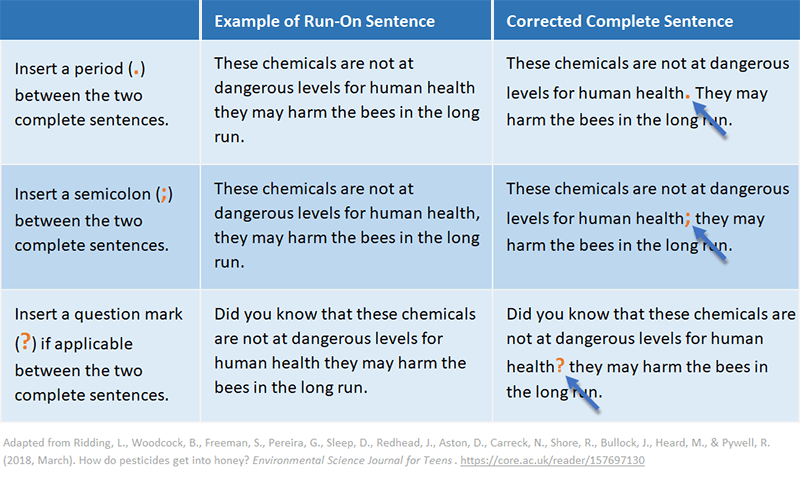
Also look for fragments. A fragment may be missing a subject, a complete verb, or a complete thought.
Fragment: Because the participant skipped breakfast.
Complete: Because the participant skipped breakfast, the researcher recorded the glucose level carefully.
The words because the participant skipped breakfast contain a subject and verb, but because makes the idea dependent. Attach it to an independent clause rather than leaving it alone.
A fast boundary check
For every period, comma, semicolon, or conjunction, ask:
- Is there a complete thought before this point?
- Is there a complete thought after it?
- If there are two complete thoughts, have I used a valid boundary?
This first pass catches the errors that most interfere with a reader’s understanding.
Pass 2: Check agreement, tense, and pronouns
Once every sentence has a clear boundary, check the grammar inside each sentence.
Subject–verb agreement
Find the sentence’s main subject and its main verb. Ignore phrases between them before deciding whether the verb should be singular or plural.
Incorrect: The results of the nutrition survey suggests a need for more education.
Correct: The results of the nutrition survey suggest a need for more education.
The subject is results, not survey. Because results is plural, the verb is suggest.
Similarly:
Incorrect: Each of the lab partners record the temperature.
Correct: Each of the lab partners records the temperature.
The subject is each, which is singular. The phrase of the lab partners adds information but does not control the verb.
Verb tense consistency
A passage usually has a dominant time frame. If you are describing a completed class activity or study, past tense will often dominate:
The class reviewed the labels and identified the nutrients.
An unexplained switch confuses the timeline:
Incorrect: The class reviewed the labels and identifies the nutrients.
Correct: The class reviewed the labels and identified the nutrients.
A shift is correct only when time actually changes:
The students recorded their meals last week, and the instructor explains the assignment requirements at the beginning of each term.
The first verb refers to a completed event; the second refers to a continuing routine.
Pronouns: agreement and clear reference
A pronoun should point clearly to its antecedent, the noun it replaces.
Unclear: The instructor placed the food records beside the class survey, and then she reviewed it.
Clear: The instructor placed the food records beside the class survey and then reviewed the food records.
The singular pronoun it could refer to either survey or record. Repeating the key noun is clearer than forcing the reader to guess.
Also check that the pronoun makes sense in number and person:
Clear: The students reviewed their food records.
Clear: Each student reviewed their food record.
In contemporary academic English, singular they/their is widely accepted when referring to a person of unspecified gender. The important editing questions are whether the antecedent is clear and whether the writer maintains a logical, consistent point of view. Follow any specific style rules your instructor gives you.
Pass 3: Check commas after the grammar is stable
Now use the comma patterns from the previous lesson. You are not searching for every possible comma rule; you are checking the high-value patterns that appear often in college writing.
Check these patterns deliberately
-
Introductory dependent clauses
Because the participants arrived late, the researcher adjusted the schedule.
-
Two independent clauses joined by a FANBOYS conjunction
The sample was small, but the findings were still useful.
-
Items in a series
The record included breakfast, lunch, dinner, and two snacks.
-
Nonessential interrupters
The survey, however, did not measure long-term eating habits.
-
Subject–verb and verb–object splits
Never insert a comma simply because the sentence is long.
Incorrect: The results of the survey, indicate a pattern.
Correct: The results of the survey indicate a pattern.
Remember that however does not fix a comma splice by itself:
Incorrect: The records showed patterns, however, they did not measure usual intake.
Correct: The records showed patterns; however, they did not measure usual intake.
Also correct: The records showed patterns. However, they did not measure usual intake.
A worked passage: edit methodically
Here is a short draft with several sentence-level errors. Read it once without correcting anything yet.
Last week, the students in the nutrition class completes a one-day food record, they listed breakfast lunch and dinner. Because some entries were incomplete. The instructor placed the food records beside the class survey, and then she reviewed it. The record showed patterns, however, it did not measure usual intake. After the class reviewed the records, they discuss changes that could improve their diets.
A weak editing approach would be to correct whatever you notice first. A stronger approach is to make passes.
| Editing pass | What to notice | Revision decision |
|---|---|---|
| Sentence boundaries | The first sentence has two independent clauses joined only by a comma. Because some entries were incomplete is a fragment. The sentence with however is a comma splice. | Separate or correctly join complete thoughts; attach the dependent clause. |
| Agreement and tense | Last week establishes a past-time frame, but completes and discuss are present tense. | Change them to completed and discussed. |
| Pronouns | In she reviewed it, it could mean the food records or the class survey. In the final sentence, they could refer to the class or the students. | Replace unclear pronouns with precise nouns. |
| Commas | The meal list needs commas. The repaired introductory clause needs a comma. However needs stronger punctuation than commas alone. | Apply the relevant comma patterns after the structural repairs. |
One polished revision is:
Last week, the students in the nutrition class completed one-day food records. They listed breakfast, lunch, and dinner. Because some entries were incomplete, the instructor reviewed the food records and the class survey. The records showed patterns; however, they did not measure usual intake. After the class reviewed the records, the students discussed changes that could improve their diets.
Notice that editing was not just about making the passage “sound better.” Each change solves a specific problem:
- The first fused structure became two complete sentences.
- The fragment was attached to a main clause.
- The past tense now matches last week.
- Ambiguous pronouns were replaced with specific nouns.
- Commas clarify the list and introductory clause.
- A semicolon and however, correctly connect two closely related complete thoughts.
A final proofreading routine
After making grammar corrections, read the passage once more for punctuation, spelling, capitalization, and consistency. Reading aloud is useful because it slows you down, but do not rely only on pauses in your voice to decide comma placement. Use grammar and sentence structure first.
Sparkle English’s “How to Proofread English Texts (5 Simple Tips) & Common Proofreading Mistakes to Avoid” models the same principle by editing a flawed paragraph one error at a time.
How to Proofread English Texts (5 Simple Tips) & Common Proofreading Mistakes to Avoid
Watch Sparkle English’s practical proofreading demonstration. It shows how a writer can identify sentence-boundary, tense, comma, spelling, and consistency problems in a single short passage.
Watch the guided edit. Pause before the corrections are explained and see whether you can identify the comma splice and verb-tense shift yourself. Focus less on memorizing every correction and more on the presenter’s habit of naming the specific type of error before revising it.
For a short assignment, reserve a final five to ten minutes for this checklist:
- Read only for fragments and run-ons.
- Read only for subject–verb agreement.
- Compare every main verb with the paragraph’s time frame.
- Circle pronouns and identify each antecedent.
- Check commas using the specific patterns you know.
- Read the revised passage aloud, or read sentence by sentence from the end to the beginning, to notice remaining surface errors.
If you use this method consistently, you will gradually begin to notice patterns in your own writing—for example, frequent tense shifts or comma splices—and can target those patterns earlier in future drafts.
Key takeaways
Effective editing is systematic, not random. To edit a short passage well:
- Establish clear sentence boundaries by repairing fragments, fused sentences, and comma splices.
- Match each main verb to its true subject.
- Maintain a consistent tense unless the meaning requires a genuine shift in time.
- Make every pronoun’s antecedent clear.
- Apply commas according to sentence structure, not pauses.
- Proofread only after the grammar and sentence structure are stable.
You have now completed the sentence-level foundation of Basic Writing. The next module moves from correct individual sentences to effective paragraphs, beginning with the topic sentence: one focused sentence that gives a paragraph a clear main idea.
Can't find a good explanation? Sign up and we'll make it for you
Sign up