
Hello! This course begins by treating integers as meaningful descriptions, not just numbers to calculate with. In this first module, you will connect positive and negative integers to real situations, then use number lines, opposites, absolute value, and comparisons to make sense of them.
The central idea is simple: a signed number tells us a quantity’s position or change relative to a reference point, usually called zero. By the end of this lesson, you should be able to decide whether a situation is represented by a positive integer, a negative integer, or zero—and explain what that number means in context.
Zero is the reference point
Integers are whole numbers that include negative numbers, zero, and positive numbers:
A positive integer describes an amount above, ahead of, gained, received, or added relative to the chosen zero point. A negative integer describes an amount below, behind, lost, owed, or removed relative to that same point.
Zero is special: it is neither positive nor negative. It means exactly at the reference point or no change.
For example:
| Context | Zero means | Positive integer | Negative integer |
|---|---|---|---|
| Temperature | on that scale | warmer than | colder than |
| Elevation | sea level | above sea level | below sea level |
| Bank balance | no money owed or held | money in the account | amount overdrawn or owed |
| Change in money | no change | gain or deposit | loss or withdrawal |
| Sports play | no yards gained or lost | gain | loss |
The sign only makes sense once you know the reference point. For instance, could mean 8 degrees below zero, 8 meters below sea level, a loss of 8 yards, or a debt of 8 dollars. The number tells how much; the context and sign tell what kind of direction or change it represents.
Temperature: below and above zero
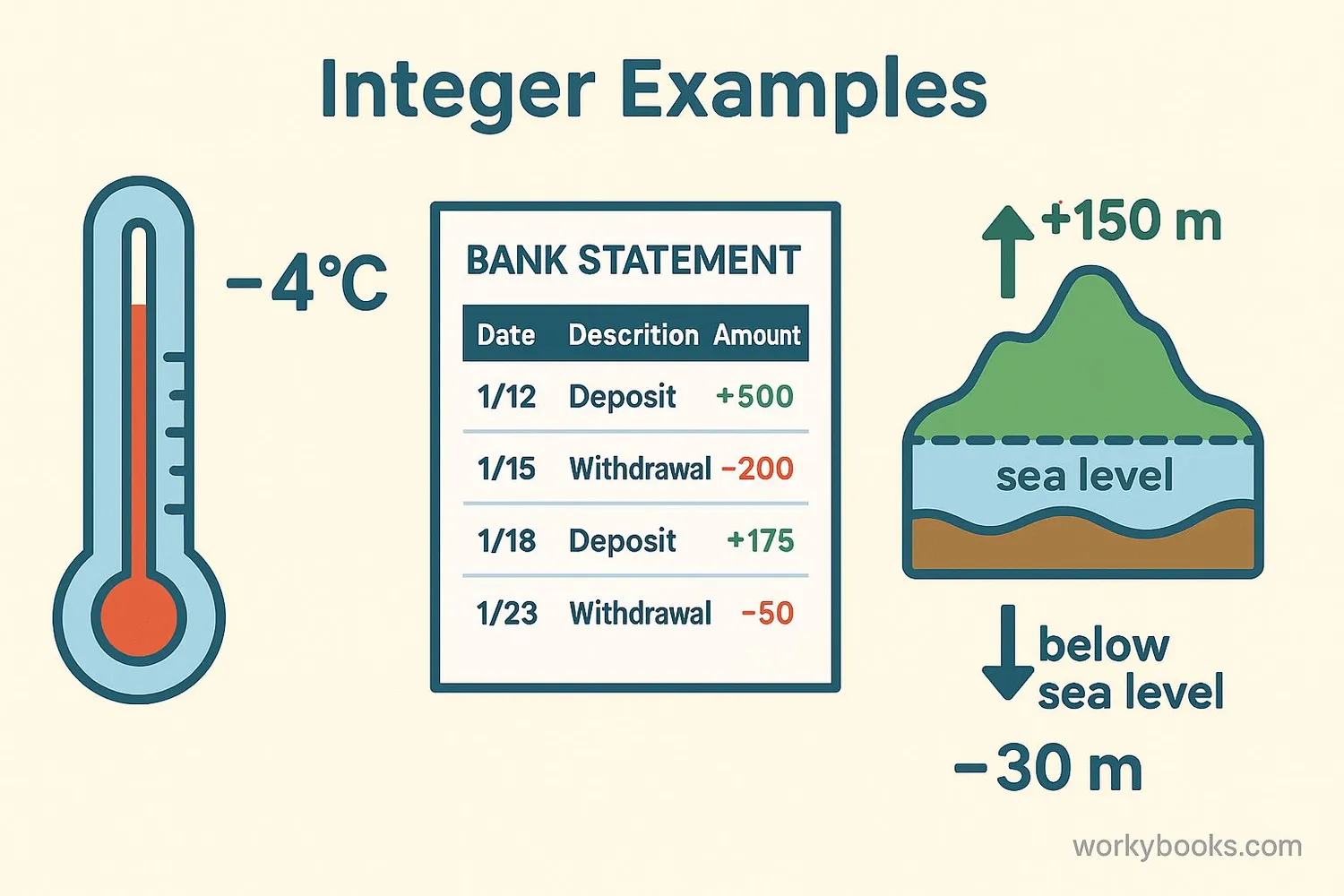
A temperature of is read as “negative four degrees Celsius.” It means the temperature is 4 degrees below .
A temperature of means 7 degrees above . We could write , but the plus sign is usually omitted. Therefore, an unsigned integer such as is normally understood as positive.
It is important not to interpret a negative temperature as “less temperature exists.” It is a location on a temperature scale relative to that scale’s zero point. The sign tells which side of zero the reading lies on.
Positive and Negative Numbers for Kids | Homeschool Pop
Watch “Positive and Negative Numbers for Kids” by Homeschool Pop for three short real-world uses of negative integers: temperature, elevation, and money.
Watch temperature to connect a thermometer reading below zero to a negative integer. Then watch elevation and money owed. For each example, identify the reference point: zero degrees, sea level, or having no debt.
Elevation: above and below sea level
Elevation measures vertical position relative to sea level.
- An elevation of means 150 meters above sea level.
- An elevation of means 30 meters below sea level.
- An elevation of means exactly at sea level.
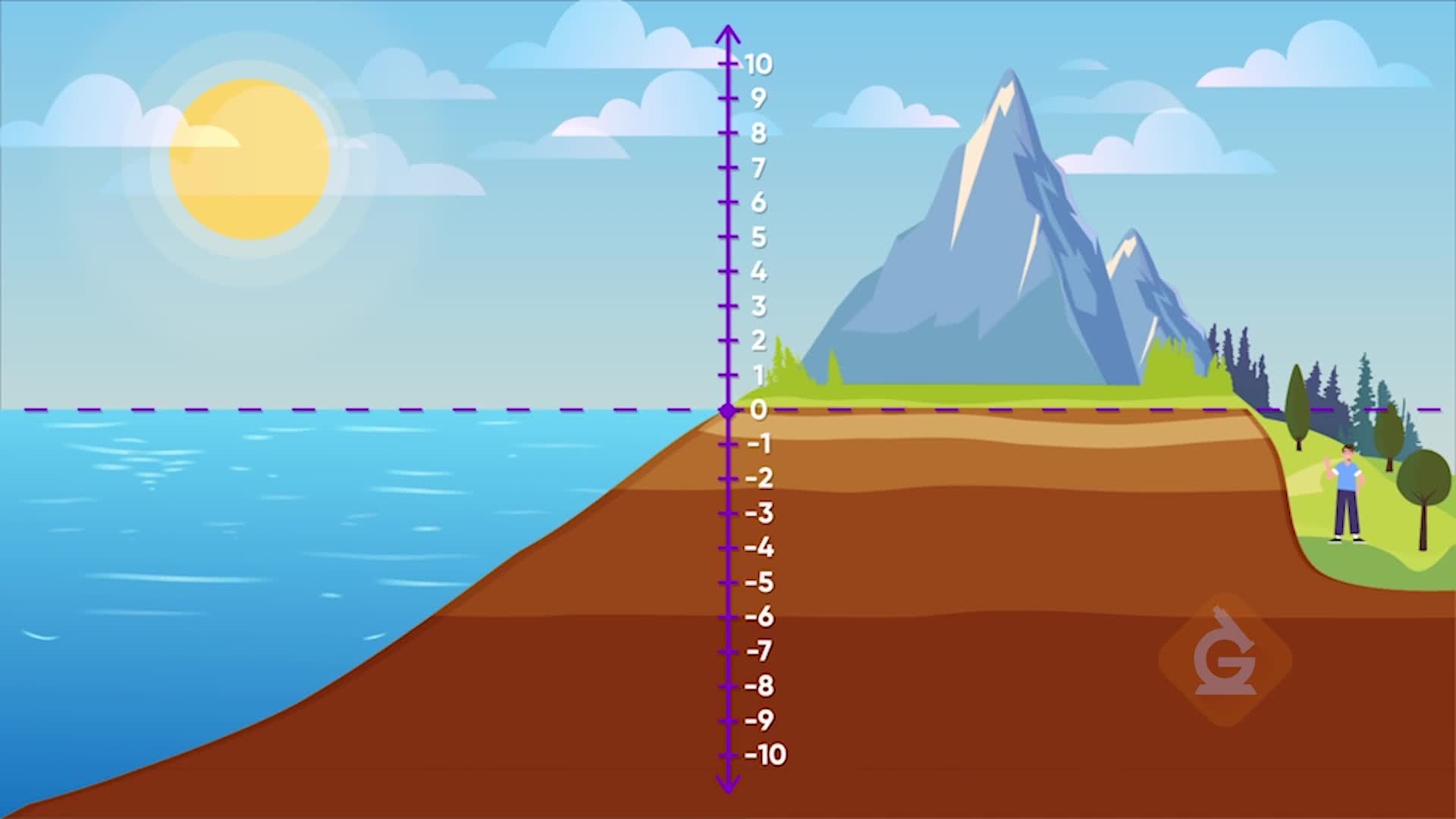
The same interpretation applies to a diver or submarine. If a submarine is at , it is 50 meters below the ocean surface when sea level is the reference point. It is not “at negative 50 meters” in some mysterious physical location; the negative sign records that its position is below the chosen baseline.
A useful sentence pattern is:
The value means units below the reference point.
For elevation, the reference point is sea level. For temperature, it is zero degrees.
3.1 Introduction to Integers - Prealgebra 2e
Read this section from OpenStax Prealgebra 2e to see how temperatures, overdrafts, elevations, and ocean depths are all represented with signed numbers.
In the subsection “Locate Positive and Negative Numbers on the Number Line,” begin at “Temperatures are not the only negative numbers.” Read the contextual examples through the explanation that a positive sign is usually left unwritten. As you read, name the zero point for each situation before deciding whether the integer should be positive or negative.
Money: distinguish a balance from a change
Money contexts need careful reading because an integer can describe either a balance or a change.
A balance
A bank balance of means the account is overdrawn by $40. In other words, $40 is owed to bring the balance back to zero.
A balance of , usually written simply as , means there is $40 in the account.
A change
A deposit of $500 changes an account by . A withdrawal of $200 changes it by .
However, a withdrawal of $200 does not automatically mean that the final account balance is . It only tells you that the balance changed downward by $200. The starting balance would be needed to determine the new balance.
This distinction appears often in word problems:
- “The account is overdrawn by $25” describes a balance of .
- “A $25 withdrawal was made” describes a change of .
- “The account received a $25 deposit” describes a change of .
Keeping the unit visible helps preserve meaning: write , , or , rather than only , when interpreting a real situation.
Gains and losses
Positive and negative integers also represent changes in many settings.
A football team that gains 6 yards has a change of yards. A team that loses 6 yards has a change of yards. Similarly:
- A stock gain of $12 can be represented by .
- A stock loss of $12 can be represented by .
- A company with a profit of $300 has relative to breaking even.
- A company with a deficit of $300 has relative to breaking even.
Words that often signal a positive integer include:
- above
- warmer than zero
- deposit
- receive
- gain
- profit
- increase
- surplus
Words that often signal a negative integer include:
- below
- colder than zero
- overdrawn
- owe
- withdrawal
- loss
- decline
- deficit
These are clues, not magic rules. Always check what is being measured and what counts as zero. For example, “a withdrawal” is negative when the quantity is the change in an account balance, while “having $50” is positive when the quantity is the amount of money held.
One notation detail will matter throughout the course: in , the minus sign is part of the number’s name—it means “negative eight.” Later, you will also use a minus sign for subtraction, as in . Context and placement tell you which meaning is intended.
A reliable interpretation routine
When a word problem contains an integer situation, use this routine:
- Identify the quantity and its unit. Is it degrees, meters, dollars, yards, or something else?
- Find the reference point. It may be zero degrees, sea level, no debt, no change, or breaking even.
- Decide the direction relative to that reference point. Is the quantity above or below, a gain or a loss?
- Attach the correct sign and keep the unit.
- State the meaning in words.
For example, “A hiker is 85 meters below sea level” becomes . The full interpretation is: the hiker is 85 meters below the sea-level reference point.
Key takeaways
Positive and negative integers describe positions or changes relative to a chosen zero point.
- Positive values describe amounts above, gains, deposits, and increases.
- Negative values describe amounts below, losses, withdrawals, debts, and decreases.
- Zero describes the reference point or no change; it is neither positive nor negative.
- The unit and situation are essential: has different meanings in , , and .
Next, you will represent integers accurately on a number line. That will give you a visual way to show every interpretation from this lesson: positive values on one side of zero and negative values on the other.
Can't find a good explanation? Sign up and we'll make it for you
Sign up