
Welcome back. In the previous lesson, you separated onboarding from implementation, activation, adoption, customer success, and support. That vocabulary matters now because a journey map must show more than a sequence of internal tasks: it must show how a customer moves from a commercial commitment to first meaningful value, then to repeated value, and finally into an ongoing success relationship.
This lesson gives you a practical way to map that path for either a self-service sign-up or a complex B2B contract. By the end, you should be able to create a journey map that makes four things visible: the customer’s intended outcome, the milestones that prove progress, the work and touchpoints that enable each milestone, and the conditions for a credible transition to long-term Customer Success.
A journey map is a model of customer progress
A customer journey map is not merely an onboarding checklist displayed horizontally. A checklist records tasks: “send welcome email,” “connect integration,” “hold training.” A journey map explains why those tasks exist, what customer change they enable, and what happens if that change does not occur.
At its best, a map answers:
- Where is the customer now?
- What outcome are they trying to achieve next?
- What observable milestone shows that they have progressed?
- What must the customer and vendor each do to reach it?
- What friction, risk, or stalled behavior should trigger action?
The map should be organized around customer states, not departments. For example, “technical configuration complete” is a useful state, while “Implementation team is finished” is not necessarily a customer outcome. A technically configured account may still have no trained owner, no live use case, and no reason to return.
A useful journey spine is:
Each arrow represents a transition that can fail. The customer may sign a contract but never mobilize stakeholders; configure the product but never use it with real work; experience one early win but never build a routine. Your map makes those failure points visible.
Mapping Your SaaS Customer Journey in Seven Steps
Read Totango’s guide to see a practical mapping process: choosing the map type, describing the customer, identifying touchpoints, marking milestones, and flagging events that need intervention.
In the section “Why Map Your SaaS Customer Journey?”, read the rationale for turning a journey map into operating procedures and action triggers. Then, in “How to Map Your SaaS Customer Journey in Seven Steps,” focus first on the distinction among map types in the map format discussion. Continue through the seven steps, paying particular attention to how the article moves from customer description and touchpoints to milestones and corrective actions.
The five building blocks
When reviewing a map, keep these elements distinct:
| Element | Meaning | Example for a B2B analytics platform |
|---|---|---|
| Stage | A period of customer progress with a dominant objective | “Become ready to analyze live operational data” |
| Milestone | A verifiable state that indicates progress | A live data source is connected and producing usable records |
| Touchpoint | An interaction with the company or product | Kickoff, in-app setup prompt, admin training, support ticket |
| Event or signal | An observable behavior or data point | Admin invited three analysts; first dashboard was shared |
| Risk trigger | A condition that should prompt intervention | No data source connected seven days after kickoff |
A stage is not a calendar week, and a milestone is not automatically a completed task. “Training delivered” is a task. “The operational owner can independently run the agreed workflow” is a milestone because it describes a new customer capability.
The lifecycle: from purchase commitment to a working habit
The lifecycle image below makes an important point: onboarding sits in a wider relationship. It starts after a sale or sign-up, connects to adoption, and eventually supports renewal, expansion, and additional deployment.
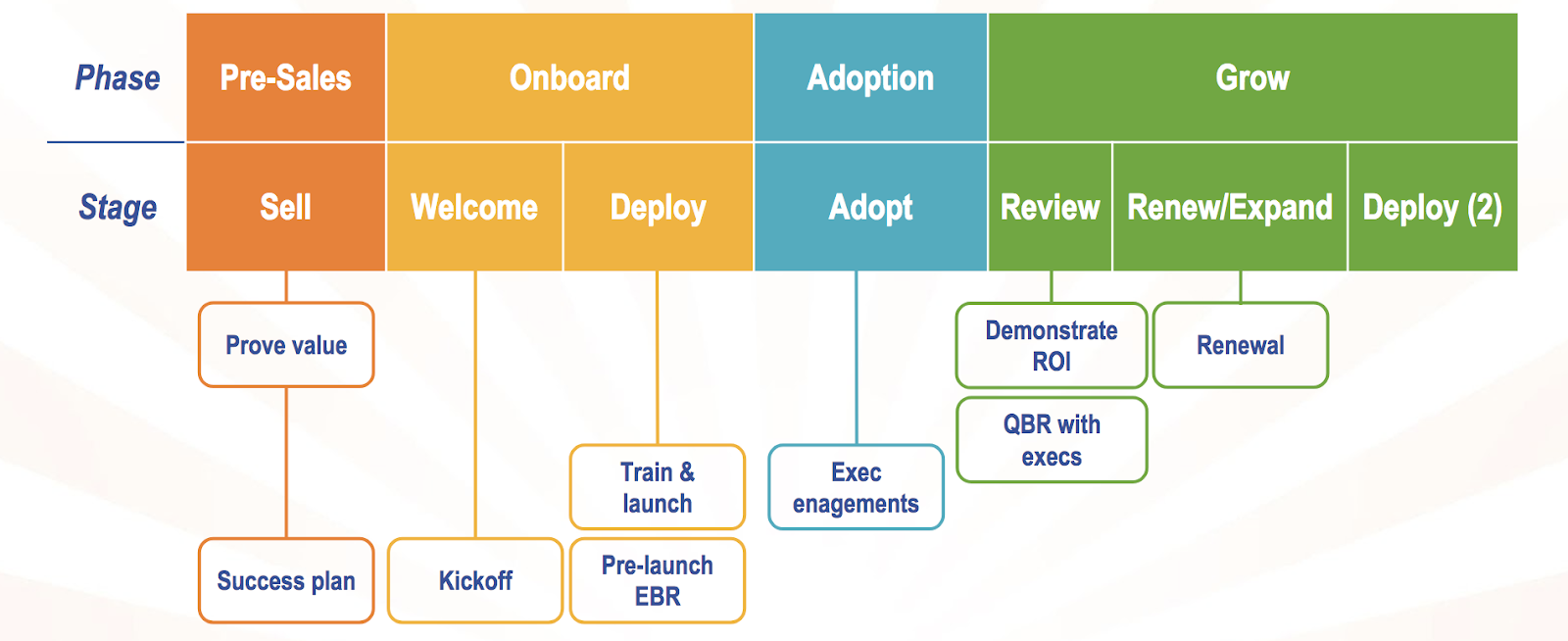
The exact labels will vary. A product-led company may call the first phase “sign-up,” while an enterprise company may call it “post-sale mobilization.” The key is to map the customer’s change in capability and confidence, rather than copying a standard lifecycle template.
1. Commitment: the customer has bought potential value
The journey begins at a signed contract, completed purchase, or self-service registration. This is not the same as value. It is a commitment based on an expectation: “We believe this product can help us achieve a result.”
For a contract-led account, the immediate questions are:
- What business outcome was sold?
- Which use case will be launched first?
- Who is the executive sponsor, operational owner, administrator, and technical contact?
- What commercial commitments, scope boundaries, integrations, or timelines were discussed?
- What assumptions must prove true for the customer to succeed?
For self-service customers, much of this context does not arrive through a sales handoff. The product must help capture it through choices such as role, intended use case, team size, desired outcome, or data source. A sign-up flow that asks for irrelevant information creates friction; one that learns the minimum necessary to guide the next step can materially shorten the journey.
2. Mobilization and readiness: turn intent into a shared plan
At this stage, the customer is moving from “we bought this” to “we know how we will use it.” A kickoff is often the visible touchpoint, but its underlying purpose is alignment:
- confirm the first use case and desired early outcome;
- identify owners and decision makers;
- set a realistic scope for the initial launch;
- surface dependencies, such as data access or security approval; and
- agree on the next milestone and how progress will be reviewed.
For lower-touch onboarding, the equivalent may be an in-product checklist, role-specific path, or welcome sequence. The medium differs, but the customer still needs clarity about the next meaningful move.
3. Setup: make the product capable of delivering the promised value
Setup includes account configuration, permissions, integrations, data import, initial workflow design, and other implementation work. It is essential but should not become the destination.
The relevant question is:
Which setup steps are truly required before this customer can experience the first intended value?
A common failure is treating every possible configuration option as mandatory. Strong onboarding distinguishes between:
- critical-path setup, which is necessary for the first live use case; and
- later optimization, which can wait until the customer has established value.
This protects time to first value and reduces cognitive overload.
4. First value: a real “aha” moment
First value occurs when the customer uses the product in a meaningful way and gets evidence that it can solve the problem they bought it to solve. It is stronger than a login, product tour, or completed configuration task.
For example:
- A payroll customer completes its first successful payroll run.
- A project-management team uses a live workspace to coordinate real deliverables and gets a reliable status view.
- A support-operations team identifies a recurring source of ticket volume from real customer data and assigns an owner to address it.
First value can be narrow. It does not need to prove the full annual business case immediately. But it must be connected to the customer’s actual job-to-be-done—not merely to product activity that is convenient to measure.
5. Habitual use: value becomes part of work
A customer reaches early adoption when value-producing behavior repeats at the frequency the workflow requires. For a weekly operating-review product, habitual use might mean reviewing and acting on the relevant dashboard every week. For an expense-management tool, it might be employees submitting expenses throughout each month and finance closing on time.
The important insight is that the appropriate frequency comes from the customer’s underlying work, not an arbitrary product-engagement target. Daily usage is not inherently better than weekly usage if the customer’s real-world task occurs weekly.
Casey Winters: Why Customer Onboarding is the Most Crucial Part of Your Growth Strategy
Watch Casey Winters’s Slush talk for a disciplined way to connect first value to habit formation. The examples are consumer products, but the logic transfers well to SaaS: identify the value-producing action, the frequency at which customers need it, and the setup that makes the first value moment possible.
Watch key action to understand the relationship between a product’s central value action and its “designated frequency.” Then watch habit and milestones for the distinction among the setup moment, the first value or “aha” moment, and the later habit moment. While watching, translate the examples into an account-level B2B workflow rather than copying their consumer-product frequencies.
A strong map therefore does not stop at activation. It includes the bridge from:
6. Ongoing customer success: sustain, demonstrate, and deepen outcomes
Eventually, onboarding should transition into an ongoing Customer Success motion. The customer is no longer primarily learning how to get started. Instead, the relationship shifts toward sustaining adoption, measuring outcomes, removing new barriers, optimizing the use case, and identifying credible opportunities for broader value.
This does not mean the customer is permanently “done.” A new business unit, integration, use case, or product module may begin a fresh onboarding journey. Mature lifecycle management is recursive: a customer can be in steady-state adoption for one workflow while onboarding a second one.
Build the map backward from the value-producing behavior
The most reliable way to create a map is to begin with the target behavior and work backward. Do not start with the current sequence of internal meetings, emails, and implementation tasks. Those activities may reflect organizational habit rather than customer need.
Suppose a fictional SaaS company, SignalDesk, sells an analytics platform to customer-support leaders. A mid-market customer bought it to reduce repeat support tickets by identifying the issues generating the most volume.
The eventual recurring behavior might be:
Every Monday, the support-operations lead reviews a SignalDesk trend report, identifies the highest-impact issue, assigns an owner, and uses the data in the operations meeting.
That statement provides a much better destination than “customer is fully trained.”
Now work backward:
- To make the Monday review possible, the customer needs a reliable report with live support data.
- To make the report reliable, the help-desk integration and category mappings must work.
- To configure those elements correctly, the vendor needs access, a technical contact, and agreement on the initial ticket categories.
- To secure those inputs, the customer needs a clear plan, accountable owners, and an understanding of what early value will look like.
Here is the resulting account-level journey map.
| Customer stage | Customer objective and experience | Customer milestone | Vendor actions and touchpoints | Evidence and risk trigger |
|---|---|---|---|---|
| Signed / committed | “We expect to reduce repeat-ticket volume.” | Desired outcome, first use case, stakeholders, and constraints are captured. | Sales-to-post-sale context transfer; welcome; prepare kickoff. | Risk: promised outcome or integration needs are unclear. |
| Mobilized | “We have a credible plan to start.” | Sponsor, operational owner, admin, and technical contact agree on scope and next actions. | Kickoff; shared plan; roles and dependency review. | Risk: no accountable customer owner or unresolved security path. |
| Configured for use | “The product can work with our real environment.” | Help-desk data is connected, mapped, and validated. | Technical guidance; integration testing; configuration support. | Risk: no usable data after an agreed interval. |
| First value | “This revealed a real source of ticket volume.” | The operations lead uses a live report to identify a priority issue. | Guided working session; in-product prompts; targeted education. | Risk: customer has only demo data or never runs the first analysis. |
| Early habit | “This is now part of our weekly operating rhythm.” | The team completes the review-and-action workflow at the agreed frequency. | Usage review; enablement for additional users; remove workflow friction. | Risk: report is created once but is not revisited or acted upon. |
| Ongoing success | “We can demonstrate progress and extend value.” | Customer has an ongoing review cadence, an outcome baseline, and a next success objective. | Transition review; regular CSM cadence; outcome and adoption monitoring. | Risk: transition occurs while ownership, adoption, or open blockers remain unclear. |
Notice that this map contains multiple layers without confusing them:
- Implementation is concentrated in the “configured for use” stage.
- Activation occurs at the first-value milestone.
- Adoption is demonstrated by the weekly operational routine.
- Customer Success continues through and beyond the transition.
- Support can appear wherever a discrete issue blocks progress.
One map per meaningful journey, not one map per company
A company may need several maps. A small self-service customer connecting a single data source has a fundamentally different journey from an enterprise customer with security review, data migration, multiple user roles, and a phased deployment.
Create separate maps when the differences alter:
- the customer’s job-to-be-done;
- the first-value event;
- the critical dependencies;
- the decision makers and users involved;
- the expected time to value; or
- the appropriate touchpoints and level of human guidance.
A single universal map often becomes vague enough to be useless. The goal is not maximal personalization for every account; it is a small set of evidence-based journey patterns that are distinct where it matters.
Make the transition to Customer Success deliberate
A poor handoff feels like abandonment: the onboarding team declares the project complete, introduces a new contact, and assumes the customer will continue on its own. A strong transition confirms that the customer can sustain value and knows what will happen next.
A transition review typically addresses five questions:
-
What value has the customer experienced so far?
State the early win in the customer’s language, not only as completed vendor tasks. -
What behavior indicates early adoption?
Identify the key workflow, who performs it, and its intended frequency. -
Who owns success from the customer side?
Confirm the operational owner and the executive sponsor’s role. -
What remains unresolved?
Separate ordinary future optimization from genuine adoption risks, open technical blockers, or expectation gaps. -
What is the next value objective and operating cadence?
Establish the next review, the ongoing CSM relationship, and the outcome the customer will pursue over the next period.
Customer onboarding checklist: A complete guide
Use HubSpot’s eight-step operational sequence as a reference model for moving from post-sale preparation through first value, early check-ins, and handoff to long-term success.
In “New Customer Onboarding Checklist: An 8 Step Guide,” read Steps 1 and 2, “Pre-Onboarding & Preparation” and “Contract & Kickoff Meeting.” Focus on the preparation rationale and the information that must be validated during kickoff. Then read Steps 5 through 8: “Training & Enablement Sessions,” “Implementation & First Value Delivery,” “Success Tracking & Early Check-Ins,” and “Handoff to Long-Term Success.” Pay special attention to the enablement distinction, the early check-ins after first value, and the handoff framing.
The resource’s sequence is useful, but do not mistake sequence for a fixed schedule. A self-service customer might reach first value in minutes, while an enterprise customer may need weeks of configuration and change management. The map should show expected timing, but its logic should be based on dependencies and evidence, not simply “what happens in week three.”
How to judge whether a journey map is credible
Before presenting a map to a hiring manager, product leader, or Customer Success team, test it with a few questions:
- Does it begin with a specific customer outcome rather than generic product setup?
- Does each stage have a customer-centered milestone with observable evidence?
- Does it identify the customer’s work as well as the vendor’s work?
- Does it distinguish a first-value event from repeated, habitual use?
- Does it expose likely friction points and define what should trigger intervention?
- Does it show a transition to ongoing success as a change in operating model, not a disappearance of support?
- Could a new team member understand what to do next for a customer who is stalled at any stage?
If the answer to these questions is yes, the map is becoming an operating tool rather than a slide.
Key takeaways
A SaaS customer journey begins at signed contract or sign-up, but purchase is only an expectation of value. A strong map follows the customer through:
Remember these principles:
- Map customer progress, not only internal tasks or team handoffs.
- Define first value as a meaningful result in the customer’s real use case.
- Define early adoption through a value-producing action performed at the appropriate frequency.
- Build maps backward from the repeated behavior that signals sustainable value.
- Transition customers deliberately into ongoing Customer Success with clear ownership, evidence of early value, known risks, and a next outcome.
In the next lesson, you will learn to extract the customer’s job-to-be-done, desired business outcome, success criteria, and constraints from discovery notes. That information supplies the raw material needed to make each journey map specific rather than generic.
Can't find a good explanation? Sign up and we'll make it for you
Sign up