
Hello, and welcome to the course. This first module establishes the vocabulary needed to discuss SaaS onboarding precisely—an essential skill when diagnosing customer problems, designing programs, or speaking with hiring teams.
In SaaS, several teams may use onboarding, implementation, activation, and adoption almost interchangeably. That creates reporting mistakes and, more importantly, poorly designed customer experiences. This lesson separates the concepts by their purpose, scope, timing, and evidence of success. By the end, you should be able to hear a vague statement such as “the customer finished onboarding” and identify what is actually being claimed—and what still needs to be true.
Start with the lifecycle, not the department chart
A customer does not experience your internal organizational boundaries. They experience one continuous journey: they buy a product because they expect an outcome, learn how to use it, encounter friction, begin using it in real work, and eventually decide whether the value justifies continued investment.
The following lifecycle framework is useful because it puts the customer’s evolving objective ahead of the company’s internal teams.
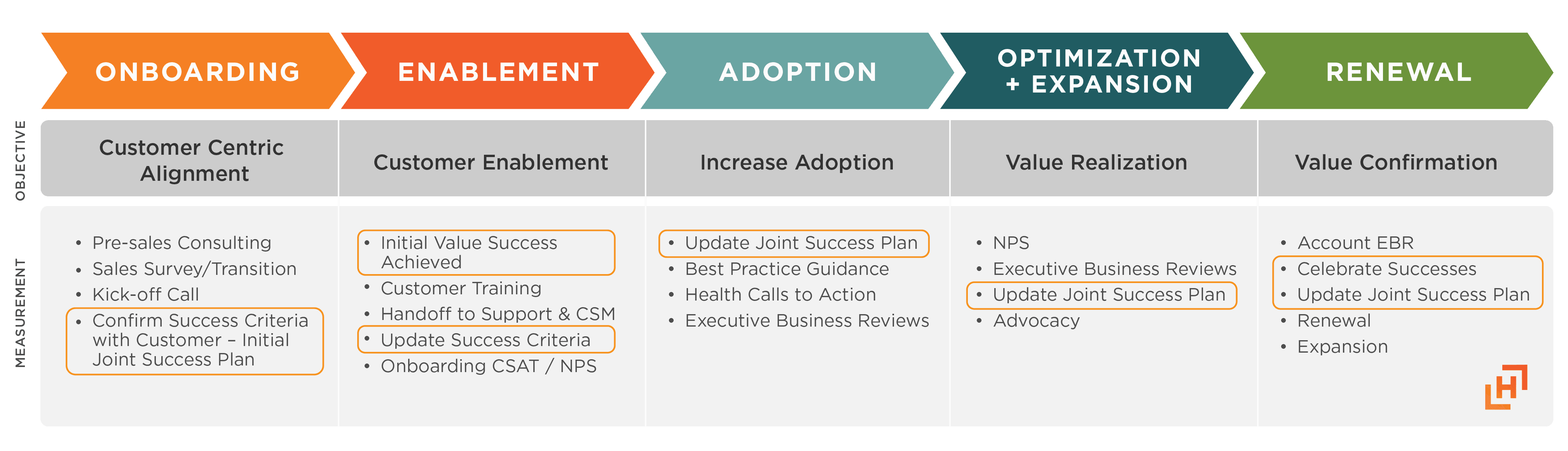
The labels differ across companies, but the underlying progression is consistent:
- Onboarding: align on the intended outcome and establish a credible route to initial value.
- Enablement: ensure people can competently perform the workflows required to create that value.
- Adoption: turn those workflows into sustained, appropriately broad use.
- Optimization and expansion: improve results, extend use cases, or expand to more users or teams.
- Renewal: confirm that realized value merits another contractual commitment.
These are not five teams, nor necessarily five strictly sequential phases. A customer might be adopting one workflow while still onboarding another business unit. The framework is a way to identify the dominant customer objective at a given moment.
A concise lifecycle view is:
The terms in this lesson sit at different points—and operate at different levels—along that path.
Customer onboarding: the outcome-centered, account-level journey
Customer onboarding is the structured post-sale journey that moves a customer from purchase or sign-up toward first meaningful value, with the right people, configuration, expectations, and plan in place to continue.
The key word is customer, rather than simply user. In a B2B SaaS setting, a customer is an account: it has an executive sponsor, an administrator, users, technical stakeholders, business processes, security constraints, and commercial expectations. Onboarding must coordinate that system—not merely teach one person where buttons are.
The Complete Guide to Customer Lifecycle Management: Key CS ...
Read Planhat’s framing of onboarding as both a customer-success process and a broader account journey. It provides a useful distinction between customer-level onboarding and the technical work that may occur within it.
In the section “What Is Customer Onboarding?”, read the definition and the paragraphs that follow. Begin with the definition and customer-goal framing. Then, in the subsection “Customer Onboarding vs. Implementation: What’s the Difference?”, read the direct comparison. Focus on the difference between an account’s path to ROI and a particular delivery activity.
A robust onboarding program usually includes some combination of:
- a sales-to-post-sale context transfer;
- confirmation of the customer’s desired business outcome;
- stakeholder roles and governance;
- a plan with milestones, dependencies, and owners;
- technical setup where needed;
- education and workflow guidance;
- monitoring for early value and risks; and
- a deliberate transition into ongoing customer success.
Notice what is not sufficient: “the account was created,” “the admin attended training,” or “the integration was connected.” Those may be useful milestones. None proves the customer has received value.
Customer onboarding versus user onboarding
This distinction will help throughout the course:
- Customer onboarding is the macro process: the account-level path to business value.
- User onboarding is the micro experience: helping an individual learn a workflow and complete product tasks.
For example, imagine a workforce-management platform sold to a retail chain:
- Customer onboarding may include aligning HR and operations leaders on a goal to reduce scheduling time, agreeing which stores launch first, importing employee data, and defining a success measure.
- User onboarding may include an individual store manager following in-app prompts to create a schedule and approve a shift swap.
Strong user onboarding supports the broader customer journey. But a polished product tour cannot fix a missing executive sponsor, an unclear rollout scope, or a customer that never agreed on what success means.
The five terms: separate them by the question they answer
A reliable way to distinguish overlapping terms is to ask: What question does this concept answer?
| Concept | Core question | Typical scope | Evidence of success |
|---|---|---|---|
| Customer onboarding | How will this account reach initial, meaningful value? | Account, stakeholders, processes, and early use | First value achieved; success path and ownership established |
| Implementation | Is the solution technically and operationally ready to use? | Configuration, data, integrations, deployment | Required solution components work as agreed |
| Activation | Has a user or account experienced the product’s core value for the first time? | A defined user or account event | A meaningful first-value event occurs |
| Adoption | Are people repeatedly using the value-producing workflows? | Users, teams, features, and workflows over time | Sustained, appropriate behavior and usage |
| Customer success | Is the customer achieving and expanding the outcomes they bought the product for? | Ongoing account relationship and outcomes | Demonstrated outcomes, retention, advocacy, expansion where appropriate |
| Support | How do we resolve a customer’s immediate question, incident, or defect? | A specific issue or request | Resolution, restored operation, satisfactory assistance |
The table is a conceptual tool, not a demand that every company organize itself into six separate groups. One Customer Success Manager may run onboarding, monitor adoption, coordinate an implementation partner, and involve Support when an issue arises. The work can be owned by one person; the concepts should still remain distinct.
Implementation is a workstream; onboarding is the journey
Implementation is the technical and operational work required to make a solution ready for intended use. It may include:
- configuring account settings and permissions;
- migrating or cleaning data;
- connecting integrations;
- setting up authentication or security controls;
- testing workflows;
- deploying the product to a user group; or
- tailoring the system to agreed requirements.
Implementation can be substantial. In an enterprise SaaS deal, it may be a multi-month project with a project manager, a statement of work, technical milestones, and formal acceptance criteria.
But implementation is not synonymous with onboarding.
The practical test
Ask this question:
If every technical task were complete, could the customer still fail to realize value?
If the answer is yes, implementation is only one component of onboarding.
Consider two examples.
Example 1: self-service analytics product
A growth manager signs up, connects a data source, and creates a dashboard without human assistance. There may be almost no implementation work. Yet onboarding still matters: the customer needs guidance toward the right data source, the first useful report, and a reason to return to it.
Example 2: enterprise HR platform
The vendor configures roles, migrates employee data, connects payroll, and passes security testing. Implementation is complete. But if managers do not know how to run the new process, executives have not agreed on rollout ownership, and no one measures the promised reduction in administrative work, the customer is not successfully onboarded.
A useful relationship is:
This does not mean implementation is unimportant. It means technical readiness is a necessary input for many customers, while onboarding is the broader discipline that connects readiness to realized value.
Activation is first value; adoption is durable behavior
Activation is a defined moment when a user or account first experiences the product’s core value. It is an event, not a lasting state.
For a project-management platform, activation might be:
- a team creates its first live project,
- assigns real work,
- and completes enough of the workflow to see an accurate status view.
For a payroll product, it might be completing the first successful payroll run. For a security product, it might be detecting and triaging the first meaningful risk.
The exact activation event is product- and use-case-specific. It should reflect a meaningful customer outcome, not empty activity. A first login is usually not activation; a configuration step often is not activation either.
Adoption, by contrast, is sustained and repeated use of the product features and behaviors that produce the intended outcome. It is visible over weeks and months.
What Is Product Adoption? Definition and How to Improve It | Gainsight
Read Gainsight’s explanation of why a first-value event and durable product use should not be measured as if they were the same outcome.
In the section “Product Adoption vs. Product Activation,” read the activation-to-adoption distinction. Then read the definition at the beginning of “What Is Product Adoption? Definition, Stages, and Why It Drives NRR,” starting with the broader adoption framing. Watch for the change from an initial event to repeated behavior that predicts renewal.
Here is the distinction in one scenario:
| Moment | What happens | Correct term |
|---|---|---|
| Monday | An operations manager creates the first automated workflow and sees it route a real request correctly. | Activation |
| Weeks 2–8 | The operations team uses the workflow every day, improves it, and relies on the resulting data in team meetings. | Adoption |
| Quarter 2 | Leadership confirms request turnaround time fell by 30%, decides to expand the product to another department, and renews. | Customer success |
The danger of confusing activation with adoption is premature celebration. A company can report a high activation rate because users complete an initial workflow, while still having poor retention because they never return and build a habit.
Activation is often part of onboarding—but not its whole definition
Onboarding should be designed to make activation likely and fast. In many SaaS businesses, time to first value is a central onboarding measure.
However, activation alone is not always enough to declare onboarding complete. A customer may activate but still lack:
- a trained owner;
- a rollout decision;
- a documented success plan;
- the users needed for the intended use case;
- confidence in ongoing operation; or
- evidence that the value can be repeated.
A value-centered onboarding completion criterion therefore usually combines a first-value milestone with enough capability, ownership, and momentum to continue.
Customer success is the enduring discipline, not merely the onboarding phase
Customer success is the proactive, ongoing practice of helping customers achieve the outcomes that justified their purchase. It extends from early onboarding through adoption, optimization, renewal, and potentially expansion.
A Customer Success team might:
- lead an onboarding kickoff;
- run outcome reviews with executives;
- identify underused high-value features;
- coordinate resources when adoption stalls;
- connect product usage to the customer’s business goals;
- prepare for renewal; and
- surface expansion opportunities when additional value is credible.
This means onboarding and customer success have a part-whole relationship:
The phrase “Customer Success owns onboarding” can be perfectly reasonable as an ownership statement. It does not mean the two terms are equivalent. In another company, Professional Services or a dedicated onboarding team may lead the onboarding work while Customer Success retains long-term accountability for the relationship and outcomes.
A useful diagnostic question is:
Are we helping this customer become successful for the first time, or helping them sustain and deepen success over time?
The first points toward onboarding. The second points toward the broader customer-success motion.
Support resolves issues; it does not replace a success path
Customer support is typically reactive, episodic assistance with a specific question, malfunction, or service request. It may be delivered by ticket, chat, email, phone, knowledge base, or community.
Support is vital during onboarding. A blocked integration, missing permission, or confusing setup step can prevent first value. Yet a fast support response does not by itself create onboarding success.
Compare the two motions:
| Support | Onboarding |
|---|---|
| Responds to a particular reported need | Proactively guides an account toward an agreed outcome |
| Usually ticket or interaction based | Usually milestone and journey based |
| Success: issue is resolved | Success: customer reaches meaningful early value and can continue |
| Can occur at any lifecycle stage | Concentrated in the early post-sale period, though duration varies |
| Often measures response, resolution, and satisfaction | Often measures time to value, milestone attainment, activation, and early adoption |
Suppose a customer submits three tickets about importing data. Support can resolve all three correctly. But if no one verifies that the imported data enables the customer’s intended reporting workflow, the account may still not be onboarded.
The inverse is also true: onboarding teams should not try to become an unofficial support desk. Recurring setup questions should be turned into clearer product guidance, education, documentation, or implementation steps; defects and incidents should move through defined Support and Engineering processes.
A classification method for real SaaS conversations
When someone describes customer work, classify it using four lenses.
1. Is the unit of analysis an account or an individual?
- Account: customer onboarding, customer success, implementation governance.
- Individual user: user onboarding, activation, feature usage.
A single account can have one executive sponsor, five administrators, and 2,000 eventual users. Do not let a single user’s product activity stand in for account-level success without checking the broader context.
2. Is the work proactive or reactive?
- Proactive: onboarding planning, enablement, success reviews, adoption interventions.
- Reactive: support tickets, incident management, answers to immediate questions.
This is not a value judgment. Reactive support is often essential; it simply has a different purpose.
3. Is the evidence an event, a behavior pattern, or an outcome?
- Event: activation—“the first workflow ran successfully.”
- Behavior pattern: adoption—“the intended team uses the workflow every week.”
- Business outcome: customer success—“the workflow reduced processing time and supports the customer’s strategic goal.”
4. Is the work a delivery component or the overall customer journey?
- Delivery component: implementation.
- Overall journey to initial value: customer onboarding.
This method prevents a common analytical error: treating every post-sale activity as onboarding. A renewal strategy, a product outage ticket, and an implementation project may all affect the customer relationship, but they are not the same type of work.
One integrated example
Imagine a SaaS company that sells a customer-feedback platform to a mid-market retailer. The retailer’s desired outcome is to identify recurring delivery problems and reduce negative customer feedback.
Here is how the terms fit together:
- Implementation: connect the retailer’s e-commerce and help-desk systems, map feedback fields, set user permissions, and test data flow.
- Customer onboarding: confirm the outcome, identify the executive sponsor and operational owner, agree on the first use case, plan the launch, enable the team, guide them toward their first useful insights, and verify that they can continue.
- Activation: the operations lead creates a usable dashboard that reveals delivery-related complaints and shares it with the right team.
- Adoption: the operations team reviews the dashboard weekly, categorizes root causes, and acts on trends as part of its normal operating rhythm.
- Customer success: the retailer can connect the platform to fewer delivery complaints, better customer experience, and an ongoing decision to retain or broaden use.
- Support: a user asks why a particular data field is not syncing; Support investigates and resolves that issue.
The boundaries are clear, but the dependencies are real. A broken integration can block activation. Weak enablement can prevent adoption. Low adoption can threaten customer success. Good lifecycle management requires seeing both the distinctions and the connections.
Key takeaways
Customer onboarding is the account-level, outcome-centered journey from purchase to initial meaningful value. It may contain technical implementation, training, stakeholder alignment, and activation work, but it is broader than any one of them.
Keep these distinctions crisp:
- Implementation makes the solution technically and operationally ready.
- Activation is the first meaningful experience of core product value.
- Adoption is repeated, habitual use of value-producing workflows.
- Customer success is the ongoing pursuit and demonstration of customer outcomes across the post-sale relationship.
- Support resolves discrete customer questions and problems at any stage.
In the next lesson, you will map the journey from contract signature or sign-up through first value, habitual use, and the transition into ongoing customer success. The vocabulary from this lesson will let you map that journey without confusing a task list, a product event, and a customer outcome.
Can't find a good explanation? Sign up and we'll make it for you
Sign up