
Hello! Welcome to the final module of your course.
In our previous lessons, we've dived deep into the technical trenches of penetration testing, culminating in advanced post-exploitation and lateral movement techniques like Pass-the-Hash. While these technical skills are the engine of an offensive security professional, this final module focuses on the chassis and steering wheel: the professional practices that direct that power, keep you safe, and ensure you provide real value.
This lesson bridges the gap between being a skilled hacker and a professional penetration tester or bug bounty hunter. We will focus on the critical pre-engagement phase. By the end of this lesson, you will be able to define the objectives, scope, and Rules of Engagement (RoE) for a professional penetration test. Mastering these concepts is non-negotiable; it’s what separates a legitimate security assessment from unauthorized, illegal activity.
1. The Foundation: Objectives and Scope
Before a single packet is sent, a professional engagement begins with a conversation. The goal is to establish a crystal-clear understanding between you and the client (or the bug bounty program). This understanding is built on two pillars: objectives and scope.
- Objectives: This is the "why." What is the client trying to achieve? What are their primary security concerns? Are they worried about customer data being stolen, their website being defaced, or service interruption? Understanding the objectives helps you focus your testing on what matters most to the business.
- Scope: This is the "what." It defines the digital territory you are authorized to test. It explicitly lists the assets that are in-scope (e.g., specific IP addresses, web applications, API endpoints) and, just as importantly, what is out-of-scope (e.g., third-party services, production databases, corporate email servers).
The diagram below provides a great visual overview of the elements that constitute a testing scope.
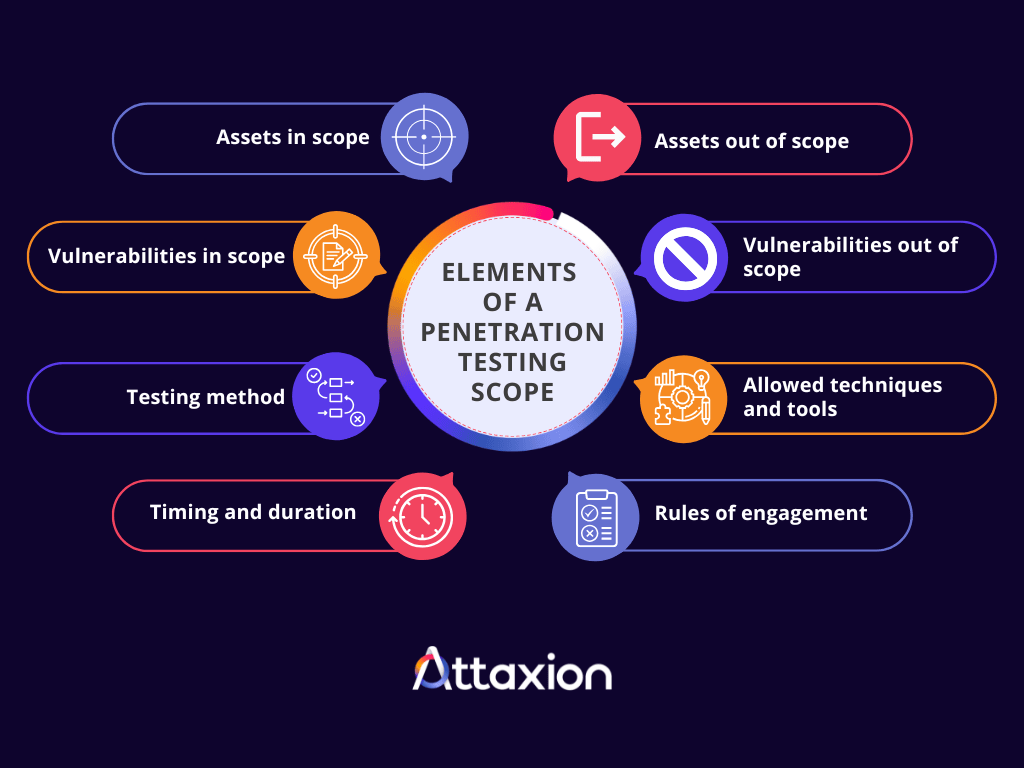
To see how these concepts are applied in practice, let's watch a segment from a video by Daniel Lowrie, where he walks through a standard scoping worksheet.
PRO-TIP When GETTING STARTED with PENTESTING - LEARN ABOUT SCOPING!
In the video 'PRO-TIP When GETTING STARTED with PENTESTING - LEARN ABOUT SCOPING!', Daniel Lowrie breaks down the initial, crucial questions that form the scope of a pentest. Pay attention to how he frames the discussion around client concerns and clear boundaries.
Watch from 00:18 to 12:32. You'll see him discuss: The importance of understanding the client's biggest security concerns (the objectives). Defining specific in-scope hosts, networks, and applications. Explicitly identifying out-of-scope assets to avoid causing damage or legal issues. The critical need to verify ownership of target assets.
As you saw, defining scope is about creating a safe and productive environment for the test. For a more structured breakdown of what goes into defining scope, the following article is an excellent resource.
What are the Rules of Engagement in Penetration Testing?
The article 'What are the Rules of Engagement in Penetration Testing?' from iosentrix provides a clear, sectioned explanation of these concepts. Let's focus on its definition of scope.
Read the section titled 'Scope Definition'. This section clearly breaks down the difference between 'In-Scope Assets' and 'Out-of-Scope Assets' and why documenting both is crucial.
For a bug bounty hunter, the program's policy page serves this exact function. The "Scope" section is your absolute source of truth. Straying from it can lead to your report being rejected or, in worse cases, getting banned from the platform.
2. The 'How': Rules of Engagement (RoE)
If the scope defines what to test, the Rules of Engagement (RoE) define how the test will be conducted. It's the operational playbook for the entire assessment. While scope and RoE are often part of the same document, it's useful to understand their distinct functions.
Let's begin by clearly separating the two concepts with a brief reading.
API Pentesting 101: The Rules of Engagement
Dana Epp's blog post 'API Pentesting 101: The Rules of Engagement' offers a concise and effective distinction between scope and RoE.
Read the introductory section 'Understanding Scope and the Rules of Engagement'. Focus on the core idea: 'While the scope defines what is allowed to be tested, the rules of engagement (RoE) define how the testing will occur.'
A comprehensive RoE document covers everything from testing windows to emergency contacts. The image below summarizes the key components.

Now, let's explore these components in more detail using our main textual resource.
What are the Rules of Engagement in Penetration Testing?
The iosentrix article provides an excellent, structured breakdown of the components that make up a professional RoE.
Read the following sections from the article: Timeframe: When can testing happen? Testing Methodology: What kind of test (black, white, grey box)? Are destructive attacks like Denial of Service (DoS) or social engineering allowed? Risk Management: How will potential risks to the client's systems be managed? Communication Plan: Who are the points of contact? How are critical findings reported? Authorization and Legal Clearance: The 'get out of jail free card'. Reporting Expectations: What will the final deliverable look like? This will give you a complete picture of a professional RoE document.
The Two Most Important Rules
Of all the components in the RoE, two stand out as absolutely critical for your protection and professionalism: Communication and Authorization.
- Communication Plan: Knowing who to call at 3 AM when you've accidentally crashed a server is crucial. The RoE must define points of contact, escalation paths, and the process for reporting high-impact vulnerabilities immediately, rather than waiting for the final report.
- Authorization: Never, ever begin a test without explicit, written permission from someone with the authority to grant it. This signed document is what separates you from a criminal. It protects you from legal repercussions if your authorized testing activities are detected or cause unforeseen issues.
API Pentesting 101: The Rules of Engagement
Let's revisit Dana Epp's article, as it contains some hard-won advice on these points, including a story about pentesters facing felony charges due to unclear authorization.
Read the sections 'Technical Points of Contact', 'Reporting Security Issues', and 'Permission to Test'. Note the emphasis on having backups for contacts and the clear instruction to 'Get permission to test in writing'.
Test your understanding!
A new client, a small online retailer, has asked you to perform a penetration test on their main e-commerce website, shop.example.com. They are not technical and simply said, "Find any security holes you can."
Based on what you've learned, what are the first three critical questions you need to ask them to begin defining the objectives, scope, and RoE?
Show answer
While many questions are valid, here are three essential ones that cover objectives, scope, and RoE:
- Objective: "What is your biggest fear regarding the website's security? Are you more concerned about customer credit card data being stolen, the website being taken offline, or fraudulent orders being placed?"
- Scope: "The test will focus on
shop.example.com. Does your site rely on any third-party services, like a payment processor or a shipping API, that we should explicitly avoid testing?" - Rules of Engagement (RoE): "Since this is your live production website, is there a specific, low-traffic time window (e.g., overnight) when we should conduct our testing? Also, who would be our 24/7 emergency technical contact in case we discover a critical issue or an unexpected problem occurs?"
Conclusion
You've now covered the foundational non-technical skills required for a career in penetration testing and bug bounty hunting. While not as flashy as discovering a zero-day, a well-defined engagement is the hallmark of a professional.
Key Takeaways:
- Objectives, Scope, and RoE are the three pillars of a professional engagement, defining the why, what, and how of a test.
- The Scope sets the boundaries, detailing what is authorized for testing and what is off-limits. Verifying asset ownership is critical.
- The Rules of Engagement (RoE) is the operational plan, covering methodology, timing, communication channels, and data handling procedures.
- Written Authorization is your legal protection and is non-negotiable. Never start a test without it.
- For Bug Bounty Hunters, the program policy is your RoE and Scope. Read it thoroughly before you begin.
Next Lesson Preview:
This lesson provided the general framework for professional engagements. In our next lesson, we will apply these concepts directly to your goal of becoming a bug bounty hunter. We will cover how to effectively navigate and interpret bug bounty program policies and scopes on platforms like HackerOne and Bugcrowd, ensuring you focus your efforts where they count and operate safely within the rules.