
Hello! Welcome to your next lesson in the final module of your journey.
In our last session, we established the professional groundwork for any security assessment by learning how to define objectives, scope, and the Rules of Engagement (RoE). This framework is what separates a professional, authorized test from random, and potentially illegal, hacking.
Today, we'll sharpen our focus and apply those principles directly to your primary goal: bug bounty hunting. The learning outcome for this lesson is to effectively navigate and interpret bug bounty program policies and scopes. Think of a program's policy page as its unique, non-negotiable RoE document. Mastering the skill of reading and respecting these policies is the single most important factor for long-term success, protecting you legally and focusing your efforts for maximum impact.
The entire bug bounty process begins with understanding the rules, as shown in the diagram below. The 'Scope' is the foundational first step.

1. The "Why" Behind the Rules: Understanding Program Scope
Before we dissect a policy document, it's crucial to understand why these rules exist. They aren't arbitrary obstacles; they are born from complex business, legal, and technical realities. As a future architect, appreciating these underlying reasons will give you a significant professional edge.
A program's scope—the list of what you can and cannot test—is often shaped by factors you can't see from the outside.
Bug Bounty Fundamentals: Scope
The video 'Bug Bounty Fundamentals: Scope' by codingo offers an excellent explanation of the business reasons that dictate a program's scope. This insight helps you understand the client's perspective.
Watch from 01:15 to 07:44. The video covers three common scenarios: Federated Business Structures: Different business units may have separate security budgets and teams. Mergers & Acquisitions (M&A): A newly acquired company's assets might be undergoing internal assessment before being exposed to public testing. Resource Capacity: A company might start with a small scope to gauge the volume of incoming reports before committing more resources.
Understanding these reasons highlights a key professional principle: respecting the scope is non-negotiable. Going out of scope doesn't just mean your report will be rejected; it can burn your reputation, get you banned from platforms, and in the worst-case scenario, lead to legal trouble. Conversely, building a reputation for respecting rules and providing high-quality, in-scope reports is the fastest way to get invited to private, more lucrative programs.
2. Anatomy of a Bug Bounty Policy
While every program's policy is unique, they generally follow a standard structure. Learning to parse this structure quickly and efficiently is a core skill. A research paper from the Technical University of Munich provides a fantastic, formal taxonomy for the contents of these policies.
The Rules of Engagement for Bug Bounty Programs
The paper 'The Rules of Engagement for Bug Bounty Programs' offers a systematic breakdown of the typical components found in a bug bounty policy. We will use its structure to guide our analysis.
Read Section 4, 'Qualitative Study' (pages 4-8). Don't worry about the academic analysis; focus on the 11 categories it identifies, from 'In-scope areas' to 'Reward evaluation'. This provides a mental checklist you can use when reading any program policy.
Now, let's walk through the most critical sections from that taxonomy, seeing how they look on a real platform.
Practical Walkthrough
First, let's see where to find these policies and what they look like in practice.
Bugcrowd University - Introduction + Become a Bug Bounty Hunter
The 'Bugcrowd University' video provides a direct, practical walkthrough of finding programs and interpreting their policy briefs on the Bugcrowd platform, using Tesla as a real-world example.
Watch from 04:02 to 06:25. Pay close attention to how the presenter identifies: The list of public programs. The Targets section, which defines in-scope and out-of-scope assets. The payout/reward information. Special 'focus areas' that tell you what vulnerabilities the company cares about most.
Using the taxonomy from the paper and the practical example from the video, let's break down the key components you must analyze.
In-Scope and Out-of-Scope Assets
This is the most important section. It is your legal and operational boundary.
- In-Scope: This lists the domains, IP addresses, applications (web, mobile, desktop), and other assets you are authorized to test. Pay close attention to wildcards (e.g.,
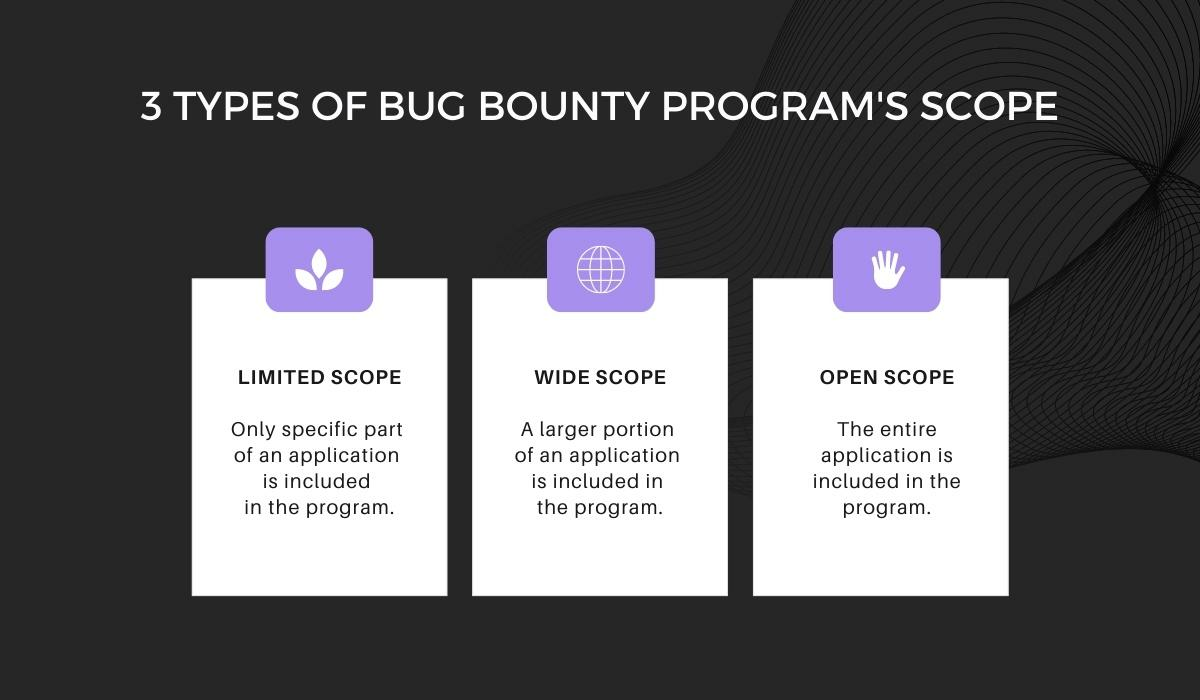
*.example.com), which mean all subdomains are in scope. The size of the scope can vary dramatically. - Out-of-Scope: This lists everything you must not touch. Common examples include third-party services (e.g., Zendesk for support, a marketing blog hosted by another company), corporate infrastructure, and specific sensitive environments. Testing out-of-scope assets is the #1 mistake new hunters make.
Eligible and Non-Eligible Vulnerabilities
- Eligible: Programs often list vulnerability types they are particularly interested in, such as SQL Injection, RCE, or significant business logic flaws. These are your high-value targets.
- Non-Eligible (Exclusions): This is a list of findings the program will not accept. Reading this carefully saves you from wasting hours on a report that will be closed as "Not Applicable." Common exclusions include:
- Findings from automated scanners without proof of impact.
- Self-XSS (requires a user to hack themselves).
- Logout CSRF.
- Missing security headers with no demonstrated exploit.
- Denial of Service (DoS) attacks.
Prohibited Actions & Submission Guidelines
- Prohibited Actions: Beyond just out-of-scope assets, this section details forbidden behaviors. This nearly always includes:
- Performing DoS/DDoS attacks.
- Social engineering or phishing employees.
- Accessing, modifying, or deleting other users' data.
- Physical attempts against company property.
- Heavy automated scanning that could disrupt services.
- Submission Guidelines: The policy will often specify how to format your reports. We will cover this in detail in the next lesson, but always check for specific requirements here.
- Legal "Safe Harbor": Look for a clause that promises the company will not initiate legal action against you if you comply with the policy. This is your "get out of jail free card." If a program doesn't have one, it's a significant red flag.
3. Strategy: Using Policies to Choose Your Targets
A program policy isn't just a list of rules; it's a strategic guide. By analyzing it, you can determine if a program is a good investment of your time and skills.
The 'Bug Bounty Playbook' gives practical advice on how to select targets based on their program policies.
Read the sections 'Picking the Platform' and 'Picking the right target' from Chapter 4 (pages 37-43). The author emphasizes three key criteria for choosing a program: Scope, Age of the company, and Payout amounts. This reinforces the idea of using the policy for strategic planning.
Based on this, when choosing a target, ask yourself:
- Is the scope large enough? A larger scope (
*.example.com) offers more potential attack surface than a single web app. - Does the scope match my skills? If a program only has a mobile app in scope, but you specialize in web apps, it's not a good fit. If they explicitly ask for business logic flaws, and that's your strength, it's a great fit.
- Are the payouts worth my time? If you're hunting for a living, prioritize programs with higher rewards for critical vulnerabilities.
- What are the exclusions? If your favorite vulnerability to hunt for is on the out-of-scope list, move on to another program.
Test your understanding!
You are evaluating two bug bounty programs:
-
Program A (MegaCorp):
- Scope:
*.megacorp.com - Payouts: Up to $20,000 for RCE.
- Exclusions: No rewards for informational findings, missing security headers, or vulnerabilities found by automated scanners. Prohibits any action that could disrupt service.
- Focus: Business logic flaws and unauthorized data access.
- Scope:
-
Program B (NewApp):
- Scope:
app.newapp.io - Payouts: Up to $1,500 for RCE.
- Exclusions: Standard OWASP Top 10 are all in scope.
- Rules: Rate-limit automated scanners to 5 requests/second.
- Scope:
Which program would be a better choice if your goal is to practice using automated tools like Nmap and Nikto to find low-hanging fruit on a wide range of hosts? Justify your answer.
Show answer
Program B (NewApp) would be the better choice.
Justification:
- Automated Scanning: Program B explicitly allows the use of automated scanners (with rate limiting), which directly aligns with the goal. Program A, on the other hand, forbids scanner-based findings and actions that could disrupt service, making large-scale scanning risky and unrewarding.
- Scope of Vulnerabilities: Program B accepts standard findings (like those from the OWASP Top 10), which are often what automated tools are good at detecting. Program A is focused on complex, high-impact business logic flaws, which typically require manual testing and deep application knowledge, not just scanners.
- Scope of Assets: While Program A has a larger asset scope (
*.megacorp.com), its restrictive rules on tooling and vulnerability types make it unsuitable for the stated goal. Program B's narrow asset scope is a better fit for a focused, tool-assisted approach.
Conclusion
You now understand that a bug bounty policy is far more than just "the rules." It's a strategic document that guides your entire engagement with a target. Reading, understanding, and respecting it is the foundation of a successful and professional bug bounty career.
Key Takeaways:
- Policies as RoE: A bug bounty program's policy is its official Rules of Engagement. It defines your legal and technical boundaries.
- Systematic Analysis: Break down policies into key components: in/out-of-scope assets, eligible/ineligible vulnerabilities, prohibited actions, and disclosure rules.
- Business Context Matters: Scopes are defined by real-world business constraints like budgets, M&A activity, and team capacity. Understanding this fosters a professional mindset.
- Strategic Selection: Use the policy to choose targets that align with your skills, goals, and desired reward level. Never waste time on a target without reading its policy first.
Next Lesson Preview:
You've learned the rules, chosen a target, and in a hypothetical future, you've found a valid, in-scope vulnerability. What's next? In our next lesson, we will focus on the most crucial communication skill for a bug hunter: how to write a clear and actionable vulnerability report that includes a description, impact, and remediation steps. A great finding with a poor report can still get you nothing.