
Last lesson introduced a three-moment body scan: notice your starting state, make brief checks during a safe drill, and compare afterwards. That gives you information. This lesson turns that information into a practical dosage decision: Is this coordination practice easy enough to stay controlled, yet challenging enough to practise attentively?
For the present stage of rehabilitation, the answer will rarely be “work as hard as possible.” Coordination improves through repeatable, accurate movement. The most useful level is usually one at which you can stay alert, breathe normally enough to speak, and recover well enough to practise again. Your physiotherapist’s specific instructions always take priority over the guidelines here.
Two different kinds of challenge
A movement drill can be challenging in at least two different ways:
-
Coordination challenge: How much attention, timing, balance, or body-position control the task requires. For example, a slow supported side-step pattern may require real concentration even if it barely raises your breathing rate.
-
Physical exertion: How hard your whole body is working. This includes breathing rate, sense of warmth, heart rate, general fatigue, and muscular effort.
These are related, but they are not the same. A drill can be physically easy and coordinatively demanding; that is often an excellent starting point for motor learning. Conversely, a brisk walk might be physically demanding but mechanically very familiar.
For your current coordination practice, movement quality is the priority. If harder breathing, fatigue, or rushing causes you to grip the support, hold your breath, lose your planned alignment, or stop noticing what your feet and legs are doing, the exercise may be too demanding for the purpose of that session.
A useful principle is:
Practise below the point where effort steals attention from movement quality.
This is not an instruction to avoid all effort. It is a way to keep effort in proportion to the goal.
Use two simple measures: RPE and the talk test
Rating of perceived exertion, or RPE, is your own overall rating of how hard an activity feels. It is not a test of toughness and not a score to improve at. It is a quick summary of signals such as breathing, warmth, fatigue, and how hard the movement feels to sustain.
Read the short sections below before using the scale. They introduce the talk test and a 0–10 exertion scale.
Exercise intensity | Better Health Channel
Read Better Health Channel’s “Exercise intensity” for two practical ways of noticing effort without equipment: the talk test and an exertion rating scale.
In the section “Measuring exercise intensity using the talk test,” read the talk-test explanation, then finish the three bullet points, including the description of vigorous effort. Next, in “Measuring exercise intensity using the exertion rating scale,” study the 0–10 chart. Read the short diary guidance after the chart. Focus on the fact that the rating is based on bodily signs and changes over time, not on comparison with anyone else.
The talk test is especially useful because it connects an internal signal—breathing—with an observable action—speaking.
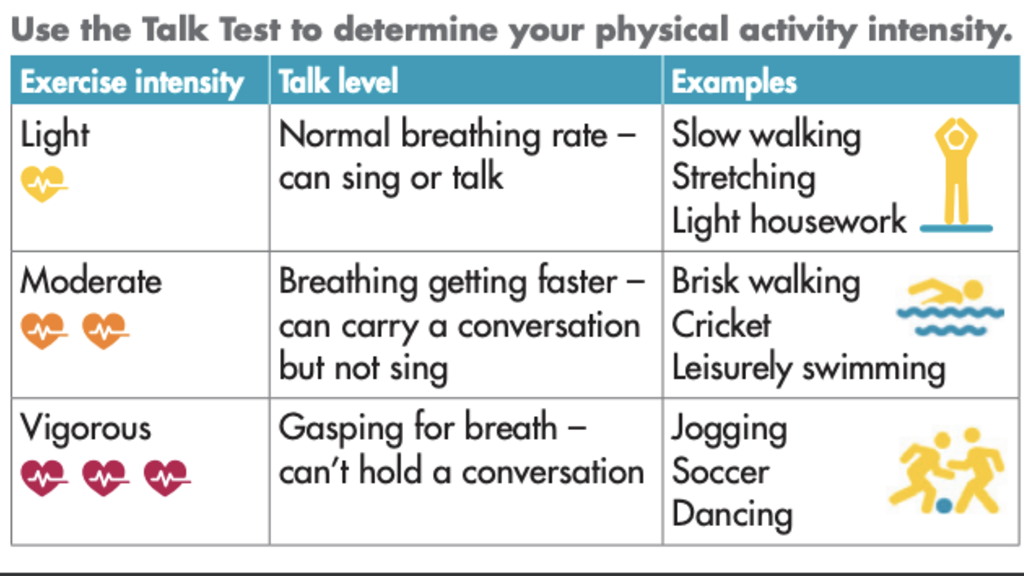
For current supported balance, weight-shifting, or controlled stepping practice, you will normally aim to be able to say a calm, complete sentence. You do not need to sing during your session. If you can comfortably say something like, “I am moving slowly and I feel steady,” your breathing is likely compatible with the drill.
If you can say only a few words before needing breath, treat that as a signal to pause and reduce the demand. Vigorous breathlessness is not needed for coordination learning, and it is not appropriate for a self-directed rehabilitation-based balance drill unless a clinician has specifically prescribed that intensity.
A practical 0–10 scale
Use the 0–10 scale consistently rather than trying to find a perfect number.
| RPE | Practical meaning for this course | Typical signs |
|---|---|---|
| 0–1 | Rest or almost no effort | Normal breathing; little sense of working |
| 2 | Very easy | Movement is noticeable, but you could continue comfortably |
| 3 | Controlled effort | You feel the body working; breathing remains easy enough for full sentences |
| 4 | Somewhat challenging | Warmer or lightly breathless, but still controlled, steady, and able to talk |
| 5 | Hard for a coordination session | You need more concentration to maintain breath and form; use this as a cue to modify |
| 6–7 | Very hard | Sustaining the task feels difficult; not a usual target for your current drills |
| 8–10 | Extremely hard to maximal | Heavy breathlessness, exhaustion, or inability to talk; stop the activity and follow your safety plan |
For most of your clinician-approved coordination work, begin around RPE 2–4. That leaves enough attention for balance, sequencing, and sensory awareness. A permitted walk, swim, or cycle session may have a different target set by your rehabilitation programme; do not assume that all movement must use the same RPE.
Rate the whole-body effort, not just one body part
When you rate RPE, assess your whole-system effort. A thigh may feel as though it is working because it is supporting you, but that local sensation alone does not define overall exertion. Include:
- breathing and ability to speak;
- general warmth or sweating;
- how quickly your pulse seems to be beating, if you notice it;
- whole-body tiredness;
- ability to keep your posture and attention organised.
This distinction matters in knee rehabilitation. A local knee sensation, pain, giving-way feeling, or new swelling is not merely a higher RPE score. It is a separate safety signal that needs the response you and your clinician have agreed. The next lesson will make the distinction between normal effort and warning signals more explicit.
This brief explanation from Vivo Phys is useful because it clarifies that RPE should represent the whole body, not simply the hardest-working muscle.
RPE - Rating of Perceived Exertion
Watch Vivo Phys’s “RPE – Rating of Perceived Exertion.” It explains how to make an exertion rating a genuinely useful self-monitoring tool.
Watch whole-body RPE to see why breathing, pulse, fatigue, and posture belong in the rating, rather than only the sensation in one muscle. Then watch self-guided use, which shows how RPE can guide practice without a heart-rate monitor. The video uses the longer 6–20 Borg scale; continue using the simpler 0–10 scale in this course rather than trying to convert between them.
Recovery is part of the dose
A session is not judged only by how it feels while you are doing it. It is also judged by whether you recover from it appropriately.
For coordination practice, pay attention to recovery at three points.
1. Between short bouts
After several supported weight shifts or a short stepping set, pause in a stable position. Notice:
- Has your breathing begun to settle?
- Can you speak a full sentence?
- Do you feel mentally organised enough to repeat the movement accurately?
- Has gripping, shoulder tension, or rushing reduced after the pause?
If the answer is yes, you may repeat the same version of the drill. If not, extend the pause or make the next bout easier.
2. At the end of the session
After you stop, your breathing and general effort should begin returning towards your usual state. You may notice warmth or a sense that the leg muscles have worked. That can be ordinary exertion. What matters is the overall pattern: you should feel that you could move around safely and that you have not emptied the tank merely to complete a short coordination practice.
3. Before the next session
Briefly compare today’s state with your usual baseline. Ask:
- Do I have my usual willingness and energy for a short practice?
- Has the previous session left me unusually depleted?
- Is sleep noticeably worse, or is whole-body fatigue lingering?
- Are there new or worsening local symptoms that fall under my physiotherapist’s stop or contact rules?
One difficult day does not prove that a drill is unsuitable. Sleep, stress, daily activity, and rehabilitation appointments can all affect perceived effort. Look for a pattern over several sessions. If the same session repeatedly leaves you less recovered than expected, its dose is probably too high at present.
A simple continue, modify, or stop rule
Use all three sources of information together: RPE, breathing, and recovery.
| What you notice | Likely response |
|---|---|
| RPE 2–4; able to speak in full sentences; movement remains deliberate and accurate; short pauses restore steadiness | Continue at the same level. Repetition is productive here. |
| RPE around 5; breathing noticeably faster; attention or movement quality begins to fade; you need longer pauses than planned | Modify. Slow the movement, reduce the number of repetitions, reduce the range, or take a longer rest. Change only one thing at a time. |
| You cannot speak more than a few words; you feel dizzy, unwell, or unusually breathless; movement becomes unsafe; you notice a clinician-defined knee warning signal | Stop. Return to a stable position and follow your agreed clinical guidance. Do not try to “train through” the signal. |
The middle category is particularly valuable. Modification is not failure; it is the skill of matching practice to your capacity on that day.
A 10–12 minute effort-and-recovery practice
Use this once or twice this week alongside your rehabilitation programme. Select only a physiotherapist-approved drill: supported weight shifting, controlled stepping without pivots, a single-leg-standing variation with the prescribed support, or another permitted low-impact movement.
Set up: about 2 minutes
Choose a stable support and set up exactly as your physiotherapist has instructed. Before starting, use the body scan from the previous lesson and note:
- current breathing;
- local knee or leg status;
- shoulders and grip;
- overall RPE at rest or supported standing.
A rating of 0–1 at rest is common, but do not worry about assigning the “right” number.
Practise in short bouts: about 6 minutes
Perform a small, planned amount of the drill. For example, use a few slow weight shifts or several controlled steps—not a maximum set.
After each bout, pause in a stable two-foot stance or sit down if that is part of your plan. Record or say quietly:
“Overall RPE: 3. I can speak normally. Breathing is a little faster, and I feel steady.”
Rest until you feel ready to reproduce the same quality. If the rating rises above your planned range or you cannot keep the movement calm and controlled, make one modification. For instance, reduce the number of repetitions or slow the tempo. Do not add a new challenge during this session.
Recover and review: about 2–4 minutes
Finish before you are tired enough to lose quality. In a safe seated or supported standing position, check:
- What is my RPE now?
- Has my breathing settled?
- Am I clearer, equally steady, and comfortably alert?
- Is there anything new that requires the response set out in my rehabilitation plan?
A compact note is enough:
Drill: supported forward-back weight shifts
During: RPE 3; full sentences; shoulders tense at first
After: RPE 1–2 after a short pause; breathing easy; shoulders softer
Next time: keep the same number of shifts and start with a slower first repetition
This note makes the next session easier to plan. It also separates a useful observation—“my effort rose to 4 today”—from a judgment—“I am unfit” or “I should push harder.”
Key takeaways
Perceived exertion is a trainable self-monitoring skill. For each practice bout, rate your whole-body effort, use breathing and the talk test as a quick check, and observe whether you recover well between bouts and by the next session.
For your current coordination work, an RPE around 2–4 will usually preserve the attention and movement quality that learning requires. If effort becomes hard, speech becomes difficult, or recovery is poorer than expected, modify the task rather than forcing the original plan.
Next, you will distinguish ordinary effort and expected muscle work from pain, instability, and other warning signals, then practise choosing a clear continue, modify, or stop response.
Can't find a good explanation? Sign up and we'll make it for you
Sign up