
Hello again. In the previous lesson, twin and adoption studies showed that genetic influence is not genetic destiny: identical twins can differ, and environments matter alongside inherited variation. Epigenetics helps explain one important part of that difference. It concerns changes in which genes a cell uses, not changes in the DNA letters themselves.
In this final lesson of the module, you will learn to distinguish a DNA sequence from gene expression, explain how chemical tags and DNA packaging can regulate expression, and connect epigenetics to development and environmental experience. Plan for about 40 minutes.
The central distinction: having a gene versus using a gene
Nearly all of your body’s cells contain essentially the same DNA sequence. Yet a muscle cell and a bone cell do very different jobs. A muscle cell makes proteins needed for contraction; a bone cell makes proteins involved in building and maintaining bone tissue.
The difference is not usually that one cell has “muscle DNA” and the other has “bone DNA.” Instead, they express different parts of the same genetic instruction set.
Gene expression is the process through which information in a gene is used to make a functional product, usually a protein. In simplified form:
- A cell accesses a gene’s DNA sequence.
- It transcribes the sequence into RNA.
- The RNA is used to produce a protein.
- That protein contributes to the cell’s structure or activity.
An epigenetic change affects one of the early steps: whether the cell can access and transcribe a gene. Crucially, the underlying DNA sequence stays the same.
A useful comparison is a cookbook. The cookbook remains intact, with all recipes still printed inside it. Epigenetic marks act more like temporary tabs, locks, or “do not use” labels that influence which recipes are available to the cook in a particular cell.
What is epigenetics? - Carlos Guerrero-Bosagna
Watch What is epigenetics? from TED-Ed. It introduces the key puzzle of genetically identical twins differing over time, then connects gene expression to chemical marks and cell specialization.
Watch the twin puzzle for the basic idea that identical DNA does not require identical outcomes. Then watch gene regulation to see how tags can limit or support transcription without rewriting DNA. Finish with development and environment, focusing on why cells with the same genome develop distinct functions and how outside conditions can be related to epigenetic patterns.
A precise definition
Epigenetics is the study of changes that regulate gene activity without changing the DNA sequence. The complete pattern of regulatory chemical marks associated with the DNA in a particular cell is its epigenome.
This means it is inaccurate to say that epigenetics “changes your genes” if that means changing the DNA letters. It changes how strongly, when, or whether a gene is used.
Two major ways cells regulate access
Two common epigenetic mechanisms are DNA methylation and histone modification. Both can affect whether transcription machinery can reach a gene.
DNA methylation: a chemical tag on DNA
A methyl group is a small chemical group that can attach to particular locations on DNA. In introductory psychology and biology, the key pattern to remember is:
- More methylation at key regulatory regions is often associated with reduced gene expression.
- The gene is still present in the DNA, but the cell may transcribe it less or not at all.
- Less methylation in those regions can permit greater expression.
Thus, methylation can act like a signal that helps silence a gene. The pattern is biologically more context-dependent than a universal on–off rule, but “methylation commonly reduces expression” is the appropriate core principle.
Histones: packaging that controls accessibility
DNA is extremely long, so cells wrap it around structural proteins called histones. DNA plus histones forms a package called chromatin.
If DNA is wrapped tightly around histones, transcription proteins have difficulty reaching the gene. If it is more loosely packed, those proteins have greater access. Chemical tags added to histones can change this packing.
A common example is histone acetylation, which often loosens DNA packaging and makes transcription more possible. Removing acetyl groups often promotes tighter packing and reduced accessibility.
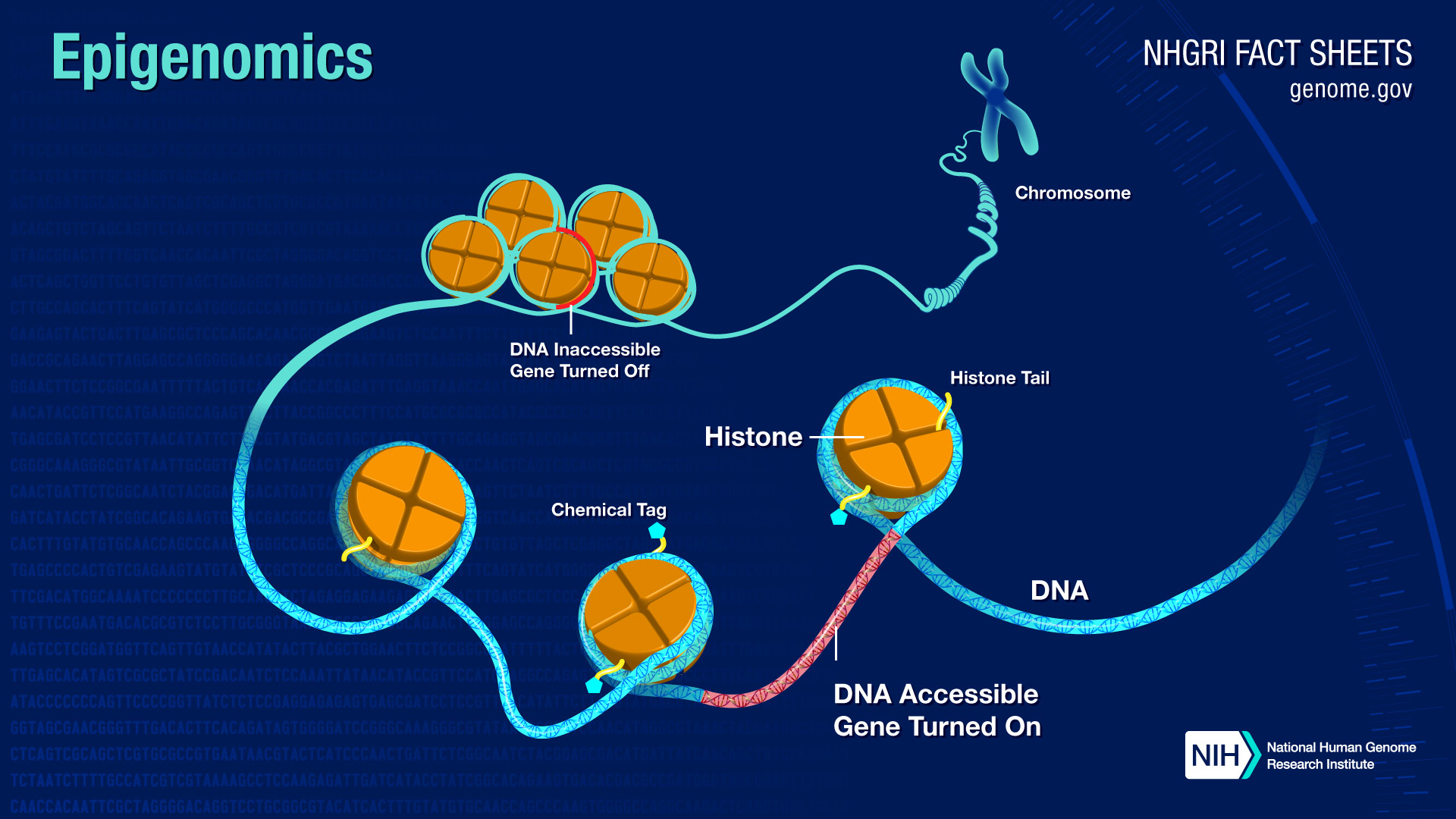
The diagram is a helpful model, but keep one qualification in mind: accessible DNA makes gene expression possible, not guaranteed. A cell may still need the appropriate transcription factors and signals to begin transcription.
What is epigenetics?: MedlinePlus Genetics
Read MedlinePlus Genetics’ concise overview to consolidate the definition of epigenetics and the two mechanisms you need to recognize: DNA methylation and histone modification.
Begin with the opening definition and read the definition and epigenome passage. Focus on the distinction between modifying DNA and changing its sequence. Then continue through the following explanation of why different cell types make different proteins. In the next paragraph, read the methylation and histone mechanisms. Notice that methyl groups can silence genes, while histone-associated chemical changes influence how tightly DNA is wrapped.
How epigenetics links genes, development, and experience
Epigenetics is essential for ordinary development. Starting from a single fertilized cell, repeated cell division produces cells that will become skin, muscle, liver, neurons, and many other types. Their DNA is nearly identical, but their epigenetic patterns differ. Those patterns help keep the appropriate genes active in each cell type and others relatively inactive.
Many epigenetic patterns are copied when a cell divides. This gives tissues stability: when a skin cell divides, its daughter cells generally retain the gene-expression pattern needed to function as skin cells.
Epigenetic patterns can also be influenced by conditions inside and outside the body. Research investigates relationships between epigenetic marks and factors such as:
- nutrition and food availability;
- exposure to pollutants, tobacco smoke, or other chemicals;
- medication and drug exposure;
- stress and other social experiences;
- developmental conditions before birth.
The scientifically careful claim is not that every experience directly “turns genes on or off,” nor that a particular behavior inevitably causes a disease through epigenetics. Human health and behavior are complex, and research often identifies associations rather than simple one-cause explanations. But environmental conditions can influence biological regulatory systems, including epigenetic processes.
This provides a biological route through which experience can become relevant to later functioning without altering a person’s DNA sequence.
A behavioral example: stress regulation
Imagine two children with similar genetic vulnerability for heightened stress reactivity. They may experience different levels of chronic stress, social support, sleep quality, nutrition, or exposure to adversity. Across development, such conditions can be associated with differences in biological stress-regulation systems, including patterns of gene expression.
Epigenetics does not imply that a stressful childhood makes later anxiety inevitable. It supports a more accurate conclusion: experience can influence the biological processes through which inherited predispositions are expressed. Supportive relationships, treatment, safe environments, and material resources remain meaningful.
This fits the biopsychosocial perspective from earlier in the module:
| Level of explanation | Example in this case |
|---|---|
| Biological | Inherited variation, stress hormones, and gene-expression regulation |
| Psychological | Appraisals of threat, coping skills, learning history |
| Social | Family support, adversity, community conditions, access to care |
Epigenetics belongs primarily at the biological level, but it can help explain how social and psychological conditions become biologically relevant.
Epigenetics is related to, but not identical with, gene–environment interaction
Earlier, you learned that a gene–environment interaction occurs when the effect of a genetic variation differs depending on environmental conditions. For example, a genetic vulnerability may affect risk much more strongly under severe stress than in a supportive environment.
Epigenetic regulation is one possible biological mechanism that may contribute to such patterns. An environment can be associated with changes in which genes are expressed, and that altered expression may affect cells, bodily systems, and behavior.
However, do not treat the terms as interchangeable:
- Gene–environment interaction describes a pattern in outcomes: the effect of genes depends on the environment.
- Epigenetics describes molecular regulation of gene activity without a DNA-sequence change.
A gene–environment interaction can exist without researchers having identified an epigenetic mechanism. Likewise, many epigenetic differences arise as normal parts of cell development, not as responses to an external life experience.
Persistence is not permanence: inheritance and reversibility
Epigenetic marks can persist when ordinary body cells divide, which is why they can support stable cell specialization. But persistence does not mean that every mark lasts forever or passes reliably from parent to child.
When sperm and egg cells form, many epigenetic marks are erased and reset. Scientists are actively studying the limited cases in which some marks may escape this resetting and affect later generations. Evidence is stronger for some animal models than for broad claims about multigenerational inheritance in humans.
For an introductory psychology course, use this cautious formulation:
Some epigenetic patterns can be maintained as cells divide. Whether and how particular environmentally influenced marks are transmitted across human generations is more limited and still under investigation.
This caution protects against a popular but misleading idea: that all life experiences permanently rewrite the biological inheritance of one’s children. Epigenetics is important, but it does not justify genetic or environmental fatalism.
A reliable explanation template
When a question asks how an epigenetic change affects gene expression without changing DNA sequence, construct your answer in four parts:
- State what does not change. The order of DNA bases in the gene remains the same.
- Name the regulatory change. For example, methyl groups are added to DNA, or a histone modification changes DNA packing.
- Explain access and transcription. The mark reduces or increases the ability of transcription machinery to access the gene.
- State the downstream effect. Less or more RNA and protein may be produced, changing the cell’s activity.
For example:
Addition of methyl groups near a gene can reduce its transcription. The gene’s DNA sequence remains unchanged, but the chemical tag makes the gene less available to the cellular machinery that reads it. As a result, less RNA and potentially less of the associated protein are produced.
Contrast that with a mutation:
A mutation changes the DNA sequence itself, such as replacing, deleting, or inserting a DNA base. An epigenetic change alters gene activity without altering that sequence.
Key takeaways
Epigenetics explains how cells can regulate gene expression without rewriting the genetic code.
- DNA sequence is the order of DNA bases; an epigenetic change leaves that order intact.
- Gene expression is the use of a gene to produce RNA and usually protein.
- DNA methylation commonly reduces expression by helping silence particular genes.
- Histone modifications affect how tightly DNA is packaged; looser packaging generally makes genes more accessible for transcription.
- Different cell types have similar DNA but different epigenetic patterns, allowing them to perform specialized functions.
- Environmental conditions can be associated with epigenetic changes, but these relationships do not make outcomes inevitable.
- Epigenetic patterns can persist through cell division; broad claims about their inheritance across human generations require caution.
You have now completed this module’s central theme: behavior is shaped neither by genes alone nor by environment alone, but by ongoing interactions among biological processes, psychological experiences, and social conditions.
Can't find a good explanation? Sign up and we'll make it for you
Sign up