
Hello again. Previously, you separated behavioral genetics from evolutionary psychology: behavioral genetics asks why people differ from one another now, whereas evolutionary psychology asks why a tendency may exist broadly in humans. We now turn to two core behavioral-genetic tools: twin studies and adoption studies.
By the end of this lesson, you should be able to look at a simple pattern of results—such as identical twins being more alike than fraternal twins, or an adopted child resembling biological rather than adoptive parents—and state what it is evidence for, as well as what it cannot establish. Plan for about 40 minutes.
The basic challenge: genes and environments usually travel together
Children typically receive genes from biological parents and also grow up in environments shaped by those parents. If a child resembles a parent in anxiety, reading ability, or musical interest, that resemblance alone does not tell us why. It might reflect inherited genetic differences, learned behavior, shared opportunities, or a mixture of all three.
Behavioral genetics tries to separate these overlapping influences by comparing people who differ in genetic relatedness and shared environments.
Two useful categories of environmental influence are:
- Shared environment: experiences that tend to make siblings alike, such as living in the same neighborhood, household resources, family rules, or a school system.
- Nonshared environment: experiences that make siblings different, such as different friends, teachers, illnesses, activities, chance events, or different treatment by the same parent. Measurement error also contributes to apparent differences.
“Environment” therefore does not mean only parenting. And because people respond differently to the same household, living together does not mean having identical experiences.
Twin studies and adoption studies | Behavior | MCAT | Khan Academy
Watch Twin studies and adoption studies from Khan Academy Medicine for a visual overview of how researchers use these comparisons to investigate nature and nurture.
Begin with the purpose to frame the problem. Then watch twin designs, focusing on why identical and fraternal twins provide a comparison. Continue with the twin example, noting both the evidence and the methodological caution. Watch adoption designs, then finish with the summary. The “twins raised apart” segment in between is useful context, but optional for this lesson.
Twin studies: changing genetic similarity while holding much of family life constant
A twin study compares resemblance within many pairs of identical and fraternal twins.
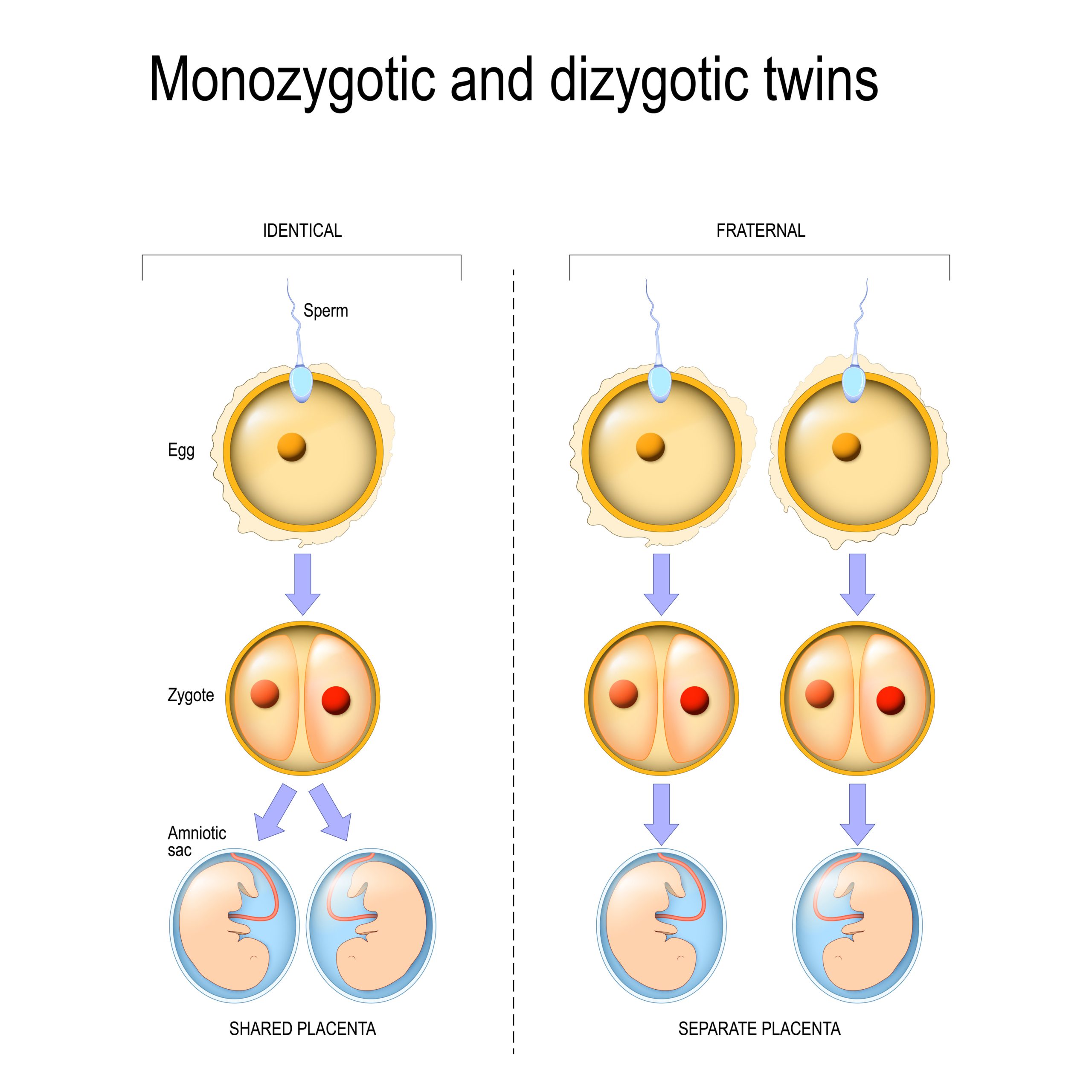
Identical versus fraternal twins
Monozygotic (MZ), or identical, twins begin as one fertilized egg that divides. They share almost all of their inherited genetic variation.
Dizygotic (DZ), or fraternal, twins develop from two different eggs fertilized by two different sperm. On average, they share about half of their segregating genetic variation, like other biological siblings.
Both types commonly grow up at the same time, in the same family, and usually in the same broader cultural setting. So, when identical twins are more alike on a trait than fraternal twins, the difference is evidence that genetic differences contribute to variation in that trait.
The logic is comparative:
| If researchers find... | The most appropriate interpretation |
|---|---|
| MZ twins are substantially more similar than DZ twins | Evidence consistent with a genetic influence |
| MZ and DZ twins are similarly alike, and both show resemblance | Evidence consistent with a shared-environment influence |
| Even MZ twins are far from perfectly alike | Evidence for nonshared environmental influences, developmental variation, and possible measurement error |
Researchers often report similarity using a correlation, written as . A higher positive correlation means that, across twin pairs, the twin who scores higher on a trait tends to have a co-twin who also scores higher. For diagnoses, studies may instead compare concordance rates: the proportion of pairs in which both twins have a condition.
Influences on Personality Development – PSY101 Introduction to Psychology
Read the twin- and adoption-study sections in Influences on Personality Development from PSY101 Introduction to Psychology. It gives the standard comparison rules you will use in scenario questions.
In “Studying Personality Using Behavioral Genetics,” begin at the paragraph starting “Although family studies can reveal whether a trait runs in a family.” Read the twin-study explanation, paying close attention to the distinct patterns for genetic, shared-environment, and nonshared-environment influence. Then read the following adoption-study paragraph, especially the comparison rule: resemblance to biological relatives is evidence for genetic influence, while resemblance to adoptive relatives is evidence for environmental influence.
Reading a simple twin result
Imagine researchers measure a trait called social confidence:
| Twin type | Correlation in social confidence |
|---|---|
| Identical twins raised together | |
| Fraternal twins raised together |
The important observation is not merely that identical twins are similar. It is that they are more similar than fraternal twins who share a similar family setting. This pattern supports the claim that genetic variation contributes to differences in social confidence.
But the result matters too: identical twins are not perfectly alike. Genes do not fully determine the trait. The remaining difference can reflect nonshared experiences, biological developmental differences, gene–environment interaction, and imperfect measurement.
A different pattern would point in another direction:
| Twin type | Correlation in weekly reading habits |
|---|---|
| Identical twins raised together | |
| Fraternal twins raised together |
Here, both kinds of twins are similarly alike. That pattern is consistent with shared family or cultural influences—perhaps household routines, access to books, or school expectations. It does not mean genes play no role whatsoever, but it offers little evidence that genetic differences are the main reason for variation in this particular sample.
A useful shortcut, used cautiously
In introductory behavioral genetics, researchers sometimes use a simplified statistical model to estimate three sources of variation:
Here, represents heritability, shared environment, and nonshared environment. With the earlier correlations of and , this rough model gives:
- , or about 60 percent genetic variation
- , or about 10 percent shared-environment variation
- , or about 30 percent nonshared-environment variation
For this course, the pattern matters more than calculating these estimates. Do not treat the equations as a direct measurement of “how genetic” an individual person is. They rely on assumptions and provide an approximation for a particular population.
What heritability does—and does not—mean
A trait is heritable when genetic differences are associated with some of the observed differences among people in a particular population.
A heritability estimate does not mean:
- a percentage of one person’s trait comes from genes;
- the trait is fixed at birth;
- environment is unimportant;
- a particular gene has been found;
- parents are unimportant to children’s wellbeing.
For instance, a trait can be highly heritable and still be responsive to environmental change. Height is influenced substantially by genes, yet population average height can shift when nutrition and health conditions change. In the same way, a heritable psychological vulnerability can be influenced by stress, social support, treatment, education, and opportunity.
Heritability is about variation within a group under particular conditions. If environments change, the estimate may change too.
Adoption studies: separating biological relatedness from rearing environment
Adoption studies create a different comparison. An adopted child is biologically related to their biological parents but is reared by adoptive parents. This allows researchers to compare resemblance associated with inherited relatedness and resemblance associated with a shared home.
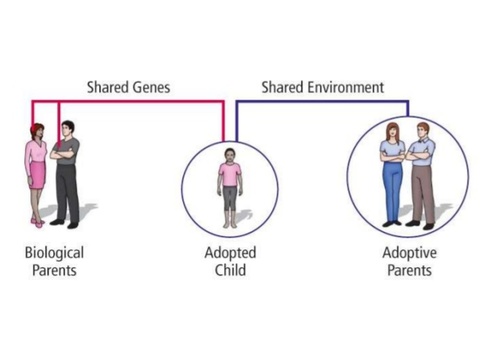
The basic interpretation is straightforward:
| If adoptees resemble... | This is evidence consistent with... |
|---|---|
| Biological parents or biological siblings | Genetic influence |
| Adoptive parents or adoptive siblings | Shared rearing-environment influence |
| Both biological and adoptive relatives | Contributions from both genetic and environmental influences |
| Neither group strongly | Possible nonshared environmental influences, developmental factors, or limited measurement reliability |
Suppose adopted adolescents’ vocabulary scores correlate more strongly with their biological parents’ scores than with their adoptive parents’ scores. This supports the inference that inherited differences contribute to variation in vocabulary scores.
Suppose instead that adopted children show similar political attitudes, religious practices, or everyday family routines to adoptive parents. That pattern is evidence that the rearing environment matters for those outcomes.
The strongest conclusion is usually not “genes win” or “environment wins.” Psychological traits often show evidence of both. Adoption studies simply give researchers a way to ask which kind of family connection predicts resemblance more strongly.
Why twin and adoption studies are evidence, not proof
Twin and adoption studies are powerful natural comparisons, but they are not controlled experiments in which researchers randomly assign genes or family life. Their conclusions should be stated carefully.
The equal-environments issue
Twin studies assume that environmental similarity does not differ enough between MZ and DZ twins to fully explain the difference in their resemblance. Yet identical twins may sometimes be treated more similarly, be dressed alike, share friends, or encourage similar identities. If this added similarity affects the trait being studied, it could make genetic effects appear stronger than they are.
Researchers address this concern in several ways, but it remains a reason to say that MZ–DZ differences are evidence consistent with genetic influence, rather than automatic proof.
Prenatal and early-life influences
Identical twins share more than DNA. They also share aspects of prenatal development. In adoption research, biological mothers provide both genes and prenatal environments. Therefore, resemblance to a biological parent is not a perfectly pure measure of genetic influence.
Adoption is not random
Adoptive families may differ systematically from the general population, often in resources or willingness to participate in research. Adoption agencies may also place children into families similar to their biological families, a practice called selective placement. This can blur genetic and environmental explanations.
Correlation is not destiny
Even when a twin or adoption study provides strong evidence for genetic influence, it describes average differences in a group. It does not predict an individual’s future with certainty. A genetic influence may operate through traits that affect the environments people seek, the feedback they receive, or how strongly they react to stress.
This returns us to the earlier lesson: genes, environments, and their interaction are not competing explanations. They work together across development.
A reliable routine for interpreting scenarios
When you encounter a test-style finding, use this sequence:
- Identify the comparison. Is it MZ versus DZ twins, biological versus adoptive relatives, or twins raised apart?
- Ask what differs genetically. MZ twins are more genetically similar than DZ twins; adoptees are genetically related to biological but not adoptive parents.
- Ask what environment is shared. Twins reared together share much of family life; adoptees share a household with adoptive relatives.
- Compare resemblance. Greater resemblance to the more genetically related group supports genetic influence. Greater resemblance to the shared-home group supports shared environmental influence.
- State the conclusion proportionately. Use “supports,” “is consistent with,” or “suggests.” Avoid “proves” and avoid claims of genetic destiny.
For example:
Identical twins show a 45 percent concordance rate for a disorder, while fraternal twins show a 15 percent rate.
The correct interpretation is: the higher concordance among identical twins provides evidence for a genetic contribution to vulnerability. However, because 45 percent is far below 100 percent, genetic similarity alone does not determine who develops the disorder; environmental and developmental factors also matter.
Key takeaways
Twin and adoption studies help psychologists separate patterns of biological relatedness from patterns of shared rearing environment.
- If identical twins are more alike than fraternal twins, that supports a genetic contribution to differences in the trait.
- If identical and fraternal twins are similarly alike, shared environmental influence is a plausible explanation.
- If identical twins are not perfectly alike, nonshared environments and developmental differences matter.
- If adoptees resemble biological relatives more than adoptive relatives, that supports genetic influence; resemblance to adoptive relatives supports environmental influence.
- These methods provide meaningful evidence, but not simple proof: assumptions about prenatal conditions, environmental similarity, and adoption placement must be considered.
Next, you will build on the idea that genes are not instructions that operate in isolation by examining epigenetic changes—changes that can affect gene expression without changing the DNA sequence itself.
Can't find a good explanation? Sign up and we'll make it for you
Sign up