
Welcome to psychology. This course examines how genes, nervous systems, brain structures, chemicals, and life experiences contribute to differences in behavior. We begin with the field’s central idea: psychology is not simply advice about people or speculation about personality. It is a science.
By the end of this lesson, you should be able to define psychology precisely and explain what makes its study scientific. You will also be able to distinguish behavior, which can be observed or measured, from mental processes, which psychologists infer using evidence.
Psychology: the science of behavior and mental processes
A concise definition is worth learning exactly:
Psychology is the scientific study of behavior and mental processes.
Each part of that definition matters.
| Part | Meaning | Examples |
|---|---|---|
| Scientific | Uses systematic, evidence-based methods rather than intuition alone | Measuring responses, comparing groups, testing predictions |
| Behavior | An observable or reliably measurable response by an organism | Speaking, studying, sleeping, avoiding eye contact, heart-rate changes |
| Mental processes | Internal activities involved in perceiving, thinking, remembering, feeling, deciding, and imagining | Attention, memory, fear, beliefs, language, problem-solving |
Psychology studies people, but it is not limited to people. Many psychologists also study animals, because animal behavior and nervous systems can help answer questions about learning, memory, development, emotion, and social behavior.
A person laughing at a message, for instance, is behavior. Their interpretation of the message as funny, their memory of a similar experience, and their emotional reaction are mental processes. The two are closely connected: mental processes influence behavior, while behavior gives researchers evidence from which they can investigate mental processes.
Intro to Psychology: What is Psychology?
Watch “Intro to Psychology: What is Psychology?” from 5-Minute Psych for a compact distinction between internal mental activity and externally observable behavior.
Watch the definition. Pause after the examples of recalling, imagining, and solving a puzzle, then compare them with the observable examples of cycling, speaking, and washing. The key distinction is not whether something is important, but whether it can be directly observed from outside.
Behavior is broader than obvious action
When people hear “behavior,” they may picture dramatic visible acts: shouting, running, fighting, or smiling. In psychology, the term is broader. Behavior includes everyday actions such as reading, eating, choosing a seat, responding to a survey, or pausing before answering a question.
It can also include responses measured with instruments. For example, researchers may measure:
- reaction time while someone completes a task;
- eye movements while they read;
- skin conductance, which often changes with sweating;
- brain electrical activity;
- the number of errors made during a memory test.
The important condition is that the response is measured reliably. A researcher needs a clear procedure so that another researcher could understand what was measured and, ideally, carry out a comparable study.
Mental processes are real, but not directly visible
Mental processes are internal events or functions. You cannot directly observe someone’s attention, confidence, memory, or fear in the same way you observe their hand rising in class. Psychology therefore does not claim to “read minds.”
Instead, psychologists make cautious inferences from several kinds of evidence:
- Observable behavior: What did the person do, say, choose, or remember?
- Self-report: What does the person say they think or feel?
- Biological measures: What happens in the brain or body?
- Context: What situation, instructions, or social conditions were present?
Suppose a student repeatedly looks away from a lecture, misses instructions, and performs poorly on a later quiz. Those observations may suggest difficulty sustaining attention. But they do not prove a single explanation. The student could be tired, anxious, distracted by a notification, confused by the material, or dealing with something outside class. Psychological science is valuable partly because it tests explanations rather than settling on the first plausible story.
Why psychology is a science
Psychological questions often start with ordinary experience:
- Why do people conform to a group?
- Does sleep affect memory?
- Why do some people develop addictions while others do not?
- How do children learn language?
- What makes a frightening event memorable?
The scientific part begins when a psychologist turns a broad question into a question that can be investigated with evidence.
1.1 What Is Psychology? - Psychology 2e | OpenStax
Read the opening material from OpenStax to see the formal definition of psychology and the logic of scientific inquiry. It also explains why researchers investigate mental processes indirectly rather than treating private experience as directly observable.
On the page “1.1 What Is Psychology?”, first read the opening discussion beginning with the core definition. Focus on how a hypothesis differs from a scientific theory and why other researchers must be able to build on the work. Then continue to the following paragraph beginning the empirical approach. Pay particular attention to the distinction between observing behavior directly and using behavior, biological indicators, and self-reports to infer mental processes.
The word empirical describes knowledge based on observation and measurement. An empirical claim is one that could, in principle, be checked against evidence.
For example:
- “People who get more sleep perform better on a memory task” is an empirical claim. Researchers can measure sleep and memory performance.
- “I personally feel sharper after sleeping well” is a useful personal observation, but it is not by itself enough to establish a general conclusion.
- “Sleep is morally good” is mainly a value judgment, not a scientific claim. Psychology may provide evidence about consequences of sleep, but evidence alone cannot decide every moral or policy question.
Scientific psychology does not eliminate uncertainty. Rather, it provides disciplined ways to reduce it.
From ideas to evidence
A psychologist typically works through a repeating cycle of explanation and evidence. The cycle matters more than any single study because conclusions become stronger when evidence accumulates, is challenged, and is replicated.
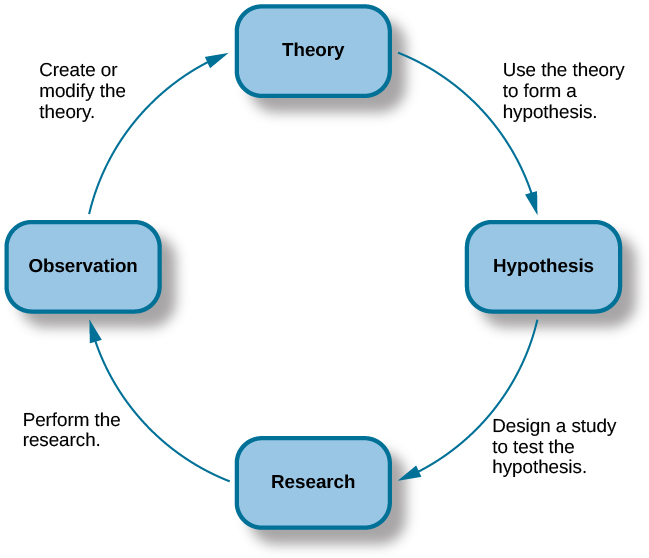
Here are the main elements in practical terms:
-
Theory
A theory is a broad, evidence-supported explanation of some aspect of the natural world. In science, a theory is not a casual guess. It organizes existing evidence and helps researchers generate new questions. -
Hypothesis
A hypothesis is a specific, testable prediction derived from a theory or prior observation. It must be possible for evidence to count against it. -
Research design
Researchers decide what they will measure, whom they will study, and how they will limit alternative explanations. They define abstract ideas in measurable ways. This is called operationalizing a concept. -
Observations and results
Researchers collect and analyze data. Results may be consistent with the hypothesis, inconsistent with it, or too unclear to decide. -
Revision and replication
Findings are communicated so that other researchers can evaluate, repeat, extend, or challenge them. A single study rarely settles a major question.
The diagram begins with theory, but real science does not always begin there. A surprising observation can also trigger a question. For example, noticing that students seem less accurate on a task after interrupted study sessions could prompt research on attention and distraction. The essential feature is the ongoing exchange between ideas and evidence.
A concrete example: notifications and attention
Consider the broad question: Do phone notifications interfere with focused reading?
A researcher must make that question specific. “Interfere” could mean slower reading, weaker comprehension, more frequent attention shifts, or a greater feeling of distraction. These measures are not interchangeable, so the researcher must choose.
One possible study could use this hypothesis:
Students who receive audible notifications while reading will remember less from the passage than students who read the same passage without notifications.
The study might measure:
- Independent condition: notifications present or absent;
- Behavioral outcome: score on a comprehension test;
- Mental process of interest: sustained attention;
- Possible controls: same passage, same time limit, similar testing environment.
Notice the distinction. A comprehension score is observable data. Attention is the mental process the researcher is trying to understand through that data. If the notification group scores lower, that result supports the possibility that interruptions impair attention during reading, but careful researchers still consider other explanations. Perhaps the notifications caused irritation rather than distraction; perhaps some participants already expected messages and felt anxious. Further studies can refine the explanation.
What psychology is—and is not
Psychology overlaps with biology, medicine, education, sociology, philosophy, and economics. It is both a natural science and a social science:
- Behavior has biological foundations: genes, hormones, neurons, and brain systems matter.
- Behavior also occurs in relationships, communities, and cultures: social norms, family, opportunity, language, and historical context matter.
The rest of this course will repeatedly connect these levels of explanation. When later lessons consider genes, neural signaling, drugs, and brain regions, the guiding question remains psychological: How do these influences help explain behavior and mental processes?
It is also useful to avoid two common misunderstandings:
- Psychology is not just common sense. Common sense can generate good questions, but its claims need systematic testing. People often remember examples that confirm their intuitions and overlook counterexamples.
- Psychology is not only therapy. Clinical psychologists do provide assessment and treatment, but psychology also includes research on learning, perception, development, health, workplaces, social influence, language, and many other areas.
A definition you can use on an assessment
If asked to define psychology, a strong answer is:
Psychology is the scientific study of behavior and mental processes. It uses systematic, empirical methods to measure observable responses and to draw evidence-based inferences about internal processes such as thinking, emotion, memory, and perception.
Avoid definitions such as “the study of the mind” alone, because they leave out behavior and scientific methods. Also avoid “the study of behavior” alone, because modern psychology investigates both observable actions and internal mental processes.
Key takeaways
- Psychology is the scientific study of behavior and mental processes.
- Behavior includes observable or reliably measurable responses, from speaking and sleeping to reaction time and physiological changes.
- Mental processes include internal activities such as perception, memory, emotion, language, and decision-making.
- Psychologists cannot observe mental processes directly, so they use behavior, self-reports, and biological measures as evidence.
- Psychological knowledge is empirical: it depends on observation and measurement rather than authority or intuition alone.
- Theories, hypotheses, research, observations, and replication form an ongoing scientific cycle.
Next, you will use the biopsychosocial approach to sort influences on behavior into biological, psychological, and social factors.
Can't find a good explanation? Sign up and we'll make it for you
Sign up