
Hello. In the previous lesson, you defined psychology as the scientific study of behavior and mental processes. You also saw why psychologists need evidence rather than a quick intuitive explanation: the same behavior can have several possible causes.
This lesson introduces a practical framework for organizing those causes: the biopsychosocial approach. By the end, you should be able to take an influence on behavior and classify it as primarily biological, psychological, or social—while recognizing that the categories often interact rather than compete.
One behavior, several levels of explanation
Suppose a student regularly avoids speaking during group discussions. A simplistic explanation might be: “They are just shy.” Psychology asks more precise questions. What bodily states may be involved? What is the person thinking or feeling? What features of their relationships, community, or culture shape the situation?
The biopsychosocial approach holds that behavior and mental processes are shaped by the interacting contributions of:
- Biological factors: bodily processes and physical characteristics.
- Psychological factors: thoughts, emotions, learning, beliefs, and coping.
- Social factors: relationships, groups, culture, resources, and social conditions.
The goal is not to force every behavior into only one box. Instead, this approach helps you identify different kinds of influence that may help explain the same outcome.
Watch “Biopsychosocial Perspective” from Skepsy for a compact introduction to the three domains and a pair of everyday applications. Notice that the model is presented as an alternative to finding one single cause.
Begin with the framework, which defines the three broad influences. Then watch the bread analogy as a reminder that contributing factors are not rival explanations. Continue through the weight example and the anxiety example. Focus on how the speaker separates inherited or bodily influences, mental processes, and social experiences.
The model grew partly as a response to overly narrow explanations of health and behavior. A strictly biological account might look only at genes, brain chemistry, or illness. Those matter, but such an account can miss a person’s beliefs, coping patterns, relationships, financial circumstances, discrimination, cultural norms, or access to support. The biopsychosocial approach asks us to consider the whole person in context.
The three categories: what belongs where?
The basic sorting rule is to ask: What kind of factor is being described right now?
| Category | Central question | Common examples |
|---|---|---|
| Biological | What is happening in the body or inherited makeup? | Genes, brain activity, nervous system functioning, hormones, illness, injury, sleep, nutrition, physical disability, substance effects |
| Psychological | What is the person thinking, feeling, perceiving, learning, or using to cope? | Beliefs, expectations, attention, memory, emotions, personality tendencies, self-esteem, appraisals, coping skills |
| Social | What features of relationships, groups, institutions, or culture shape the situation? | Family relationships, peers, school, work, income, neighborhood, media, religion, social norms, culture, discrimination, social support |
A useful distinction:
- Biological does not mean only genes. Lack of sleep, a concussion, hormonal changes, medication effects, and physical illness can all be biological factors.
- Psychological does not mean “mental disorder.” It refers broadly to internal processes: interpreting a situation, remembering an event, feeling anxious, expecting failure, or using a coping strategy.
- Social does not mean only friends. It includes family, community, education, work, economic resources, cultural expectations, and the opportunities or barriers built into a person’s environment.
2 | Becoming Us – Seven Themes, One Psychology
Read the subsection “The Biopsychosocial Model” in Becoming Us – Seven Themes, One Psychology. It provides a clear definition of the model and examples of factors within each domain.
In the subsection “The Biopsychosocial Model,” locate the paragraph beginning “Through this perspective.” Read the core definition, paying attention to the word “interactive.” Then read the domain examples. Use the final sentence to reinforce the idea that behavior is context-dependent rather than fully explainable in isolation.
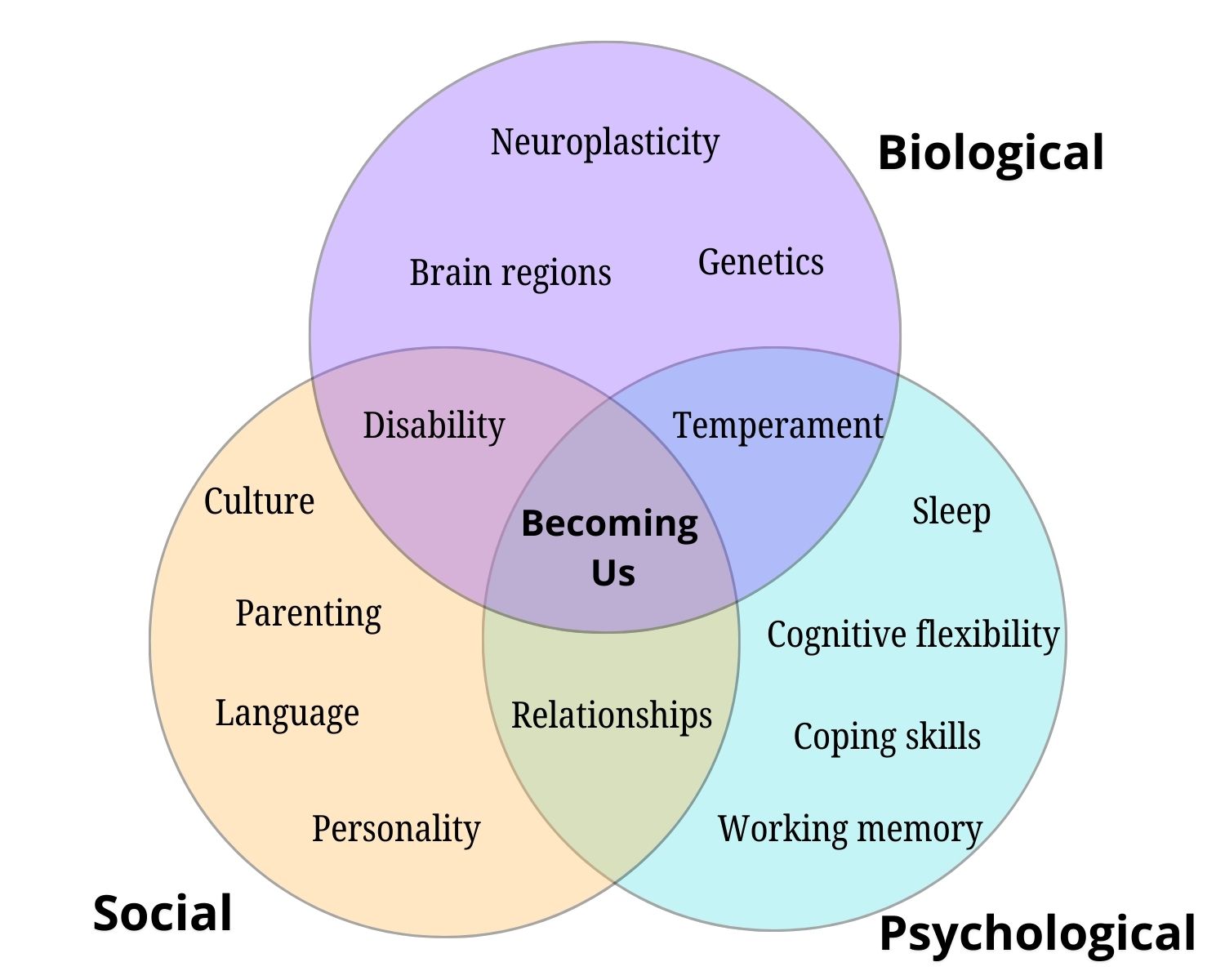
The Venn diagram is important because it prevents a common mistake: treating the three categories as sealed compartments. For example, temperament has biological contributions, but it affects psychological patterns of emotion and can influence social relationships. Relationships are social, but they can influence emotion, stress responses, and coping. The labels are useful tools for analysis, not claims that human life can be divided perfectly into three independent parts.
How to sort an influence accurately
When a question gives you a scenario, do not begin by labeling the person. Begin with the specific influence named in the scenario.
Use this five-step method:
-
Identify the behavior or mental process being explained.
Make it concrete: avoiding a social event, studying late, becoming angry, remembering poorly, or seeking help. -
Underline the proposed influence.
For example: “The person slept only four hours,” “They expect others to reject them,” or “Their friends pressure them to attend.” -
Decide which level the influence describes.
A sleep-deprived body is biological. An expectation of rejection is psychological. Pressure from friends is social. -
State why it fits that category.
A brief explanation makes the label more defensible than simply writing “B,” “P,” or “S.” -
Look for interactions after sorting.
Do not put an item in all three categories merely because the categories influence one another. Label the immediate factor first, then explain its connections.
Example: avoiding a class presentation
Imagine that Maya postpones preparing for a required class presentation and then considers skipping class on presentation day. Several influences might be present:
| Specific influence | Primary category | Why |
|---|---|---|
| Maya has been sleeping poorly for several nights and feels physically exhausted. | Biological | Sleep affects bodily functioning, alertness, and energy. |
| She thinks, “If I make one mistake, everyone will think I am incompetent.” | Psychological | This is a belief and interpretation of the situation. |
| A previous classmate publicly mocked her presentation style. | Social | This is an interpersonal experience occurring in a group setting. |
| Her instructor provides a supportive rehearsal session and clear expectations. | Social | The classroom environment and available support are social conditions. |
| She uses paced breathing and breaks preparation into short tasks. | Psychological | These are coping strategies directed at managing emotion and behavior. |
Notice what this analysis does not say. It does not claim that poor sleep causes avoidance in every person, that a negative belief arose from nowhere, or that a difficult peer experience permanently determines Maya’s future behavior. It identifies plausible contributors that can be investigated.
A fuller explanation might say that poor sleep makes concentration and emotion regulation more difficult; the prior negative social experience strengthens Maya’s threat-focused thoughts; and those thoughts make avoidance seem temporarily safer. Each factor remains distinguishable, even though they affect one another.
Distinguishing a factor from its effects
A frequent source of confusion is that one factor can produce effects in another domain.
Consider a family that strongly values academic achievement:
- The family’s expectation is a social factor, because it is a norm communicated through a relationship and cultural setting.
- A student’s thought, “An A means I am worthwhile,” is a psychological factor, because it is a belief.
- The student’s racing heart before an exam is a biological factor, because it is a bodily stress response.
These are connected, but they are not the same thing. The social expectation may shape a psychological belief; the belief may be associated with a biological stress response. Good biopsychosocial reasoning keeps the levels clear.
The same principle applies to emotion. An emotion can involve:
- bodily sensations and brain activity, which are biological;
- the person’s interpretation, feeling, and attention, which are psychological;
- rules about when and how emotion should be expressed, which are social and cultural.
Therefore, instead of asking whether emotion is “really” biological or psychological, ask which component of the emotional experience is being explained.
A closer look at interactions
The model is not a contest between “biology” and “environment.” A biological predisposition may change how strongly someone responds to stress. A social environment may provide coping strategies that change how the person responds. Psychological expectations may influence whether someone seeks support, rests, studies, or avoids a challenge.
Consider a person who is struggling to concentrate at school:
- A biological analysis might examine sleep, nutrition, medication effects, illness, or sensory functioning.
- A psychological analysis might examine attention, motivation, anxiety, working memory, beliefs about ability, or study strategies.
- A social analysis might examine classroom conditions, family responsibilities, peer distraction, language barriers, access to quiet study space, or teacher support.
None of these explanations automatically cancels the others. The appropriate explanation depends on evidence, and the relative importance of each domain can differ across people and situations.
This point is especially important ethically. A biopsychosocial explanation avoids blaming a person for every difficulty by recognizing real physical constraints and social barriers. It also avoids fatalism: biological vulnerability does not mean a behavior is inevitable, and a difficult environment does not mean change is impossible.
Common sorting errors to avoid
Treating all experience as “psychological”
Experiences happen in a context. Being bullied, losing a job, growing up with limited resources, or encountering cultural stereotypes are generally social influences. The resulting fear, self-doubt, or coping pattern may be psychological, but the external situation should not disappear from the analysis.
Treating personality as purely biological
Personality traits can have biological contributions, but they also develop through experience and influence psychological responses. If a question specifically describes inherited temperament or nervous-system reactivity, biological may be the best answer. If it describes a person’s habitual interpretation of stress, psychological may be more accurate.
Calling culture “psychological”
Culture is usually classified as social because it consists of shared meanings, practices, norms, and institutions. A person’s personal belief is psychological; the cultural system that helps shape or reinforce that belief is social.
Assuming biological means unavoidable
Genes, brain processes, and physical health matter, but they influence probabilities and constraints rather than functioning as a complete script for behavior. Later lessons on genes and environments will develop this idea further.
Using the model as a checklist rather than an explanation
Listing one biological, one psychological, and one social factor is only a starting point. A strong explanation shows how the proposed factors relate to the behavior and acknowledges that evidence would be needed to determine their actual importance.
Key takeaways
The biopsychosocial approach explains behavior and mental processes by considering three interacting levels of influence:
- Biological: body, brain, genes, health, sleep, hormones, and physical states.
- Psychological: thoughts, emotions, memory, beliefs, learning, personality patterns, and coping.
- Social: relationships, groups, culture, institutions, resources, and social conditions.
When sorting a scenario, identify the specific factor first and classify the level it directly describes. Then, if relevant, explain how factors across levels may interact. The model is valuable because it replaces one-cause explanations with a more realistic account of people as biological organisms, thinking and feeling individuals, and members of social worlds.
Next, you will examine a related distinction: nature, nurture, and gene–environment interaction.
Can't find a good explanation? Sign up and we'll make it for you
Sign up