
Hello again. In the previous lesson, you learned to define a system of interest and distinguish its elements, external systems, and enabling systems. That boundary discipline matters here: systems engineering concerns not only the product inside the boundary, but also the relationships, decisions, and enabling arrangements needed for that system to succeed throughout its life.
This lesson explains why systems engineering exists, what value it creates, and why its role extends from an initial mission or opportunity through operation and eventual retirement. The central idea is that systems engineering is not a one-time requirements activity or a layer of documentation. It is the integrative technical work that helps a complex system remain aligned with stakeholder value as knowledge, design maturity, and life-cycle conditions change.
Systems engineering: enabling success, not doing every job
INCOSE defines systems engineering as:
A transdisciplinary and integrative approach that enables the successful realization, use, and retirement of engineered systems.
Each word carries weight.
- Transdisciplinary means it works across disciplinary and organizational boundaries: software, mechanical, electrical, human factors, safety, operations, logistics, finance, suppliers, regulators, and users.
- Integrative means it focuses on the relationships among parts and decisions, not just whether each individual part is competently designed.
- Enables is deliberately more accurate than guarantees. Systems engineering improves the basis for sound decisions and exposes problems early, but it cannot compensate completely for poor manufacturing, inadequate funding, or ineffective operational management.
- Realization, use, and retirement establishes the scope. A system is not successful merely because it can be built; it must be usable, supportable, adaptable where needed, and safely retired.
Systems Engineering Overview - SEBoK
Read “Systems Engineering Overview” from the Systems Engineering Body of Knowledge (SEBoK). It establishes the official INCOSE definition and makes an important scope distinction: systems engineering integrates the technical whole, but it does not replace every engineering, manufacturing, or management activity.
In the section “Scope of Systems Engineering within the Engineered Systems Domain,” first read from the scope distinction through the discussion of implementation and management. Then read the paragraphs that introduce the official INCOSE definition, focusing on the definition itself. Notice the difference between enabling successful realization and personally performing every realization activity.
A useful way to state the purpose in an exam answer is:
Systems engineering integrates stakeholder needs, technical disciplines, life-cycle considerations, and decision evidence so that a system can deliver intended value over its complete life cycle.
This differs from several common but incomplete descriptions:
| Incomplete description | What it misses |
|---|---|
| “Systems engineering is writing requirements.” | Requirements matter, but they must be connected to architecture, implementation, verification, operations, and change. |
| “Systems engineering is project management.” | Project management controls resources, cost, and schedule. Systems engineering provides and integrates the technical basis for many project decisions. |
| “Systems engineering is the work of one senior engineer.” | It is an interdisciplinary capability; technical leadership may be distributed across a team. |
| “Systems engineering is needed only while designing.” | Operation, maintenance, upgrades, retirement, and disposal all have system-level consequences. |
| “Systems engineering guarantees success.” | It improves decision quality and reduces avoidable failure modes; it cannot eliminate uncertainty or external constraints. |
The system engineer is therefore concerned with questions that fall between specialized tasks:
- Does the proposed solution meet the real stakeholder need?
- Do subsystem decisions remain compatible with the whole-system objectives?
- Are interface assumptions mutually consistent?
- Can the integrated system be verified and validated?
- What does a design choice imply for training, maintenance, safety, cost, operations, and disposal?
- When operational evidence reveals a problem, what must change without compromising the rest of the system?
Those are system questions. They cannot reliably be answered by looking at one component or one discipline in isolation.
Why the added effort creates value
For a simple, familiar task, people can often coordinate informally. As complexity increases, however, no individual can keep all requirements, interfaces, assumptions, constraints, stakeholder concerns, and pending changes in working memory. The cost of misunderstanding also rises: a late correction may affect completed hardware, software, tests, documentation, training, supply contracts, and operating procedures.
Systems engineering adds deliberate activities such as requirements reviews, architecture descriptions, interface definitions, trade studies, models, technical reviews, and traceability. These are not valuable merely because they produce documents. Their value is that they improve decisions before commitments become expensive or irreversible.
What Is Systems Engineering? | Systems Engineering, Part 1
Watch “What Is Systems Engineering? | Systems Engineering, Part 1” from the MATLAB channel. The selected segments give a concise explanation of systems engineering as the work of reconciling stakeholder, project, and specialist-engineering concerns, then illustrate why early systems thinking can prevent costly rework.
Watch the systems view to see how an initially vague goal is developed into a system definition that specialists can implement. Then watch the rework example, which uses an automobile door to show why discovering needs and interfaces late creates an avoidable redesign cycle. Focus on the principle, not on the specific product example: complexity makes informal coordination unreliable.
Consider the automobile-door example at a systems level. A team that starts by building “a door with a latch” may subsequently discover needs for visibility, powered windows, electrical power, finger protection, software control, sealing, crashworthiness, diagnostics, maintainability, and manufacturing compatibility. Each late discovery interacts with previous design choices.
Systems engineering does not claim that every need can be discovered at the beginning. That would be unrealistic. Instead, it creates a disciplined way to:
- expose important needs and constraints as early as practical;
- explore feasible alternatives before committing to one;
- record the rationale behind decisions and assumptions;
- make interfaces and responsibilities explicit;
- test whether the integrated result satisfies defined criteria; and
- control change when new evidence appears.
The value is best understood as a reduction in avoidable uncertainty and avoidable rework, while preserving the ability to adapt as genuine new knowledge emerges.
Value is not only financial
Reduced rework can save cost and schedule, but systems engineering has broader value:
| Value created | How systems engineering contributes |
|---|---|
| Stakeholder value | Connects the delivered capability to mission objectives, user needs, and operational outcomes. |
| Technical coherence | Ensures that requirements, architecture, interfaces, and implementation decisions are mutually consistent. |
| Risk reduction | Identifies high-consequence interactions, assumptions, constraints, and failure modes before full deployment. |
| Verification confidence | Defines what evidence will demonstrate that requirements have been met. |
| Operational suitability | Considers users, procedures, maintenance, logistics, training, infrastructure, and environmental conditions. |
| Adaptability and knowledge retention | Preserves the reasoning and system knowledge needed for upgrades, anomaly resolution, and eventual retirement. |
A good systems-engineering effort is therefore proportionate. A small, low-risk product may need lightweight requirements and a few structured technical reviews. A safety-critical transportation system, medical system, or system of systems requires much more explicit coordination and evidence. The outcomes remain necessary; the exact methods, models, formality, and documentation are tailored to the situation.
Systems engineering is a life-cycle responsibility
A life cycle is the set of stages through which a system is conceived, developed, realized, used, supported, and retired. The labels vary by organization and domain, but the underlying logic remains: decisions made in one period influence what is possible, costly, safe, or useful later.
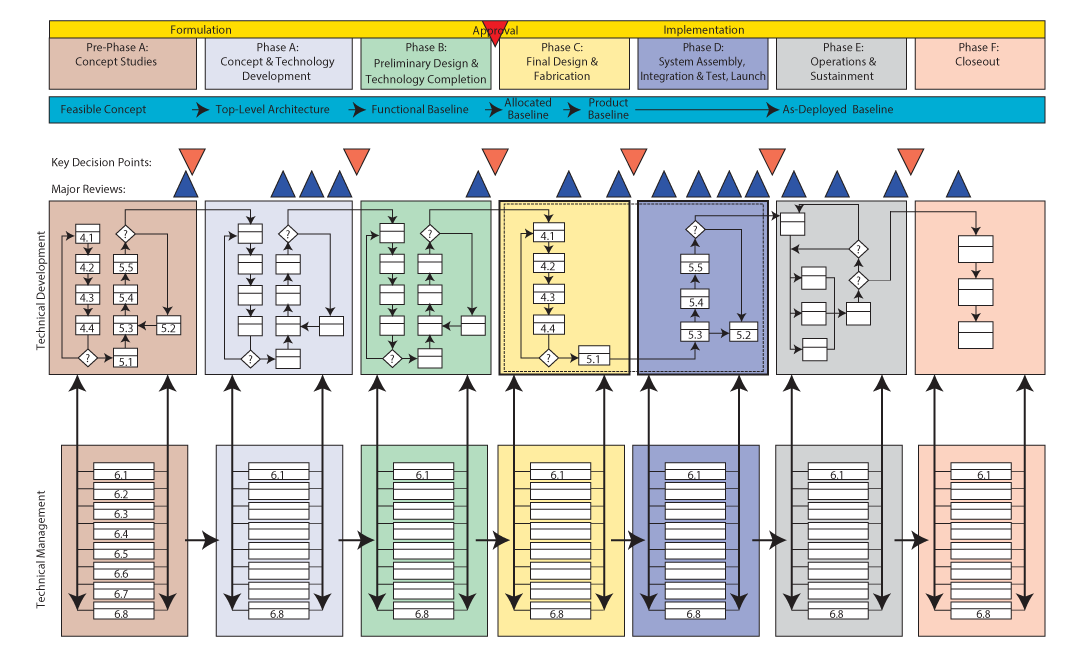
The diagram should not be read as a claim that all projects follow one rigid sequence. Actual work includes feedback, iteration, and tailoring. Its key lesson is that system maturity changes over time, and systems engineering provides continuity through those changes.
Early concept and mission framing
At the earliest point, the system may be only a problem, opportunity, or desired outcome. Systems engineering helps the organization understand:
- the mission or business problem;
- the intended users and other stakeholders;
- measures of effectiveness and constraints;
- the operational context;
- alternatives that could satisfy the need; and
- major life-cycle implications.
The value here is preventing premature solution selection. If a city says, “We need autonomous delivery drones,” the underlying need might instead concern timely access to medical supplies. A drone may be one possible solution, but road vehicles, improved depot placement, partnerships, or a mixed delivery service may prove superior once cost, regulation, weather, maintenance, and user needs are considered.
Requirements and architecture definition
Once the intended outcome is better understood, systems engineering translates stakeholder expectations into system requirements and uses them to explore and define an architecture. It addresses questions such as:
- What must the system do?
- How well must it perform?
- What interfaces must it satisfy?
- What constraints apply?
- Which functions belong in which elements?
- Which architectural alternative best balances performance, cost, schedule, risk, and life-cycle needs?
The value is preserving a justified connection between the mission and the emerging technical solution. Specialist teams can then work with meaningful, allocated responsibilities rather than disconnected interpretations of a vague objective.
Implementation, integration, and verification
During realization, individual elements are built, acquired, or configured. Systems engineering remains essential because a set of individually correct elements may still fail when combined.
At this point, the focus includes:
- controlling interfaces and configurations;
- managing technical risks and changes;
- planning the integration sequence;
- verifying that requirements are satisfied with suitable evidence; and
- assessing whether the integrated system behaves as intended.
The relevant question is not simply, “Does the subsystem work?” It is also, “Does it work correctly with the other elements, under the required conditions, while supporting the system objective?”
Transition, operation, and maintenance
A verified system still has to be introduced into its real operating environment. Systems engineering considers the transition arrangements: operator training, support equipment, installation, data migration, procedures, service readiness, safety approvals, and interoperability with external systems.
During operation, new evidence accumulates. Actual usage may reveal unanticipated loads, maintenance burdens, human-workload issues, obsolescence, cybersecurity vulnerabilities, or performance shortfalls. Systems engineering helps interpret that evidence at the system level and assess proposed corrective actions or upgrades.
This is especially important because operations personnel are rightly focused on delivering the current service safely and reliably. Changes to that service, however, must be assessed for their broader interactions and consequences.
Retirement and disposal
Retirement is also a systems problem. It may involve hazardous materials, protected information, contractual obligations, environmental regulations, data retention, migration of users to a replacement system, or the safe separation of tightly integrated assets.
A retirement decision made without adequate system understanding can create safety, security, environmental, or continuity failures. Considering retirement early does not mean designing every disposal detail at concept stage. It means recognizing that disposal constraints can affect architecture, materials, data strategy, interfaces, and total life-cycle cost.
systems engineering - principles
Read two focused passages from INCOSE’s “Systems Engineering Principles.” They support the life-cycle argument in this lesson: systems engineering deepens and preserves understanding as a system matures, and it continues through operation, decommissioning, and disposal.
First, in Principle 6 on p. 18, read the description beginning with progressive understanding. Pay particular attention to the possibility of losing system knowledge during later life-cycle phases. Then, in Principle 11(a) on p. 27, read the whole life-cycle passage. Distinguish responsibility for running the current operation from systems-engineering responsibility for assessing and integrating system changes.
One integrated effort, with activities that persist
It is tempting to picture systems engineering as a one-way handoff: define requirements, design, build, test, then finish. That picture is too simple.
As a project progresses, understanding becomes more detailed. Models are refined, assumptions are tested, and trade-offs change as evidence becomes available. Requirements, architecture, verification planning, risk management, configuration management, and technical decision-making may each be revisited. The work is connected, even though its emphasis changes.
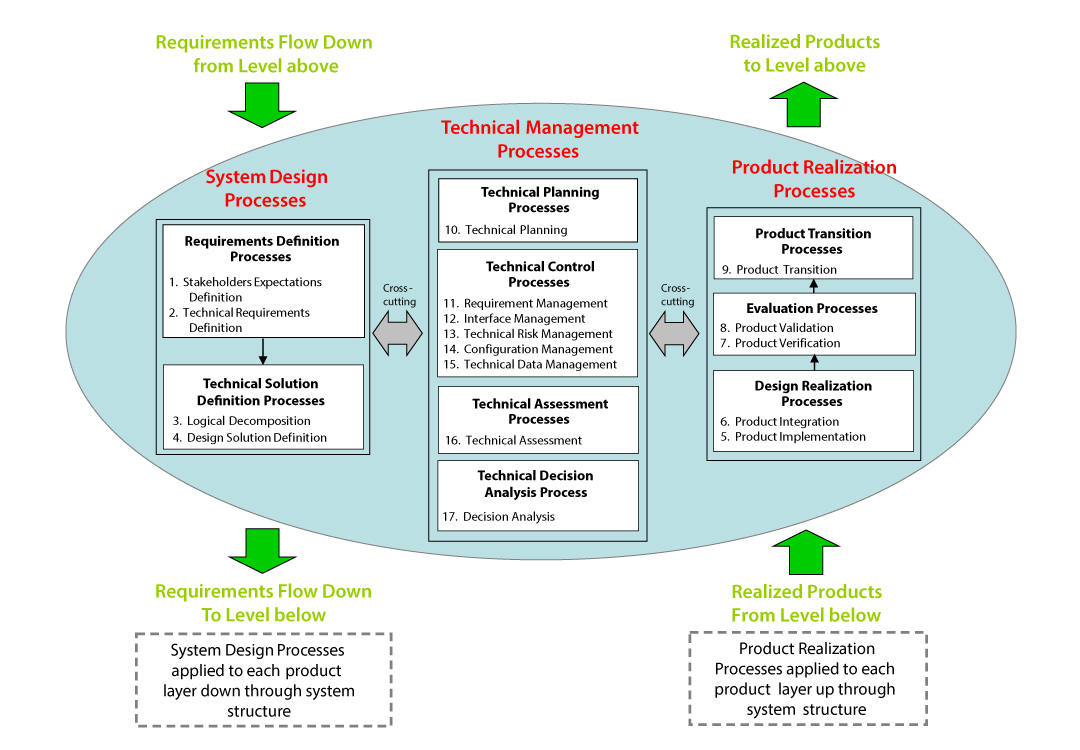
This diagram highlights three complementary kinds of work:
- System design processes define stakeholder expectations, technical requirements, logical decomposition, and design solutions.
- Product realization processes implement, integrate, verify, validate, and transition the resulting product.
- Technical management processes plan, assess, control interfaces and configuration, manage risks and information, and support decisions throughout the work.
Technical management is not an administrative afterthought. For example, interface management ensures that teams building separate elements share compatible assumptions. Configuration management ensures that verification evidence is tied to the correct version of the system. Risk management helps leaders decide where uncertainty deserves additional analysis, prototype work, or contingency.
The diagram also shows that requirements are progressively allocated through system levels, while realized elements are progressively integrated into larger systems. For now, treat this as a life-cycle continuity principle. You will examine the recursive application of technical processes through system hierarchy in Module 2.
Applying the life-cycle view: vaccine delivery service
Return to the temperature-controlled vaccine-delivery service used in the previous lesson. Suppose its mission is to deliver vaccines from a regional warehouse to clinics while maintaining specified storage conditions and reliable delivery times.
Without a life-cycle systems-engineering view, a project might define success narrowly: buy refrigerated vehicles, install temperature sensors, and begin deliveries. That approach could overlook critical interactions.
| Life-cycle focus | Systems-engineering question | Example consequence if ignored |
|---|---|---|
| Mission and concept | What service outcome is actually needed, for whom, and under which conditions? | The fleet is sized for average demand but cannot support critical outbreak conditions. |
| Requirements and architecture | How do vehicles, dispatch, power, drivers, clinics, data systems, and procedures work together? | Temperature sensors record data but cannot reliably alert the dispatcher or clinic. |
| Realization and integration | Are interfaces and configurations controlled across vehicles, sensors, communications, and dispatch software? | A software update changes a data format and prevents alarm messages from being interpreted. |
| Verification and transition | What evidence shows the complete service meets requirements in representative conditions? | Each vehicle passes a workshop test, but service performance fails during real loading and route delays. |
| Operations and maintenance | What operational data should trigger a corrective action or upgrade? | Repeated battery degradation causes intermittent monitoring failures that are treated as isolated incidents. |
| Retirement | How will temperature records, vehicle assets, batteries, and sensitive clinic data be managed at retirement? | Records required for regulatory accountability become inaccessible after a system replacement. |
Notice that systems engineering does not replace the work of refrigeration engineers, software developers, logistics planners, drivers, maintenance personnel, or regulatory specialists. It integrates their relevant knowledge so the service as a whole achieves its objective.
This is also why enabling systems matter. A maintenance-support system, driver-training system, calibration facility, and information-management system may not be part of the delivery service’s immediate operational boundary, yet they can determine whether that service remains safe and effective over time.
A concise CSEP-style reasoning pattern
When an exam question asks for the purpose or value of systems engineering, identify the wording in the scenario:
- Multiple stakeholder concerns or conflicting objectives: systems engineering integrates and balances them.
- Subsystems developed by different teams or suppliers: systems engineering manages architecture, interfaces, and integration.
- Late defects or repeated redesign: systems engineering seeks earlier clarification, analysis, and verification planning.
- A system entering service: systems engineering supports transition, operational readiness, and validation in the intended context.
- An upgrade, obsolescence issue, or anomaly during operation: systems engineering assesses system-level change impacts.
- Decommissioning, disposal, repurposing, or replacement: systems engineering addresses safe and compliant system retirement.
Be cautious with distractors that claim systems engineering:
- ends once the design is released;
- is identical to project management;
- focuses only on technical components rather than people, information, processes, and enabling systems;
- guarantees success regardless of implementation or operational quality; or
- adds documents without influencing decisions.
For your longer-term MBSE and Cameo goal, this lesson supplies the reason modeling is valuable. A SysML model is not useful merely because it is graphical. Its value lies in maintaining an integrated representation of stakeholder needs, system behavior, structure, interfaces, constraints, and verification relationships as the system changes. Later lessons will make those relationships concrete.
Key takeaways
Systems engineering is an integrative, transdisciplinary approach that enables successful realization, use, and retirement of systems. Its purpose is to keep stakeholder needs, technical decisions, life-cycle constraints, and evidence aligned as a system matures.
Its value comes from improving whole-system decision quality: exposing critical interactions early, reducing avoidable rework, managing interfaces and change, supporting verification and operational readiness, and preserving system understanding for upgrades and retirement.
Most importantly, systems engineering spans the entire life cycle. Its emphasis shifts from mission framing and concept exploration to requirements, architecture, realization, integration, transition, operation, evolution, and retirement—but the need for system-level integration remains.
Next, you will apply this life-cycle perspective more concretely by identifying system boundaries, interfaces, and environmental elements in a practical case.
Can't find a good explanation? Sign up and we'll make it for you
Sign up