
Welcome to your first geography flashcard lesson. This course will help you build a compact set of high-school study cards while learning how geographers describe Earth: first through the five themes, then with maps and coordinates, continents and oceans, and finally climate and seasons.
In this lesson, you will learn to recognize the five themes of geography in a short statement and justify your answer with the most precise subtype available. The goal is not merely to memorize five labels. It is to notice what a geographic statement is really asking: where something is, what it is like, how places are connected, how people and environments affect one another, or how places form a larger pattern.
Five lenses for studying a place
Geographers can study the same location in several valid ways. A city, for example, has a location, distinctive features, connections to other places, relationships with its environment, and membership in regions. The five themes are lenses: choose the lens that best matches the main focus of the statement.
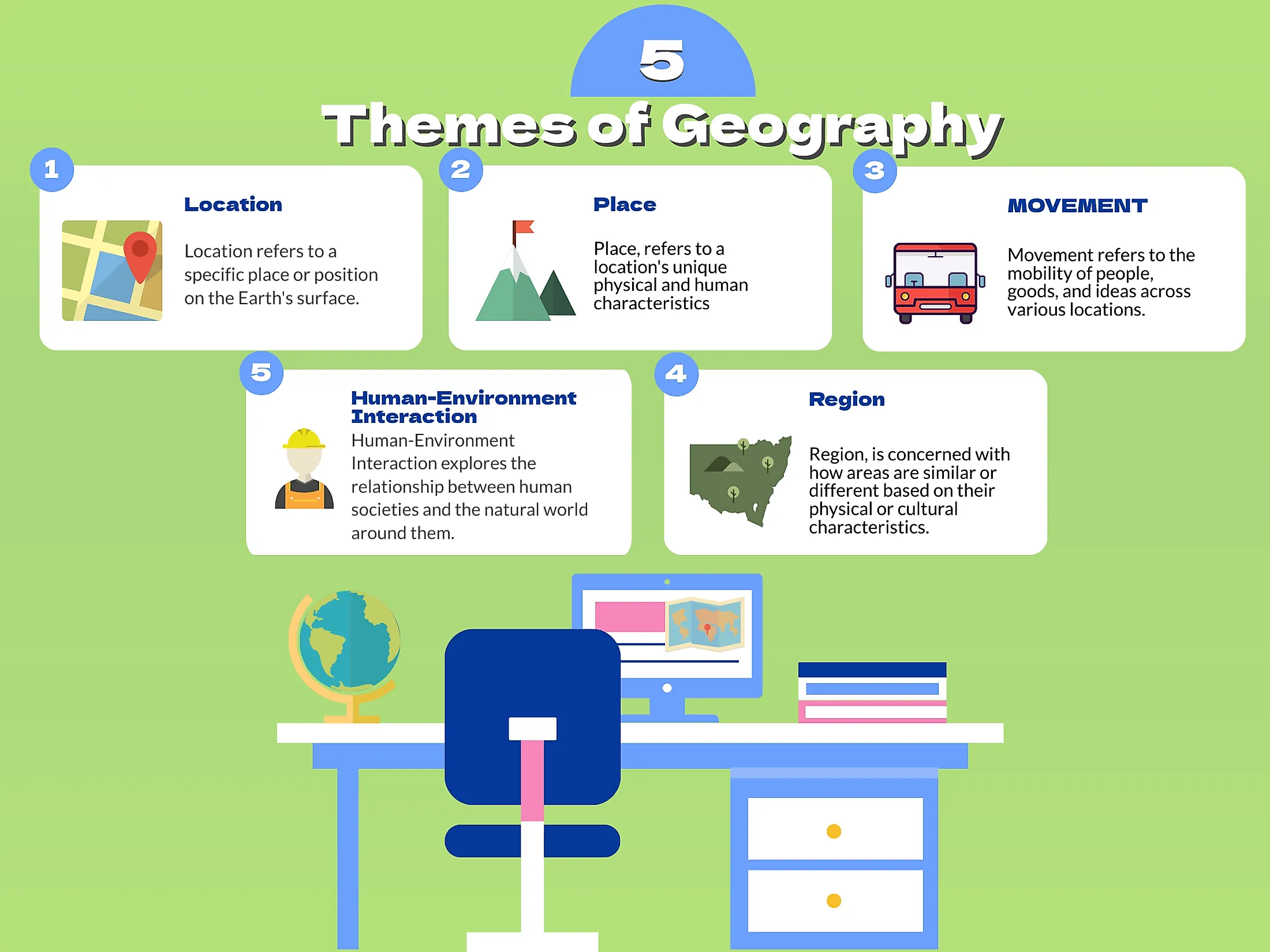
A useful mnemonic is MR. HELP:
- Movement
- Region
- Human-Environment Interaction
- Location
- Place
Watch this short overview once before working through the distinctions below.
Five Themes Of Geography (AP Human Geography)
Watch “Five Themes Of Geography (AP Human Geography)” by Mr. Sinn. It gives a compact explanation of every theme and introduces the subtypes that make your flashcard answers more precise.
Watch the overview for the full list of themes. Then watch movement, focusing on movement between places rather than a person simply moving around one room. Continue with regions, especially the distinction among formal, functional, and perceptual regions. Watch human environment for the two-way relationship between people and nature. Finish with location and place, including absolute versus relative location and physical versus human characteristics of place.
The five themes and their key subtypes
The quickest reliable method is to begin with a guiding question. Do not pick a theme because a sentence happens to mention a country or city; almost every geographic statement does. Instead, identify the information the sentence emphasizes.
| Theme | Guiding question | What to look for | Important subtypes |
|---|---|---|---|
| Location | Where is it? | Coordinates, address, direction, nearby landmarks | Absolute; relative |
| Place | What is it like there? | Features that make one particular location distinctive | Physical; human |
| Human-Environment Interaction | How do people and nature affect each other? | Dependence on, adaptation to, or modification of nature | Depend; adapt; modify |
| Movement | What moves or connects places? | People, goods, or ideas traveling between locations | People; goods; ideas |
| Region | What larger area shares something in common? | A group of places linked by a shared characteristic, system, or perception | Formal; functional; perceptual |
Location: where is it?
Location identifies a position on Earth.
-
Absolute location gives an exact, fixed position. It may use latitude and longitude, a street address, or GPS coordinates.
Example: “The White House is at 1600 Pennsylvania Avenue NW, Washington, DC.”
Classification: Location, absolute, because the address identifies one exact place. -
Relative location explains position in relation to something else. It often uses words such as north of, next to, near, across from, or between.
Example: “The library is across from the high school.”
Classification: Location, relative, because the library is described using a nearby landmark.
A relative location can change in usefulness if landmarks disappear or names change; an absolute location is designed to be precise and stable.
Place: what is it like there?
Place describes the traits that give a particular location its character.
- Physical characteristics occur naturally: landforms, rivers, climate, soil, vegetation, and wildlife.
- Human characteristics are created by or describe people: population, language, religion, architecture, government, cultural traditions, and land use.
Example: “Seattle has a mild, wet climate and a large port.”
This is Place. Its wet climate is a physical characteristic; its port is a human characteristic. A single description can include both kinds of characteristics.
A key distinction: place describes one location’s traits. It does not necessarily compare many locations or group them together.
Human-Environment Interaction: how do people and nature affect each other?
Human-Environment Interaction, often shortened to HEI, focuses on the relationship between people and the natural environment. It has three especially useful subtypes:
-
Dependence: people rely on environmental resources.
Example: A fishing community depends on a healthy coastal fish population for food and income. -
Adaptation: people adjust their behavior or technology to environmental conditions.
Example: People in very hot climates use shade, lightweight clothing, and air conditioning. -
Modification: people change the natural environment.
Example: Farmers irrigate dry land or engineers build a dam.
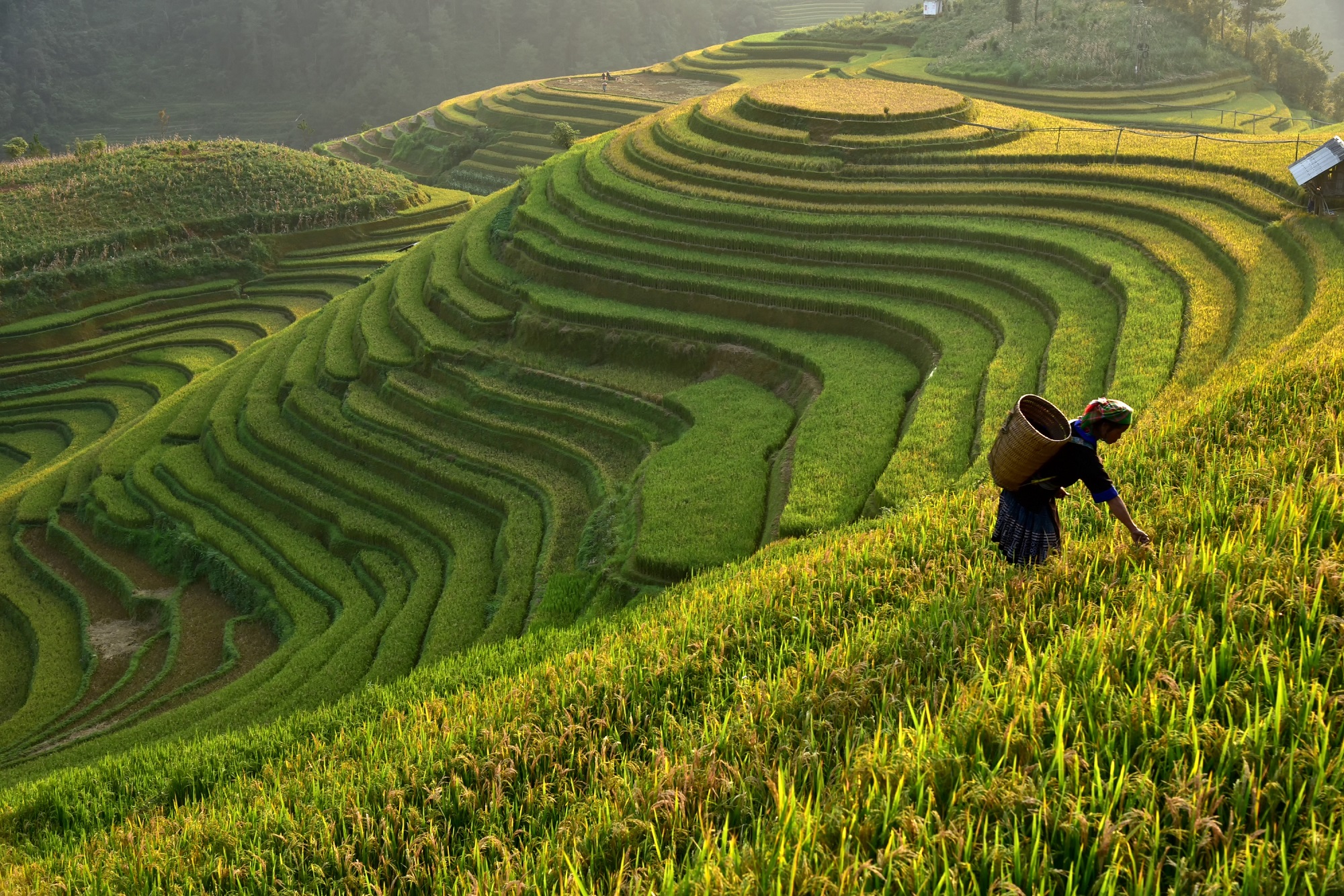
The rice terraces are a helpful reminder that more than one subtype can sometimes apply. In a test-style statement, select the subtype most strongly supported by the wording. If the statement emphasizes building the terraces, choose modification. If it emphasizes farming successfully on steep mountainsides, adaptation is also defensible.
Movement: what travels between places?
Movement concerns connections among places through the transfer of people, goods, and ideas.
- People: migration, commuting, tourism, refugees relocating
- Goods: trade, shipments, imports, exports
- Ideas: language, music, inventions, religious beliefs, news, and online information
Example: “Coffee beans are shipped from Brazil to cafes in Canada.”
Classification: Movement, goods, because a product travels between places.
Example: “A dance trend spreads worldwide through social media.”
Classification: Movement, ideas, because information and culture are being shared across places.
The word movement does not mean any physical action. “A student walks to the kitchen” is usually not a geographic movement example. Geography is interested in broader connections among locations and their effects.
Region: what places belong together?
A region is an area whose locations share something meaningful. Regions are useful because geographers can discuss a pattern without listing every individual place.
Three common region types are:
-
Formal region: an area with a measurable shared trait or an official boundary.
Example: A U.S. state is a formal political region with legal borders. The Sahara is a formal physical region defined by a very dry climate. -
Functional region: an area organized around a central point, service, or network.
Example: The delivery zone served by one pizza restaurant is a functional region centered on that restaurant. A city’s bus network can also form a functional region. -
Perceptual region: an area people believe exists or identify as a region, but whose borders are not exact.
Example: “The Midwest” or “the Middle East” may mean slightly different areas to different people.
Regions may also be described by the trait that unites them:
- A physical region shares natural features, such as climate or landforms.
- A human region shares cultural, political, social, or economic traits.
For instance, “the Midwest is known for growing grains” identifies a region organized around a shared human-economic activity. “The Sonoran Desert has distinctive plants and animals” identifies a physical region.
A method for classifying any short example
When a statement seems to fit more than one theme, do not panic. Geographic themes overlap in real life. Your task is to identify the statement’s primary emphasis and support your decision with evidence.
Use this four-part response pattern:
Theme — subtype, because [specific clue from the statement].
For example:
Location — relative, because it places the museum near the river.
Use this decision process:
- Look first for an exact address, coordinates, directions, or nearby landmarks. If those are the main point, choose Location.
- Look for a description of a single location’s natural or cultural traits. Choose Place.
- Look for an action or relationship involving people and the natural world. Choose Human-Environment Interaction.
- Look for people, products, or ideas traveling between locations. Choose Movement.
- Look for a larger area whose places share a trait, service pattern, boundary, or common perception. Choose Region.
- State the subtype whenever the evidence supports one.
Avoiding the most common mix-ups
Place versus region
Both themes use characteristics. The difference is the scale and purpose.
-
“Mount Fuji is a steep volcanic mountain in Japan.”
Place — physical characteristic. It describes one specific location. -
“The Pacific Ring of Fire contains many volcanoes.”
Region — formal physical region. It groups many locations by a shared physical pattern.
Place versus Human-Environment Interaction
A human feature can describe a place, but a human action that changes or responds to nature is HEI.
-
“Amsterdam has many canals.”
Usually Place — human characteristic, because it describes what Amsterdam is like. -
“Residents built canals to manage water in low-lying land.”
Human-Environment Interaction — modification, because it emphasizes people altering their environment.
Location versus movement
A statement can name locations without being about location.
-
“Mexico is south of the United States.”
Location — relative, because the point is where Mexico is. -
“Workers commute from Mexico to the United States.”
Movement — people, because the point is travel between places.
Formal versus perceptual regions
- “California” is a formal political region because official borders define it.
- “The South” is typically a perceptual region because people may disagree about which states belong to it.
Worked classifications
Read the statement, identify its main focus, and notice how the justification points to specific evidence.
| Geographic statement | Best classification | Justification |
|---|---|---|
| “Nairobi is located at about south latitude and east longitude.” | Location — absolute | Latitude and longitude give a precise position. |
| “Nairobi lies southeast of Lake Victoria.” | Location — relative | The location is described in relation to another feature. |
| “Nairobi has a highland climate and a diverse population.” | Place — physical and human characteristics | Climate is physical; population is human. |
| “People migrate from rural areas to Nairobi for work.” | Movement — people | People are moving between places. |
| “Phones made in one country are sold in another.” | Movement — goods | Products travel through trade. |
| “An online video teaches viewers in many countries a new recipe.” | Movement — ideas | Information and culture spread among places. |
| “A desert community installs solar panels because it receives abundant sunlight.” | HEI — dependence/adaptation | People use an environmental resource and adjust technology to local conditions. |
| “A government clears forest land to build a highway.” | HEI — modification | People change the natural environment. |
| “A radio station’s listening area reaches towns around the city.” | Region — functional | The area is connected to a central communication service. |
| “People disagree about where the Midwest begins and ends.” | Region — perceptual | The borders depend on people’s ideas rather than a fixed official line. |
Your flashcard set
Make these as physical index cards or in a flashcard app. Keep the front short enough that you must retrieve the answer from memory. On the back, write the bolded answer and the brief explanation.
| Card front | Card back |
|---|---|
| What are the five themes of geography? | Movement, Region, Human-Environment Interaction, Location, Place. Mnemonic: MR. HELP. |
| What question does Location answer? | Where is it? |
| Absolute location | An exact position, usually given by coordinates, GPS, or a street address. |
| Relative location | A location described in relation to another place, using clues such as near, north of, or across from. |
| What question does Place answer? | What is it like there? |
| Physical characteristics of place | Natural traits such as landforms, climate, rivers, soil, vegetation, and wildlife. |
| Human characteristics of place | People-related traits such as population, language, religion, buildings, culture, and government. |
| What question does HEI answer? | How do people and the natural environment affect one another? |
| HEI: dependence | People rely on environmental resources for needs such as food, water, energy, or shelter. |
| HEI: adaptation | People adjust to environmental conditions, such as wearing warm clothing in cold climates. |
| HEI: modification | People change the environment, such as building dams, roads, terraces, or irrigation systems. |
| What question does Movement answer? | What moves between places, and how are places connected? |
| Three types of movement | People, goods, and ideas. |
| What question does Region answer? | How and why are places similar to or different from one another? |
| Formal region | A region with clear boundaries or a measurable shared trait, such as a country or desert climate zone. |
| Functional region | A region organized around a central node, service, or network, such as a delivery area. |
| Perceptual region | A region based on people’s beliefs or impressions, with flexible boundaries, such as “the South.” |
| Best justification format | Theme — subtype, because [evidence from the statement]. |
For effective review, first study the cards by theme. Then shuffle them so you must distinguish similar concepts, especially place versus region and place versus human-environment interaction. Finally, say the justification aloud rather than only naming the theme.
The five themes are tools for asking precise questions about Earth and the people who live on it. Remember the central contrasts: location is where; place is what it is like; movement is what travels; region is what areas share; and human-environment interaction is the two-way relationship between people and nature.
Next, you will build on this foundation by learning how to interpret a map’s title, legend, symbols, scale, compass rose, and cardinal directions.
Can't find a good explanation? Sign up and we'll make it for you
Sign up