
Good to see you again. Last lesson established the core gold CFD P/L calculation: price movement multiplied by your broker’s contract size and your lot size. Now we add the two execution frictions that can make a chart idea look better on screen than it performs in the account: spread and slippage.
For a breakout scalper, these costs matter especially because targets and stops may be relatively close. The aim is not to eliminate them—you cannot—but to estimate them before entering and then compare your estimate with actual demo fills.
Two prices, not one: the spread
A gold CFD quote normally has two executable prices:
| Quote | What it means | Used when |
|---|---|---|
| Bid | Price available to sell at | Opening a short or closing a long |
| Ask | Price available to buy at | Opening a long or closing a short |
The spread is the difference:
Suppose XAUUSD is quoted:
Then:
If you buy, you enter at . If you immediately closed that long position, you would sell at . Nothing in the market has changed, yet the position has lost per ounce because you crossed from the ask to the bid.
For a short, the same principle applies in reverse. You sell at the bid and would need to buy back at the ask. An immediate round trip also costs the full spread.
This is why the spread is a round-trip trading cost. On a chart showing only one price—often a bid or midpoint chart—you may not visually see that cost until you open the order ticket or inspect the fill.
What Are Spreads In Forex? (EVERYTHING YOU NEED TO KNOW)
Watch “What Are Spreads In Forex?” by The Trading Channel for a visual explanation of bid, ask, and why a chart can appear to touch a level while an order behaves differently.
Watch bid ask mechanics to see how the two prices create the spread and affect a buy entry. Then watch order effects for examples of a stop or target behaving differently from a single-price chart. The video uses a forex pair and pip language; carry over the bid/ask logic, but use actual gold price distances such as 0.30, not its pip conventions.
For your gold breakout process, do not place an entry simply because price “barely broke” a level on the candle chart. First look at the live bid and ask. A very small break can be mostly spread rather than meaningful movement beyond the range.
Calculating the dollar cost of spread
Use the specification card you built in the earlier lessons:
- : contract size in ounces per lot
- : position size in lots
- : spread in gold price units
The dollar cost of a full round-trip spread is:
If your broker uses the common specification of ounces per lot, and you trade lots:
So your position controls 10 ounces.
With a spread:
That is not an additional surprise fee that appears afterward. It is embedded in the fact that a long buys at the ask and sells at the bid, while a short sells at the bid and buys at the ask.
Pricing explained: spreads, overnight costs & GSLO fees | Capital.com
Read Capital.com’s commodity example to see a complete spread-cost calculation based on a gold bid/offer quote.
Under “Spread cost examples for CFD trades,” read the “Commodities” example. Start at the gold spread example. Notice that the article separates the spread into half at entry and half at exit when viewed from the midpoint, but the full round-trip cost is still the full 0.30 spread. Its “10 contracts” equal 10 ounces in that specific example; do not substitute that contract convention for the specification of your own TradeLocker symbol.
A fast scale check
Assume, for illustration only, that lot equals 100 ounces.
| Spread | lots | lots | lot |
|---|---|---|---|
A wider spread does not change whether a breakout is structurally valid. It changes how much distance price must travel before the trade becomes profitable.
Slippage: when the actual fill differs from the requested price
Slippage is the difference between the price you requested or expected and the actual price at which the broker fills your order.
For estimating risk, focus on adverse slippage: fills worse than your intended price.
- For a long entry, adverse slippage means buying higher than expected.
- For a long exit, adverse slippage means selling lower than expected.
- For a short entry, adverse slippage means selling lower than expected.
- For a short exit, adverse slippage means buying back higher than expected.
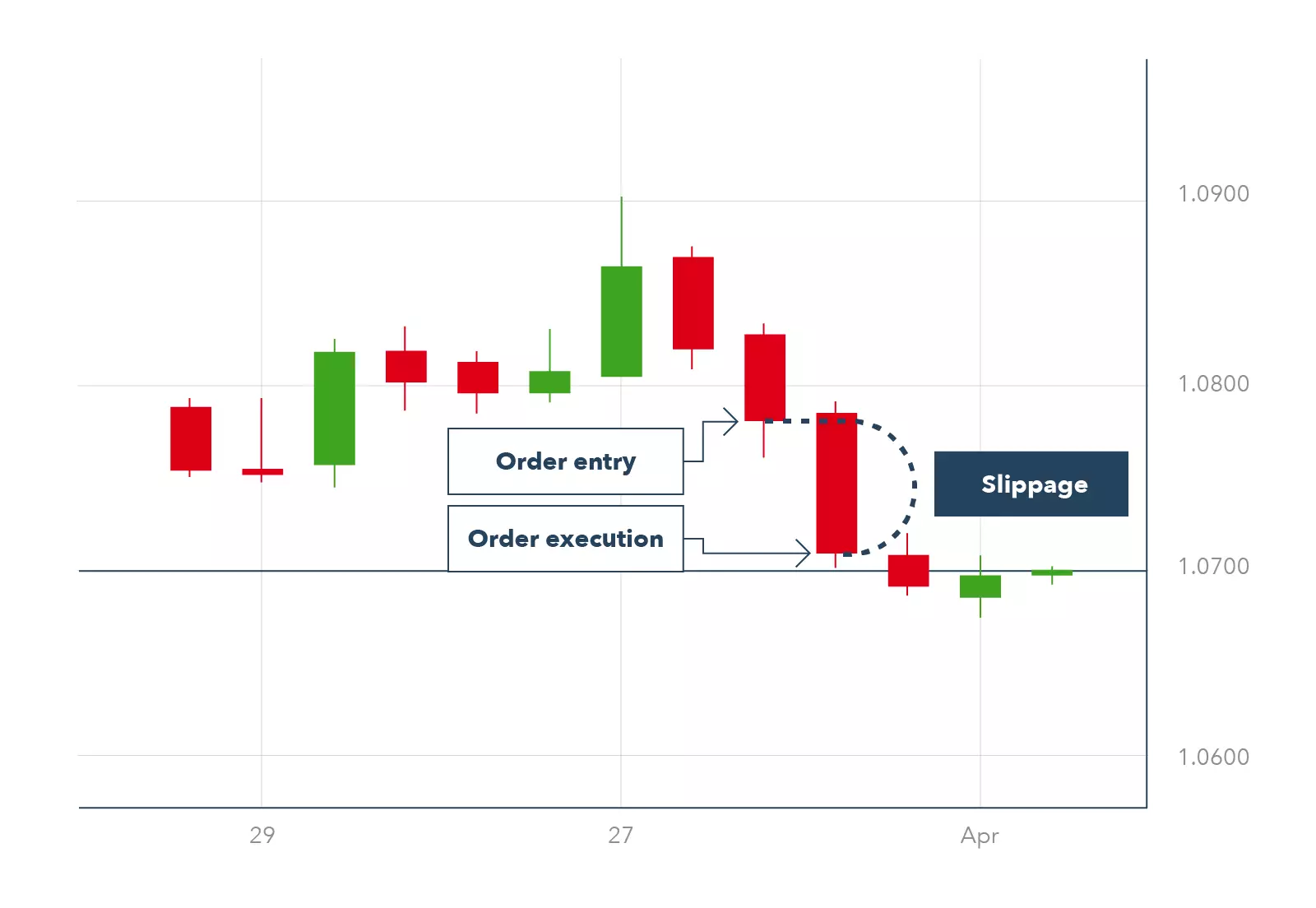
Slippage is not guaranteed to occur on every trade, and it can sometimes be positive. However, for a conservative plan, treat your assumed slippage as a possible cost. It becomes more relevant during sudden movement, thinner liquidity, widened spreads, and major scheduled news.
What Is Slippage in Trading and How Can You Avoid It? - IG UK
Read IG UK’s explanation of why requested and actual execution prices can differ, then follow its numerical example.
In “What is slippage?”, read positive and negative slippage. Then move to “Example of slippage” and read the worked example. The example is for shares, but the calculation transfers directly to gold: unfavorable price difference per unit multiplied by units controlled.
The complete estimate: spread plus assumed slippage
Let:
- be the quoted spread
- be assumed adverse slippage at entry
- be assumed adverse slippage at exit
- be contract size
- be lot size
When the spread is assumed to stay the same from entry to exit, estimate total round-trip execution cost as:
All three price distances must be written in the same gold-price units. For example, spread, entry slippage, and exit slippage give:
This is a per-ounce friction estimate before multiplying by your controlled gold units.
Worked example: a long breakout
Assume:
- Contract size: ounces per lot
- Position size: lots
- Controlled quantity: 10 ounces
- Spread:
- Assumed adverse entry slippage:
- Assumed adverse exit slippage:
First calculate the price cost:
Then calculate the dollar cost:
Break it down:
| Cost component | Price distance | Dollar cost at 10 ounces |
|---|---|---|
| Spread | ||
| Entry slippage | ||
| Exit slippage | ||
| Total estimated cost |
Now connect this to actual fills. Suppose the initial midpoint is , and gold later rises by to a midpoint of .
With no spread or slippage, the 10-ounce position would make:
But suppose you requested to buy at the ask and were filled at . Later you intended to sell at the bid but were filled at .
Your actual P/L is:
The difference between the friction-free result and the actual result is exactly the estimated execution cost.
A short trade uses the same cost formula
Cost calculation is direction-neutral. The spread and adverse slippage both work against you whether you buy first or sell first.
Suppose a short breakout has:
- Controlled quantity: 20 ounces
- Spread:
- Entry slippage:
- Exit slippage:
Total estimated price cost:
Dollar cost:
If gold falls by from midpoint to midpoint, the friction-free gross result on 20 ounces would be:
After the estimated execution cost:
The short has not become “bad” because it pays spread. But a small target can become impractical if costs consume too much of the available move.
Do not subtract the same cost twice
This distinction prevents a very common journal error.
Situation 1: planning from a midpoint or single-price chart
If your planned profit is based on a chart midpoint or a theoretical one-price market, estimate spread and slippage separately:
Situation 2: planning from actual bid and ask prices
If you calculate a long trade using the actual ask for entry and actual bid for exit, the quoted spread is already included in the calculation. In that case, only allow separately for future slippage and any other fees that apply.
Situation 3: reviewing an already completed trade
If you have actual platform fills, calculate P/L directly from them:
Do not calculate actual fill-to-fill P/L and then subtract spread and slippage again. The final fills already reflect those effects.
The cleanest journal format is:
| Field | Example |
|---|---|
| Intended entry | Buy at |
| Actual entry fill | |
| Intended exit | Sell at |
| Actual exit fill | |
| Spread observed | |
| Entry slippage | adverse |
| Exit slippage | adverse |
| Final P/L | Calculated from actual fills |
If the platform reports multiple fills, use its displayed average fill price for the whole position. That average is the number you need for the P/L and slippage record.
A practical pre-trade cost routine for gold
Before a demo breakout trade, record these facts:
-
Snapshot the live bid and ask.
Calculate the current spread rather than assuming it is always the same. -
Copy your actual contract size and intended lot size.
Never use the 100-ounce convention unless it is confirmed for your symbol. -
Choose a conservative slippage assumption.
At first, use a modest fixed assumption in replay or demo, then replace it with an average from your own recorded fills. Around major news, do not assume normal conditions. -
Calculate estimated cost.
- Compare that cost with the available target distance.
A trade whose target is only slightly larger than its normal execution cost deserves rejection. A breakout needs enough clean price space to cover friction and still offer a meaningful reward.
Spread and slippage are not excuses to widen a stop, increase size, or spam extra entries. They are predictable reasons to demand more space and cleaner conditions before taking a setup.
Key takeaways
A full gold CFD trade pays the bid/ask spread once across entry and exit, plus any slippage that occurs at either fill.
- Use price distances such as or , not vague pip labels.
- For a 100-ounce contract at lots, each of gold price distance costs .
- Spread is already included when you calculate P/L from real bid/ask fills.
- Slippage is the difference between intended and actual fills; for risk planning, model adverse slippage rather than hoping for positive slippage.
- Record observed spread and actual fills in demo. Your own TradeLocker data is more useful than generic claims about how cheap or expensive gold “should” be to trade.
Next, you will choose between market, limit, and stop orders for specific breakout-entry conditions. That choice determines not only how a trade enters, but also how much control you have over the execution price.
Can't find a good explanation? Sign up and we'll make it for you
Sign up