Hello and welcome back!
In our last module, we focused on overcoming buyer hesitation by addressing objections and providing proof. You learned how to turn a simple FAQ section into a strategic tool to reassure buyers and reinforce your value proposition.
This week, we begin a new module, "Writing Authoritative Long-Form Content." We're shifting from addressing specific objections to building the comprehensive, in-depth arguments that establish your company as a trusted authority. The first step in this process is creating a solid plan.
Today's lesson will tackle the learning outcome: Outline a white paper that educates B2B buyers while subtly positioning a solution. We'll cover the strategy behind a great white paper and walk through the steps to create a clear, persuasive outline that serves as the blueprint for your writing.
The White Paper's Dual Purpose: Educate and Position
Your experience in copywriting has likely taught you that a direct sales pitch isn't always the most effective approach. This is especially true in B2B, where buyers are often researching a complex problem long before they're ready to evaluate vendors.
A white paper is not a sales brochure; it's an educational tool. Its goal is to help the reader understand a problem, explore a challenge, or learn about a new opportunity in their industry. The "sale" is subtle. By providing genuine value and insight, you position your company as a credible expert, making your solution the logical choice when the time comes.
Let's explore this core philosophy.
Why the Smartest White Papers Lead with Insight, Not Sales Pitches
This article from Connected Copy neatly explains why the best B2B white papers lead with insight, not a sales pitch. It gets to the heart of the strategy we'll be using today.
Please read the introduction (the first few paragraphs) and the section under the heading 'How to choose the topic and title of your white paper?'. Focus on the idea of serving a 'dual purpose': educating the audience while subtly positioning your company as a solution provider.
The key takeaway is that your topic and title must be tactical. You choose a problem that your audience genuinely cares about and that your product is uniquely equipped to solve. You teach them about the problem and the characteristics of an effective solution, which—not coincidentally—are the very characteristics of your product.
The Blueprint: Structuring a Persuasive White Paper
Once you've chosen a tactical topic, the next step is to structure your argument. A well-structured white paper guides the reader on a logical journey from a problem they recognize to a solution you will introduce.
While formats can vary, most successful white papers follow a standard flow. This article provides an excellent step-by-step breakdown.
How To Write a White Paper: Your Step-by-Step Guide
Now, let's look at the practical framework for your outline. This guide from Brafton breaks down the standard white paper structure into eight clear steps.
Read the section titled 'How To Structure a White Paper: 8 Steps'. As you read, notice how the document builds its case progressively, earning the reader's trust by defining the problem and sharing research before even mentioning a solution.
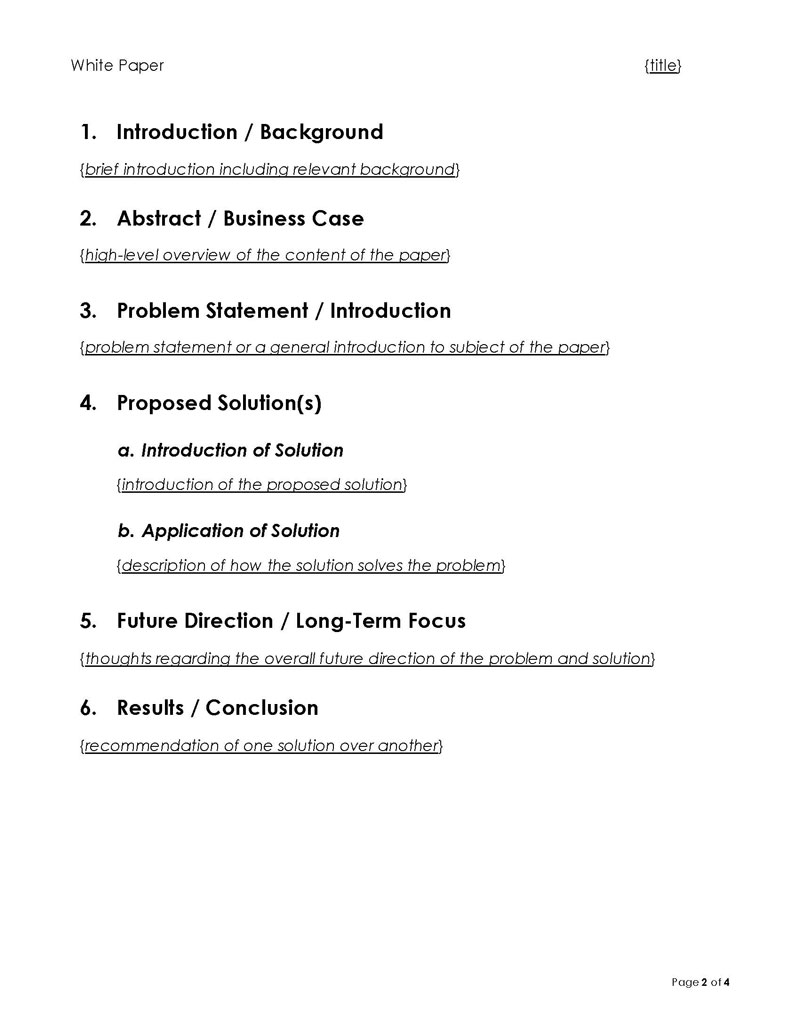
This 8-step structure forms a powerful narrative:
- Title & Summary: Grab attention and promise value.
- Introduction: Set the scene and state the problem's relevance.
- Problem Statement: Deeply explore the reader's pain point.
- Research/Analysis: Back up the problem with data and evidence. This is where you build authority.
- Proposed Solution: Introduce the category of solution that addresses the problem. This is the crucial "pivot."
- Conclusion: Summarize the argument and reinforce the key takeaways.
- CTA: Tell the reader what to do next.
Here is a visual representation of a similar structure, which you can use as a mental model.
Your Turn: Outline a White Paper
It's time to put this into practice. Let's create an outline for a B2B technology company.
Scenario:
- Company: "FortifyData," a cybersecurity firm.
- Product: A platform that helps mid-sized e-commerce businesses prevent customer data breaches and comply with privacy regulations (like GDPR).
- Target Audience: Non-technical VPs of Marketing or Operations. They are deeply concerned about the business risks of a data breach (lost sales, brand damage, fines) but don't understand the technical complexities.
Your Task:
Based on the scenario, create a high-level outline for a white paper.
- Propose a Tactical Title: Write a title that would appeal to the VP of Marketing/Ops. It should focus on their business problem, not on the technology.
- Create a Section Outline: Using the structure we just reviewed, list the key sections of the white paper (e.g., Introduction, Problem, Solution, etc.). For each section, write one bullet point describing the content and how it serves the reader.
Take about 10 minutes for this exercise. Aim for clarity and a logical flow.
Example Breakdown
Excellent. This exercise requires you to think strategically about both the audience's mindset and the company's goals. Here’s one possible approach:
1. Tactical Title:
- The E-commerce Growth Killer: How Hidden Data Privacy Risks Are Stalling Your Sales and What to Do About It
Why it works: It speaks directly to a business leader's top priorities (growth, sales) and frames the problem in terms of risk and loss. It avoids technical jargon and promises a solution ("What to Do About It").
2. Section Outline:
- Introduction:
- Set the scene: E-commerce is more competitive than ever, and customer trust is the new currency. Briefly introduce the idea that data privacy is no longer just a legal issue, but a core driver of brand loyalty and growth.
- Problem Statement: The Silent Risk to Your Brand:
- Detail the specific business consequences of a data breach for an e-commerce company: cart abandonment, negative reviews, loss of customer lifetime value, and significant fines. Use storytelling to paint a picture of what's at stake.
- Analysis: Why Standard Protections Are No Longer Enough:
- Educate the reader on the evolving landscape of privacy regulations (GDPR, CCPA) and the increasing sophistication of cyber threats. Use statistics on data breaches in the retail sector to build urgency and credibility.
- Proposed Solution: The Framework for Automated Trust & Compliance:
- Introduce the concept of a proactive, automated approach to data security. Describe the ideal solution's characteristics: continuous monitoring, simplified compliance reporting, and the ability to demonstrate security to customers—without needing a dedicated IT security team.
- Conclusion: Turning Privacy from a Liability into an Asset:
- Summarize the argument: In today's market, proactively managing data privacy isn't a cost center; it's a competitive advantage that builds trust and drives sales.
- About FortifyData & Call to Action (CTA):
- Briefly introduce FortifyData as a platform built on the principles of the "Automated Trust & Compliance" framework described above. The CTA would be to "Request a complimentary privacy risk assessment for your e-commerce store."
This outline educates the VP on a critical business issue and subtly guides them to the conclusion that a solution like FortifyData is not just a nice-to-have, but a necessity for growth.
Conclusion
Great work today. You've learned the strategic foundation of one of the most powerful assets in B2B marketing.
Key Takeaways:
- A successful white paper's primary goal is to educate and build authority, not to make a hard sales pitch.
- The most effective structure guides the reader logically from a problem they care about to a solution you provide.
- Subtle positioning is achieved by defining the problem and the ideal solution in a way that makes your product the clear, logical next step for the reader.
Preview of the Next Lesson:
Now that you have the blueprint, our next lesson will focus on crafting the most critical part of the document: the opening. We will learn how to write an executive summary for a B2B white paper that compels the reader to continue.