Hello and welcome to our next session!
In our last lesson, we created the strategic blueprint for a B2B white paper, outlining how to educate a buyer about a problem while subtly positioning your solution. We used the "FortifyData" scenario to map out a document that would guide a non-technical VP from recognizing a business risk to understanding the need for a solution.
Today, we're writing the very first thing that VP will read: the executive summary. This is arguably the most important page of your entire white paper. For a busy executive, this summary is the gatekeeper; it determines whether they invest their time in reading the full document or move on.
Our goal for this lesson is to write an executive summary for a B2B white paper that compels the reader to continue. We'll explore the different strategic approaches to an executive summary and then you'll write one yourself.
The Two Goals of an Executive Summary
An executive summary serves two masters: the reader and the marketer.
- For the Reader: It allows a time-pressed executive to quickly grasp the essence of the white paper—the problem, its importance, and the promised outcome—so they can decide if it's relevant to them.
- For the Marketer: A well-written summary doesn't just summarize; it persuades. It hooks the reader by confirming you understand their world and promises valuable insight, giving them a powerful incentive to keep reading.
There isn't just one way to write an executive summary. The best approach depends on who you're writing for and where they are in their buying journey. The most common distinction is between two types: the Preview and the Synopsis.
Let's dive into what these are and what they include.
The Two Types of White Paper Executive Summary
This article from CopyEngineer offers an excellent breakdown of the two primary types of executive summaries. The analogy it uses is a great way to remember the strategic difference.
Please read from the heading 'The Two Types of Executive Summary' to the end of the section on 'The Synopsis'. Focus on understanding the 'movie trailer' vs. 'spoiler alert' analogy and the specific components of both the Preview and Synopsis styles.
To recap, the two styles serve different purposes:
- The Preview: Like a movie trailer, it focuses on building intrigue around the problem. It sets the scene, details the stakes, and hints at a better way forward without giving away the solution. Its job is to make the reader think, "Yes, that's my problem. I need to understand this better."
- The Synopsis: Like a plot spoiler, it gives the reader the full picture upfront, including the solution and its results. It's direct and to the point, showing the reader exactly what they will gain by implementing the recommended approach.
Choosing Your Strategy: Problem-Aware vs. Solution-Aware
So, how do you decide which one to use? The key is to think like your buyer. Where are they in their journey?
- Are they still trying to fully understand their problem? (Problem-Aware)
- Or do they already understand the problem and are now actively evaluating different solutions? (Solution-Aware)
The Two Types of White Paper Executive Summary
Now let's connect these two summary types to the buyer's journey. This next section from the same article provides a clear rule of thumb.
Please read the section titled 'When to Use Each Type of Executive Summary'. This directly links the summary style to the prospect's stage in the sales cycle.
As the article explains:
- Use the Preview style for top-of-funnel content when your audience is in an educational, problem-discovery phase.
- Use the Synopsis style for bottom-of-funnel content when your audience is in an evaluation phase and wants to see results and proof.
Let's look at an example of a Synopsis-style summary.
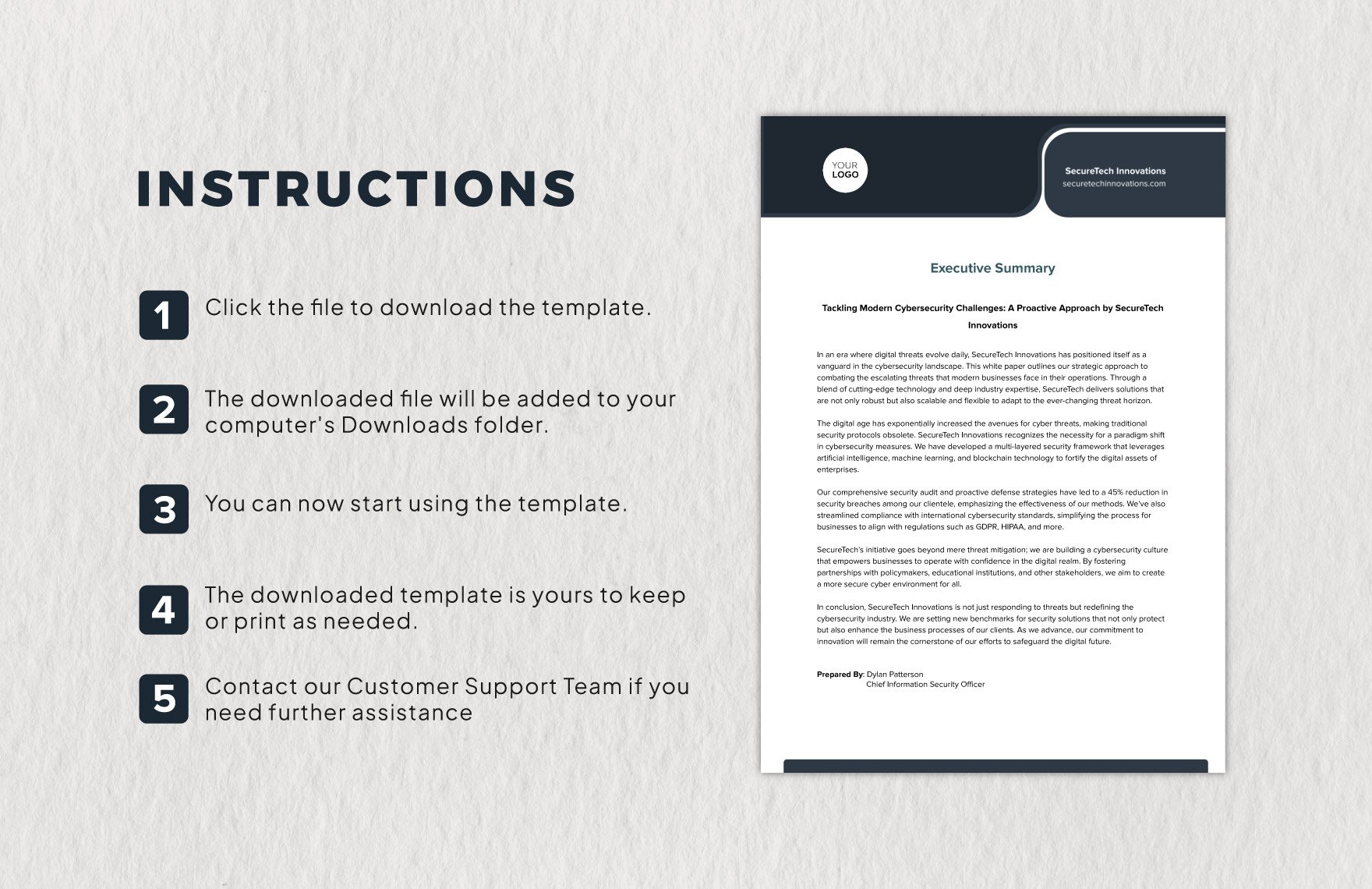
Notice how this example quickly moves to the solution ("multi-layered security framework") and a quantifiable result ("45% reduction in security breaches"). This is designed for a reader who is likely comparing vendors and wants to see hard evidence of performance.
Your Turn: Write a "Preview" Executive Summary
Now it's time to apply this to our scenario from the last lesson. Your task is to write an executive summary for the FortifyData white paper.
Scenario Recap:
- Company: "FortifyData," a cybersecurity firm.
- Product: A platform that helps mid-sized e-commerce businesses prevent customer data breaches.
- Target Audience: Non-technical VPs of Marketing or Operations. They are likely aware that data privacy is an issue but may not grasp the full business impact.
- White Paper Title: The E-commerce Growth Killer: How Hidden Data Privacy Risks Are Stalling Your Sales and What to Do About It.
Your Task:
Given that the audience is likely problem-aware but not yet solution-aware, the Preview style is the most effective choice. Write a short executive summary (around 150-200 words) using the four-part structure for a Preview summary:
- Market Conditions: What is the current situation for e-commerce businesses?
- Problem Assessment: What is the core problem and why are current approaches failing?
- Ramifications and Repercussions: What are the business costs of this problem?
- Promise of a Better Solution: Offer hope and a reason to read on, without revealing the specifics of your product.
Take about 8-10 minutes for this writing exercise.
Example Breakdown
Great. This is a core skill in long-form content. Here is one way you could have approached it, following the Preview structure:
Executive Summary
(Market Conditions)
In today's crowded e-commerce market, customer trust is the ultimate competitive advantage. While brands invest heavily in user experience and marketing, a critical foundation of that trust—data privacy—is often treated as a technical afterthought.
(Problem Assessment)
For growing e-commerce businesses, managing data privacy has become a complex and resource-draining challenge. Standard security measures are no longer sufficient to combat evolving threats, and navigating global regulations like GDPR is a constant struggle for teams without dedicated legal and IT security staff.
(Ramifications)
The consequences of inaction are not just legal; they are commercial. A single data breach can lead to devastating brand damage, a loss of customer loyalty, and a direct hit to sales revenue, derailing growth projections overnight.
(Promise of a Better Solution)
However, a new approach is emerging that allows businesses to move from a reactive, compliance-focused posture to a proactive strategy. This white paper outlines a framework for turning data privacy from a business liability into a powerful asset that builds customer trust and protects your bottom line.
Why it works:
- It speaks directly to the VP's world: "competitive advantage," "growth projections," "bottom line."
- It builds urgency by framing the problem in terms of business risk, not technical details.
- The final paragraph creates intrigue and promises a valuable new perspective, compelling the reader to turn the page to learn what that "new approach" is.
Conclusion
Excellent work today. You've learned how to craft the most crucial part of a white paper—the opening that convinces a busy executive to engage with your content.
Key Takeaways:
- The executive summary's primary job is to persuade a reader to invest their time.
- There are two main types: the Preview (problem-focused, for early-stage buyers) and the Synopsis (results-focused, for late-stage buyers).
- Choosing the right style depends entirely on your audience and their stage in the buying journey.
Preview of the Next Lesson:
We've focused on a white paper that follows a classic problem-solution structure. In our next lesson, we will explore another powerful form of long-form content. We'll learn how to structure a thought leadership article that challenges a common assumption in the buyer's industry, a technique used to establish deep authority and stand out from the competition.