
Good to see you again. In the previous lesson, you separated long-term investing, swing trading, and intraday trading by the planned holding period, evidence, and risk controls. That distinction still matters, but there is another question to answer before analysing a chart:
What exactly does buying this ticker give you, and what risks are embedded in that route to exposure?
A US share, a UK share, a gold exchange-traded product, and Bitcoin can all appear as a price chart in TradingView. Yet they differ substantially in ownership rights, trading sessions, currency exposure, volatility, and the ways leverage can turn a manageable idea into an unacceptable loss.
This lesson gives you a comparison framework you can reuse every time you encounter a new symbol. It is educational material, not a recommendation to buy or trade any instrument.
A ticker is not the investment
A chart answers, “How has this quoted price moved?” It does not by itself answer:
- What legal or economic interest do I receive?
- What asset actually drives this instrument’s value?
- When can I enter or exit?
- In which currency is my result ultimately measured?
- Is leverage present explicitly, or hidden in the product structure?
The first distinction is between ownership and exposure.
- Ownership means you hold an interest in an entity or asset, with rights defined by law and the product terms.
- Exposure means your return is linked to something, such as gold, oil, or Bitcoin, without necessarily owning that underlying asset directly.
For example, buying ordinary shares in a company makes you an equity holder in that company. Buying a gold ETF or ETC normally makes you the holder of units or securities issued by a fund or product provider; your return is designed to reflect gold in some specified way. Buying spot Bitcoin may give you ownership of Bitcoin under the relevant platform’s terms, or direct control of it if you withdraw it to a self-custodied wallet. Neither is a share in a company.
US and UK shares: ownership of a business
An ordinary share represents a residual ownership interest in a company. In practical terms, shareholders may receive dividends if the board declares them, may usually vote on certain corporate matters, and benefit if the company grows in value. They also stand behind lenders and bondholders if the company fails: shareholders can lose their entire investment.
Most retail investors hold shares through a broker’s nominee structure rather than having their own name recorded directly in the company register. Economically, though, the position is still share ownership, subject to the broker’s custody arrangements and the applicable market rules.
A “US stock” or “UK stock” is less precise than it sounds. Keep three attributes separate:
| Attribute | Example question | Why it matters |
|---|---|---|
| Company domicile | Where is the company incorporated and regulated? | Affects reporting, taxes, governance, and legal framework |
| Exchange listing | Does it trade on Nasdaq, NYSE, the London Stock Exchange, or more than one venue? | Determines trading session, available liquidity, and ticker |
| Trading currency | Is the quoted share price in USD or GBP? | Affects currency conversion and your home-currency return |
A UK-headquartered firm can trade in London in GBP and also have a US listing or an American Depositary Receipt, often called an ADR, quoted in USD. The business is the same economic enterprise, but the instrument, trading venue, currency, and settlement arrangement may differ.
International Investing | Investor.gov
Read Investor.gov’s overview to establish why a foreign listing is not simply “the same stock in another currency.” It is especially useful for thinking about currency movements, liquidity, market hours, and ADRs.
In the opening list of international-investing risks, read the currency discussion beginning with currency risk. Then read the later liquidity discussion beginning with market liquidity. Focus on why a foreign asset’s local return and your personal return can differ. Then find the section “How can I invest internationally?”. Read the first paragraph on ADRs, from the ADR explanation, followed by the paragraphs on US-registered mutual funds and ETFs. Notice that a fund, an ADR, and direct foreign-market trading are different routes to exposure.
Company risk is still the central risk
The exchange location does not make a share “safe.” A US or UK share can fall because the company’s earnings weaken, debt becomes difficult to service, competitors take market share, management makes poor capital-allocation decisions, or investors decide the previous valuation was too high.
The practical difference for this course is that you will later analyse individual shares with both:
- Fundamental evidence: revenue, margins, cash flow, debt, valuation, and business quality.
- Technical evidence: trend, support and resistance, volume, volatility, and an entry or exit plan.
For now, retain the basic claim: buying a fully paid ordinary share is normally buying a slice of a business. It is not borrowing money merely because the share price is volatile.
Commodity products: usually exposure, not a barrel of oil or a gold bar
Commodities such as gold, silver, crude oil, natural gas, wheat, and copper are physical goods. Most individual investors do not buy, store, insure, and arrange delivery of those goods. Instead, they use exchange-traded products.
The labels can be confusing:
- An ETF is generally a fund whose units trade on an exchange.
- An ETC is a common European and UK label for an exchange-traded commodity product; its legal structure may differ from a conventional fund.
- An ETN is generally a debt security issued by a financial institution. It introduces issuer credit risk in addition to market exposure.
Do not assume the label tells you the whole story. Read the product’s key information document, prospectus, and factsheet before treating any commodity ticker as equivalent to its underlying commodity.
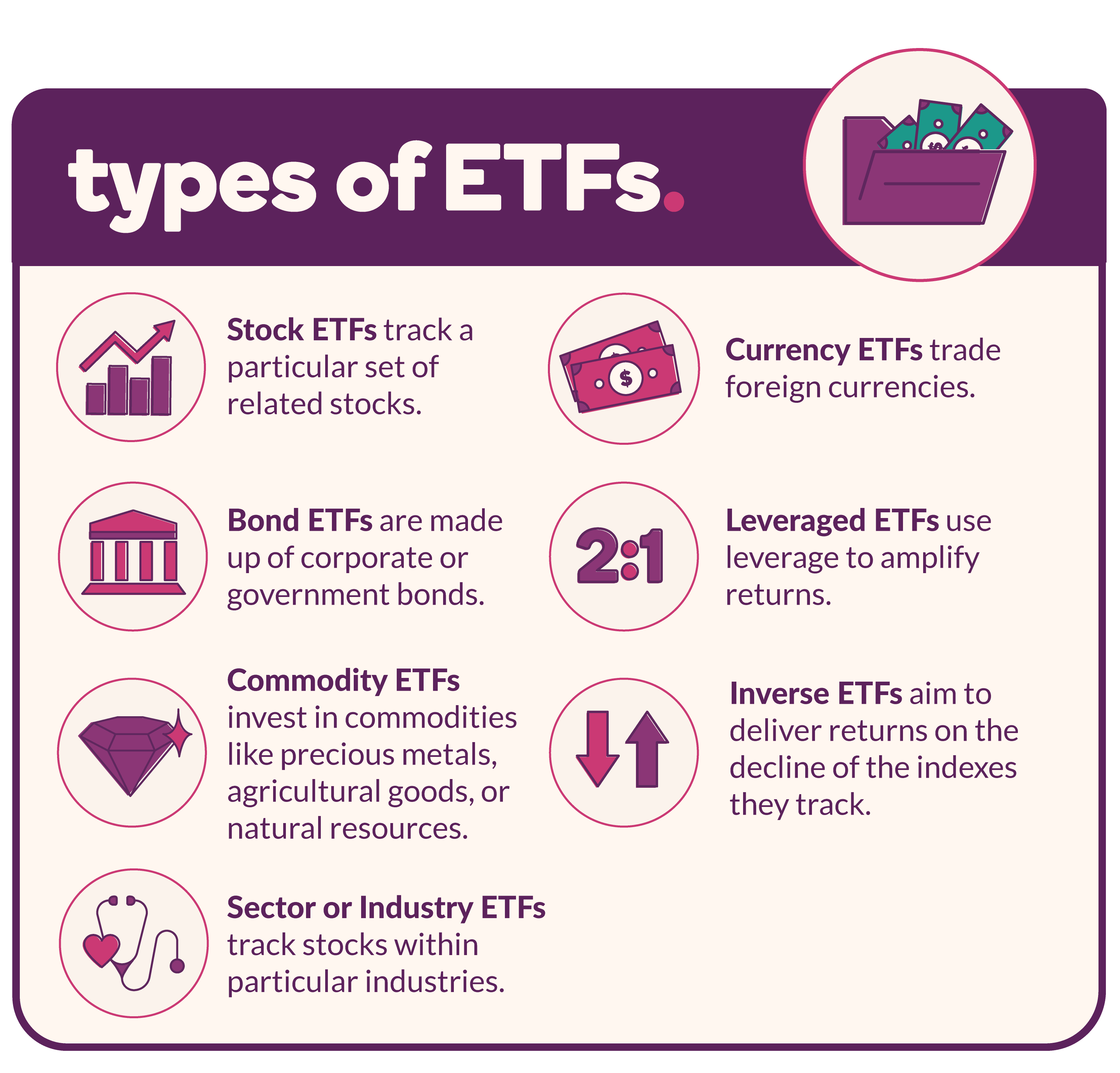
Two broad structures are particularly important.
Physically backed products
A physically backed gold product may hold allocated gold bullion through a custodian. If it works as intended, its value should broadly track the price of gold, less fees and possible frictions.
Here, you own units in the product, not a personal claim on a numbered gold bar that you can casually collect. The details of redemption rights, custody, fees, and the product’s legal structure are defined in the documentation.
Futures-based products
Many commodity products cannot conveniently store the commodity. Oil, natural gas, agricultural goods, and sometimes metals may therefore be tracked using futures contracts.
A futures contract is an agreement whose value is linked to a future delivery date. A fund that holds futures must periodically replace contracts that are nearing expiry with later-dated contracts. This is called rolling the futures position.
As a result, the product’s return can differ materially from the headline spot-price move of the commodity. It is affected by:
- The commodity’s price movement.
- The shape of the futures curve and the cost or benefit of rolling contracts.
- Product fees.
- In some cases, the currency in which the contracts and collateral are held.
So the statement “oil rose 10%, therefore my oil fund rose 10%” may be false. The correct question is: what does this specific product track, and how?
Commodity products are useful examples of why the word “exposure” is more accurate than “ownership.” You are investing in a security whose performance is linked to a commodity under defined rules.
Spot major cryptocurrencies: digital asset exposure with operational risk
Spot crypto means buying or selling the underlying cryptoasset at its current market price, rather than trading a derivative such as a futures contract, perpetual contract, option, or CFD.
For major assets such as Bitcoin and Ethereum, a spot purchase is economically different from buying a company share:
- It does not give you a claim on business profits or dividends.
- It does not give you shareholder voting rights in a corporation.
- Its value depends heavily on what other participants are willing to pay, network adoption, liquidity, market structure, regulation, and confidence in the ecosystem.
- Ownership and custody arrangements matter much more directly than with a conventional broker-held share.
If Bitcoin is held on a centralised exchange, you may see a balance in your account but rely on that firm’s systems, custody practices, withdrawal policies, and solvency. If it is transferred to a self-custodied wallet, control of the private keys becomes central: losing the recovery phrase can mean permanently losing access. Self-custody removes one category of intermediary risk but introduces personal operational responsibility.
Read the UK Financial Conduct Authority’s “Crypto: The basics” for a cautious explanation of what cryptoassets are and why their risks extend beyond price movement. The UK-specific regulatory discussion should not be treated as universal, but the risk categories are broadly useful.
Start in “What is crypto?” with the DLT explanation. You do not need to memorise the mechanics of blockchain yet; focus on the absence of a single central operator in public networks. Next, under “Where does crypto come from?”, read the discussion of unbacked crypto. Finally, in “Investing in crypto?”, read from the risk warning. Distinguish market volatility from firm failure, custody failure, and cyberattack risk.
The FCA’s warning is deliberately strong: cryptoassets can suffer large price movements, and platform or custody problems can make loss worse than a chart alone suggests. “Major” does not mean low risk; it usually means the asset has greater market capitalisation and liquidity than smaller tokens.
Trading hours change both opportunity and risk
An instrument’s listing venue determines when you can normally trade it. Its underlying market may be active at very different times.
| Instrument | Typical primary trading availability | Important implication |
|---|---|---|
| US-listed shares and US-listed ETFs | Regular session is generally Monday to Friday, 09:30 to 16:00 Eastern Time, excluding exchange holidays | News outside the regular session can produce a price gap at the next open |
| London-listed shares and London-listed ETPs | Regular London Stock Exchange trading is generally Monday to Friday, 08:00 to 16:30 London time, excluding holidays | The GBP price may react to US market news after London has closed |
| Commodity exchange-traded product | Trades during the hours of its listing exchange | Gold, oil, or futures markets may move while the ETP itself is closed |
| Spot Bitcoin or Ethereum | Usually trades 24 hours a day, every day, on crypto venues | Weekend news can move the market immediately; exchanges can still have outages, maintenance, or thin liquidity |
Exact schedules, holiday closures, auctions, and extended-hours access vary by exchange and broker. In particular, the UK-US time difference changes briefly around daylight-saving transitions, so avoid relying on one fixed conversion between London and New York.
Extended-hours US share trading may be available through some brokers, but it often has lower liquidity and wider bid-ask spreads than the regular session. For a beginner, a price displayed overnight should not be treated as equally easy to trade at that price.
A commodity product creates an important timing mismatch. Suppose a London-listed gold product is closed, but gold futures move sharply overnight. The product can open significantly higher or lower the next day. The chart may look like it “jumped,” but the underlying market did not stop moving merely because that listed product was closed.
Crypto has no comparable official daily close. That removes conventional overnight closure gaps, but it does not remove gap-like execution risk: a sharp move during sleep, a liquidity vacuum, or an exchange disruption can still make an intended exit much worse than expected.
Volatility is not the same as danger, but it changes the plan
Volatility is the magnitude and frequency of price movement. It does not say whether price will rise or fall; it says how widely price tends to vary.
A diversified, broad stock ETF is often less volatile than a single technology share. A single commodity product can be more volatile than a broad equity index, particularly when supply disruptions or geopolitical events dominate. Major cryptocurrencies have historically experienced especially large price swings, including severe multi-week drawdowns.
A useful, deliberately cautious comparison is:
| Category | Common volatility pattern | Risks beyond normal price movement |
|---|---|---|
| US/UK individual shares | Varies widely by company; earnings reports can cause abrupt gaps | Business failure, valuation compression, sector shocks |
| Commodity ETPs | Can move sharply around supply, weather, inventory, geopolitical, and currency events | Tracking difference, futures-roll effects, issuer or structure risk |
| Spot major crypto | Often very high and continuous, including weekends | Platform failure, custody mistakes, cyberattack, regulatory changes, fragmented liquidity |
Avoid turning this into a rigid ranking. A small speculative stock can be more volatile than Bitcoin in a given month; a physically backed gold product can be calmer than a highly leveraged equity ETF. Assess the actual instrument, not just its category.
Later, you will use chart tools such as average true range, Bollinger Bands, and support/resistance zones to make volatility visible. For now, the operational conclusion is simple: a more volatile asset requires a smaller position for the same account-level risk.
Currency risk: the return you see may not be the return you receive
Your broker account has a base currency: perhaps GBP, USD, EUR, or another currency. A share or product has a trading currency. These may differ.
For someone measuring results in USD, a UK share quoted in GBP has two moving parts:
- The local GBP share price.
- The GBP/USD exchange rate.
Ignoring taxes, fees, and spreads, the home-currency return can be represented as:
Here, is the change in the value of the local currency when measured in the account currency.
Suppose a UK share rises in GBP, but GBP falls against USD over the holding period. The approximate USD return is:
That is a gain of only in USD terms, before dealing costs and taxes. The company analysis may have been correct, while currency movement absorbed most of the local share-price gain.
Currency exposure can be less obvious than the instrument’s price label:
- A US stock quoted in USD has direct USD currency exposure for a GBP-based investor.
- A London-listed share quoted in GBP may earn much of its revenue in USD, EUR, or other currencies.
- A gold ETP quoted in GBP may still be economically driven by gold’s global USD price.
- BTC/USD exposes a GBP- or EUR-based investor both to Bitcoin’s movement and to their conversion between USD and the account currency.
The product’s trading currency is therefore a clue, not a complete currency-risk analysis.
Leverage: identify it before it identifies you
Leverage means controlling exposure larger than the cash committed. It amplifies gains and losses.
A fully paid cash purchase of ordinary shares, an unleveraged ETF, or spot Bitcoin bought without borrowing does not normally create a debt obligation to a broker. You can still lose all capital invested if the asset collapses, but you are not automatically magnifying the price move through borrowed funds.
Leverage can enter through several routes:
| Route | What it does | Core danger |
|---|---|---|
| Margin borrowing | Broker lends funds against your account | Losses are magnified; margin calls or forced sales may occur |
| CFDs, futures, and perpetual contracts | Deposit supports a larger notional position | A relatively small move can exhaust margin quickly |
| Leveraged ETPs | Product targets a multiple of daily movement | Losses are amplified; multi-day returns may diverge from the advertised multiple |
| Short selling | You profit if price falls, but must later buy back the asset | Losses can be very large if price rises; borrowing and margin rules apply |
A product containing futures is not automatically a leveraged product from your perspective. A commodity fund may use futures to gain exposure while you buy ordinary fund units fully paid. However, it can still be volatile and can still track the commodity imperfectly. Read the product documentation rather than inferring leverage from the chart or the word “futures.”
The same warning applies especially strongly to crypto platforms. A spot BTC/USD purchase is not the same as a leveraged BTC perpetual position, even if both are displayed next to each other on the same app. High volatility plus high leverage is a hazardous combination: even a modest adverse market move can trigger liquidation.
For the paper-trading work in this course, use unleveraged notional exposure until you can consistently define an entry, a stop, a position size, and a maximum account risk. Leverage is not a substitute for a trading edge or risk management.
A quick TradingView comparison routine
Use TradingView now as an inspection tool, not as a signal generator. The aim is to train yourself to ask the right questions before analysing indicators.
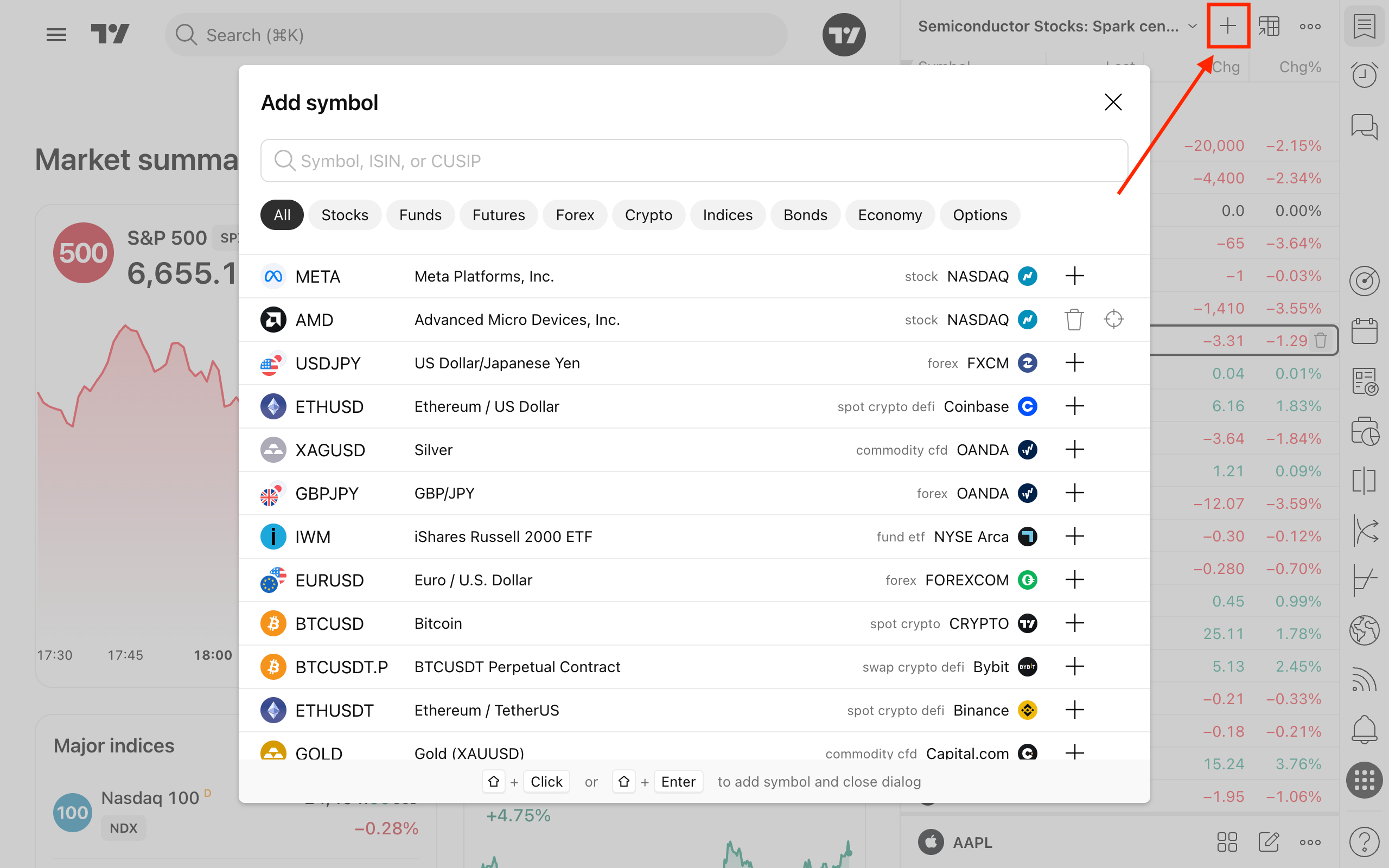
Open the symbol search with the plus icon beside a watchlist, as shown in the TradingView Add symbol dialog. Search for one clearly identified instrument from each category:
- A large US-listed company share.
- A London-listed company share.
- A commodity product that clearly states whether it is physically backed or futures based.
- A major spot crypto pair from a named venue, such as BTC/USD or ETH/USD.
For each one, make a compact four-line instrument card in your notes:
| Field | What to record |
|---|---|
| What do I own or track? | Share in a company, fund/product unit, or cryptoasset |
| Where and when does it trade? | Exchange or venue, currency, normal trading session |
| What drives the return? | Company results, commodity price and product method, or crypto market demand |
| What can amplify loss? | Volatility, currency conversion, product structure, margin, or platform/custody risk |
Do not assume that search results with similar names are equivalent. For crypto especially, BTCUSD from one venue and BTCUSD from another venue can have slightly different prices, volume, and liquidity. For exchange-traded commodity products, similar labels may conceal materially different structures.
This routine is deliberately slower than clicking “Buy,” but it prevents a common beginner error: analysing a chart well while misunderstanding the instrument being traded.
Key takeaways
Before comparing charts, identify the financial object behind the ticker.
- US and UK ordinary shares are ownership interests in companies, though domicile, exchange listing, and trading currency can differ.
- Commodity ETFs, ETCs, and similar products usually provide exposure through a product structure. A physically backed product and a futures-based product can behave differently even when linked to the same commodity.
- Spot major crypto is exposure to a digital asset, not ownership of a business. Its risks include price volatility as well as custody, platform, and operational risks.
- Trading hours matter because underlying markets and listed products may not be open at the same time. Crypto trades continuously, while shares and exchange-traded products follow their venue’s session.
- Currency movement can increase or reduce the return you realise in your account currency.
- Leverage is a separate risk layer. It may arise from margin, derivatives, short selling, or leveraged products; avoid it while developing your paper-trading process.
Next, you will turn this comparison into a practical paper-trade order plan: choosing an instrument and an order type, then estimating how spread, commission, slippage, and currency conversion affect the outcome.
Can't find a good explanation? Sign up and we'll make it for you
Sign up