
Good to see you again. In the previous lesson, you established the practical frame for Task 2: it is a connected essay of at least 250 words, normally completed in about 40 minutes, and it carries twice the weighting of Task 1. You also learned that the full 40 minutes must include planning and checking, not only drafting.
This lesson looks inside that essay format. A Task 2 essay is not simply a number of paragraphs placed together: each paragraph has a distinct job. By the end, you should be able to identify what an introduction, body paragraph, and conclusion are meant to do—and, equally importantly, recognise content that does not belong in each one.
The basic architecture: a reader’s route through your answer
A practical default structure for many Task 2 responses is four paragraphs:
- an introduction;
- body paragraph 1;
- body paragraph 2;
- a conclusion.
Some answers need a third body paragraph, but two well-developed body paragraphs are often a manageable choice in a 40-minute test. The key principle is not an exact paragraph count. It is functional organisation: the reader should immediately understand your answer, follow the reasoning that supports it, and see how the essay finishes.
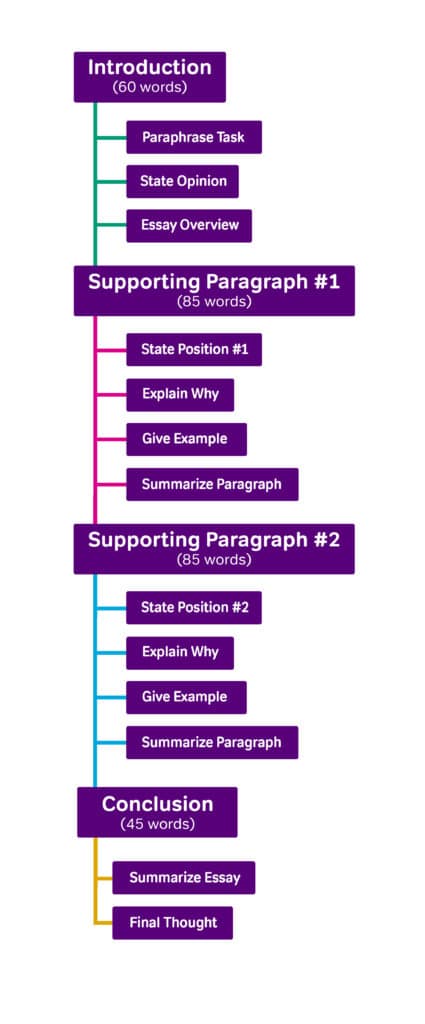
The infographic gives approximate word allocations, but treat these as planning guides rather than fixed rules. An effective essay is not produced by forcing every introduction into exactly 60 words or every body paragraph into exactly 85. The paragraph must do its job clearly and economically.
A useful way to think about the overall structure is:
| Essay section | Central question it answers | Main function |
|---|---|---|
| Introduction | “What is this essay’s response and direction?” | Orient the reader and answer the task at a high level. |
| Body paragraphs | “Why is that response convincing?” | Develop relevant main ideas through explanation and support. |
| Conclusion | “What answer has the essay established?” | Bring the response to a clear, consistent close. |
The order matters because an IELTS examiner reads under time pressure. A clear structure makes your response easier to understand and helps demonstrate coherence. However, structural labels alone do not earn marks: each paragraph must contain relevant content and connect logically to the question.
Understand IELTS Writing Task 2 in 5 Minutes
Watch “Understand IELTS Writing Task 2 in 5 Minutes” from IELTS Advantage for a compact visual overview of how the three essay sections work together.
Watch the structure overview. Notice the distinct sequence of functions: the writer first establishes a response, then develops separate ideas in the body, and finally recaps the answer. Focus on what each section contributes, rather than memorising every sentence pattern.
The introduction: establish the response, not the whole argument
The introduction is the reader’s entry point. Its job is to show that you understand the prompt and to make the direction of your response clear.
For most Task 2 questions, a concise introduction does two things:
- Paraphrases the relevant topic or issue in the prompt.
- States the thesis, meaning the direct answer, position, or planned coverage required by that particular question.
For an opinion question, the thesis normally makes your position clear. For example, if the question asks whether governments should fund public transport rather than build new roads, the introduction should reveal whether you agree, disagree, or agree only to a particular extent. Later sessions will examine the different question types; for now, retain the broader rule: the introduction must answer the task’s demands at a high level.
Consider this prompt:
Some people believe that governments should spend more money on public transport than on building new roads.
To what extent do you agree or disagree?
Here is an introduction:
Although expanding road networks may relieve congestion in the short term, public investment should primarily be directed towards reliable mass transit because it can reduce both traffic volume and urban pollution.
This short paragraph performs two jobs:
- It presents the issue in different language: road construction, public investment, traffic congestion, and mass transit.
- It states a position: public transport should receive priority, with two reasons that will be developed later.
It does not attempt to explain every detail, give statistics, or present a complete example. Those are body-paragraph jobs. A long introduction can consume valuable time and may repeat ideas that should be developed in the main part of the essay.
What does not belong in an introduction?
Avoid treating the opening as a place for general “warming up.” These moves often add words without advancing the response:
- broad historical claims, such as “Since the beginning of time, transport has been important”;
- memorised phrases, such as “This controversial topic has generated much debate”;
- detailed examples or evidence before the main ideas have been introduced;
- a position that is vague, delayed, or inconsistent with the body paragraphs.
The introduction is a map, not the journey itself. It tells the reader where the essay is going; it does not need to contain all the reasoning that will get there.
The body paragraphs: do the intellectual work
The body paragraphs are the main part of the essay. Their purpose is to develop the response. This is where you explain why your position, comparison, solution, or answer is reasonable.
A strong body paragraph has one controlling focus. It usually begins with a topic sentence that states the paragraph’s main idea. The following sentences explain the idea, show its consequences or causes, and may provide a relevant example.
For the transport prompt, a first body paragraph might be organised like this:
| Sentence role | Possible content |
|---|---|
| Topic sentence | Public transport can reduce the number of private vehicles on city roads. |
| Explanation | When buses, trains, and metro systems are affordable and dependable, commuters are less likely to drive individually. |
| Further development | Fewer cars during peak periods reduces congestion and lowers fuel consumption. |
| Example | For instance, a frequent rail service can enable large numbers of workers to travel into a city centre without using private cars. |
| Link back | Therefore, such investment addresses congestion more sustainably than adding road capacity alone. |
Notice the difference between a topic and a main idea:
- Topic: public transport
- Main idea: reliable public transport reduces private-car use and therefore congestion
“Public transport is important” is too broad to control a paragraph. It gives the reader no clear line of reasoning. The more precise main idea gives the paragraph a direction and makes relevant explanation possible.
A body paragraph also needs more than a list. The following is not developed:
Public transport has many benefits. It is cheap. It is fast. It is environmentally friendly. It helps cities.
These statements may be relevant, but the connections remain unclear. The reader needs to see the reasoning: how does a benefit occur, why does it matter, and how does it support the essay’s answer?
The official IELTS preparation guidance links strong Task 2 responses to a clear opening and position, relevant main ideas, and logical conclusions. It also explains why paragraphing matters: paragraphs organise topics, while the ideas within each paragraph must follow a logical sequence.
Writing test preparation resources
Read the Task Response and Coherence and Cohesion transcripts from IELTS.org. They connect paragraph functions to what the examiner needs to see: a clear position, developed relevant ideas, logical organisation, and a conclusion that follows from the response.
In the “Task response (Writing task two)” section, read opening and ending roles. Focus on the relationship between a stated position, the main ideas in paragraphs 2 and 3, and the final paragraph. Then, in the “Coherence and cohesion” section, read paragraph organisation. Pay particular attention to the idea that each body paragraph has a central topic and that its sentences need a logical internal order.
Two rules for body-paragraph control
Rule 1: one paragraph, one central purpose.
If a paragraph begins by explaining the environmental benefit of public transport but finishes by discussing road safety, its focus has split. Road safety may be a valid point, but it should be developed separately if it is needed at all.
Rule 2: every supporting sentence must earn its place.
Ask of each sentence: “Does this explain, illustrate, or logically extend the paragraph’s main idea?” If the answer is no, the sentence is probably irrelevant padding, a repeated point, or an idea that belongs elsewhere.
In later sessions, you will learn to write precise topic sentences, develop cause-and-effect reasoning, and choose examples. At this stage, the essential distinction is simple: the introduction announces; the body proves and develops.
The conclusion: close the answer without adding a new one
The conclusion is the final paragraph. It should confirm the answer that the essay has already established.
A concise Task 2 conclusion usually:
- restates the position or overall answer in fresh language;
- summarises the main points from the body paragraphs at a high level;
- introduces no new main idea, evidence, example, or qualification.
For the transport example, a suitable conclusion could be:
In conclusion, although wider roads may offer temporary relief, governments should give greater priority to public transport because it can discourage private-car use and reduce the environmental costs of urban travel.
This conclusion does not copy the introduction word for word. Instead, it returns to the same position and brings together the two ideas developed in the body: congestion and environmental impact.
Compare it with this weaker version:
In conclusion, governments should invest in public transport. They should also introduce free buses, create cycle lanes, ban cars from city centres, raise petrol taxes, and use electric vehicles.
The first sentence is an appropriate conclusion. The rest introduces several undeveloped policies. Even if these policies are sensible, the reader encounters them too late: they were not planned, explained, or supported in the body paragraphs. This makes the essay feel unfinished rather than complete.
A conclusion is therefore not a place for a dramatic final thought, a new solution, or an apology such as “There are many other points to consider.” Its value lies in control. It shows that the writer has maintained a clear answer from opening to closing.
Seeing the sections as a complete response
Return to the four-paragraph model:
| Paragraph | Function | What the examiner should be able to identify |
|---|---|---|
| Introduction | Reframes the prompt and gives the overall answer or position. | “I know what this writer will argue or cover.” |
| Body paragraph 1 | Develops one relevant reason, viewpoint, problem, advantage, or other main point. | “This point supports the response and is explained.” |
| Body paragraph 2 | Develops another relevant main point. | “The response is sufficiently developed and organised.” |
| Conclusion | Restates the established answer and main reasoning. | “The essay has reached a logical, consistent ending.” |
This structure will vary slightly according to the question. A discussion question may assign one body paragraph to each specified view; a problem–solution question may use one paragraph for problems and another for solutions. Nevertheless, the broad division of labour remains stable:
- Introduction: clarify the response.
- Body: develop the response.
- Conclusion: consolidate the response.
Do not confuse “clear structure” with using a rigid memorised template. A reader should see a coherent response to this exact prompt, not a pre-learned essay with a few topic words inserted.
A quick functional check while reading an essay
When you encounter a Task 2 model response, label its paragraphs mentally before judging its language:
- Introduction: Can you underline the writer’s direct answer, position, or stated scope?
- Body paragraph 1: Can you name its single main idea in a short phrase?
- Body paragraph 2: Is its main idea distinct, but still connected to the thesis?
- Conclusion: Does it summarise what came before without adding a new argument?
If you cannot answer one of these questions, the essay may have a structural weakness—even if its vocabulary is sophisticated.
Homework: paragraph-function annotation
Choose the Task 2 essay example in the “IELTS Essay Structure & Paragraphs” resource. Do not write a full response.
- Label each paragraph: introduction, body paragraph, or conclusion.
- For each paragraph, write one sentence explaining its function in that essay.
- In the three body paragraphs, underline the sentence that you think states the controlling idea. Then write a brief note explaining how the remaining sentences develop that idea.
- Finally, identify one sentence from the conclusion that restates the writer’s position and confirm whether it introduces any new argument.
Your notes should focus on function and organisation, not on correcting grammar or vocabulary.
A Task 2 essay needs clear division of labour. The introduction establishes an answer and direction; the body paragraphs develop separate, relevant main ideas through explanation and support; and the conclusion brings the established response to a close without adding new material. A familiar four-paragraph framework can help you organise quickly, but the quality of the response depends on whether every paragraph performs its own function.
Next, you will turn from essay architecture to assessment: the four IELTS Writing criteria and the features examiners consider under each one.
Can't find a good explanation? Sign up and we'll make it for you
Sign up