
Welcome back. In the previous lesson, you learned the basic architecture of a Task 2 response: an introduction establishes the answer, body paragraphs develop it, and a conclusion closes it without adding new arguments. You also saw why the recommended 40 minutes must cover more than drafting.
This lesson turns that structure into a practical test-day routine. By the end, you will have a repeatable process for pre-writing, writing, and post-writing, with clear time limits and checkpoints. The goal is not to rush; it is to prevent predictable problems such as answering the wrong question, losing direction halfway through, or submitting avoidable language errors.
A 40-minute process, not 40 minutes of drafting
A useful default allocation is:
This is a workable default, not a rigid law. Some candidates may prefer four minutes to plan and six minutes to check. What matters is that you protect all three phases. Do not borrow time from planning because you feel ready to write, and do not treat checking as optional because you have reached the word limit.
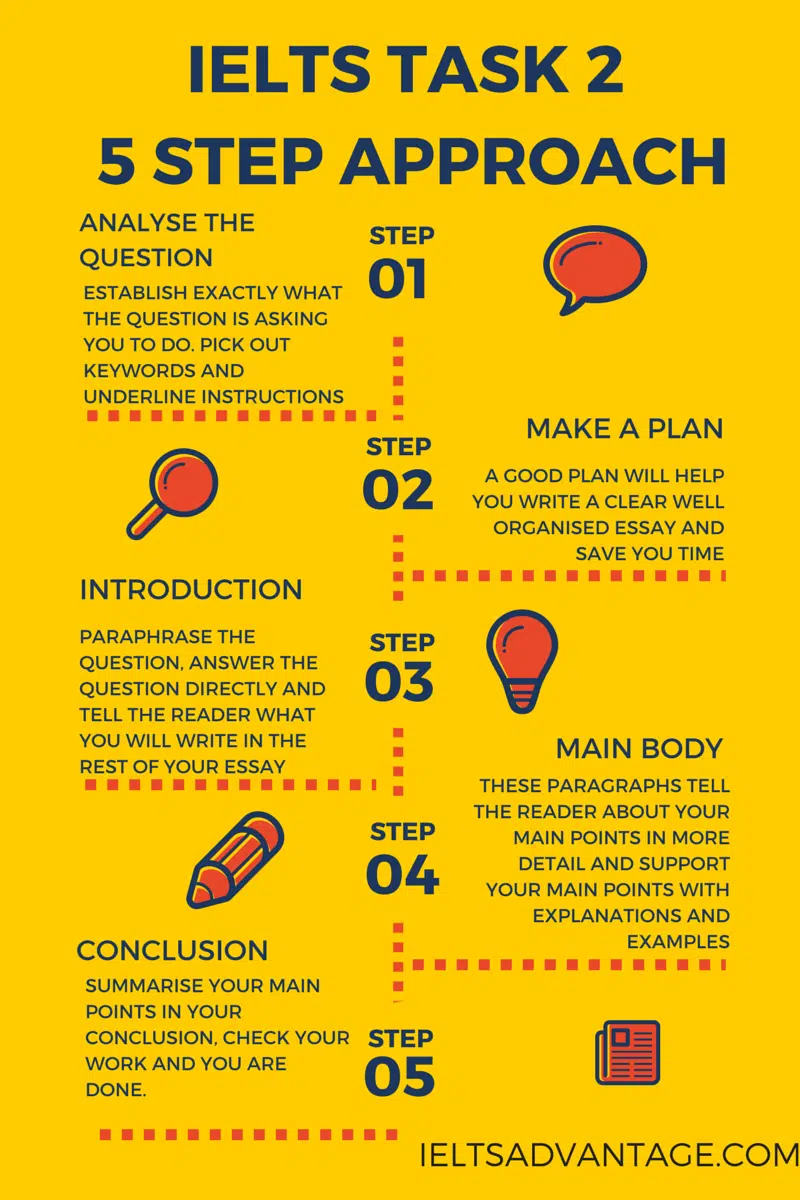
The five-step approach in the infographic is helpful because it makes one point clear: a finished essay is the result of several decisions, not a single act of writing. For time management, however, it is useful to group those decisions more broadly.
| Phase | Suggested timing | Main purpose |
|---|---|---|
| Pre-writing | Minutes 0–5 | Understand the prompt, decide on a response, and organise ideas. |
| Writing | Minutes 5–35 | Draft the introduction, body paragraphs, and conclusion from the plan. |
| Post-writing | Minutes 35–40 | Check task coverage, organisation, and high-impact language errors. |
A process is valuable because it reduces the number of decisions you must make while writing. If you have already chosen a position and two main ideas, you can focus your attention on explaining them clearly.
IELTS preparation: Power Writing for IELTS Task 2 Writing
In “IELTS preparation: Power Writing for IELTS Task 2 Writing,” the British Council Teacher Trainer separates planning, organising, drafting, evaluating, and revising. Watch it to see why planning and checking are part of writing rather than optional extras.
Watch planning and organising, paying particular attention to the need to analyse the whole prompt and arrange ideas before drafting. Then watch drafting and review for the distinction between checking task coverage and editing grammar or spelling.
Phase 1: pre-writing in five minutes
Planning does not mean writing a miniature essay in note form. It means making enough decisions that the draft has a clear destination.
Use this five-minute sequence:
| Time | Action | Result |
|---|---|---|
| Minute 1 | Read the entire prompt carefully. | You understand the situation and the question. |
| Minute 2 | Identify the task demand. | You know what you must answer, discuss, compare, explain, or evaluate. |
| Minutes 2–4 | Choose a position or central answer and generate two relevant main ideas. | You have a controllable argument rather than a list of unrelated thoughts. |
| Minute 5 | Allocate ideas to body paragraphs and note brief supporting details. | You have a paragraph-level route for the draft. |
Later sessions will teach you how to analyse each Task 2 question type precisely. For now, remember the essential discipline: do not react only to the topic word. Read the instruction as carefully as the topic.
Consider this prompt:
Some schools have restricted the use of mobile phones by students.
Is this a positive or negative development?
A quick plan could look like this:
| Plan element | Brief notes |
|---|---|
| Task | Decide whether school restrictions are positive or negative. |
| Position | Positive overall. |
| Body paragraph 1 | Fewer digital distractions; better concentration during lessons; improved learning. |
| Body paragraph 2 | Less screen time; more face-to-face interaction; stronger student well-being. |
| Conclusion | Restate that restrictions are beneficial because they support learning and social development. |
Notice what is not in this plan:
- complete topic sentences;
- memorised introductory phrases;
- advanced vocabulary chosen only to sound impressive;
- five or six possible arguments;
- detailed examples that have not yet been developed.
The plan is deliberately short. It should be written in phrases, because its function is to guide your draft—not to consume the drafting time.
A common concern is: “What if I cannot think of the perfect ideas?” In Task 2, a relevant, explainable idea is more useful than an original but difficult one. Choose two points you can develop logically. A clear explanation of a familiar point will usually be more effective than a complicated claim that cannot be supported within one paragraph.
Write an IELTS Band 9 Writing Task 2 Essay with an ex-examiner!
In “Write an IELTS Band 9 Writing Task 2 Essay with an ex-examiner!,” E2 IELTS presents a compact four-phase routine and a slightly different timing split. Use it to compare schedules and see why the final review period must be protected.
Watch the four phases. The presenter suggests roughly four minutes for analysis and planning, 32 minutes for drafting, and four minutes for review. Focus on the principle behind the numbers: a schedule may vary slightly, but planning and proofreading remain fixed stages.
Different teachers may recommend a 5–30–5 split or a 4–32–4 split. Both can work. For this course, use 5–30–5 while practising because it gives a beginner-friendly buffer for planning and a full final check. Once the routine becomes automatic, you can adjust by a minute if needed—but do so deliberately, not because the draft has drifted beyond its time limit.
Phase 2: drafting with checkpoints
The drafting phase should follow the plan, not replace it. You will still make language choices as you write, but you should not be deciding your entire position or inventing a new essay structure at minute 20.
For a standard four-paragraph response, this schedule is realistic:
| Time | Drafting focus | Checkpoint |
|---|---|---|
| Minutes 5–9 | Introduction | Paraphrase the topic and make the overall response clear. |
| Minutes 9–20 | Body paragraph 1 | Develop one main idea with explanation and, where useful, an example. |
| Minutes 20–31 | Body paragraph 2 | Develop a distinct but equally relevant main idea. |
| Minutes 31–35 | Conclusion | Restate the established answer and summarise the main reasoning. |
The previous lesson explained the different functions of these paragraphs. The timing now gives those functions practical boundaries.
Use stopping points
A timed plan only works if you are willing to move on. For example:
- At minute 9, stop improving the introduction and begin body paragraph 1.
- At minute 20, move to body paragraph 2 even if the first paragraph is not stylistically perfect.
- At minute 31, make sure you have begun the second body paragraph or are ready to write the conclusion.
- At minute 35, stop drafting and begin checking.
This does not mean writing carelessly. It means recognising that an unfinished conclusion or a missing body paragraph creates a larger problem than one sentence that could have been more elegant.
One useful habit is to avoid writing your conclusion only after you feel that the essay is “complete.” The conclusion is part of the required structure, so reserve time for it. If you are close to the minimum word count, do not add unrelated material to the conclusion. Instead, develop an existing body point more clearly, provided you still leave time to finish the response.
IELTS Writing Task 2: The Complete Guide (2026)
Read the “Time Management” subsection in Magoosh’s guide for a concise version of the 5–30–5 routine and an explanation of why skipping planning often causes problems later in the draft.
Under “IELTS Writing Task 2 Tips,” find the “Time Management” subsection. Read the three timing recommendations, then read why planning pays. Focus on the connection between a short plan and a more coherent, efficient draft.
Phase 3: use the final five minutes strategically
Post-writing is not a vague instruction to “check everything.” You will have limited time, so use a fixed order. First check problems that could affect the meaning and completeness of the response; then check language.
A five-minute post-writing routine
| Time | Check | Questions to ask |
|---|---|---|
| Minute 35–36 | Task coverage | Have I answered every part of the question? Is my position clear and consistent? |
| Minute 36–37 | Paragraph focus | Does each body paragraph have one main idea? Does the conclusion introduce anything new? |
| Minutes 37–39 | Grammar and punctuation | Are there sentence fragments, run-on sentences, verb-form errors, missing articles, or subject–verb agreement errors? |
| Minute 39–40 | Vocabulary and spelling | Have I misspelled key words? Have I used a word incorrectly or repeated it unnecessarily? |
The order matters. Correcting a spelling mistake is worthwhile, but it cannot compensate for failing to answer part of the task. Similarly, changing a simple word into an unfamiliar “advanced” synonym in the final minute may introduce an error. Prioritise clarity and accuracy.
During this final review, resist three unhelpful impulses:
- Do not rewrite the whole introduction. Improve it only if the position or task response is genuinely unclear.
- Do not add a new argument in the conclusion. A new idea needs explanation, and there is no time or space for that at the end.
- Do not make cosmetic changes that create risk. Keep accurate language unless a revision clearly improves precision or correctness.
The final check is where you confirm that the essay you wrote is the essay you intended to write at minute 5.
Build your own process card
Before your next timed Task 2 practice, create a small process card in your notebook. It should be brief enough to memorise:
0–5: Read, identify the task, choose a position, plan two body ideas.
5–35: Introduction; body paragraph 1; body paragraph 2; conclusion.
35–40: Task coverage; paragraph focus; grammar; vocabulary and spelling.
Then add two personal rules:
- A stopping rule: for example, “I begin the conclusion no later than minute 31.”
- A recovery rule: for example, “If one paragraph is taking too long, I finish its explanation, avoid extra detail, and move to the next section.”
A recovery rule is especially important. In a timed exam, an imperfect but complete response is usually preferable to an unfinished response containing one highly polished body paragraph.
Brief process rehearsal
Without writing an essay, practise saying the routine aloud once. Your goal is to be able to answer these questions quickly:
- What must be decided before drafting begins?
- When should the introduction be finished?
- What will you check before correcting vocabulary or spelling?
If you can answer those questions automatically, you are beginning to turn a general strategy into a usable exam routine.
Homework: create and test a Task 2 process plan
Do not write a full essay.
Use this prompt:
More people are using social media to obtain news and information.
Is this a positive or negative development?
- Set a timer for five minutes. Create a phrase-level plan: identify the task, choose a position, and note two body-paragraph ideas with brief support.
- Write your 30-minute drafting schedule beside the plan, including the minute when you will start each paragraph.
- Create a four-point, five-minute checking list specific to this response. Include one task-coverage check, one organisation check, one grammar check, and one vocabulary or spelling check.
- Finally, write two sentences evaluating your process: identify the stage most likely to challenge you and state the recovery rule you will use.
Keep the work at planning and process level. The purpose is to make the routine reliable before you apply it to complete responses.
A strong Task 2 response begins before the first sentence and continues after the final one. Use a protected pre-writing phase to understand and organise the task, a timed drafting phase to produce every required paragraph, and a focused post-writing phase to correct the most important weaknesses. The 5–30–5 schedule gives you a practical structure; your task is to make it automatic through repeated component-level practice.
Next, you will examine the four IELTS Writing assessment criteria—Task Response, Coherence and Cohesion, Lexical Resource, and Grammatical Range and Accuracy—and learn what each one asks an examiner to notice.
Can't find a good explanation? Sign up and we'll make it for you
Sign up