Hello! Welcome to the eighth module of our course, where we shift our focus to building and leveraging long-term relationships.
Introduction
In our last lesson, we dissected the tactics of negotiation, focusing on the anchoring effect and the strategic decision of when to make the first offer. Much of that discussion assumed a single, discrete transaction. But as a business owner, most of your interactions won't be one-offs. You'll be dealing with the same suppliers, the same contractors, and hopefully, repeat customers.
This lesson tackles a fundamental shift in strategic thinking. Our goal is to recognize how relationship value affects one-time versus repeated negotiation strategies. You'll learn to distinguish between situations where you should maximize a single outcome and those where nurturing the ongoing relationship is the more profitable long-term play. This is the difference between winning a battle and winning the war.
For your woodworking business, this distinction is critical. A tough, competitive negotiation might be right for buying a used CNC machine from a business that's closing down. But that same approach could be disastrous with the lumber supplier you'll depend on for the next ten years.
1. Playing the Right Game: Transactional vs. Relational Thinking
Many businesses struggle because they apply a short-term, transactional mindset to what should be long-term, relational partnerships. They win a small advantage today at the cost of a valuable relationship tomorrow. This creates what's known as a "trust tax"—where every interaction becomes slower, more complex, and more costly because of a lack of goodwill.
The following audio provides a powerful introduction to this idea. It contrasts a consultant who optimized every transaction and lost her clients, with a firm that optimized for the second meeting and thrived.
Game Theory: The Simple Strategy that Will Change Your Life Forever (Audiobook)
Listen to the first few minutes of 'Game Theory: The Simple Strategy that Will Change Your Life Forever'. It perfectly frames the core idea of this lesson: optimize for the long-term relationship, not the short-term win.
Please listen from 00:31 to 06:43. Pay close attention to the concept of the 'trust tax' and the story of Marcus, who succeeded by focusing on making the first project so smooth that clients couldn't wait to work with him again.
As the audio highlights, winners in business understand that life is a repeated game. Every decision shapes not just the immediate outcome, but future possibilities. When you build a reputation for being a great partner, negotiations shorten, margins can improve, and opportunities find you.
2. One-Shot vs. Repeated Games: The "Tomorrow Test"
So, how do you know which game you are in? The key lies in understanding the difference between a one-shot interaction and a repeated game.
-
One-Shot Game: A single interaction with no expectation of future dealings. In this scenario, there are no future consequences for your actions today. The classic example is the Prisoner's Dilemma, where in a single round, the most rational choice for both players is to defect (act selfishly), even though they would both be better off if they cooperated.
-
Repeated Game: A series of interactions over time. Here, your actions today directly impact how the other person treats you tomorrow. The prospect of future interaction casts a "shadow of the future" over the present, making cooperation a much more rational and profitable strategy.
The following audio segment explains this distinction and introduces a simple, powerful framework called the "Tomorrow Test" to help you diagnose which game you're playing in under 60 seconds.
Game Theory: The Simple Strategy that Will Change Your Life Forever (Audiobook)
Let's return to the audiobook to learn how to distinguish between these two types of games. The logic of the Prisoner's Dilemma is explained in a business context, followed by the actionable 'Tomorrow Test'.
Please listen from 11:47 to 17:20. Focus on a) why defection is rational in a true one-shot scenario and b) the three questions that make up the 'Tomorrow Test'.
The Tomorrow Test asks three simple questions:
- Will we interact again?
- Will others see how this interaction unfolds? (Reputation)
- Will reputation spillover affect future opportunities?
If the answer to all three is "no," you're in a one-shot game, and a more defensive, competitive strategy might be appropriate. If the answer to any of them is "yes," you're in a repeated game, and you should optimize for the long-term relationship.
Test your understanding!
Apply the "Tomorrow Test" to these two scenarios for your woodworking business:
- You are negotiating the price of a unique, antique workbench you found on a local marketplace. The seller is an individual moving out of state next week.
- You are negotiating your first order with a supplier who specializes in the high-grade walnut you need for your premium cabinets. They are one of only two such suppliers in your region.
Which is the one-shot game and which is the repeated game? How might your negotiation strategy differ?
Show answer
-
Antique Workbench: This is a classic one-shot game.
- Will you interact again? No, the seller is leaving.
- Will others see? Unlikely.
- Will reputation spillover? No, it's a private transaction.
- Strategy: You can negotiate more competitively (a "win-lose" approach). Your primary goal is to get the best possible price on this single transaction. You might make a low anchor offer and hold firm on your price.
-
Walnut Supplier: This is a clear repeated game.
- Will you interact again? Yes, you'll need them for every future project.
- Will others see? Your supplier talks to other woodworkers. Your reputation as a good or bad client could spread.
- Will reputation spillover? Yes. A good relationship could lead to better service, first access to special stock, or more flexible payment terms. A bad relationship could lead to the opposite.
- Strategy: You should adopt a collaborative ("win-win") approach. The goal isn't just to get the lowest price on this first order, but to establish a fair, reliable partnership that benefits you both in the long run. You might focus on demonstrating you'll be a reliable, high-volume customer in exchange for favorable long-term pricing.
3. Strategy for Repeated Games: Tit-for-Tat
If cooperation is the goal in repeated games, how do you achieve it without being taken advantage of? Game theory has a famously effective answer: the Tit-for-Tat strategy.
It's remarkably simple:
- Start by cooperating.
- Then, do whatever your opponent did in the previous round.
This video provides a fantastic explanation of why this simple algorithm consistently outperforms more complex strategies in the Iterated Prisoner's Dilemma. Given your engineering background, you'll likely appreciate the logical elegance of this feedback system.
The Evolution of Cooperation // Iterated Prisoner's Dilemma
This video from Dr. Trefor Bazett, 'The Evolution of Cooperation,' visually demonstrates how different strategies fare in repeated games and why Tit-for-Tat is so robust.
Please watch from 03:16 to 12:45. Pay attention to how Tit-for-Tat punishes defection but also forgives quickly, preventing long spirals of retaliation. Also, note the four key properties of successful strategies discussed at the end of the clip: nice, retaliating, forgiving, and non-envious.
Tit-for-Tat works because it is:
- Nice: It starts cooperatively, signaling good faith.
- Provocable (or Retaliating): It immediately punishes uncooperative behavior, so it can't be easily exploited.
- Forgiving: It returns to cooperation as soon as the other party does, preventing long-lasting feuds over a single mistake.
- Clear: It's so simple that your opponent can easily understand the pattern and predict your behavior.
In a business context, this means you lead with trust, but you don't allow yourself to be a doormat. If a supplier is late on a delivery, you impose the agreed-upon penalty. But as soon as they are back on schedule, the relationship returns to normal.
4. A Practical Framework: The Negotiation Matrix
We can tie all these concepts together with a practical tool used in business schools: the Lewicki and Hiam Negotiation Matrix. It helps you choose the right negotiation style by plotting your situation on two axes: the importance of the outcome and the importance of the relationship.
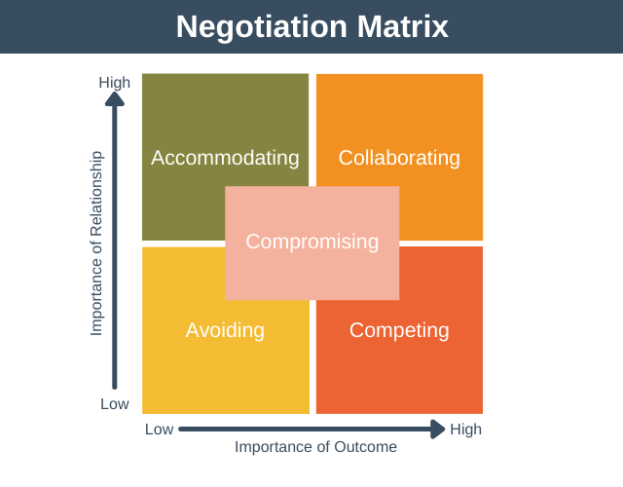
Let's explore the key styles from this matrix.
Lewicki and Hiam’s Negotiation Matrix
The article 'Lewicki and Hiam’s Negotiation Matrix' from Toolshero provides clear descriptions of these negotiation styles and when to use them. It directly connects the strategy to the value you place on the relationship.
Please read the subsections describing the 'Competing', 'Collaborating', and 'Accommodating' styles. As you read, think about a specific negotiation for your business that would fit into each category.
Here’s how the styles map to our discussion:
- Competing (Win-Lose): High Outcome, Low Relationship. This is your one-shot game strategy. You push hard for your own interests because there's no long-term relationship to preserve. (e.g., Buying that antique workbench from the seller who is moving away).
- Collaborating (Win-Win): High Outcome, High Relationship. This is your repeated game strategy. You need a good outcome, but you also need the relationship to thrive. You invest time to find creative solutions that benefit both parties. (e.g., Setting up terms with your main walnut supplier).
- Accommodating (Lose-Win): Low Outcome, High Relationship. You intentionally take a small loss on an unimportant issue to build goodwill for the future. This is a strategic investment in the relationship. (e.g., Agreeing to pick up a small order yourself to help out your busy supplier, strengthening the partnership for future, more important negotiations).
The key insight is that your negotiation style is not fixed; it's a strategic choice dictated by the context.
Conclusion
Today, we've established a crucial dividing line in strategic thinking: the difference between a one-time transaction and an ongoing relationship. Mistaking one for the other is a common and costly business error.
Key Takeaways:
- One-Shot Games have no "shadow of the future," making competitive, win-lose strategies rational. Your goal is to maximize the value of the single transaction.
- Repeated Games are influenced by the future. Your reputation and the value of the relationship itself become strategic assets, making cooperative, win-win strategies (like Tit-for-Tat) more profitable over the long term.
- The "Tomorrow Test" helps you quickly diagnose whether you're in a one-shot or repeated game.
- The Negotiation Matrix provides a practical framework for choosing a style (Competing, Collaborating, etc.) based on the importance of the outcome versus the relationship.
Preview of the Next Lesson:
We've seen how the prospect of future interaction encourages cooperation with partners like suppliers and customers. But what about competitors? In our next lesson, we will analyze how cooperation with competitors can be sustained in a repeated game, exploring situations where even rivals can find it mutually beneficial to cooperate rather than compete to the death.