Hello! Welcome to our next lesson on negotiation.
In our last session, we identified the core sources of bargaining power. We established that while patience and information are important, the most fundamental source of power is your Best Alternative to a Negotiated Agreement, or BATNA. It's the ultimate trump card because it gives you the ability to walk away from a bad deal.
Today, we will build directly on that foundation to address our learning outcome: Analyze how your and their alternatives (BATNAs) affect negotiation outcomes. We'll move from simply knowing that BATNAs are important to using them as a powerful analytical tool. You'll learn a systematic process to evaluate your alternatives and estimate your counterpart's, allowing you to define the true bargaining range and negotiate with confidence.
From Alternatives to Walk-Away Points: Defining BATNA and ZOPA
Let's start with a quick and clear refresher on the two most important acronyms in negotiation: BATNA and ZOPA.
Negotiating Using BATNA and ZOPA
The video 'Negotiating Using BATNA and ZOPA' from Sales Training International offers a concise explanation of these core concepts.
Please watch the first two segments of the video (from 00:00 to 01:26). Focus on how: BATNA is defined as your backup plan or 'walk-away point.' ZOPA (Zone of Possible Agreement) is the overlap between the buyer's and seller's acceptable ranges.
The key insight is that your BATNA determines your reservation point (your walk-away price). The seller also has a BATNA that determines their reservation point. The space between these two points is the ZOPA—it's the only place a deal can happen.
This diagram shows it perfectly:

Imagine you are the buyer. If you can improve your BATNA (e.g., find a better alternative supplier), your "Worst Case" moves to the left, say from $7,900 to $7,000. This shrinks the ZOPA and gives you more power, as the seller must now offer a price below $7,000 to win your business.
A Systematic Process for Determining Your BATNA
Thinking about your BATNA shouldn't be a vague exercise. It's an analytical process. Given your engineering background, you'll likely appreciate this structured approach.
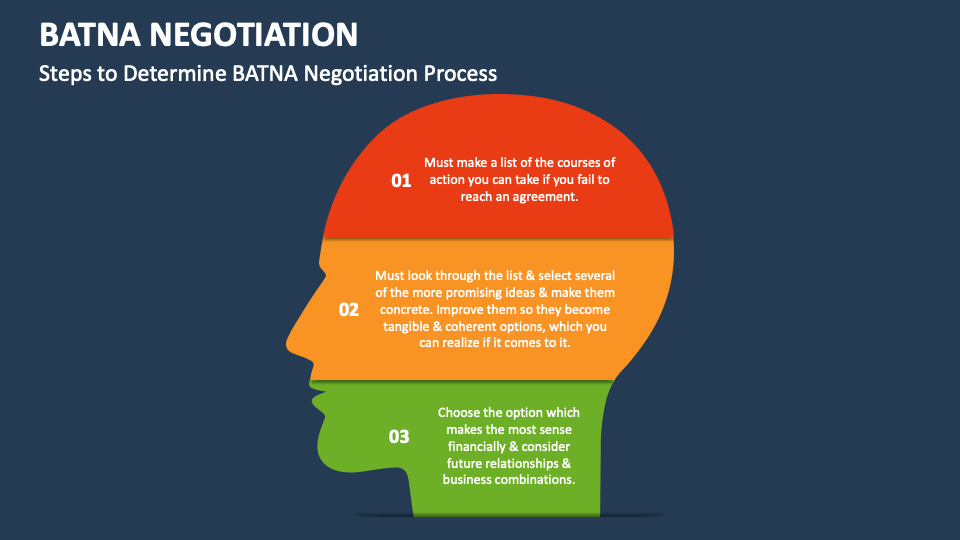
To put this into practice, let's look at a resource that formalizes this process.
BATNA Basics: Boost Your Power at the Bargaining Table
The article 'BATNA Basics: Boost Your Power at the Bargaining Table' from the Program on Negotiation at Harvard Law School provides an excellent, four-step process for calculating your BATNA and your reservation value.
Please read the first section, 'Assess your BATNA using a four-step process' (pages 1-2). Pay close attention to the business partnership example and how the protagonist, Shapiro, could have used a simple formula to calculate the true value of his BATNA (going to court) and avoided a costly mistake.
Let's apply that four-step process to a crucial decision for your woodworking business: buying your first major CNC machine. You are negotiating with "Supplier A".
-
List your alternatives: If you don't buy from Supplier A, what will you do?
- Buy a similar machine from "Supplier B".
- Buy a used CNC machine from an online marketplace.
- Outsource your CNC cutting to another local shop for the first year.
- Don't buy a CNC at all and focus only on furniture that can be made with more basic tools.
-
Evaluate your alternatives: This is where you put numbers and real value to each option.
- Supplier B offers a machine for $32,000, but its software is less intuitive.
- A used machine costs $20,000, but has no warranty and could have high maintenance costs (let's estimate $5,000 in potential repairs/upgrades in the first year).
- Outsourcing would cost about $100/hour. You estimate you'll need 200 hours in the first year, totaling $20,000, but you build no equity in an asset.
- Not buying a CNC severely limits your product line to lower-value items.
-
Establish your BATNA: Looking at the list, buying from Supplier B seems to be your Best Alternative. The used machine is too risky, and outsourcing costs a lot without giving you an asset.
-
Calculate your reservation value: Your BATNA is the $32,000 machine from Supplier B. Therefore, your reservation value in the negotiation with Supplier A is $32,000. You should not accept any offer from Supplier A that is worse than this alternative (e.g., higher price for the same features, much longer delivery time, etc.). You now have a clear, data-driven walk-away point.
Analyzing the Other Party's BATNA
Knowing your own BATNA is only half the battle. Your power in a negotiation is directly affected by how strong or weak the other party's BATNA is.
If their alternative is weak, they need the deal with you more. If their alternative is strong, they can afford to be tough.
BATNA Basics: Boost Your Power at the Bargaining Table
Let's return to the 'BATNA Basics' article for a powerful illustration of why you must analyze the other side.
Please read section 2, 'Take your BATNA to the next level' (pages 3-5). Focus specifically on point #2, 'Assess their BATNA with care.' The story of the Mississippi farmer is a classic example of what happens when you only focus on your own side of the equation and leave millions on the table.
Applying this to your business:
- When buying from a supplier: Before you negotiate for that CNC machine, do your homework. Is this a new model they are trying to promote? Are they trying to clear out last year's inventory before a new model arrives? If so, their BATNA (keeping the machine in stock) is weak. Conversely, if it's their most popular model with a six-month waiting list, their BATNA (selling to the next person in line) is extremely strong, and you'll have very little room to negotiate on price.
- When selling to a customer: When a client asks for a quote on a full set of kitchen cabinets, what are their alternatives? Are there other local woodworkers who can match your quality? Or are you the only one in the region specializing in the premium, high-gloss finish they want? A client with few good alternatives has a weak BATNA and will be willing to pay more for your unique service.
From Analysis to Action: Strengthening Your Position
Your BATNA is not static. You can, and should, actively work to improve it before you enter a negotiation. A stronger BATNA is a direct investment in your bargaining power.
Using BATNA (Best Alternative to a Negotiated Agreement) ...
This article from Ramen Legal, 'Using BATNA in Contract Negotiations,' offers excellent, practical advice for startups on how to proactively build a stronger negotiating position.
Please read three short sections from this guide: '3. Developing a Strong BATNA': Focus on the actionable advice like conducting research and building multiple alternatives. '4. Leveraging BATNA in Contract Negotiations': Note the advice on how to assess the other party's BATNA and use your own to strengthen your position. '7. Common Pitfalls and How to Avoid Them': Pay special attention to the pitfalls of 'Revealing BATNA Prematurely' and 'Ignoring the Other Party's BATNA.'
The key takeaway is that preparation is everything. Before talking to your primary CNC supplier, get a formal, written quote from Supplier B. This transforms your BATNA from a vague idea into a concrete, ready-to-go alternative.
Test your understanding!
You are negotiating the price for a large quantity of premium walnut lumber with "Supplier Alpha."
- Your Situation: You've done your research. Your BATNA is to buy the same quantity and quality of walnut from "Supplier Beta" for a total cost of $5,000, including shipping.
- Their Situation: You've heard from others in the industry that Supplier Alpha has a large inventory of walnut that they need to move to make space for a new shipment of oak.
- What is your reservation price in the negotiation with Supplier Alpha?
- How does your analysis of Supplier Alpha's BATNA affect your negotiation strategy? Should you start with a high or low offer?
Show answer
-
Your reservation price is $5,000. You should not accept any deal from Supplier Alpha that costs you more than your best alternative. Any price below $5,000 creates value for you.
-
Your analysis shows that Supplier Alpha likely has a weak BATNA. Their alternative to selling to you is to keep the lumber in stock, which costs them money and storage space they need. This gives you significant bargaining power.
Therefore, your strategy should be to make a confident and aggressive (but still reasonable) opening offer. You wouldn't open at $4,900, as that's too close to your limit. You might start much lower, perhaps around $4,000 or $4,200, justifying it based on the large volume you're purchasing. You have room to negotiate upwards because you know they are likely eager to make a deal.
Conclusion
Today, you've moved from a general understanding of bargaining power to a specific, analytical framework centered on BATNAs. This approach allows you to enter any negotiation with a clear-eyed view of the strategic landscape.
Key Takeaways:
- Your BATNA is your best course of action if a deal isn't reached, and it directly determines your reservation price (your walk-away point).
- A negotiation is only possible within the ZOPA (Zone of Possible Agreement), which is the space between the buyer's and seller's reservation prices.
- You can increase your power by actively improving your BATNA before you negotiate (e.g., by getting competing quotes).
- Analyzing the other party's BATNA is just as critical as knowing your own. A weak BATNA on their side is a major source of power for you.
Preview of the Next Lesson:
Now that you understand how your BATNA provides the power to walk away, our next lesson will focus on how to communicate that power. We will explore how to determine credible versus non-credible threats and promises in business negotiations. You'll learn that a threat is only credible if it is backed by a strong BATNA, turning your analysis from today into a powerful tool of influence.