Hello! Welcome to the next module in our course, "Foundations for Strategic Business Decisions."
In the last few lessons, we've focused entirely on your relationship with competitors, analyzing pricing as a strategic game and learning how to avoid mutually destructive price wars. But as a business owner, competitors are only one set of players you'll interact with. Your success also depends heavily on your interactions with two other crucial groups: suppliers and customers.
Today's lesson marks our shift into this new area: negotiation. We'll begin by addressing the learning outcome: Identify your sources of bargaining power in supplier and customer negotiations. Understanding where power comes from is the first step to wielding it effectively, whether you're buying a major piece of machinery, sourcing your premium lumber, or closing a deal with a high-end client.
What is Bargaining Power?
At its core, every negotiation is about dividing a "pie" of value. This "pie" is the mutual benefit created when a deal is made. Economists call this the bargaining surplus. Your bargaining power is simply your ability to claim a larger slice of that pie.
To understand this, we first need to define the boundaries of the negotiation.
Negotiation & Economics: basics
This document, 'Negotiation & Economics: basics', provides a clear and fundamental explanation of the negotiation space. It introduces the core concepts of 'reservation points' and the 'bargaining zone'.
Please read the section titled 'The zone of possible agreement (bargaining zone)' (page 7). It uses a simple example of selling a bike to illustrate the key terms. Focus on understanding the definitions of: Reservation Point: Your 'bottom line' or walk-away point. Bargaining Zone (or ZOPA): The Zone of Possible Agreement, which is the range of prices between the buyer's and seller's reservation points.
Let's apply this to your business:
- You're buying a CNC machine. The seller's reservation point is the absolute minimum price they'll accept (e.g., $18,000). Your reservation point is the absolute maximum you're willing to pay (e.g., $22,000).
- The Bargaining Zone (ZOPA) is the $4,000 range between $18k and $22k. Every dollar within this zone is part of the surplus you're negotiating over.
- If you have high bargaining power, you might close the deal at $18,500. If the seller has high power, you might pay $21,500.
Your goal is to identify and cultivate the factors that give you this power.
An Overview of Bargaining Power Sources
So, where does this power come from? It's not just about being a tough talker. It stems from a set of strategic factors.
Bargaining 101 (#3): Sources of Bargaining Power
The video 'Bargaining 101 (#3): Sources of Bargaining Power' by William Spaniel gives an excellent, concise overview of the key sources of power in any negotiation.
Please watch the introductory section from the beginning to 01:18. Pay attention to the list of eight sources of power he introduces. We will be diving into the most critical ones for your business.
As you saw, bargaining power comes from many places. For your new business, we'll focus on the most impactful ones: outside options, patience, and information.
1. Outside Options: The Ultimate Source of Power
The most fundamental source of bargaining power is your Best Alternative To a Negotiated Agreement (BATNA). It's what you'll do if the current negotiation fails. A strong BATNA means you can afford to walk away from a bad deal.
Bargaining 101 (#3): Sources of Bargaining Power
Let's revisit William Spaniel's video to hear his explanation of outside options.
Please watch from 03:34 to 04:14, where he discusses how having an alternative forces the other side to be 'nicer' to you.
Application to your business:
- Negotiating with Suppliers: Before you even contact a CNC machine vendor, get quotes from two or three of their competitors. Each of those other quotes is a powerful BATNA. If one vendor's final offer is $21,000, but you have a credible quote for a comparable machine at $20,000 from another, you have immense leverage.
- Negotiating with Customers: Suppose a potential client is demanding a 25% discount on a large kitchen cabinet project. If you have a waiting list of other clients ready to pay full price, your BATNA is excellent. You can politely decline the discount, knowing you have a profitable alternative. If you have no other clients lined up, your BATNA is weak, and you'll feel pressure to accept the bad deal.
Improving your BATNA is the single most important preparation you can do before any negotiation.
2. Patience: The Power of Not Being Desperate
Time is a critical factor in negotiation. The party that is more patient and less desperate for an immediate deal almost always has more power.
Bargaining 101 (#3): Sources of Bargaining Power
Let's hear Spaniel's take on why patience is so critical.
Now watch from 02:35 to 03:34. Notice his point that the person who needs the deal the most gets the worst end of it.
Application to your business:
- Buying Equipment: If you wait until your old machine breaks down and your production is completely halted to negotiate for a new one, you have no patience. The supplier will sense your urgency. By planning your purchases months in advance, you signal that you can wait for the right deal, which gives you power.
- Securing a Lease: If you need to be in a new workshop by the first of next month, your landlord has significant power. If your timeline is flexible, you can negotiate harder on terms and price.
3. Information: The Power of Knowledge
The more you know about the other party's situation—their costs, their deadlines, their alternatives (their BATNA!)—the more power you have. Asymmetric information, where one party knows more than the other, is a major source of power.
Bargaining 101 (#3): Sources of Bargaining Power
Let's watch one more clip from Spaniel's video on the power of knowledge.
Please watch from 06:25 to 07:37. He explains the choice you face when you don't have information: make a 'safe' (costly) offer or an 'aggressive' (risky) offer. Good information helps you avoid this dilemma.
Application to your business:
- With Suppliers: Before negotiating for a specific species of lumber, research the current market rates. Is there a surplus driving prices down? Is it a rare, coveted wood? Knowing the supplier's likely cost basis allows you to make an aggressive but reasonable offer.
- With Customers: During your initial consultations, ask good questions. What's their overall renovation budget? Are they getting other quotes? A client who reveals they have a $100k budget and loves your design gives you the power to price your work based on the value you provide, rather than just guessing.
A Framework for Analyzing Supplier Power
When dealing specifically with suppliers, we can use a more structured framework developed by Michael Porter. This helps you systematically analyze how much power your suppliers have over you.
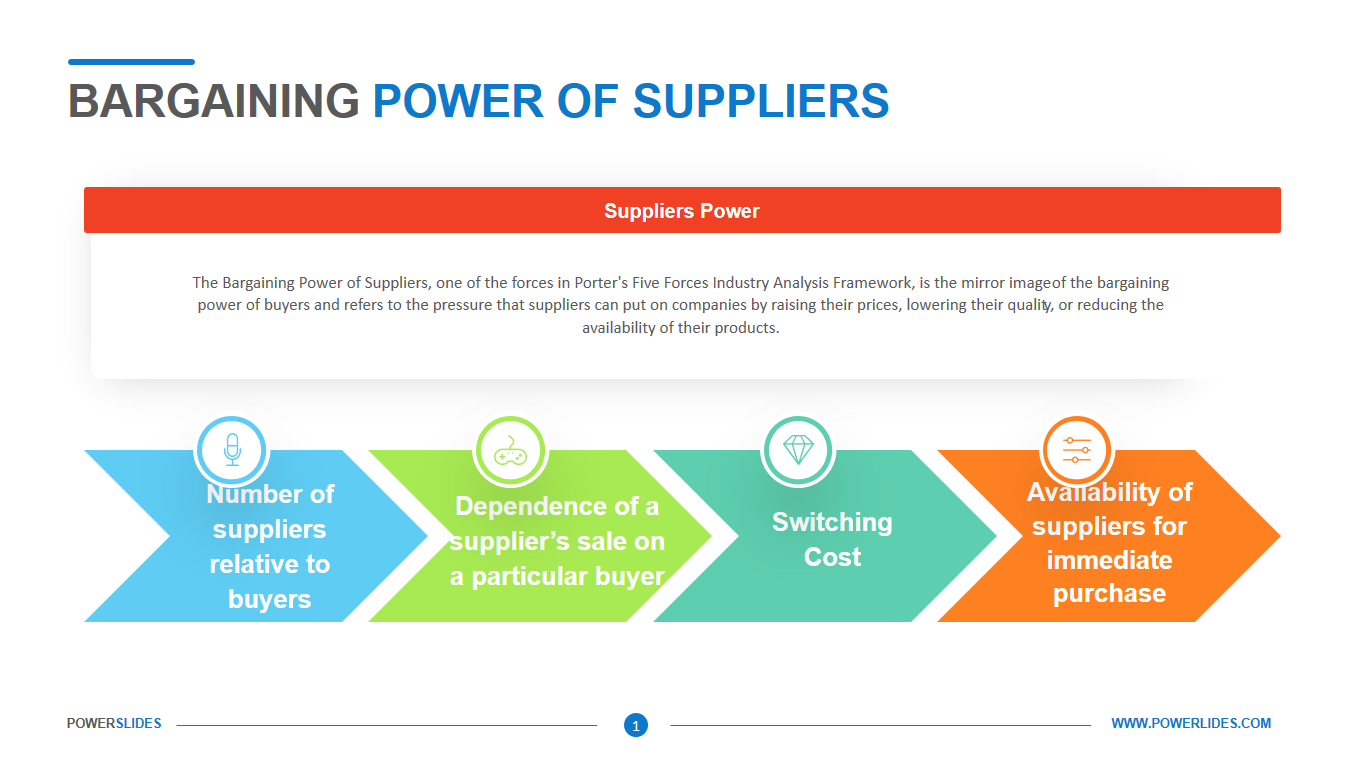
Porter's 5 Forces: Bargaining Power of Suppliers
The video 'Porter's 5 Forces: Bargaining Power of Suppliers' from the Edspira channel provides a fantastic, practical breakdown of these factors.
Please watch the entire video (it's about 6 minutes). As you watch, think about how each factor applies to two different types of suppliers for your business: A supplier of a common material, like MDF or standard plywood. A supplier of a unique, high-end CNC machine or a rare type of hardwood.
Let's quickly apply those factors to your business:
- Supplier Concentration: If there is only one local dealer for the CNC brand you want, that dealer has high power. If there are dozens of lumberyards selling Red Oak, each has low power.
- Switching Costs: Once you invest time learning the software for a specific CNC machine (e.g., a ShopSabre), the cost and hassle of switching to another brand (like Avid CNC) are high. This gives ShopSabre's tooling and parts suppliers more power over you in the future.
- Criticality of Input: For your premium brand, a flawless piece of figured walnut is a critical input. The supplier who can provide it has a lot of power. The screws you use to assemble cabinets are not critical; you can buy them anywhere, so their supplier has no power.
- Threat of Forward Integration: Can your lumber supplier decide to start making and selling their own premium cabinets? It's possible. If that threat is credible, it gives them leverage in your negotiations.
Creating Power: You Can Set the Rules of the Game
Finally, remember that bargaining power isn't just something you have or don't have. You can actively create it by being the one who designs the negotiation process.
How to use game theory to maximize your negotiation outcomes
This procurement guide, 'How to use game theory to maximize your negotiation outcomes,' has a great section on this concept, which it calls 'Mechanism Design.'
Please read the two pages that cover 'The Suppliers Dilemma' and 'Mechanism Design'. The key insight is on the second page: 'Setting the rules of the negotiation gives the advantage to the rule setting party (the buyer).'
When you are the buyer, you can be the "policeman" from the Prisoner's Dilemma—you can set the rules!
How to set the rules as a buyer:
- Create a Formal RFQ (Request for Quotation): Instead of just calling one supplier, create a document that specifies exactly what you need (e.g., CNC machine specs, delivery date) and send it to three vendors. You have just designed a competitive game where they have to bid for your business.
- Maintain Multiple Suppliers: Even if one lumber supplier gives you a slightly better price, make it a point to give a small amount of business to a second supplier. This keeps the primary supplier on their toes and ensures you always have a strong, active BATNA. You've designed a system that preserves your bargaining power.
Test your understanding!
Imagine you're negotiating with a supplier for a unique, exotic wood veneer. This supplier is the only one in your state who stocks it, and they know your client wants it for a high-profile project.
First, identify the primary source of the supplier's bargaining power. Then, list at least two things you could do to increase your own bargaining power in this situation.
Show answer
Supplier's Power Source: The supplier's main source of power is Monopoly Power (from Spaniel's list) or High Supplier Concentration (from Porter's framework). They have a unique, critical product with no immediate local substitutes.
How to Increase Your Power:
- Improve Your BATNA (Outside Option): Research the possibility of importing the veneer directly from an international supplier. Even if it's more complicated, getting a quote creates a credible alternative and puts a ceiling on what the local supplier can charge.
- Gain Information/Knowledge: Research the global market price for this veneer. Find out what a fair price should be. This prevents you from accepting an outrageously high offer and allows you to anchor the negotiation around a more reasonable number.
- Leverage Patience: If the client's timeline is flexible, you can communicate that you are willing to wait for a better price or explore other design options, reducing the supplier's ability to pressure you with scarcity.
- Change the Game: Offer the supplier a larger deal—perhaps committing to buy other, more common materials from them for the next six months in exchange for a better price on the exotic veneer. This changes the negotiation from a single transaction to a larger, relationship-based deal.
Conclusion
Today, we've broken down the often-vague concept of "bargaining power" into concrete, identifiable sources. You've learned that power isn't just about attitude; it's a strategic asset you can analyze and cultivate.
Key Takeaways:
- Bargaining power is your ability to capture more of the bargaining surplus (the value created in a deal).
- Your most crucial source of power is your BATNA (Best Alternative to a Negotiated Agreement). Always know what you'll do if you walk away.
- Patience and information are powerful tools. The more you have of both, the weaker the other party's position becomes.
- When dealing with suppliers, you can systematically analyze their power by looking at factors like concentration, switching costs, and the criticality of their product.
- You can actively create your own power by designing the negotiation process, for example, by forcing suppliers to compete for your business.
Preview of the Next Lesson:
Now that we know where bargaining power comes from, we need to learn how to use it to our advantage. In the next lesson, we will focus specifically on your BATNA. We'll explore how to analyze your and their alternatives to set concrete goals and anchors for your negotiation, moving from identification to direct application.