Welcome back! In our last lesson, we zeroed in on the final step of the persuasion flow: writing clear, low-friction calls-to-action (CTAs). We saw how the right CTA, matched to the buyer's readiness, can turn a convinced reader into a qualified lead.
Today, we're going to zoom out and put all the pieces of this module together. We've covered structure, feature-to-outcome translation, stakeholder messaging, social proof, and CTAs. Now, you'll use that knowledge to perform one of the most valuable functions of a senior copywriter: improving existing copy.
Our learning outcome is to critique and rewrite a section of a B2B landing page to better address a target buyer's needs. This lesson is all about moving from a writer to a strategist—someone who can diagnose weaknesses in copy and transform it to drive results.
1. Frameworks for Effective Critique
A good critique isn't based on vague feelings; it's a systematic analysis. To do this effectively, we need a reliable framework. The following article provides an excellent checklist for evaluating and improving B2B copy.
I Read 100 SaaS Landing Pages So You Don't Have To
Let's establish a clear, actionable framework for analyzing B2B copy. The article 'I Read 100 SaaS Landing Pages So You Don't Have To' by Pallavi Pant on Medium provides an excellent structure.
Please read two parts of this article: 'The 5-Step Framework for High-Converting Copy': Starts with 'Step 1: Lead with the Outcome...' and ends with '...highly rewarding for the user.' '3 Common Mistakes That Kill Conversions' As you read, think of these as a practical checklist for evaluating any piece of B2B copy.
This framework gives you a tactical "how-to." To understand the psychology behind why it works, we can use a simple but powerful mental model: Alex Hormozi's Value Equation.
Effective copy increases the perceived value of an offer by:
- Maximizing the Dream Outcome (the result the buyer wants).
- Maximizing the Perceived Likelihood of Achievement (their belief they'll get that result).
- Minimizing the Time Delay (how long it takes to get the result).
- Minimizing the Effort & Sacrifice (how hard it is to get the result).
Notice how the 5-step framework aligns with this. "Lead with the outcome" focuses on the Dream Outcome. "Address the hidden objection" increases the Likelihood of Achievement. Making things specific and clear reduces perceived Effort.
Keep both the 5-step checklist and the Value Equation in mind as we move to our practical exercise.
2. Analysis of a Weak Landing Page
Now, let's apply these frameworks to a real-world example of a weak B2B landing page.
How To Create High Converting B2B Landing Pages in 2025
The video 'How To Create High Converting B2B Landing Pages in 2025' includes a great segment where the presenter critiques several underperforming pages. We're going to focus on one of them.
Please watch from 06:03 to 06:44. Pay close attention to the analysis of the 'Greystone' landing page. The presenter quickly identifies flaws related to credibility, the call-to-action (which he calls the 'lure'), and overall message clarity.
As you saw, the Greystone page fails on several fronts. Let's break it down using our 5-step checklist from the Medium article.
The "above the fold" section of the Greystone page presents:
- Headline:
Bridge and Mezzanine Loans - Call-to-Action:
Meet Our Leadership
Using your checklist, how does this stack up?
- Step 1: Lead with the Outcome? No. It leads with the product category (a feature). It doesn't say what the buyer gets.
- Step 2: Address Objections? No. It creates objections by lacking any credibility signals.
- Step 3: Use Specific Numbers? No. The copy is generic.
- Step 4: Show, Don't Tell? No. It just tells you the loan types.
- Step 5: Low-Friction CTA? No. "Meet Our Leadership" is a terrible CTA. It's not what the buyer came for and offers them no value. It's a high-friction, zero-value action.
The page is a classic example of the "We" Syndrome—it's all about what the company is, not what the buyer needs.
3. Your Turn: Rewrite the Landing Page Section
This is your main task for today. You are the new copywriter for Greystone. Your goal is to transform the weak "above the fold" section into a compelling message that resonates with the target buyer.
Target Buyer Persona:
- Who: A mid-sized real estate developer.
- Goal: Secure financing for a new construction project quickly.
- Pain Point: Frustrated with the slow, bureaucratic process of big banks. They are worried about missing project deadlines due to financing delays.
- Need: A fast, flexible, and reliable financing partner.
Your Task:
Rewrite the following elements for the Greystone landing page's "above the fold" section to better address the target buyer's needs.
- Headline:
- Sub-headline (or 2-3 short bullet points):
- Call-to-Action (the button text):
Use the 5-step framework and the Value Equation to guide your writing. Focus on the buyer's dream outcome (fast funding), increase their perceived likelihood of achieving it (by sounding credible and professional), and reduce the perceived effort (with a clear, logical next step).
Take about 10-12 minutes for this exercise.
4. Deconstructing the Rewrite
Excellent work. Rewriting requires you to step into the buyer's shoes and answer their unspoken question: "What's in it for me?"
Here is one possible way to approach the rewrite, with explanations for each choice:
My Example Rewrite:
-
Headline:
Get Your Real Estate Project Funded in as Little as 7 Days.- Why it works: It leads directly with the buyer's dream outcome (getting funded). It uses a specific number ("7 Days") to make the promise concrete and address their pain point about speed (minimizing Time Delay).
-
Sub-headline:
Tired of slow bank approvals and rigid terms? We provide fast, flexible bridge and mezzanine loans for developers who need to move quickly.- Why it works: It directly addresses the hidden objection and pain point (slow banks). It positions Greystone as the solution. It uses "You-focused" language by implication ("Tired of...?").
-
Call-to-Action:
See Your Funding Options- Why it works: This is a low-friction micro-commitment. It's not "Apply Now" (too much commitment) or "Meet our Leadership" (irrelevant). It promises immediate value—information that helps the buyer make a decision. It reduces the perceived Effort & Sacrifice.
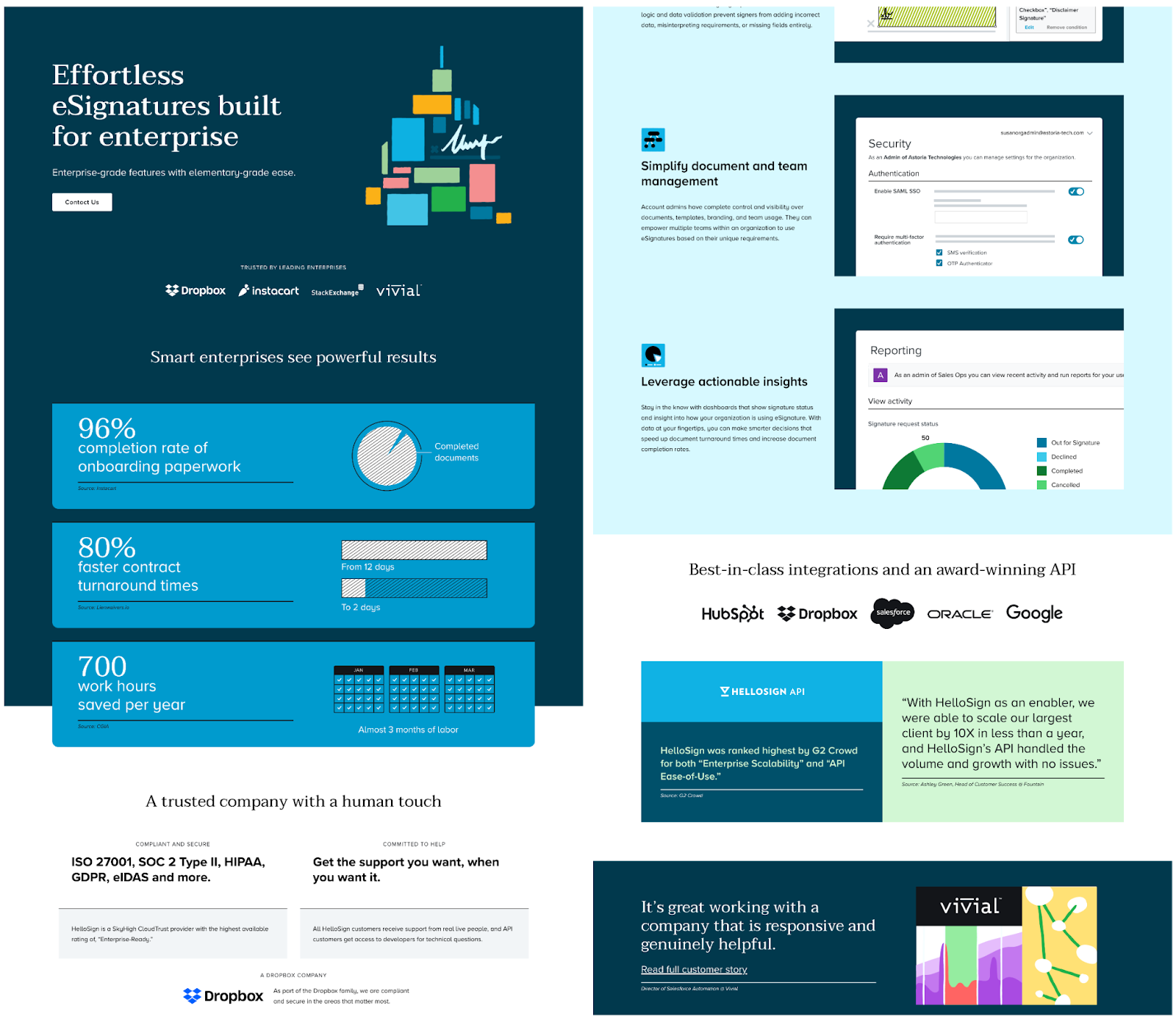
This revised version transforms the page from a static label into a dynamic solution. It speaks directly to the developer's needs and anxieties. For a visual of how these principles come together on a well-designed page, look at this example from HelloSign.
Conclusion
Great job today! You've successfully applied a full suite of copywriting principles to diagnose and fix a weak B2B landing page. This ability to critique and improve is what separates good copywriters from great ones.
Key Takeaways:
- Critique with a Framework: Use structured models like the 5-step checklist and the Value Equation to analyze copy objectively.
- Shift from "We" to "You": The most powerful rewrite often involves changing the perspective from what the company offers to what the customer achieves.
- Rewrite for a Specific Persona: The best copy is a direct answer to a specific person's problem. By defining the buyer's needs and pains, your copy becomes sharp and relevant.
Preview of the Next Module:
Over the last several lessons, we've learned how to craft and refine copy based on strategy and best practices. But in the real world, how do we prove our new version is better?
Our next module, "Testing and Iterating Your Copy," takes us into the world of data. In our first lesson, we will learn how to design a simple A/B test for a B2B headline, email, or CTA, and define its success metrics. This is how you'll demonstrate the tangible business impact of your copywriting skills.