
Hello again. In the last lesson, you saw that an agent’s model-driven choices can vary across runs, and that this uncertainty can compound as the agent selects tools and interprets results. The product implication was clear: consequential behavior needs evidence, guardrails, verification, and escalation—not merely a lower temperature setting.
That leads to a more fundamental PM decision: should this task have an autonomous agent at all? An agent can remove user effort in valuable, messy workflows, but it also adds cost, latency, operational complexity, and new failure modes. This lesson gives you a practical way to identify tasks where that trade is justified, and where conventional software or a structured AI workflow is the better product.
Autonomy is a means, not the product
A user generally does not want “an agent.” They want an outcome: a return completed, an account issue resolved, a report produced, or a code change prepared for review.
Conventional software supports that outcome by presenting a predetermined process. It may automate individual steps, but the system controls the sequence. An autonomous agent is different: it receives a goal, determines a suitable next step from the situation, uses tools, checks what happened, and adapts until it reaches a completion condition or a stopping point.
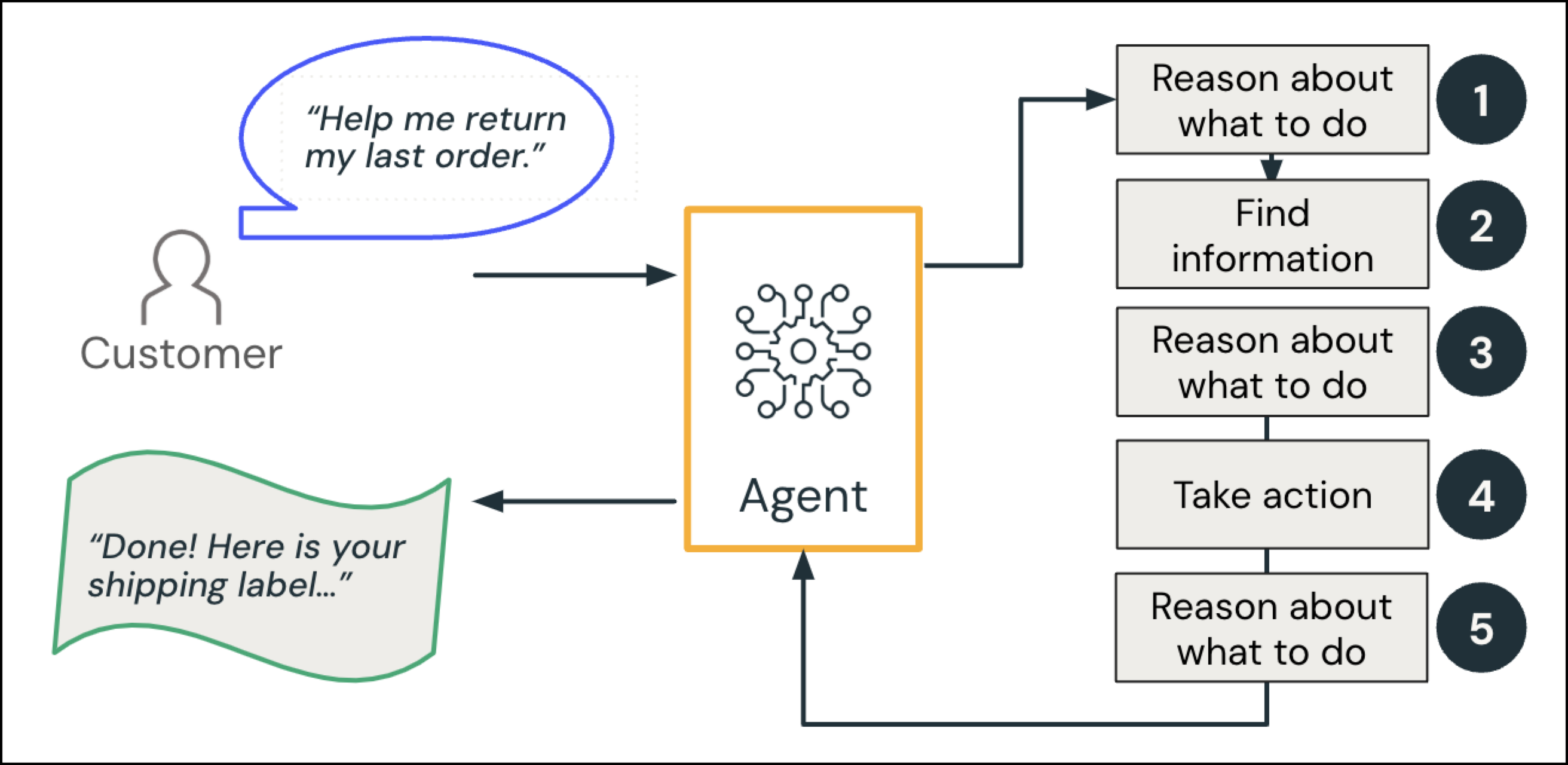
For example, consider three product designs for the goal “Help me return my last order.”
| Product approach | What controls the workflow? | Example experience |
|---|---|---|
| Deterministic automation | Explicit rules and a fixed path | The user selects an order, selects a return reason, and receives a label if eligibility rules pass. |
| Structured AI workflow | The product controls the path; an LLM assists at selected steps | The user describes the issue in free text; the model extracts the return reason, while fixed rules decide eligibility and the user submits the return. |
| Autonomous agent | The model chooses permitted next steps within boundaries | The user states their goal conversationally; the agent identifies the likely order, checks policy and delivery status, asks only necessary clarifying questions, creates the authorized return, verifies it, and explains the outcome. |
The distinction is not whether an LLM appears in the product. A summarizer, chatbot, classifier, or document extractor is not automatically an agent. The essential question is whether the LLM controls meaningful workflow execution: choosing actions and adapting to results on the user’s behalf.
A practical guide to building agents
Read OpenAI’s guide for a concise definition of an agent and its decision criteria. It is especially useful for separating “an LLM feature” from an autonomous system that acts through tools.
In the section “What is an agent?”, read the definition and core characteristics. Notice that tool access alone is insufficient: the model must manage execution, recognize completion, and be able to halt or hand control back. Then, in “When should you build an agent?”, read the three signs of agent fit: nuanced decisions, unwieldy rule systems, and unstructured information. Treat these as positive signals to investigate, not as an automatic approval to build.
The agent’s advantage is therefore not “better conversation.” Its advantage is the ability to handle variation that would otherwise force users or operations staff to repeatedly interpret, decide, act, and recover from exceptions.
The core test: does the workflow need flexible judgment?
A fixed workflow is usually preferable when its decision path is known in advance and can be expressed cleanly in rules, forms, or a small number of controlled AI calls. It is cheaper, easier to test, easier to explain, and more predictable.
Autonomy begins to add value when the product cannot reasonably predefine the path for every case—but the task still has a meaningful end state.
Three task properties are particularly important.
1. The task contains context-sensitive decisions
Some decisions depend on an interpretation of a user’s situation, not merely a single field or threshold. Customer-support exceptions are a useful example:
“My package arrived late, the item is damaged, and I need a replacement before Friday.”
A rigid flow can process ordinary returns. But resolving this request may require the system to determine which order is relevant, distinguish late delivery from damage, check inventory, interpret return policy, compare replacement and refund options, and decide whether an exception needs approval.
This is a promising domain for agent autonomy if the agent is constrained to approved remedies and can retrieve the relevant facts. The value comes from handling the variety of legitimate cases without making the user navigate several disconnected forms or making a support representative reconstruct the situation manually.
By contrast, “send a password-reset email to the address on file” is normally not an agent problem. The desired action, eligibility rule, and endpoint are already clear. A deterministic service should perform it.
2. The work depends heavily on unstructured inputs
Many business processes begin in language rather than clean database fields:
- a support conversation;
- an email from a vendor;
- an insurance claim narrative and supporting documents;
- a security questionnaire;
- a software bug report;
- a request that refers to previous conversations, policies, and account history.
LLMs can interpret and synthesize that material. Agent autonomy becomes useful when interpretation must lead to different next actions, rather than merely producing a summary for a human.
For instance, an agent handling a vendor security review might read a questionnaire, locate relevant internal policies, identify missing evidence, request clarification from the vendor, populate supported answers, and route particular high-risk gaps to a security reviewer. A static rules engine struggles when the documents, language, and gaps differ in each review.
However, document input by itself does not justify an agent. If every invoice has the same layout and the same required fields, a document-extraction workflow followed by deterministic validation may be enough. Do not turn a reliable extraction-and-review pipeline into an agent simply because the source is a PDF.
3. The sequence of work varies from case to case
The strongest agent candidates often require a variable sequence of tool use. The agent needs to observe a result, decide what information is missing, select the next approved tool, and recover from ordinary blockers.
A coding agent illustrates this well. “Fix this bug” may involve reading several files, searching the codebase, examining tests, making a focused change, running the test suite, diagnosing a failure, and revising the patch. The appropriate number and order of steps depend on the repository and issue. Automated tests provide useful feedback about whether the outcome works.
The same principle applies outside software. In a customer-support case, the agent may need account data first; in another, shipment tracking first; in another, a policy lookup and human approval. A hard-coded decision tree grows brittle when it must represent every valid ordering and exception.
Agentic AI: Workflows vs. agents
Watch “Agentic AI: Workflows vs. agents” from Google Cloud Tech for a visual comparison of predictable agentic workflows and more autonomous goal-seeking agents.
Start with the distinction, which defines workflows as more predictable and agents as able to choose tasks and their order. Then watch two examples to compare invoice processing with a website-building agent. Finish with the product tradeoff: many problems benefit from a structured workflow with limited AI, while bounded objectives can justify greater autonomy.
A PM rubric for deciding whether autonomy earns its cost
“Complex” is not enough. An agent can be technically possible and still be a poor product investment. Use the following six questions to assess a candidate task.
| Decision dimension | A strong signal for autonomy | A signal to prefer conventional software or a structured workflow |
|---|---|---|
| Decision-path variability | Valid cases require different steps, ordering, or recovery strategies. | The path can be represented with a small, stable set of rules and branches. |
| Need for judgment | Decisions require contextual interpretation, exceptions, or tradeoffs. | Decisions are based on explicit, objective business rules. |
| Unstructured information | The system must interpret conversations, documents, or ambiguous requests before acting. | Inputs are reliable, structured fields. |
| Value of completed task | Completing the task saves meaningful expert time, improves a valuable outcome, or unlocks revenue or retention. | The task is low-value or occurs at a volume where agent cost would exceed the benefit. |
| Verifiability and feedback | The system can check success through tool results, tests, status changes, or user confirmation. | Correctness is hard to observe until much later, or cannot be checked reliably. |
| Error consequence | Errors are limited, reversible, and controllable through scope and approvals. | Errors are high-consequence, irreversible, difficult to detect, or legally sensitive without meaningful safeguards. |
The final two dimensions are deliberately in tension. A task may be complex and valuable, yet too risky for independent execution. In that case, the answer is often not “abandon AI.” It is “reduce the autonomy.”
For example, a financial-services agent might collect information, summarize a case, identify missing documentation, and prepare a recommendation. It should not autonomously approve a high-value loan exception. The product can capture the value of language understanding and workflow preparation while retaining a human decision-maker for the consequential judgment.
A useful way to write the decision is:
Give the agent autonomy over decisions that are variable, valuable, evidence-grounded, and reversible. Keep deterministic controls or human ownership for decisions that are policy-critical, irreversible, or hard to verify.
This is much more precise than saying “keep a human in the loop.” It identifies which loop, which decision, and why.
Apply the rubric: access support is not one task
Continue with the Analytics Portal access-support scenario from the prior lessons. It can sound like one task—“help me get access”—but it contains several different jobs.
| Workflow element | Best initial approach | Why |
|---|---|---|
| Authenticate the requester | Deterministic system control | Identity verification should use explicit security controls, not model judgment. |
| Interpret the employee’s request | LLM-assisted | Users describe access needs in varied language. |
| Check account status, role, recorded approval, and policy | Deterministic tool calls and validations | These are authoritative facts and policy conditions. |
| Decide which missing information to request | Bounded agent decision | The needed follow-up may vary by the case. |
| Grant the standard group when every condition is met | Deterministic action after validated conditions | The agent may initiate the flow, but the permission system enforces the rule. |
| Grant privileged access or override missing approval | Human approval or a separate controlled process | The consequences are greater and the policy boundary must not depend on model discretion. |
| Confirm the outcome to the employee | Agent-generated explanation grounded in verified results | Natural language helps, but the factual claim must follow entitlement verification. |
This decomposition is a central AI Agent PM skill. Rather than asking, “Should this be an agent?”, ask:
- What user outcome are we trying to complete?
- Which sub-decisions genuinely require flexible interpretation?
- Which facts and permissions must remain deterministic?
- What evidence proves success?
- Where must the agent stop and request human judgment?
The result may be a bounded agent, not a fully free-form one. It can converse, find missing information, select among a small set of allowed actions, and handle routine cases independently. Its boundaries remain enforced outside the model.
Building Effective AI Agents \ Anthropic
Anthropic’s “Building Effective AI Agents” reinforces the principle of increasing complexity only when the task warrants it. Read it to sharpen your judgment between a fixed workflow, an LLM-assisted workflow, and an agent.
First, in “When (and when not) to use agents,” read the complexity tradeoff. Focus on the contrast between predictable, well-defined workflows and flexibility at scale. Next, in “Building blocks, workflows, and agents,” read the agent description. Pay attention to the requirements for tool feedback, human checkpoints, and stopping conditions—not simply planning. Finally, read the practical-fit criteria at the beginning of Appendix 1. The combination of conversation, action, clear success criteria, feedback loops, and oversight is a strong pattern to look for.
Common PM mistakes in choosing agent autonomy
Mistake 1: Automating an unclear process
If humans cannot explain a reasonably consistent goal, policy, and successful outcome, an agent will not resolve the underlying ambiguity. It may merely make inconsistent decisions faster.
Before agentizing a workflow, establish:
- the user’s desired outcome;
- the information needed to progress;
- the allowed actions;
- the policy and permission boundaries;
- observable completion and escalation conditions.
If these do not exist, discovery and process design come before an agent build.
Mistake 2: Treating a long ruleset as proof that an agent is needed
A rule system can become complicated because the business policy is genuinely complicated. Replacing it with an LLM may conceal the policy rather than simplify it.
Agent autonomy is useful when the complexity comes from language, context, open-ended inputs, and varying paths. But eligibility, pricing, permissions, and compliance rules frequently need an explicit source of truth. An agent may interpret a request and navigate the process; it should not silently invent the policy.
Mistake 3: Using autonomy when a copilot solves the actual user problem
Sometimes the bottleneck is not execution. It is that a skilled employee needs faster understanding, drafting, or retrieval.
A support copilot that summarizes the case, surfaces relevant policy, and drafts a response can deliver substantial value while the representative retains the final decision and action. This may be the right first product when errors are costly or when the team lacks evidence that autonomous resolution is reliable.
Autonomy should be earned with evidence, not assumed as the most advanced-looking option.
Mistake 4: Ignoring unit economics and latency
Autonomous loops often make multiple model calls and tool calls. They can be slow, especially when they search, retry, or request clarifications. A task must be valuable enough that a higher per-task cost and longer completion time are acceptable.
For a high-volume, simple request—such as checking a shipping status—a fixed integration usually wins. For an infrequent but time-consuming task that occupies a skilled employee for 45 minutes, an agent that reliably completes much of the work may justify materially higher cost.
Mistake 5: Confusing “can act” with “should act”
Tool access raises stakes. A system that can read an account record may be acceptable with modest safeguards; a system that can issue refunds, delete data, alter permissions, or send external commitments needs much stronger controls.
When risk is high, constrain autonomy by:
- making tools read-only;
- limiting the allowed action set;
- requiring a confirmation or approval before an external commitment;
- imposing amount, scope, and iteration limits;
- routing uncertain or exceptional cases to a human;
- logging the evidence and actions needed for review.
These are product choices that define a safe and useful agent experience. The safety and human-control module will turn them into concrete specifications later in the course.
A quick classification method for discovery
When you encounter a proposed “AI agent” idea, classify it before discussing models or frameworks:
-
State the user outcome in one sentence.
For example: “Resolve eligible delivery-related return requests without a support representative.” -
List the decisions and actions required to reach that outcome.
Separate interpretation, factual checks, decisions, external actions, and verification. -
Identify what varies.
Does language vary? Does the order of steps vary? Are there legitimate exceptions? Or is the process actually stable? -
Locate deterministic boundaries.
Name the policies, permissions, calculations, and irreversible actions that must be enforced outside model judgment. -
Assess value, verification, and consequence of error.
A valuable but unverified, high-consequence action is not a good candidate for unsupervised autonomy. -
Choose the smallest adequate product pattern.
Start with deterministic automation, an LLM feature, a structured AI workflow, a bounded agent, or a human-led copilot. Escalate only when the prior option cannot meet the user need.
This “smallest adequate pattern” prevents a common product trap: treating agency as the default architecture instead of treating it as a targeted response to a real workflow problem.
Key takeaways
- Agent autonomy creates value when a task requires flexible, context-sensitive decisions and variable tool-use paths that conventional workflows struggle to represent.
- Strong candidates commonly combine unstructured information, meaningful actions, clear completion criteria, feedback from the environment, and manageable risk.
- A task’s complexity alone does not justify an agent. The task must also be valuable enough to warrant extra latency and cost, verifiable enough to manage uncertainty, and safe enough to bound errors.
- Many products should use a structured AI workflow or a copilot rather than a fully autonomous agent.
- Treat autonomy as a spectrum. Give agents bounded authority over routine, reversible, evidence-based decisions; retain deterministic controls and human approvals for consequential decisions.
- The PM’s job is to decompose a proposed workflow, identify the real source of variation, and select the smallest product pattern that reliably delivers the user outcome.
Next, you will move from choosing the right pattern to the broader role itself: mapping the AI Agent PM’s responsibilities from discovery through launch and post-launch operations.
Can't find a good explanation? Sign up and we'll make it for you
Sign up