
Hello. So far, you have distinguished deterministic automation, copilots, and autonomous agents; traced the observe–reason–act loop; examined why model outputs introduce uncertainty; and learned to choose the smallest adequate level of autonomy for a workflow.
This final lesson in the foundations module widens the lens. An AI Agent PM is not simply the person who writes a requirements document and hands it to engineering. The role coordinates a continuing product system: user workflow, model behavior, tools, data, evaluation, safety controls, launch decisions, and post-launch learning. By the end, you should be able to map what the PM is accountable for at every lifecycle stage, while distinguishing that from work performed by engineering, design, domain experts, legal, and operations.
The job: steward a learning system, not a one-time feature
For conventional software, a useful mental model is often:
- Understand a problem.
- Specify behavior.
- Build and test the feature.
- Launch it.
- Fix defects or add features later.
Agent products retain those activities, but model behavior, external data, and tool results make the product less stable. A perfectly reasonable user request may be phrased differently tomorrow; an upstream policy document may change; a tool may return an unexpected error; a new model version may improve one type of case while degrading another.
The AI Agent PM’s central responsibility is therefore to maintain an evidence-based connection between:
- a real user outcome;
- the agent’s permitted decisions and actions;
- measurable quality, safety, cost, and latency standards;
- the operational evidence needed to decide whether to expand, change, constrain, or pause the product.
That does not mean the PM personally performs every specialist task. An effective division of responsibility looks like this:
| Area | PM is accountable for | Specialists primarily responsible for |
|---|---|---|
| User and business value | Defining the problem, target user, desired outcome, and success measures | Research, analytics, customer-facing domain teams |
| Agent behavior | Deciding intended capabilities, boundaries, escalation rules, and user experience | AI engineers, designers, domain experts |
| Technical delivery | Making product trade-offs understandable and deciding priorities | Engineers implement architecture, integrations, reliability, and security controls |
| Evaluation | Defining what “good enough” means for users and the business; approving thresholds | Engineers and data specialists build evaluation infrastructure and run tests |
| Safety and compliance | Ensuring risks are surfaced, mitigations are product requirements, and unresolved risks are visible in decisions | Security, privacy, legal, compliance, and domain owners provide formal expertise and approvals |
| Launch and operations | Deciding rollout scope, success criteria, rollback conditions, and iteration priorities | Engineering and operations teams maintain systems and respond technically to incidents |
The distinction matters. “PM owns quality” does not mean “PM manually labels every test case” or “PM writes the monitoring pipeline.” It means the PM ensures the team agrees on what quality means, why it matters, what evidence will demonstrate it, and what happens when the evidence falls short.
How to Become an AI Product Manager in 2026 | Ex-Google, Microsoft
Watch the relevant excerpts of “How to Become an AI Product Manager in 2026” by Aishwarya Srinivasan for a concise contemporary view of why AI PM work includes evaluation, post-release performance, safety, and technical trade-offs—not just roadmap management.
Watch the role shift to hear why agentic products expand PM responsibility beyond a conventional feature launch. Then watch the operating questions, focusing on the quality, latency, cost, monitoring, and failure-impact questions a PM should be able to frame for the team.
A useful professional standard follows:
You do not need to be the most technical person in the room. You do need to make sure the room is solving the right problem, measuring the right outcomes, and making explicit trade-offs rather than accidental ones.
The lifecycle is a loop, not a handoff sequence
The AI Agent Lifecycle illustration presents six visible stages: design, build, test, deploy, operate, and iterate. It places safety controls and feedback loops inside the lifecycle rather than treating them as a final checklist.
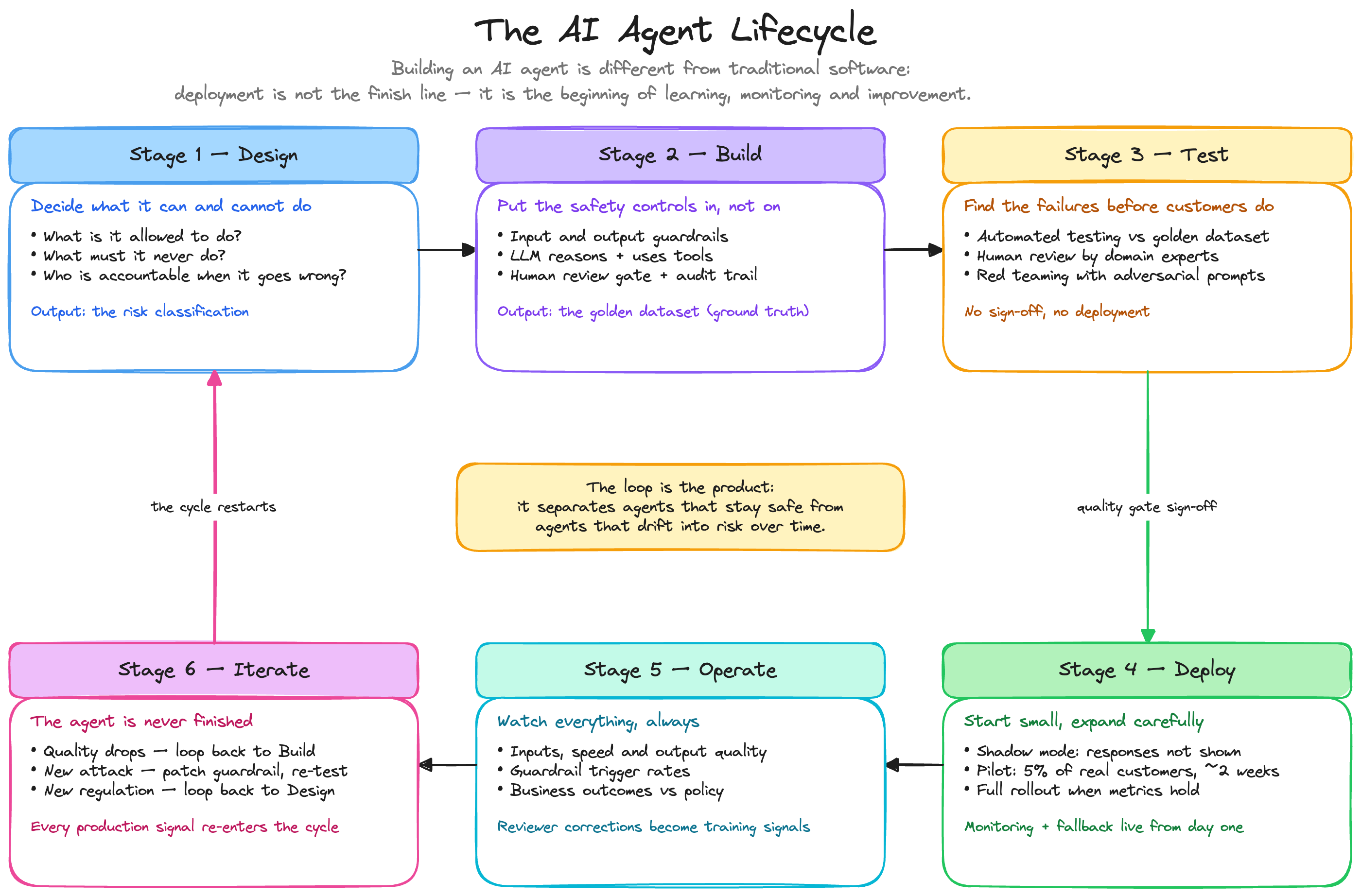
Different organizations use different labels. Microsoft Learn describes five phases: discovery, experimentation, build, deploy, and operational steady state. These fit together cleanly:
| Practical lifecycle | Main question | PM’s key responsibility | Evidence needed before moving forward |
|---|---|---|---|
| Discovery / design | Is this a valuable problem that should use AI or agent autonomy? | Define the user outcome, workflow, stakeholders, constraints, risks, and value hypothesis. | Clear problem, viable autonomy scope, baseline workflow, and measurable outcome. |
| Experimentation / test | Can a bounded version work reliably enough on representative cases? | Define the hypothesis, baseline, evaluation cases, and decision threshold for proceeding. | Prototype evidence from realistic cases, including failures and limitations. |
| Build | Can we turn the proven concept into a usable, controlled product? | Align requirements, UX, technical architecture, safety boundaries, evaluation, instrumentation, and cross-functional decisions. | An implementation that meets agreed acceptance and release criteria. |
| Deploy | Can we expose the product to real users without taking uncontrolled risk? | Select the cohort, rollout stages, onboarding, guardrails, rollback conditions, and go/no-go decision. | Readiness evidence, owners on call, and tested containment plans. |
| Operate / iterate | Is the product delivering sustained value safely and economically? | Interpret product and agent signals, prioritize fixes, manage incidents, and decide what to change and retest. | Continued performance above thresholds or a justified intervention, constraint, or retirement decision. |
The lifecycle should not be read as a conveyor belt. Findings in testing can change the product scope. A production incident can expose a missing requirement. A newly discovered policy constraint can require a new design decision. The loop is normal, not a sign that the team “failed to plan.”
Agent development lifecycle | Microsoft Learn
Read “Agent development lifecycle” from Microsoft Learn for a compact lifecycle framework. It is especially useful for seeing why agent work needs early validation and ongoing operational attention rather than a one-time delivery mindset.
In the opening section, read from the paragraph beginning the lifecycle rationale and principles. Focus on the five phases and the claims that phases can overlap, depend on feedback, and mitigate risk early. Then find the section “Build and deployment phases” and read the build through operations discussion. Notice that architecture decisions affect later reliability, and that operations includes continuous evaluation and adjustment.
What the Agent PM does in each phase
1. Discovery: frame a problem worth solving
Discovery is where the PM prevents “agent first, problem later” thinking. The goal is not to collect a list of desirable model features. It is to establish a specific workflow problem, determine whether bounded autonomy is warranted, and identify what success and failure would look like.
The PM should lead the team to answer:
- Who has the problem? Identify the user and any affected non-user, such as an approver, customer, administrator, or support team.
- What outcome matters? State a result, not an interaction. “Employees receive appropriate Analytics Portal access quickly” is better than “employees can chat with an access bot.”
- What is the current workflow? Map the steps, information sources, decisions, pain points, exceptions, and current completion time or effort.
- Why an agent? Use the autonomy rubric from the previous lesson: variation, unstructured inputs, value, verifiability, and error consequences.
- Where are the boundaries? Identify policies, permission checks, irreversible actions, and decisions that must remain deterministic or human-owned.
- What will prove value? Establish a baseline and a testable hypothesis.
Typical PM artifacts at this stage include a workflow map, opportunity statement, value hypothesis, initial risk register, stakeholder map, and a small set of candidate measures.
A discovery decision might be:
Build a bounded access-support agent that interprets standard employee requests, retrieves approved facts, identifies missing information, and initiates only validated standard-access flows. It must not grant privileged access, bypass approvals, or make access decisions outside the entitlement system.
That statement gives engineering, design, security, and the domain owner a common product boundary. It is much more actionable than “Build an AI assistant for access.”
2. Experimentation: replace a compelling demo with credible evidence
A demo answers, “Can the model do this once?” Experimentation answers, “Under what conditions does this product work, fail, and create enough value to justify building it?”
Here the PM defines the learning agenda. It should include:
- the hypothesis being tested;
- a non-agent baseline, such as the current workflow or a simpler AI-assisted flow;
- representative cases, not only polished examples;
- measures for task completion, correctness, user effort, latency, cost, and safety;
- explicit thresholds for the next decision.
For an access-support agent, representative cases would include standard requests, incomplete requests, conflicting account data, expired approvals, requests for privileged access, and tool failures. The point is not to make the prototype look weak. It is to discover which cases it can safely handle, which need clarification, and which need escalation.
The PM also prevents a common experimental mistake: evaluating only the agent’s prose. An agent can produce a helpful-sounding response while retrieving the wrong policy, failing to create the request, or claiming success when a tool call failed. Evaluation must assess the verified workflow outcome, not merely whether the text sounds plausible.
A credible experiment ends with a decision, such as:
- proceed to an MVP with routine standard-access cases only;
- redesign the workflow as a copilot because autonomous action is not yet reliable;
- collect missing data or clarify policy before investing further;
- stop because the value does not exceed the cost and risk.
3. Build: turn product intent into a system people can trust
Once evidence supports the opportunity, the PM translates it into decisions that a cross-functional team can build and review. This is where conventional PM work—scope, prioritization, requirements, design coordination, dependencies, and delivery planning—meets AI-specific requirements.
The PM needs to align the following elements:
| Product element | The PM’s framing question |
|---|---|
| Goal and completion | What exact user outcome is the agent trying to achieve, and how can it verify completion? |
| Boundaries | Which actions, decisions, data, and policy interpretations are prohibited or require approval? |
| Tools and data | What authoritative systems may the agent access, and what permissions should it have? |
| User experience | When should users see progress, sources, uncertainty, requested confirmation, failure, or escalation? |
| Evaluation | What cases must pass before release, and what failures are unacceptable? |
| Instrumentation | What inputs, decisions, tool results, versions, user corrections, and outcomes need to be logged? |
| Operations | Who responds when a tool fails, a guardrail triggers, or quality declines? |
In this stage, the PM should make decision rights visible. For example, a security lead may own approval of data-access controls; the entitlement-system owner may own access-policy enforcement; engineering may own retry behavior and reliability design; the PM owns the product decision about whether the agent is allowed to initiate a request automatically or must ask the user first.
This is also when a PM must resist vague acceptance criteria such as “the agent answers correctly.” Since outputs vary, better criteria describe observable behavior:
- The agent retrieves access status only from authorized systems.
- It asks for missing business justification rather than inventing one.
- It never grants privileged access autonomously.
- It correctly routes policy exceptions to the assigned approver.
- It confirms completion only after the entitlement system returns a successful status.
Later modules will make these into behavior specifications, structured output contracts, safety plans, and formal evaluation rubrics. For now, recognize them as core PM responsibilities, not engineering afterthoughts.
4. Deploy: manage exposure, trust, and reversibility
Deployment is not the finish line. It is the first time real users, real data, and real workflow variation can challenge the product assumptions.
The PM’s deployment responsibility is to decide how much exposure is justified by the evidence. A prudent release plan often includes:
- Shadow mode, where the agent processes real cases without affecting users or systems.
- Internal or expert-user testing, where knowledgeable users can spot and report failures.
- A limited beta cohort, selected for manageable risk and useful feedback.
- Gradual expansion, only after quality and operational signals meet agreed criteria.
The PM should ensure that each stage has:
- a target cohort and scope;
- success and guardrail metrics;
- a clear owner for monitoring and incident response;
- user-facing explanation of the agent’s capabilities and limits;
- rollback or fallback conditions;
- decision authority for pausing or expanding rollout.
For the access-support agent, an early cohort might be a small internal group requesting only a standard, low-risk Analytics Portal role. The initial version could prepare requests and ask for confirmation before submitting them. This containment is a product design choice: it lets the team learn from real usage without granting broad authority prematurely.
5. Operate and iterate: turn production signals into better decisions
After launch, the PM’s attention shifts from whether the product can work to whether it continues to create value under real conditions.
An operational dashboard should help distinguish several categories of problems:
| Signal type | Example question |
|---|---|
| Adoption | Are eligible users starting tasks, returning, and choosing the agent over the old workflow? |
| Outcome quality | Are users reaching verified completion, and are escalations or corrections increasing? |
| Safety and policy | Did the agent attempt disallowed actions, mishandle sensitive data, or trigger safeguards? |
| Reliability | Are model calls, tools, integrations, or queues failing or slowing down? |
| Economics | Is cost per successfully completed task acceptable relative to saved effort or business value? |
The PM’s job is not to react to every metric dip with “improve the prompt.” They need to diagnose the likely category of issue. A decrease in completion might result from unclear onboarding, a changed company policy, a broken tool integration, poor retrieved context, model quality regression, or an overly broad user cohort. Each cause implies a different intervention.
A sound iteration loop does five things:
- Captures production evidence, including user corrections and escalations.
- Categorizes the failure by cause and severity.
- Chooses a targeted product or technical change.
- Adds the failure pattern to the evaluation set.
- Retests before expanding the change.
This is why an agent PM needs version awareness. When quality changes, the team should be able to determine which model, instructions, tools, knowledge sources, and evaluation set version were in use. Otherwise, improvement becomes guesswork.
A concrete responsibility map: the access-support agent
Here is the end-to-end map for the running Analytics Portal scenario.
| Lifecycle stage | PM decision | Collaboration needed | Resulting artifact or evidence |
|---|---|---|---|
| Discovery | Standardize on the user outcome: appropriate access with less employee and support effort. Restrict initial scope to routine requests. | Employees, support, IT access owner, security, legal or compliance if required | Workflow map, value hypothesis, constraints, baseline |
| Experimentation | Test whether the agent can identify request type, retrieve authoritative facts, request missing information, and route exceptions correctly. | AI engineer, access-domain expert, support representatives | Prototype results, representative test cases, pass and escalation rates |
| Build | Specify permitted tools, read/write permissions, user confirmations, escalation rules, source display, acceptance criteria, and logs. | Engineering, design, security, entitlement-system owner | Behavior specification, MVP PRD, safety requirements, evaluation plan |
| Deploy | Start with a narrow cohort and limited role type; establish rollback conditions and support process. | Operations, support, engineering, internal communications | Rollout plan, dashboard, on-call ownership, user onboarding |
| Operate | Review verified completion, incorrect routing, tool failures, latency, cost, and user feedback. | Analytics, engineering, support, domain owner | Operating review, incident records, prioritized improvement backlog |
| Iterate | Expand or constrain scope based on evidence; turn recurring failures into new evaluation cases. | Same partners, with governance review for higher-risk scope changes | Updated policy boundaries, versioned evaluation set, revised release decision |
Notice the continuity: the original workflow and boundaries from discovery become the criteria for experiment design; the experiment results determine MVP scope; the MVP requirements determine what must be monitored; production failures become inputs for the next discovery and evaluation cycle.
That traceability is a hallmark of professional product management. It allows you to answer a stakeholder’s question—“Why does the agent require confirmation before submitting this request?”—with user, safety, and evaluation evidence rather than intuition.
A practical operating posture for an Agent PM
At any lifecycle point, keep four questions active:
- Value: What user or business outcome are we improving, relative to what baseline?
- Control: What can the agent do, what must it never do, and who owns exceptions?
- Evidence: What observations justify our next product decision?
- Learning: If the system fails or behavior changes, how will we detect, contain, explain, and improve it?
These questions provide a reliable way to participate in technical conversations even while your implementation skills are still developing. You can ask an engineer, “How will we know the agent actually completed the requested action?” You can ask a domain expert, “Which exception is safe to handle automatically, and which requires approval?” You can ask a designer, “At what moment does a user need to understand that the agent is waiting on a tool or human reviewer?”
Those are product questions with concrete technical consequences.
Key takeaways
- An AI Agent PM is accountable for the product’s end-to-end learning loop: problem framing, scope, evidence, boundaries, launch decisions, monitoring, and iteration.
- The PM does not replace engineers, designers, domain experts, security, legal, or operations. The PM aligns their work around a shared user outcome and explicit product decisions.
- Agent lifecycle phases are iterative: discovery, experimentation, build, deployment, and operations continually inform one another.
- A compelling demo is not sufficient evidence. PMs define representative evaluation, baselines, thresholds, and decision gates.
- Launch should be staged and reversible, with clear cohort scope, monitoring, ownership, and rollback criteria.
- Post-launch operation is product work. Production signals must be interpreted, converted into targeted interventions, and fed back into evaluation.
Next, you will begin Agent Opportunity Discovery by mapping a workflow into goals, decisions, actions, tools, and failure points. That map becomes the raw material for choosing a strong agent opportunity rather than starting from an appealing but underspecified AI idea.
Can't find a good explanation? Sign up and we'll make it for you
Sign up