
Hello. In the first diagnostic, you saw that central idea is one of the core GED RLA question types. This short, question-led session focuses only on that skill: finding what a whole passage is mainly saying, rather than choosing an interesting but smaller detail.
The goal is simple: after reading a short passage, you should be able to state its central idea in one clear sentence.
The fast GED method
A central idea is the passage’s most important point. It is not just the topic.
- Topic: what the passage is about
- Central idea: what the author says about that topic
For example:
- Topic: community gardens
- Central idea: community gardens can improve neighborhoods by providing food and bringing residents together.
A useful GED answer usually includes both the topic and the author’s main point about it.
Use this three-step check:
- Read the entire passage. Notice what idea appears more than once.
- Separate the big point from examples. Names, numbers, dates, and one specific event are often supporting details.
- Say it in your own words. If your sentence covers most of the passage without adding new information, it is likely the central idea.
A good central-idea answer is:
| It should be | It should not be |
|---|---|
| Broad enough to cover the whole passage | One small detail or example |
| Supported by several details | A statement not found or supported in the passage |
| Specific about the author’s point | So broad that it could fit almost any passage |
GED RLA Reading Comprehension Practice Questions to Increase Your Score
Watch “GED RLA Reading Comprehension Practice Questions to Increase Your Score” from Test Prep Champions for a quick method called RAP: Read, Ask, Put it in your own words.
Watch the RAP method. Focus on the three actions: read one paragraph, identify its main idea and supporting ideas, then restate the main idea in your own words. The “title” question mentioned in the video is especially useful: ask yourself what short title you would give the passage.
Spotting wrong answer choices
GED questions often make wrong answers sound reasonable because they use words from the passage. Before choosing, test each answer.
1. Is it only one detail?
If an answer focuses on one person, date, example, or fact, it is probably too narrow.
2. Does it cover the beginning, middle, and end?
The right answer should account for most of the information. It should not fit only one sentence or paragraph.
3. Does it go beyond the passage?
Do not choose an answer just because it sounds wise or true in real life. Choose only what the passage supports.
4. Does it change the author’s point?
Watch for extreme words such as always, never, only, and completely. If the passage is balanced or qualified, an extreme answer may twist its meaning.
[PDF] RLA - Reading for Key Ideas and Details - AWS
Read the “Main Ideas and Details” portion of this GED Kaplan worksheet. It gives the same pass-focused habit: identify the author’s point, then see how the details and paragraphs support it.
In the “Main Ideas and Details” section, read from the definition and method. Focus on the three questions: What point is the author making? Which sentences introduce each paragraph’s point? How do the paragraphs fit together? You can skip the later sections on contrast and cause-and-effect for now.
One short passage: find the central idea
Use the worksheet below as today’s main-idea drill. Read the passage titled “The Value of Perseverance.” Do not try to memorize every fact. Instead, notice the repeated message:
- The first paragraph defines perseverance.
- The Thomas Edison story gives one example.
- The final paragraph explains why the idea matters in daily life.
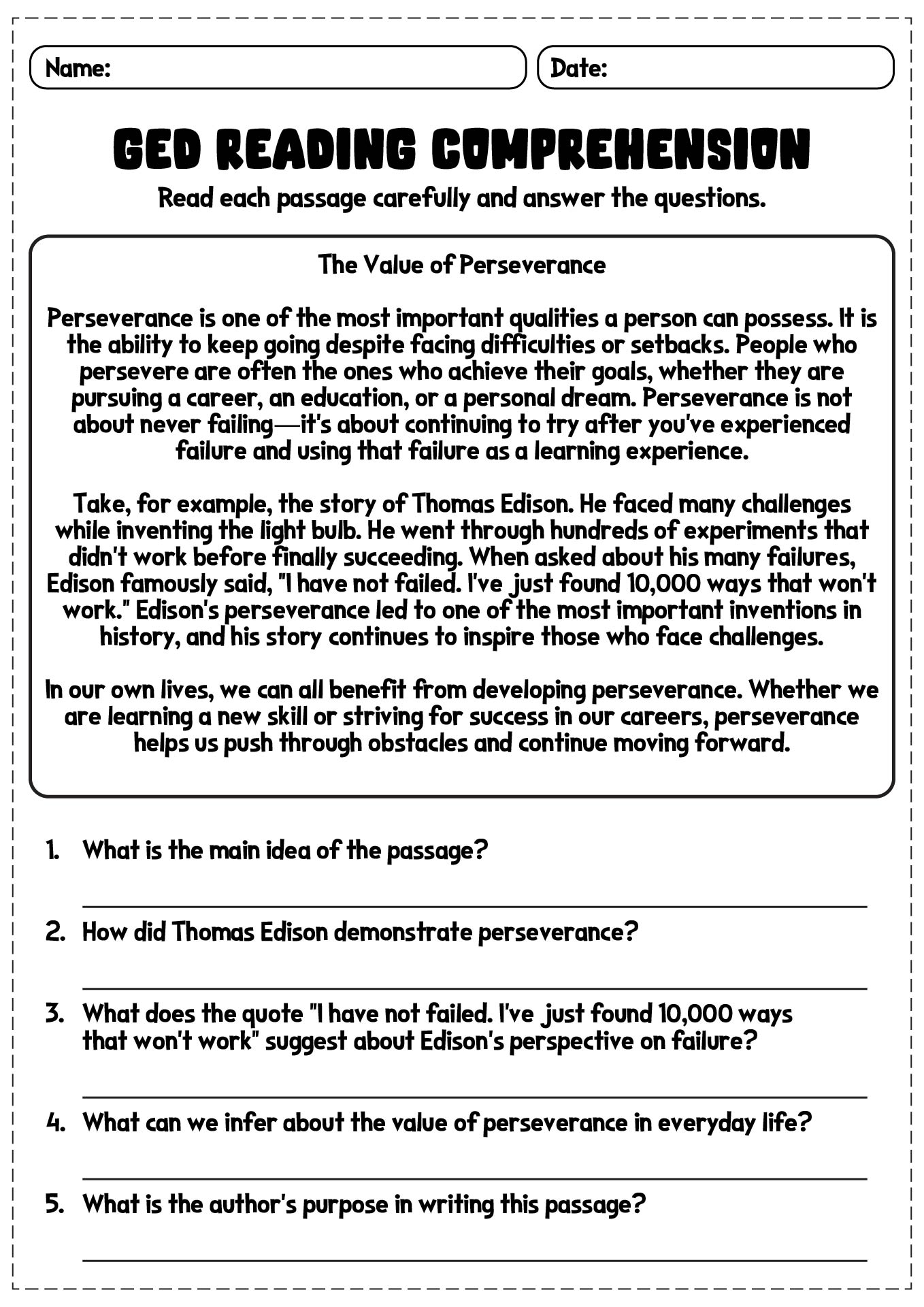
For Question 1 only, write your answer in your own words before looking at the choices or asking for feedback. Keep it to one sentence.
Use this frame if it helps:
The passage explains that __________ because __________.
Then do a quick proof check: Can you point to at least two parts of the passage that support your sentence? If yes, you have probably found the central idea.
Do not choose “Thomas Edison kept trying” as your final main idea. That is an important supporting example, but the whole passage is making a broader point about perseverance.
Your 20-second test-day routine
When you see a central-idea question on the GED:
- Read the passage once without stopping at every unfamiliar word.
- Ask: “What is the author mostly trying to tell me?”
- Give the passage a short mental title.
- Eliminate answers that are one detail, too broad, or unsupported.
- Choose the answer that summarizes the whole passage most accurately.
The key takeaway is: the central idea is the author’s main message about the topic, supported by the passage’s details. Do not let a vivid example, such as Edison’s experiments, replace the larger point.
Next, you will build on this by selecting the specific details that support an inference about a passage.
Can't find a good explanation? Sign up and we'll make it for you
Sign up