
Hello. In the last lesson, you practiced finding a passage’s central idea—the big message across the whole text. Now narrow your focus: GED questions often ask what a detail suggests about a person, event, or author’s view.
This lesson is about selecting textual evidence that proves an inference. Keep it practical: you do not need to overthink or make a complicated guess. You need a reasonable conclusion and the exact clue that supports it.
Inference: conclusion plus proof
An inference is a conclusion the text suggests without stating it directly.
For example, if a passage says, “Maya checked the bus schedule three times and stood near the door with her bag,” a reasonable inference is that Maya is eager or worried about leaving. The passage never says “Maya is eager,” but her actions are clues.
On the GED, remember this formula:
But the question in this lesson is often one step more specific:
Which sentence or detail best supports the inference?
That means you are not being asked only for the conclusion. You must locate the proof inside the passage.
Use this fast method:
- Read the inference or answer choice first. Put it in simple words.
- Find the clue that most directly proves it.
- Make a full proof sentence in your head: “Because the passage says ___, the reader can infer ___.”
- Reject details that are merely related. A detail may mention the same character or topic but still fail to prove the conclusion.
A strong evidence choice is specific and direct. A weak choice may be true, but it does not clearly support the inference.
Do not confuse evidence with a guess
The GED wants an educated conclusion, not a personal opinion.
Suppose a passage says:
Carlos arrived early, reviewed his notes, and asked the teacher whether he could begin first.
A supported inference is that Carlos is prepared or eager to take the test.
These would not be supported:
- Carlos will earn the highest score.
- Carlos studied all night.
- Carlos wants to become a teacher.
Those statements might be possible, but the text does not give enough proof.
The official GED strategy calls this reading “between the lines,” while still relying on the surrounding clues—not inventing a story beyond them.
7 Reading Strategies You Can Use on the RLA Module of the GED Test
Read the “Look for Signals” strategy from GED.com. It gives a simple way to infer meaning from an author’s clues rather than from unsupported assumptions.
In Section 5, “Look for Signals,” read the signal strategy. Then read the short Sean-and-the-door example immediately after it. Focus on the difference between what the text directly tells you—Sean slammed the door—and the reasonable conclusion it allows—he was likely angry about the note.
Use the “because” test
When you must choose evidence, test each possible detail with because.
| Inference | Possible evidence | Does it pass? |
|---|---|---|
| A character is nervous. | The character’s hands shook while waiting. | Yes: shaking is a direct clue. |
| A character is nervous. | The character arrived at the station at noon. | No: it may be true, but it does not prove nervousness. |
| An author supports recycling. | The author explains that recycling reduces landfill waste. | Yes: this gives a reason for the author’s position. |
| An author supports recycling. | The author mentions plastic bottles. | Usually no: the topic alone is not proof of support. |
The test is:
Because this detail appears in the text, the inference makes sense.
If you cannot finish that sentence clearly, look for stronger evidence.
Example: what John’s words and actions reveal
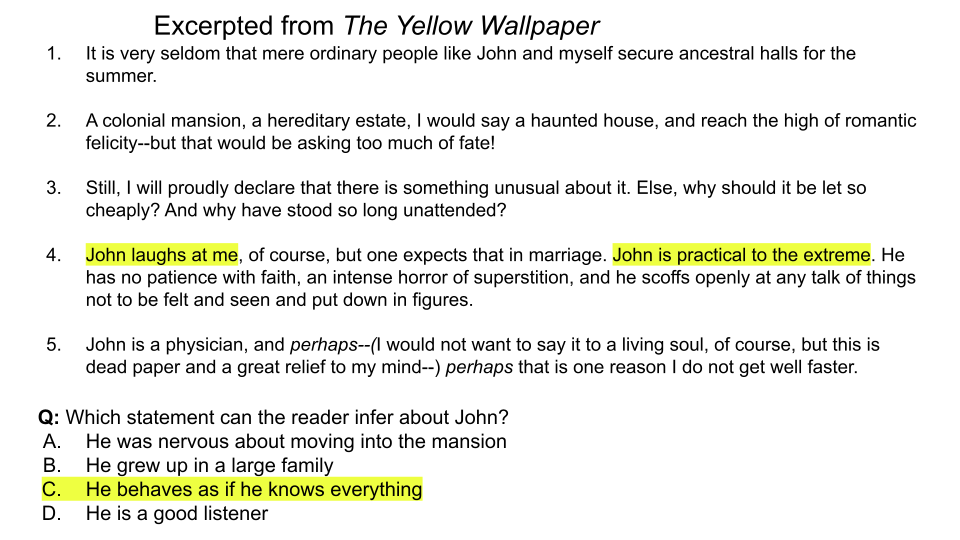
Read the excerpt in The Yellow Wallpaper inference question. It asks what readers can infer about John. The supported answer is that he behaves as if he knows everything.
Notice the difference between claim and evidence:
- Inference/claim: John behaves as if he knows everything.
- Best supporting clues: He “laughs” at the narrator, has “no patience” with beliefs he cannot measure, and “scoffs openly” at such ideas.
Those details show that John dismisses views different from his own. The passage does not state, “John thinks he knows everything.” You infer it from his behavior.
The other choices fail because the text gives no proof that John is nervous about the mansion, grew up in a large family, or listens well. That is an important GED habit: eliminate answers that are possible in real life but unsupported in the passage.
GED RLA Reading Comprehension Strategy/Practice for Fiction on Reasoning Through Language Arts
Watch “GED RLA Reading Comprehension Strategy/Practice for Fiction on Reasoning Through Language Arts” from Test Prep Champions for a quick walkthrough of the John question. The explanation models how to connect the answer choice to details in the passage and eliminate choices with no evidence.
Watch the John example. Pause before the explanation if you want to decide first. Then focus on why John’s laughter, extreme practicality, and open scorn are evidence for the “know-it-all” inference—and why the other choices have no textual support.
A GED shortcut: evidence must match the exact claim
When answer choices are close, look for the most direct match.
If the inference is about a character’s feelings, choose actions, dialogue, or descriptions that reveal feelings.
If the inference is about a character’s personality, choose repeated behavior or strong descriptive language.
If the inference is about an author’s claim, choose a fact, example, or reason that supports that exact claim.
Avoid three common traps:
- Same topic, wrong point: The detail mentions the subject but does not prove the inference.
- Too broad: The detail is general, while another choice gives clearer proof.
- Outside knowledge: You know something might happen in real life, but the passage itself does not show it.
For a fast test-day approach, underline—or mentally note—two words in the inference. Then scan for the sentence that answers: “What in the passage makes me think that?”
The key takeaway is simple: an inference is a reasonable unstated conclusion, and textual evidence is the exact wording or action that makes that conclusion reasonable. Choose proof, not just a detail from the same passage.
Next, you will use the same proof-checking skill to decide whether cited evidence truly supports an author’s claim.
Can't find a good explanation? Sign up and we'll make it for you
Sign up