
Welcome to the first lesson in your foundation course. This module builds the real-number intuition that later supports algebra, graphs, inequalities, statistics, and eventually AI mathematics. Although ordering integers is elementary material, it is worth rebuilding it precisely: a sign is not decoration, and “larger” always means farther right on a number line.
By the end of this lesson, you should be able to place positive integers, negative integers, and zero on a number line; compare two values using , , and ; and arrange a list from least to greatest or greatest to least.
The number line: numbers are positions
A number line is a line on which each number has a position. Choose a point for zero, then mark equal intervals. Moving one interval right adds ; moving one interval left subtracts .
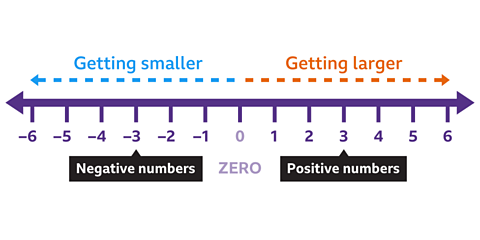
Three facts organise everything in this lesson:
- Zero is the reference point. It is neither positive nor negative.
- Positive numbers lie to the right of zero. Usually we write , rather than , but they mean the same thing.
- Negative numbers lie to the left of zero. The minus sign in is part of the number’s name and position.
The arrows at both ends matter: the number line continues without end. There is no greatest positive integer, and no smallest negative integer.
For example, the numbers from to , in left-to-right order, are:
Notice the subtle but crucial point: is less than , even though is greater than . The negative sign reverses the intuition you may have developed for positive counting numbers.
A useful real-world interpretation is temperature. A temperature of is colder, and numerically lower, than . Likewise, a bank balance of represents a larger debt than , so it is the lower number.
The governing rule: left is less, right is greater
The number line turns comparison into a geometric observation:
- A number to the left is less than a number to its right.
- A number to the right is greater than a number to its left.
Mathematically, for two numbers and ,
means “ is less than ,” or equivalently, “ lies to the left of .”
Similarly,
means “ is greater than ,” or equivalently, “ lies to the right of .”
Finally,
means the two expressions name the same number and therefore the same position.
Consider these comparisons:
because lies to the left of .
because every positive integer lies to the right of every negative integer.
because zero lies to the right of all negative numbers.
The central habit is to read the entire inequality aloud. For instance,
reads: “negative six is less than one.” This prevents a common error: focusing only on the digits and while ignoring the sign.
Ordering Integers | Positive & Negative Numbers | Math with Mr. J
Watch “Ordering Integers | Positive & Negative Numbers” from Math with Mr. J for a concise visual demonstration of reading order directly from a number line.
Watch the core rule for the left-versus-right principle. Then watch ascending order, where a set of integers is plotted and read from least to greatest. Finish with descending order, noticing that greatest-to-least means reading the same kind of line from right to left. Pause before each final ordering and predict it on paper.
Comparing signs before comparing sizes
When comparing integers, begin with their signs. This avoids nearly all early mistakes.
| Numbers being compared | Reliable conclusion |
|---|---|
| Positive and negative | The positive number is greater. |
| Zero and positive | The positive number is greater. |
| Zero and negative | Zero is greater. |
| Two positive numbers | The usual larger numeral is greater. |
| Two negative numbers | The one closer to zero is greater. |
The final row needs deliberate attention. Compare and :
- is three units left of zero.
- is eight units left of zero.
- is farther right.
Therefore,
Equivalently,
A compact way to state this is: among negative integers, the one with the smaller distance from zero is the greater number. This statement is not a replacement for the number line; it is a consequence of the number line.
Why “larger digits” can mislead
The notation includes the digits and , but it is not larger than :
On the number line, is farther left. In a financial context, owing puts you in a lower position than owing .
Do not use the shortcut “the number with bigger digits is bigger” unless both numbers are positive. First identify the signs.
Plotting integers accurately
To plot an integer, first locate , check the scale, then move the required number of equal intervals.
Suppose a number line marks each integer from to .
- To plot , start at and move four equal intervals right.
- To plot , start at and move four equal intervals left.
- To plot , mark the centre reference point itself.
A hand-drawn number line is a valuable reasoning tool. It does not need to be beautiful, but its intervals must represent equal changes. For a set containing , , , , and , include all values from at least to , with evenly spaced tick marks. Mark each requested value, then read their locations.
When comparing only two small integers, you may mentally visualise the line. When the values are numerous, mixed in sign, or easy to confuse, draw it. That is not a weakness; it is a transparent mathematical representation.
Ordering a whole set of integers
Ascending order means least to greatest. On a number line, read from left to right.
For the set
the plotted values appear left to right as:
Thus, in ascending order,
Descending order means greatest to least. Read from right to left:
Here is a dependable paper-and-pencil method:
- Identify all negative values, zero if present, and all positive values.
- Order the negative values carefully: the most negative value comes first in ascending order.
- Place after all negatives and before all positives.
- Order positive values as usual.
- Check the finished list by imagining movement strictly rightward for ascending order, or strictly leftward for descending order.
For example, order
from least to greatest.
First, the negatives must come first. Among them, is farthest left, then , then . Zero follows. The positives follow in their usual order:
A quick validation is to compare each adjacent pair:
Every inequality is true, so the ordering is correct.
Common errors and how to correct them
Treating the minus sign as an operation
In this lesson, is a single signed number: “negative six.” You are locating a position, not performing subtraction.
Write signs clearly in your notebook. A faint or missing minus sign can change an answer completely.
Assuming the number farther from zero is always greater
This is true only on the positive side. On the negative side, moving farther from zero means moving left, which makes the number smaller:
The correct universal rule is not “farther from zero is greater.” It is farther right is greater.
Reversing the order of negative integers
An incorrect ascending list might place before , because . But the locations are reversed:
A temperature check makes the error visible: is colder than .
Mixing up “least to greatest” and “greatest to least”
Translate the instruction before you start:
- least to greatest: begin at the far left;
- greatest to least: begin at the far right.
At the end, test whether every next number has moved in the requested direction.
A short mastery routine
Use about 10–15 minutes of your two-hour mastery session for this routine, with no calculator:
- Draw three number lines with different ranges, such as to , to , and to .
- On each line, plot a mixture of negative integers, zero, and positive integers.
- Write one ascending chain and one descending chain from each set.
- In an error log, record any comparison that initially felt counterintuitive, especially a pair of negative numbers. State the reason in number-line language: “ is greater because it lies to the right of .”
This verbal justification will become useful later when inequalities are solved algebraically and represented graphically.
Key takeaways
A number line gives a precise meaning to order:
- Negative integers are left of ; positive integers are right of .
- Values increase from left to right and decrease from right to left.
- A number farther right is greater; a number farther left is less.
- Every positive integer is greater than , and is greater than every negative integer.
- Between two negative integers, the one closer to zero is greater.
- Ascending order is left to right; descending order is right to left.
Next, you will use signed-number order as the foundation for evaluating expressions containing integers and the four arithmetic operations.
Can't find a good explanation? Sign up and we'll make it for you
Sign up