
Hello. In the previous lesson, integers were positions on a number line: values farther right are greater, and negative values lie left of zero. Now we use that picture dynamically. Addition and subtraction move a position; multiplication and division combine signed quantities; and the order of operations makes sure that a numerical expression has one unambiguous value.
By the end of this lesson, you should be able to evaluate valid expressions containing positive and negative integers, parentheses, and all four arithmetic operations. The careful written method developed here will carry directly into algebraic expressions, equations, and programming calculations.
Signed arithmetic: keep the number and the operation distinct
A minus sign can play two different roles:
- In , it is part of the number “negative seven.”
- In , it denotes the operation “subtract seven.”
When negative numbers occur in the middle of an expression, parentheses prevent ambiguity. For example,
means “eight subtract negative three,” whereas
means “eight add negative three.” Write the parentheses; they make both your reasoning and later error-checking much more reliable.
Addition: combine movement on the number line
Adding a positive integer moves right; adding a negative integer moves left. Thus,
because starting at and moving units right lands at . Conversely,
because adding moves units left.
For efficient calculation, use the signs and the distances from zero:
| Signs of the two addends | What to do | Example |
|---|---|---|
| Same signs | Add their distances from zero; keep the common sign. | |
| Different signs | Find the difference between their distances from zero; use the sign of the number farther from zero. |
The “farther from zero” statement is about absolute value, or distance from zero. In
the negative contribution has magnitude , while the positive contribution has magnitude . After cancelling positive units against negative units, negative units remain.
Subtraction: add the opposite
Subtraction is best handled by one dependable identity:
In words: subtracting a number is the same as adding its opposite.
For instance,
and
The second example is often memorised as “two negatives make a positive.” That slogan is too vague: it does not tell you what to do in a longer expression. The precise action is to change subtraction into addition and replace the number being subtracted by its opposite.
How to Add, Subtract, Multiply, and Divide Integers | A Review of Integers | Math with Mr. J
Watch “How to Add, Subtract, Multiply, and Divide Integers” from Math with Mr. J for a visual review of signed arithmetic. It reinforces the number-line meaning of addition and the “add the opposite” method for subtraction before moving to multiplication and division.
Watch integer addition, focusing on why different signs require comparing distances from zero. Then watch integer subtraction; pause after the first subtraction example and state the rewrite rule in your own words. Continue with multiplication signs and division signs. In the final two parts, attend to the fact that multiplication and division use the same sign rule.
Multiplication and division of integers
For multiplication and division, first calculate using the positive magnitudes, then determine the sign.
| Signs of the two numbers | Sign of product or quotient |
|---|---|
| Same signs | Positive |
| Different signs | Negative |
So,
because the signs are the same, while
because the signs differ. Division follows exactly the same pattern:
and
Division can be checked by multiplication. The statement
is correct because
This inverse-operation check is particularly useful when a negative sign is easy to lose.
Why does a negative times a negative give a positive?
The rule is not arbitrary; it is needed to keep arithmetic consistent. Consider
The bracket has value zero, so the entire expression must equal zero. If multiplication distributes over addition, then
The first product is . Therefore, the second product must be , because
Hence,
The same-sign-positive rule ensures that multiplication behaves consistently with addition and subtraction.
Two boundaries matter:
- Multiplying any integer by gives .
- Division by is undefined. An expression with a zero divisor cannot be evaluated.
The order of operations
An expression is not evaluated strictly from left to right. Mathematical notation gives some operations priority over others.
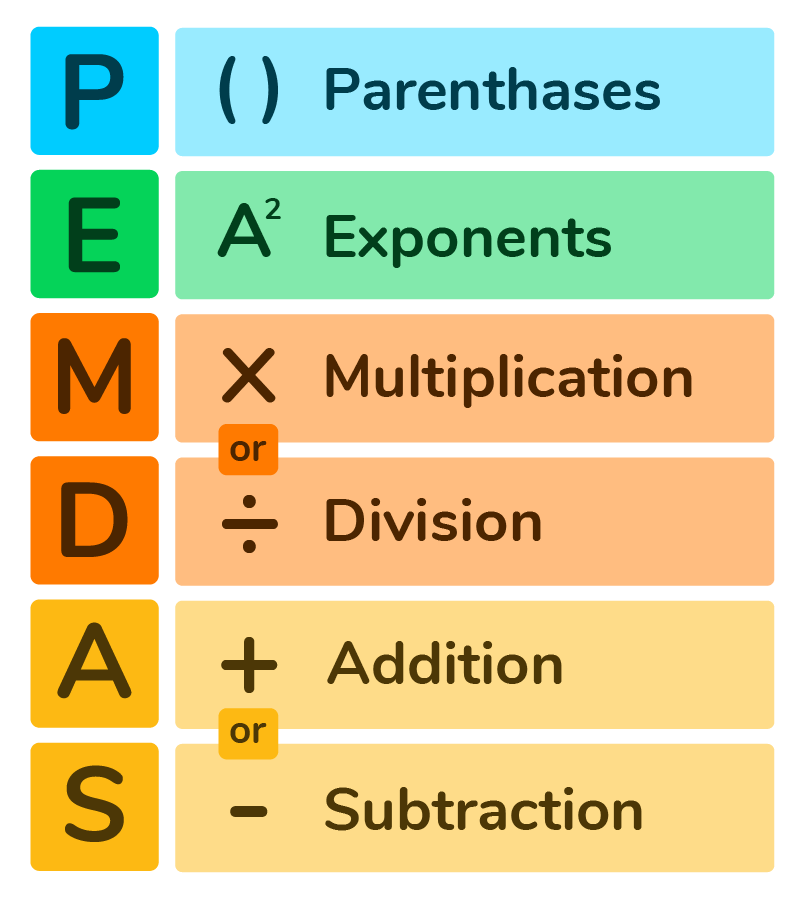
The PEMDAS image is useful, but it can create two misconceptions. The letters do not mean that multiplication always happens before division, nor that addition always happens before subtraction. The correct procedure for this lesson is:
- Evaluate inside parentheses, brackets, or other grouping symbols, beginning with the innermost group.
- Perform multiplication and division in the order they occur, from left to right.
- Perform addition and subtraction in the order they occur, from left to right.
Exponents appear in PEMDAS, but they belong to the next module. For now, no exponent step is needed.
Equal priority means left to right
Consider
Division and multiplication have equal priority, so calculate the first one encountered:
Calculating first would silently change the expression. It would introduce a grouping that was never written.
The same principle applies to addition and subtraction:
It is not correct to add and first, since the original expression does not group them together.
Order of Operations with Integers | Positives and Negatives | PEMDAS | Math with Mr. J
Watch “Order of Operations with Integers” from Math with Mr. J. The example is valuable because it combines parentheses, division, multiplication, and negative values while preserving each sign carefully.
Watch the priority review for the stated order of operations. Then watch the worked expression. Notice two habits: simplify the parentheses before anything outside them, and treat multiplication and division as equal-priority operations evaluated from left to right.
Evaluating complete integer expressions
A disciplined layout is more than presentation. It prevents you from accidentally changing an operation or dropping a negative sign.
Evaluate:
First, simplify the grouping symbols:
There are no more grouping symbols. Multiplication and division have equal priority, so work from left to right:
Finally,
Therefore,
Notice that the intermediate result is positive because the division has two negative values. Multiplication by then gives a negative final answer.
Now consider an expression using all four operations:
There are no brackets to simplify. The division occurs before the multiplication because it appears first among the equal-priority operations:
Now evaluate the remaining multiplication:
Only addition and subtraction remain. Work from left to right, remembering that subtracting means adding :
Thus,
A practical checking routine
Before accepting a final answer, use this audit:
- Check grouping. Did you finish every operation inside parentheses or brackets?
- Check priority. Did every multiplication or division occur before the remaining addition or subtraction?
- Check direction. Within equal-priority operations, did you move left to right?
- Check signs. Is each negative quantity still visibly attached to its number?
- Check reasonableness. Is the final sign plausible? For example, a positive number plus a large negative contribution should not usually become a large positive answer.
For your notebook, reserve a small “integer operations” error log. When an answer is wrong, classify the cause rather than writing only the correction: lost negative sign, incorrect subtraction rewrite, incorrect same/different-sign rule, or incorrect operation order. Rework the same expression one day later without looking at the first attempt. That spacing turns a corrected procedure into a durable habit.
Key takeaways
To evaluate expressions involving integers:
- Addition combines signed values; when signs differ, compare their distances from zero.
- Rewrite subtraction as addition of the opposite:
- For multiplication and division, equal signs give a positive result and different signs give a negative result.
- Never divide by zero.
- Evaluate grouping symbols first.
- Multiplication and division share priority and are completed left to right.
- Addition and subtraction share priority and are completed left to right.
- Preserve negative numbers with parentheses, especially when they are factors, divisors, or numbers being subtracted.
Next, you will extend these arithmetic skills from integers to fractions and mixed numbers, where the same careful treatment of signs and operation order remains essential.
Can't find a good explanation? Sign up and we'll make it for you
Sign up