
Welcome back. In the previous lesson, you built a compact Unit 1 retrieval map covering conversions, electron configurations, PES, and periodic trends. This lesson turns that map into a test-taking tool: before calculating or choosing an answer, you will identify what the question is actually testing and write the first useful step.
That habit matters because Unit 1 questions often contain familiar words such as “mass,” “electron,” or “spectrum,” but ask for very different reasoning. By the end of this lesson, you should be able to look at a representative AP-style prompt and say: “This is a mass-spectrum question; my first step is to connect peak position with isotope mass and peak height with abundance,” rather than starting an unrelated calculation.
Diagnose the question before solving it
A strong first step is an action that produces information needed for the requested answer. It is not “do chemistry,” “use the periodic table,” or “start calculating.”
Use this quick diagnostic routine:
- Read the final question first. What must you determine: particles, formula, element identity, trend, ion charge, or sample purity?
- Identify the evidence type. Look for masses, percentages, a spectrum, an electron configuration, a periodic-table position, or a particle diagram.
- Name the concept. Choose the narrowest Unit 1 topic that fits.
- Write one first-step sentence on scratch paper before looking deeply at answer choices.
A useful template is:
Concept: ________
First step: ________, because the prompt gives ________ and asks for ________.
For example, if equal masses of several oxides are compared for “greatest mass of oxygen,” the concept is mass percent composition. The first step is not to convert each sample to moles. Because every sample has the same total mass, first compare the oxygen mass fraction in each formula:
The question’s wording determines the method. “Equal masses” is the clue that percent composition is the efficient route.
The Unit 1 concept-to-first-step map
| If the prompt features... | It is probably testing... | Correct first step |
|---|---|---|
| grams, moles, atoms, molecules, or formula units | Moles and molar mass | Write the starting and requested units; choose conversion factors that cancel unwanted units. |
| peaks at mass numbers or , with abundances | Mass spectrometry and isotopes | Label peak position as isotope mass and peak height as relative abundance; convert percentages to decimals if averaging. |
| element masses or percent composition of a compound | Empirical formula | Convert each element’s mass to moles. |
| two substances in a sample, impurity, alloy, or measured element percentage | Mixture composition or purity | Identify the measured component and compare its mass fraction with that of the pure substance or possible impurities. |
| atomic number, orbital boxes, unpaired electrons, or configuration choices | Electron configuration | Determine the electron count, then fill or inspect subshells using Aufbau, Pauli, and Hund. |
| binding-energy peaks and relative intensities | PES | Read the axes first; then use peak heights for electron counts and positions for binding energy. |
| relative size, ionization energy, or electronegativity | Periodic trends | Locate the elements relative to one another; decide whether energy level, shielding, or is the key factor. |
| metal plus nonmetal, likely ions, or a formula unit | Valence electrons and ionic compounds | Write the likely ion charges first, then find the lowest whole-number ratio with net charge zero. |
The key distinction is between evidence and target. A problem may mention a chemical formula, but that does not automatically make it an empirical-formula problem. It may instead ask about particle number, percent composition, or ion charge.
Quantitative prompts: choose the bridge before calculating
Many Unit 1 questions are built around a conversion or ratio. The first decision is: What bridge connects what I have to what I need?
Moles, mass, and particles
If the question starts with grams and asks for moles, particles, or atoms, begin with units. For a sample of a compound, grams must first become moles:
Then, if the target is particles, use Avogadro’s number:
If the target is atoms inside a compound, remember one additional bridge: the formula subscript. A mole of contains mol of carbon atoms.
Common wrong first step: multiplying grams directly by Avogadro’s number.
Correction: grams and particles are not directly connected; molar mass supplies the missing bridge.
Mass spectrum versus PES: do not confuse the graphs
Both types of spectroscopy use peaks, but their meanings differ.
| Graph | Horizontal-axis meaning | Peak height meaning | Typical first step |
|---|---|---|---|
| Mass spectrum | isotope mass, often | relative abundance | Record isotope masses and fractional abundances. |
| PES spectrum | binding energy | number of electrons in a subshell | Check axis direction and compare peak intensities. |
For a mass-spectrum average, the first calculation setup is a weighted average:
Do not take an ordinary average of isotope masses unless their abundances are equal.
Empirical formula
If the prompt gives grams or percentages of elements in a single compound and asks for its simplest formula, begin by converting every elemental quantity to moles. Subscripts represent mole ratios, not mass ratios.
For a compound containing iron and oxygen, the structure of the work is:
Only after both conversions should you divide each mole amount by the smallest value and turn any simple fractional ratio into whole numbers.
Mixtures and purity
A purity question is often disguised as a formula or mass question. Look for clues such as impure, alloy, mixture, contaminant, percent by mass, or which sample is more pure.
The first step is usually to identify the measured component and its expected percentage in a pure sample. If an impure glucose sample has a lower carbon percentage than pure glucose, for example, the impurity must have a lower carbon mass fraction than glucose. You do not yet need to calculate the complete composition of the mixture.
Watch how the first four questions in this video are classified before they are solved.
Michael Farabaugh's “Topics 1.1 - 1.3 MCQ Practice” models the decision-making behind several common quantitative Unit 1 question types.
Watch mass percent reasoning to see why equal sample masses call for comparing oxygen mass fractions. Then watch mass spectrum clues, focusing on what the graph can and cannot establish. Continue with empirical formula setup; notice that grams become moles before they become subscripts. Finish with purity evidence, where the absence of an expected isotope peak becomes the decisive observation. Before each segment, pause and state the concept and first step aloud.
Electron-structure prompts: count first, then interpret
Electron-configuration questions look different from calculation problems because the “data” may be an atomic number, a configuration, or an orbital diagram. The first move is still precise: establish how many electrons are present and whether the species is neutral or charged.
- For a neutral atom, electrons equal atomic number.
- For a cation, subtract electrons equal to the positive charge.
- For an anion, add electrons equal to the magnitude of the negative charge.
Then use the task word to decide what to inspect:
| Asked for... | First thing to inspect |
|---|---|
| Ground-state configuration | Fill subshells in energy order. |
| Unpaired electrons | Draw or mentally construct orbital boxes for the final partially filled subshell. |
| Valence electrons | Identify electrons in the highest principal energy level for a main-group atom. |
| Electron configuration of a transition-metal cation | Write the neutral configuration first, then remove electrons from the outer subshell before the subshell. |
| Likely monatomic ion charge | Find the number of main-group valence electrons. |
A configuration such as may tempt you to count every electron. But if the question asks for a Lewis dot diagram, the target is only the six outer-shell electrons: . Identifying the target prevents unnecessary work.
PES: evidence for electron configuration
In PES, never assign peaks by moving casually from left to right until you have read the binding-energy axis. Some AP graphs place high binding energy on the left; others reverse the direction.
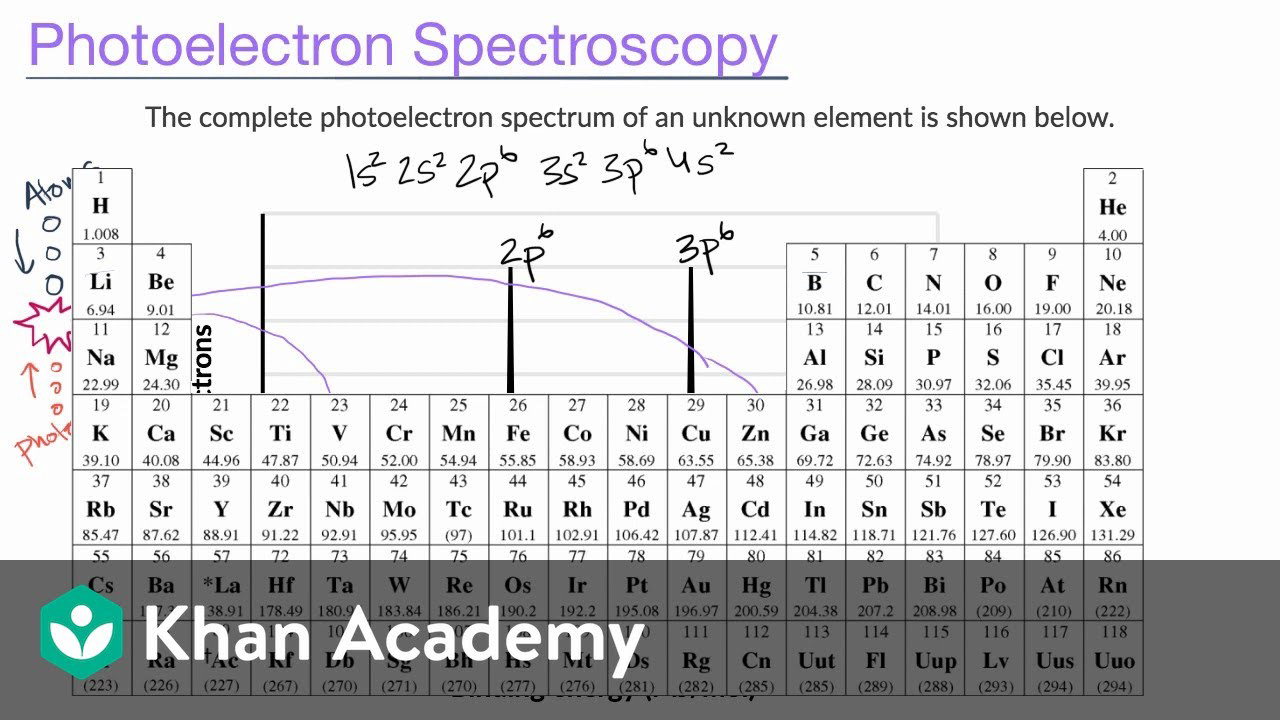
After checking the axis direction, use this order:
- Compare relative peak heights to infer how many electrons each peak represents.
- Assign occupied subshells from core to valence according to binding energy.
- Add the electrons to identify a neutral atom, if the spectrum is complete.
- For a comparison question, connect higher binding energy to stronger nucleus–electron attraction.
For two isoelectronic species, electron number is already held constant. The first comparison should therefore be nuclear charge. More protons produce stronger attraction and higher binding energy for comparable electrons.
In “Topics 1.4 - 1.6 MCQ Practice,” Michael Farabaugh demonstrates the shift from composition questions to electron configurations and PES interpretation.
Watch configuration construction and identify the initial electron-count step. Then view cation formation, paying attention to why transition-metal cations lose outer s electrons first. For PES reasoning, watch binding energy comparison and isoelectronic species. Finish with element identification, where relative peak heights are translated into an electron configuration.
Periodic and ionic questions: reason from structure, not memorized directions
For periodic-trend questions, arrows are a backup memory aid, not a full solution. Your first step should identify the relationship between the elements.
Relative atomic and ionic radius
- Same group: first compare the number of occupied energy levels. More levels usually means a larger radius.
- Same period: first compare . More protons with similar shielding pull electrons closer, producing a smaller radius.
- Isoelectronic ions: first compare proton number. More protons pulling on the same number of electrons means a smaller ion.
Ionization energy and electronegativity
The same first comparisons apply:
- Across a period, increasing holds valence electrons more tightly.
- Down a group, increased distance and shielding make valence electrons easier to remove and less strongly attracted in bonds.
A good explanation names the physical factor. “Fluorine is higher on the periodic table” is incomplete. “Fluorine’s valence electrons are closer to the nucleus and less shielded, so they experience stronger attraction” is a chemical explanation.
Ionic-compound formulas
For a formula question such as calcium with oxygen, do not start by guessing a familiar formula. First write charges:
Because one of each ion gives a net charge of zero, the formula is . If the charges do not cancel one-to-one, choose the smallest whole-number ratio that does. For instance, and require two aluminum ions and three oxide ions, giving .
Read selected questions in the notes below as classification practice. Spend only a few seconds naming the concept and first step before you assess the choices.
[PDF] Unit 1 - Atomic Structure & Properties - Chemistry Teaching Resources
These Chemistry Teaching Resources notes provide AP-style periodic-trend and ionic-compound prompts. They are useful for practicing the difference between an explanation question and a formula-writing question.
Read the opening causal summary before attempting the problems. Then find “1.7 Practice Problems” on pages 57–60. For Questions 2, 4, 5, 13, and 16, identify whether you should first compare shells, shielding, or effective nuclear charge. Next, find “1.8 Practice Problems” on pages 65–66. For Questions 1, 4, and 9, write ion charges before considering any formula answer choice.
An error audit for answer choices
Answer choices are designed to reward predictable shortcuts. Before committing, ask whether your work avoids these common mismatches:
| Tempting shortcut | Why it fails | Better check |
|---|---|---|
| Using an isotope’s mass number as molar mass | Molar mass is the weighted average from the periodic table. | Use the listed atomic mass or calculate a weighted average. |
| Treating a tall PES peak as high binding energy | Height counts electrons; position indicates binding energy. | Read both axes separately. |
| Rounding to in an empirical formula | A meaningful fractional ratio must be scaled. | Multiply all ratios by , , or another small integer. |
| Removing electrons before electrons from a transition-metal cation | The outer electrons are removed first. | Write the neutral configuration, then remove from outermost . |
| Explaining a trend only with “it is farther right” | Location describes the pattern but not the cause. | State , distance, and/or shielding. |
AP Chem Unit 1 Review: Atomic Structure & Properties | Fiveable
Fiveable’s review is a concise final check against the errors that cause otherwise avoidable Unit 1 misses.
In “Common unit 1 mistakes,” read the error checklist. Then, under “How this unit shows up on the AP exam,” read the exam-pattern summary. Add the one mistake you are most likely to make to the margin of your retrieval map.
Key takeaways
The goal of a first step is to choose a method that matches both the evidence and the question’s target.
- Mass, moles, and particles: begin with unit analysis.
- Mass spectra: distinguish isotope mass from abundance; use a weighted average when needed.
- Empirical formulas: convert all elemental masses to moles first.
- Mixtures and purity: compare a measured component’s mass fraction to the pure substance or candidate impurity.
- Electron configurations: determine electron count before filling or interpreting orbitals.
- PES: read axis direction, then separate peak position from peak height.
- Periodic trends: compare shells, shielding, and , not just trend directions.
- Ionic formulas: write ion charges before balancing the formula.
The next module begins with a deeper focus on the most common quantitative bridge in Unit 1: converting among grams, moles, and representative particles using molar mass and Avogadro’s number.
Can't find a good explanation? Sign up and we'll make it for you
Sign up