
Hello! This first lesson builds the foundation for an efficient AP Chemistry Unit 1 review: a one-page retrieval map. Rather than trying to memorize disconnected facts, you will organize the high-frequency ideas that AP questions repeatedly connect: quantity conversions, electron arrangement, photoelectron spectroscopy (PES), and periodic trends.
By the end, you should be able to cover your page and redraw its essential contents from memory in a few minutes. Keep one blank sheet of paper beside you; it will become your personal Unit 1 map.
The purpose of a retrieval map
A retrieval map is not polished notes. It is a compact set of cues that lets you reconstruct the chemistry under time pressure.
Your page needs four zones:
- Moles, mass, and particles
- Electron configurations and orbital rules
- PES interpretation
- Periodic trends and their causes
The key principle is to write relationships with units and reasons, not merely slogans. For example, “ionization energy increases up and right” is useful; “because distance and shielding decrease while effective nuclear charge increases” is what earns explanation points.
Watch this short AP Unit 1 overview before constructing the map. It gives you the intended level of detail and several representative examples.
AP Chemistry Unit 1 in 10 Minutes! | Atomic Structure and Properties
Watch the selected parts of “AP Chemistry Unit 1 in 10 Minutes!” by Jeremy Krug (krugslist). It provides a fast visual tour of the four regions that will appear on your map.
Watch mole conversions to review the units that connect grams, moles, and particles. Then watch electron structure, focusing on what an electron configuration records and why core electrons are held more strongly. Continue with PES reading and periodic trends. Pause briefly after each segment and add only the rules you can explain, rather than copying every example.
Zone 1: the quantity-conversion hub
In chemistry, the mole is the bridge between a mass you can measure and particles that are too small to count one by one.
Write this at the top-left of your page:
The word representative matters. State the object that fits the substance:
- element sample: atoms, such as Cu atoms
- covalent compound: molecules, such as molecules
- ionic compound: formula units, such as formula units
- sample of charged particles: ions, such as ions
Next, make a three-part conversion hub:
| Starting quantity | Relationship | Destination |
|---|---|---|
| grams | divide by molar mass in | moles |
| moles | multiply by molar mass in | grams |
| moles | multiply by particles per mol | particles |
| particles | divide by particles per mol | moles |
The central equation is:
where is amount in moles, is mass in grams, and is molar mass in grams per mole.
The unit-cancellation check
Instead of memorizing “multiply” or “divide” as separate rules, let units determine the setup. Suppose the question asks for molecules from grams of water. Grams cannot convert directly to molecules. You must first reach moles:
The unwanted units cancel: grams, then moles. Molecules remain.
Add this reminder to your map:
For a multistep conversion, arrange each factor so the current unwanted unit cancels.
Molar mass cue
For an element, its atomic mass on the periodic table gives its molar mass numerically. For a compound, multiply each atomic mass by the subscript and add.
For example:
A formula mass in atomic mass units and a molar mass in grams per mole have the same numerical value, but not the same unit:
Keep this zone compact. The later mole-focused module will develop empirical formulas and more involved conversions; for now, the goal is to recognize the correct bridge immediately.
Zone 2: electron configurations and orbital rules
Electron configurations describe how electrons occupy orbitals in a ground-state atom. In the upper-right of your map, record the three governing rules.
| Rule | Retrieval cue |
|---|---|
| Aufbau principle | Fill lower-energy subshells before higher-energy subshells. |
| Pauli exclusion principle | Each orbital holds at most two electrons, and paired electrons have opposite spins. |
| Hund’s rule | In equal-energy orbitals, place one electron in each orbital before pairing. |
Subshell capacities
An orbital holds a maximum of two electrons. A subshell contains a characteristic number of orbitals:
| Subshell | Number of orbitals | Maximum electrons |
|---|---|---|
| 1 | 2 | |
| 3 | 6 | |
| 5 | 10 | |
| 7 | 14 |
For the elements most commonly encountered in introductory Unit 1 questions, write the filling order through :
This is an energy order, not simply a numerical-shell order. That is why fills before .
For a neutral atom, the number of electrons equals the atomic number. For example, sulfur has atomic number 16:
To draw its orbital diagram, use Hund’s rule in the subshell: put one electron into each of the three orbitals before pairing the fourth.
A useful mini-check is that every superscript in the configuration must add to the correct total number of electrons.
Why configurations matter later
Configuration language will reappear in each of the other zones:
- It tells you how many electrons occupy each subshell in a PES spectrum.
- It distinguishes core electrons from outer, valence electrons.
- It helps explain why some electrons are easier to remove than others.
- It provides a structural basis for periodic trends.
For this first retrieval page, do not try to memorize every exception or transition-metal ion rule. Focus on the standard filling pattern and the three principles.
Zone 3: PES as an electron-configuration graph
Photoelectron spectroscopy measures the energy needed to remove electrons from atoms. A PES spectrum therefore turns electron structure into experimental evidence.
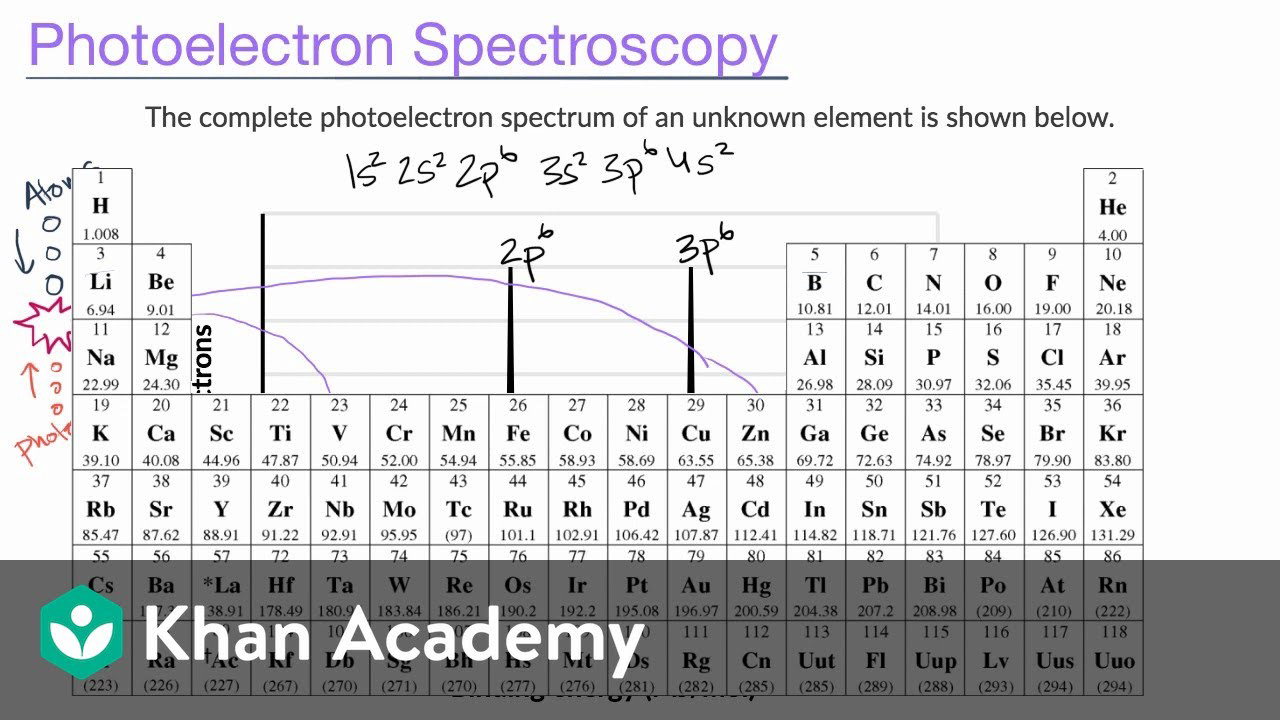
Write four PES cues in the lower-left part of the page:
| What you observe | What it means |
|---|---|
| A peak | One occupied subshell |
| Taller or larger peak | More electrons in that subshell |
| Higher binding energy | Electrons are held more tightly; usually core electrons |
| Lower binding energy | Electrons are easier to remove; often valence electrons |
The underlying idea is Coulombic attraction. Electrons nearer the positively charged nucleus, and electrons that experience less shielding, are held more strongly. Removing them requires more energy.
How to read a PES spectrum
Use the following reliable process:
- Read the horizontal-axis label first. Binding-energy axes are sometimes displayed in reverse directions, so do not assume that “left” always means high or low binding energy.
- Use peak size to determine occupancy. A peak representing six electrons should be about three times the size of one representing two electrons, assuming the spectrum uses relative intensity normally.
- Assign subshells from core to valence. The earliest, most tightly bound peak corresponds to , followed by , , and so on.
- Add all represented electrons. For a neutral atom, that total is its atomic number and identifies the element.
For instance, a spectrum with peak occupancies gives:
There are 20 electrons total, so the neutral atom is calcium.
Two important cautions belong on your map:
- Peak position tells binding energy, not number of electrons.
- Peak intensity tells electron count, not how tightly electrons are held.
PES is especially valuable because it provides evidence for the subshell structure that electron configurations represent symbolically.
Zone 4: periodic trends and the explanations beneath them
Periodic trends are not arbitrary arrows to memorize. They follow from three connected variables:
- Effective nuclear charge, : the net positive pull felt by an electron after shielding by other electrons.
- Distance between the nucleus and the valence electrons.
- Shielding by core electrons.
Across a period, each element gains protons while electrons enter the same principal energy level. Shielding changes relatively little, so increases. The nucleus pulls the electrons inward more strongly.
Down a group, valence electrons occupy higher energy levels. Their greater distance and greater shielding outweigh the increased number of protons.
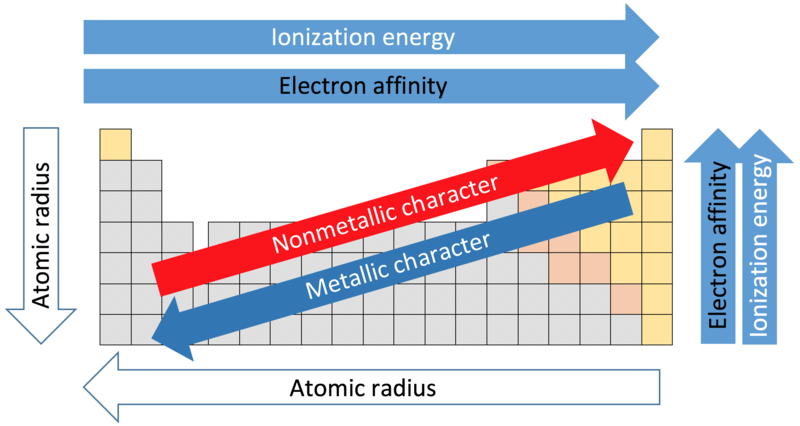
Write the trends as a two-column reference:
| Property | Across a period, left to right | Down a group |
|---|---|---|
| Atomic radius | decreases | increases |
| First ionization energy | generally increases | decreases |
| Electronegativity | increases | decreases |
| Metallic character | decreases | increases |
| Effective nuclear charge on valence electrons | increases | roughly similar within a group |
Interpret each trend precisely
Atomic radius is a measure of atomic size. Across a period, increasing pulls electrons closer, so radius decreases. Down a group, an added occupied energy level places valence electrons farther from the nucleus, so radius increases.
First ionization energy is the energy required to remove the first electron from a gaseous atom:
If electrons are closer to the nucleus or feel a greater effective nuclear charge, removal is harder. Thus, first ionization energy generally increases up and to the right.
Electronegativity is an atom’s ability to attract shared electrons in a chemical bond. The same factors that make an atom small and strongly attractive produce high electronegativity. This trend also increases toward the upper right, with fluorine typically the highest.
For a quick directional memory cue:
- Atomic radius: larger toward the lower left.
- Ionization energy and electronegativity: larger toward the upper right.
When an AP question asks why, avoid saying only “because of the periodic trend.” Use one of these explanation frames:
| Comparison | Strong explanation |
|---|---|
| Same period | The atom farther right has greater , so its electrons are pulled closer and held more tightly. |
| Same group | The atom lower in the group has valence electrons in a higher energy level, farther from the nucleus and more shielded. |
These explanations connect directly to PES: core electrons have high binding energies because they are close to the nucleus and poorly shielded; valence electrons have lower binding energies because they are farther away and shielded.
Build, cover, and retrieve
Now turn the ideas into your one-page map. Aim for clarity rather than decoration. Your finished page can follow this layout:
| Upper left | Upper right |
|---|---|
| Mole definition; Avogadro’s number; grams–moles–particles conversion relationships; | Aufbau, Pauli, Hund; capacities; filling order through |
| Lower left | Lower right |
|---|---|
| PES: peak equals subshell; height equals electron count; binding energy distinguishes core and valence electrons | Atomic radius, ionization energy, electronegativity directions; , distance, shielding explanations |
Use this three-round study routine:
- Construct: Write the map while using this lesson.
- Retrieve: Cover it and redraw it from memory on a blank page. Give yourself about five minutes.
- Correct: Compare the two pages. Add only what was missing or confused, then repeat the retrieval later today or tomorrow.
The goal is not a perfect first attempt. The places where recall fails show exactly what needs attention.
Key takeaways
Your Unit 1 retrieval map should preserve four core systems:
- Conversions: use molar mass to connect grams and moles; use Avogadro’s number to connect moles and representative particles.
- Electron filling: follow Aufbau, Pauli, and Hund; remember the capacities , , , and .
- PES: peak position reflects binding energy, while peak intensity reflects the number of electrons in a subshell.
- Periodic trends: atomic radius increases toward the lower left; ionization energy and electronegativity generally increase toward the upper right because of changes in effective nuclear charge, distance, and shielding.
The next lesson will use this map actively: you will identify what a representative Unit 1 multiple-choice question is testing and choose the correct first step before doing any calculation or detailed analysis.
Can't find a good explanation? Sign up and we'll make it for you
Sign up