
Welcome to our next lesson. We've spent the last few sessions exploring how heaps can be used to solve complex problems involving dynamic sets of data, like finding a running median. Today, we shift our focus from heap-based patterns to another fundamental algorithmic category: advanced searching.
You are likely very familiar with binary search, the quintessential algorithm for finding an element in a sorted array. But what happens when the array isn't perfectly sorted? In interviews for high-performance systems roles, you'll often encounter problems that test your ability to adapt core algorithms to new constraints. This lesson is dedicated to exactly that. We will explore the Modified Binary Search pattern, learning how to apply it to arrays that are "almost sorted"—specifically, rotated sorted arrays and arrays where elements are slightly displaced.
By the end of this lesson, you will be able to identify and implement efficient logarithmic-time solutions for searching in these non-standard, yet structured, array types.
1. The Challenge: A Sorted Array with a Twist
Standard binary search relies on a simple, powerful invariant: if the target is less than the middle element, it must be in the left half, and if it's greater, it must be in the right half. This invariant breaks the moment the array's perfect order is disrupted.
Consider an array that was sorted and then rotated. For example, [0, 1, 2, 4, 5, 6, 7] rotated by 4 positions becomes [4, 5, 6, 7, 0, 1, 2]. If we search for 0 and pick a midpoint, say 7 (at index 3), we see that 0 < 7. In a normal sorted array, we'd search left. Here, that would be a mistake, as 0 is in the right half.
The key insight is that even though the whole array isn't sorted, it's composed of parts that are.
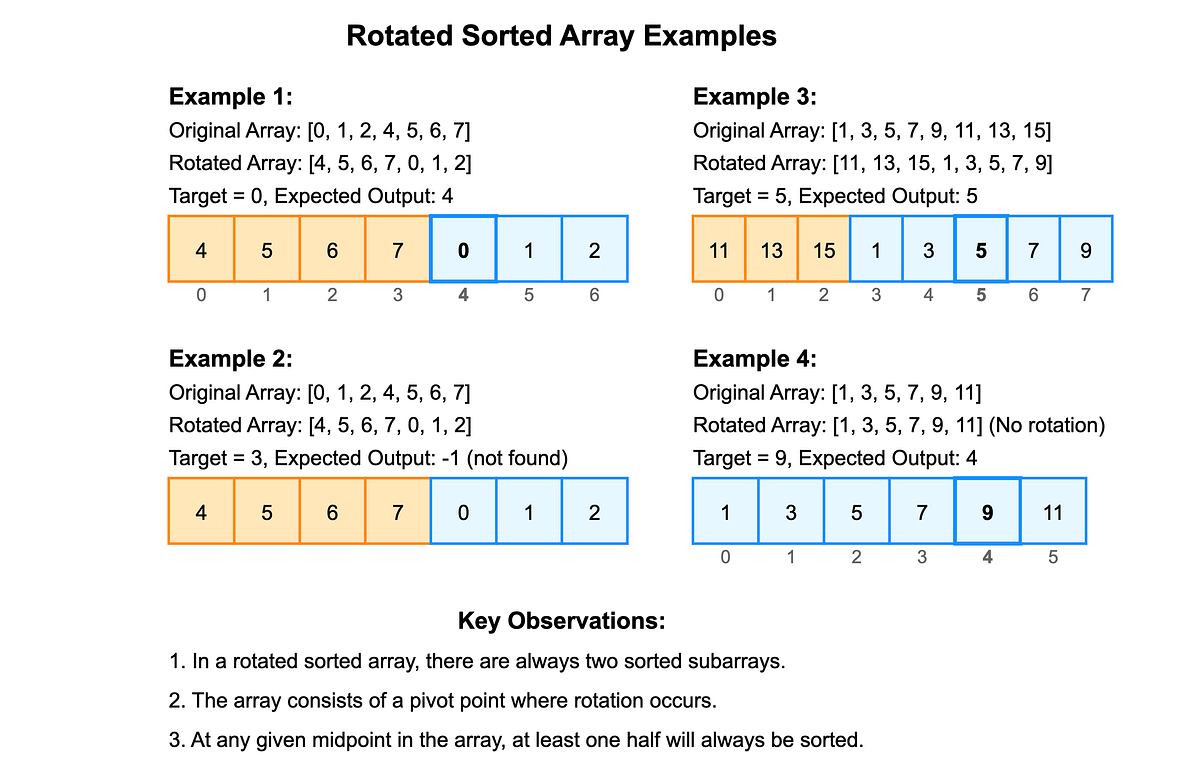
This structure is what we will exploit. Our goal is to modify binary search to identify the sorted portion at each step and use that information to intelligently narrow down the search space.
2. Algorithm: Search in Rotated Sorted Array
The most elegant solution involves a single pass of binary search. At each step, with our left, mid, and right pointers, we have to answer two questions:
- Which half is currently sorted (from
lefttomid, or frommidtoright)? - Based on that, where could our
targetpossibly be?
We can determine which half is sorted by comparing nums[mid] with the boundary element nums[left].
- If
nums[left] <= nums[mid], the left half (lefttomid) is sorted. - Otherwise, the right half (
midtoright) must be sorted.
Once we've identified the sorted half, we can check if the target falls within its range.
- If it does, we search within that half.
- If it doesn't, the
targetmust be in the other, non-sorted half, so we search there.
This process is repeated, halving the search space at each iteration, preserving the complexity.
The following video provides an excellent visualization and walkthrough of this exact logic. It breaks down the decision-making process for adjusting the left and right pointers in each scenario.
Search in rotated sorted array - Leetcode 33 - Python
This NeetCode video explains the one-pass modified binary search algorithm for rotated arrays.
Watch from this section to see how a rotated array can be visualized as two sorted portions. The core logic is explained between these timestamps. Pay close attention to the conditions used to decide whether to search left or right based on which portion is sorted. Finally, observe a concrete example walkthrough that applies this logic step-by-step.
Now that you have the conceptual foundation, let's look at how this translates into code. The following resource provides a clear write-up and implementations. It covers both the more intuitive two-pass approach (first find the pivot, then search) and the optimized one-pass approach we just discussed.
33. Search In Rotated Sorted Array - Solution & Explanation
This article from NeetCode provides code and explanations for the problem.
First, briefly review the "Binary Search (One Pass)" approach under section "4." to see the algorithm in written form. Then, study the implementations provided. Since you are proficient in Go and JavaScript, examine the Go implementation and the JavaScript implementation. Finally, read the Common Pitfalls section, which highlights crucial edge cases, such as handling non-rotated arrays and off-by-one errors in pointer updates.
3. A Different Twist: Almost-Sorted Arrays
Let's consider another variation you might encounter. What if the array is "almost sorted" or "nearly sorted"? In this context, it means an element that belongs at index i in a sorted array can be found at index i-1, i, or i+1.
For example: arr[] = [10, 3, 40, 20, 50, 80, 70]
Here, 3 is adjacent to 10, 20 is adjacent to 40, and so on.
Again, standard binary search fails. But since the displacement is strictly local (limited to adjacent positions), we can modify our search strategy.
The core idea is to check not just the middle element, but its neighbors as well.
- Calculate
mid. - Check if
targetis atarr[mid],arr[mid-1], orarr[mid+1]. - If found, return the index.
- If not, we need to decide which half to discard. If
target < arr[mid], it must be in the left part. However, we can't just setright = mid - 1, because the element atmid-1has already been checked. To ensure progress, we jump two steps:right = mid - 2. Similarly, iftarget > arr[mid], we setleft = mid + 2.
This guarantees we shrink the search space at every step while accounting for the local displacements.
The following resource clearly explains this logic and provides a straightforward implementation.
Search in an almost sorted array - GeeksforGeeks
This GeeksforGeeks article provides a concise explanation and implementation for searching in nearly sorted arrays.
Read the section "[Expected Approach] - Using Binary Search" to understand the core idea of the algorithm. Then, review the JavaScript implementation provided to see how this logic is translated into code.
Conclusion
In this lesson, we've elevated the classic binary search algorithm into a powerful, adaptable pattern. By learning to look for underlying structure in "broken" sorted arrays, we can preserve the coveted time complexity that is critical for scalable solutions.
Key Takeaways:
- Modified Binary Search: The core pattern involves adapting binary search's search-space reduction logic to accommodate specific structural properties of an array (e.g., rotation, local displacement).
- Rotated Sorted Array: The key is to recognize that at least one half of the array is always sorted. By identifying the sorted half, you can determine whether to continue the search there or in the other half.
- Almost-Sorted Array: The key is to check the
midelement and its immediate neighbors, then adjust the search pointers by two positions to ensure the search space is always reduced. - Interview Mindset: These problems are designed to test your ability to reason about and adapt fundamental algorithms, a crucial skill for any senior engineer.
In our next lesson, we will move from searching problems to generative ones. You will learn how to use recursion and backtracking to solve problems that involve generating all possible subsets or combinations, a foundational technique for tackling a wide range of combinatorial challenges.