
Welcome to the final lesson of this module. In our last session, we adapted the classic binary search algorithm to handle arrays with specific structural quirks. Today, we pivot from searching for a single item to a more creative challenge: generating all possible combinations of items.
This lesson introduces backtracking, a powerful recursive technique for solving problems that involve exploring a large space of potential solutions. Specifically, you will learn how to apply backtracking to generate all subsets (the power set) of a given set of elements. Mastering this pattern is crucial, as it forms the foundation for a wide range of common interview problems involving permutations, combinations, and constraint satisfaction.
By the end of this lesson, you will be able to identify subset generation problems and implement a clean, recursive backtracking solution to solve them.
1. The Core Idea: The Decision Tree
Imagine you have a set of numbers, say [1, 2, 3]. To form a subset, you must make a decision for each number: should it be included in the subset or not?
- For
1: Include or Exclude? - For
2: Include or Exclude? - For
3: Include or Exclude?
This sequence of binary choices naturally forms a decision tree. Each path from the root of the tree down to a leaf represents a unique combination of choices, which in turn defines a unique subset. Exploring every single path from the root to a leaf will give us all possible subsets.
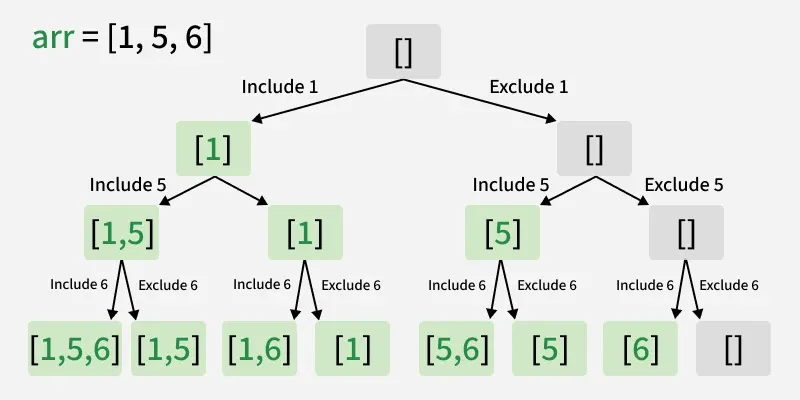
The algorithm we will use to traverse this tree is a form of Depth-First Search (DFS). When we reach a leaf, we record the subset. Then, we "backtrack" up the tree to explore a different branch. This process of exploring, recording, and undoing choices is the essence of the backtracking pattern.
2. A Universal Template for Backtracking
As an experienced developer, you appreciate reusable patterns. Backtracking problems often conform to a general, recursive template. Understanding this template can demystify many seemingly complex problems.
The following video introduces this concept and applies it directly to the subset problem we're studying. It effectively frames backtracking as a systematic traversal of a decision tree.
Solve ANY Backtracking Problem on Leetcode (Template + Explanation)
This video from the Bitflip channel explains the core concept of backtracking and provides a universal template.
First, watch the introduction from the beginning to solidify the decision tree analogy. Next, pay close attention to the detailed explanation of the subsets problem. The video walks through the include/skip logic and how the code maps directly to this decision process. Finally, the video summarizes the four key components of the backtracking template: the base case, the choices, constraints, and the backtracking step.
This "choose, explore, un-choose" cycle is the heart of the algorithm. Now, let's dive into a more detailed breakdown of the implementation.
3. Implementing the Subsets Pattern
The resource below provides a comprehensive walkthrough of the subset problem, from intuition to implementation and complexity analysis. It aligns perfectly with the "include/exclude" decision model we've discussed.
78. Subsets - In-Depth Explanation
This article from AlgoMonster provides a step-by-step guide to solving the subsets problem using backtracking.
Start by reading the Intuition section to reinforce the core concept. Next, study the Solution Approach. This section formalizes the algorithm, defining the base case, the two recursive cases (exclude and include), and the critical backtracking step. Follow the Example Walkthrough for nums = [1, 2, 3]. This will help you visualize the call stack and how the different subsets are built and recorded. Since you're proficient in both JavaScript and Go, examine the TypeScript and C++ implementations in the "Solution Implementation" section. The TypeScript code is almost identical to JavaScript, and the C++ lambda function provides a concise structure that is conceptually similar to what you might write in Go. Pay attention to how current_subset (or t) is passed and manipulated. Finally, carefully read the section on Common Pitfalls. Understanding why you must pass a copy of the current subset to your results and why the pop() operation is essential will prevent common bugs.
The time complexity of this algorithm is . This is because there are possible subsets, and for each subset, we may need up to time to create a copy to add to our results list. The auxiliary space complexity is to store the current subset and to account for the depth of the recursion stack.
4. Backtracking in Context
The "Pick / Not Pick" strategy you've just learned is one of the fundamental patterns in backtracking. Other common patterns exist for problems like permutations (where order matters) and combinations (where size is fixed).

In interviews, a common follow-up to the subsets problem is "Subsets II," which introduces duplicate numbers into the input array. This requires a small but crucial modification to the logic to avoid generating duplicate subsets. The core idea is to sort the input array and, within the recursive helper, add a condition to skip an element if it's the same as the previous one and you're at the same level of recursion. This is a great extension to think about once you are comfortable with the basic pattern.
Conclusion
In this lesson, we transitioned from searching algorithms to generative ones, using backtracking to construct all possible solutions from a set of choices. This powerful recursive pattern is central to solving a wide class of algorithmic puzzles.
Key Takeaways:
- Backtracking as a Decision Tree: Problems like subset generation can be modeled as a decision tree, where each path from the root to a leaf represents a potential solution.
- The "Include/Exclude" Pattern: For subsets, the core logic involves making a binary choice for each element: either include it in the current path or exclude it.
- Choose, Explore, Un-choose: The general backtracking template involves making a choice, recursively exploring the consequences of that choice, and then undoing the choice (the "backtrack" step) to explore other possibilities.
- Implementation Details: Remember to add a copy of your solution to the results list and to always perform the backtracking step to clean up the state for subsequent recursive calls.
We've now seen how a DFS-like traversal can solve combinatorial problems by exploring an implicit tree. In the next module, we will begin our study of Graphs and Trees, applying DFS and its counterpart, Breadth-First Search (BFS), to traverse and analyze explicit graph and tree data structures. This will be a natural extension of the recursive thinking you've honed today.