
Hello! Welcome to the final lesson of our module, "Preksha Dhyaan: The Path of Perception."
In our last few sessions, you've built a strong practical foundation in Preksha Dhyaan. You've learned to still the body with Kayotsarga, focus your awareness with Shwas Preksha and Sharira Preksha, and actively cultivate positive mental states with Anupreksha. You have experienced these techniques firsthand. Now, it's time to connect that experience to the underlying theory.
This lesson addresses our learning outcome: Explain how Preksha Dhyaan aims to transform adhyavasaya. We will unpack the Jain model of the mind to understand precisely what adhyavasaya is and how the meditation practices you've learned are designed to purify it, paving the way for profound personal transformation. This will form the crucial philosophical bridge to our later discussions on sleep, consciousness, and spiritual progress.
1. What is Adhyavasaya? The Disposition Behind the Action
At the heart of Jain psychology is the concept of adhyavasaya (mental disposition). It's more than a fleeting thought; it is the deep-seated intention or state of consciousness that precedes and drives our actions. Think of it as the inner "blueprint" for our behavior.
To understand this, consider the classic Jain parable illustrated below. The goal for all six people is the same: to get mangoes from a tree.
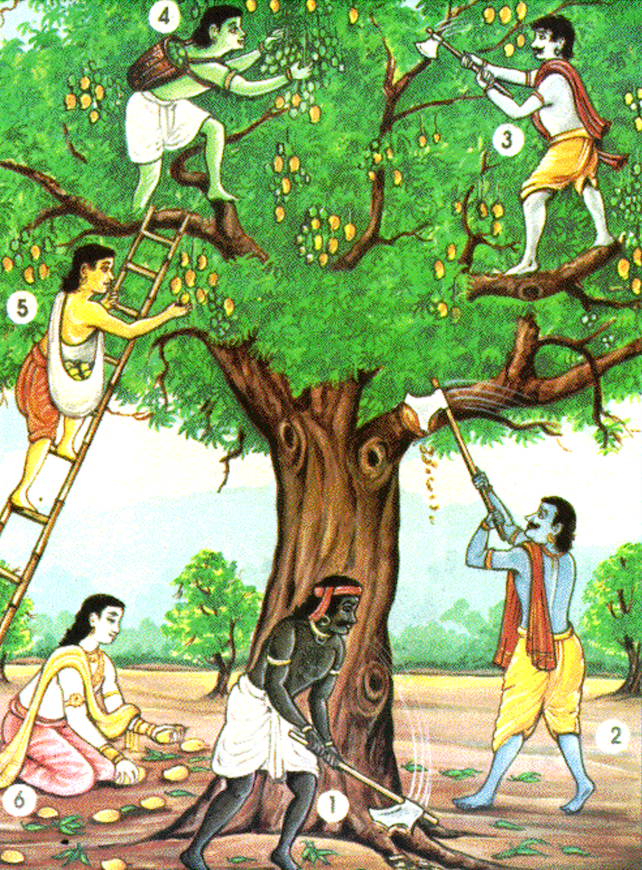
The person who chops down the tree, the person who breaks branches, and the person who simply collects fallen fruit all achieve the same outcome. However, their internal dispositions—their adhyavasaya—are worlds apart. One is violent and destructive, another is moderately harmful, and the last is patient and harmless. In Jain philosophy, it is this adhyavasaya that is the primary determinant of the karmic bondage (bandha) that results from an action.
A helpful way to define this is provided in a resource we will explore.
The following reading from 'LEHSYA – THE BASICS' offers a concise set of definitions for the key terms we will be discussing. It will help us build a clear vocabulary.
Please read the section titled 'DEFINING LESHYA'. Pay close attention to the definition of Adhyavasay: 'that power of the soul which remains unobstructed by the karmic body. The state of consciousness at that time; a ‘snapshot’ of the soul!'. Also, familiarize yourself with the definitions of Kashay and Yog.
As the reading highlights, adhyavasaya is a "snapshot of the soul" at any given moment. It is the immediate psychic expression that drives what we think, say, and do. But where does this snapshot come from?
2. The Inner Chain of Command: From Karma to Action
Adhyavasaya is not created in a vacuum. It is the result of a subtle, dynamic process deep within our consciousness. Understanding this process reveals exactly where meditation can intervene.
This process can be understood as a chain reaction:
-
The Source: Karma and Kashaya
The process begins with the fruition of past karmas. As these karmic particles ripen and release their energy, they interact with the field of kashayas—our primal passions of anger, pride, deceit, and greed. This potent mix of past karma and current passion radiates from the soul as a new psychic expression: the adhyavasaya. -
The Transformation: Leshya and the Body
This adhyavasaya, existing as subtle vibrations, then interacts with our leshya, the psycho-spiritual "coloring" of the soul we discussed in a previous module. This interaction further shapes the disposition and begins its journey toward physical manifestation. -
The Manifestation: The Neuro-Endocrine System and Yoga
The final step is the bridge between the subtle and the gross. These vibrations influence the physical body, specifically the neuro-endocrine system. This triggers the release of hormones that generate emotions and urges. These urges then manifest as yoga—the observable activities of our mind (thoughts), speech, and body. These actions, in turn, attract new karma, and the cycle continues.
The following reading provides a detailed account of this mechanism, connecting the subtle philosophy to tangible biology.
Preksha Dhyana Perception of Psychic Colours
This reading from Acharya Mahapragya's tradition, 'Preksha Dhyana Perception of Psychic Colours', explains the intricate process of how a subtle psychic expression is translated into a physical action.
Please read from the 'Introduction' (starting 'Sometimes a person behaves well...') through the subsection 'Functions of Lesya'. Focus on understanding the flow: how adhyavasaya in the form of 'ultramicro-waves' interacts with lesya and then influences the endocrine and nervous systems to produce behavior. The diagram on page 6 of the PDF provides a useful summary of this flow.
To summarize this crucial flow:
Fruition of Past Karma + Kashaya (Passions) → Adhyavasaya (Mental Disposition) → Leshya (Psycho-Spiritual Coloring) → Neuro-Endocrine System (Hormones/Nerves) → Yoga (Thought, Speech, Action) → New Karmic Bondage
Seeing this chain laid out clearly, the question becomes: how can we break it? This is precisely the goal of Preksha Dhyaan.
3. Intervention and Transformation: How Preksha Dhyaan Purifies Adhyavasaya
Preksha Dhyaan is a system designed to intervene in this cycle and transform adhyavasaya from a state of impurity, driven by passions, to a state of purity and clarity. It does this through two primary mechanisms, which directly correspond to the practices you have learned.
Mechanism 1: Purifying through Objective Perception (Preksha)
The first method is about preventing the pollution from happening in the first place. The practices of Shwas Preksha (breath perception) and Sharira Preksha (body perception) train you to be a neutral observer—a pure "spectator" or "knower" of reality. You are trained to perceive sensations without reacting with the kashayas of attachment (like) or aversion (dislike).
When the mind is in this state of pure observation, the psychic energy it radiates is not contaminated by the passions. This results in the formation of a pure adhyavasaya. You essentially cut the link between the kashayas and the adhyavasaya, allowing your innate consciousness to express itself without distortion. You are not suppressing the passion; you are simply not engaging with it, allowing it to pass without coloring your mind.
Mechanism 2: Purifying through Active Contemplation (Anupreksha)
The second method is an active intervention. This is the work of Anupreksha (contemplation), which you practiced in our last lesson with the theme of Maitri (Amity). This technique, along with Lesya Dhyana (perception of psychic colors), works by consciously generating positive, "benevolent" psychic vibrations.
These self-generated waves of amity, compassion, or impermanence act as a powerful antidote. They meet and neutralize the "malevolent" waves arising from the kashayas and fruiting karma. The result is a transmutation—the raw energy of the negative disposition is transformed, and the adhyavasaya is "decontaminated" before it can manifest as a harmful thought or action.
The following text explains these two methods of transformation in detail.
Preksha Dhyana Perception of Psychic Colours
We return to 'Preksha Dhyana Perception of Psychic Colours' to read the section that explicitly details how meditation transforms our inner world.
Please read the section titled 'Transmutation and Transmutation' and the subsection 'Emotional Purity'. Focus on the two ways described to countermand the forces of kashaya: Making psychic energy 'purely objective' so it is not polluted (the spectator role). Producing 'delusion-subsiding' waves through meditation to neutralize the 'delusion-producing' waves (the active role). Notice the analogy of waves interacting with and neutralizing each other.
Test your understanding!
Based on the two mechanisms you've just studied, how would you describe the difference between the approach of Sharira Preksha (body perception) and Anupreksha (contemplation of amity) in dealing with a feeling of anger as it arises?
Show answer
-
With Sharira Preksha, you would adopt the "spectator" role. You would observe the physical sensations of anger—perhaps heat in the face, tension in the shoulders, a rapid heartbeat—with impartial awareness. By not reacting with aversion ("I hate this feeling"), you prevent the kashaya from further polluting your adhyavasaya. You simply watch the anger wave rise and fall without identifying with it.
-
With Anupreksha, you would take a more active role. Recognizing the anger, you would consciously begin generating the "counter-waves" of amity. You might contemplate, "This anger brings suffering. May all beings, including myself, be free from this feeling. I have amity with all." This actively transmutes the energy of anger into the energy of friendship and compassion, neutralizing it.

Conclusion
In this lesson, we have moved from practice to theory, uncovering the "why" behind the Preksha Dhyaan techniques you've learned. You now have a model for understanding how your inner world operates according to Jain philosophy and, crucially, how you can consciously change it.
Key Takeaways:
- Adhyavasaya is the foundational mental disposition or intention that shapes our actions and determines our karmic path.
- It arises from a dynamic cycle where past karmas and passions (kashayas) generate subtle vibrations that influence our body and mind.
- Preksha Dhyaan transforms adhyavasaya through two distinct but complementary mechanisms:
- Objective Perception (Preksha): By developing a "spectator" attitude, we prevent our passions from contaminating our mental dispositions.
- Active Contemplation (Anupreksha): By consciously generating positive mental states, we can neutralize and transmute negative dispositions as they arise.
Preview of the Next Module:
This lesson concludes our deep dive into the specific techniques and theory of Preksha Dhyaan. You now have a solid understanding of the tools for cultivating awareness and transforming your inner state.
In our next module, "Sleep and Meditation: A Comparative Analysis," we will begin the great synthesis that is the core of your goal. We will start by asking: What is the purpose and function of sleep versus meditation from a scientific perspective? We will place the states of consciousness achieved through meditation side-by-side with the states of consciousness experienced during sleep, setting the stage to explore how one might influence—or even replace—the other.