
Hello! Welcome to our next lesson in "Preksha Dhyaan: The Path of Perception."
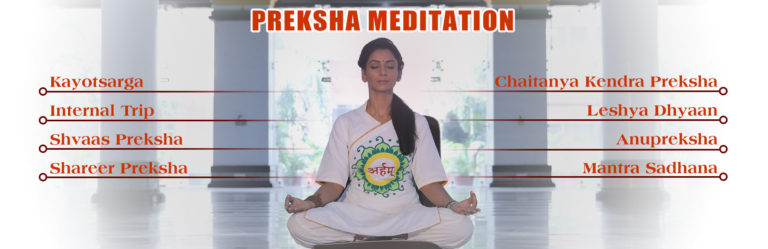
In our journey so far, we have cultivated a sequence of foundational skills. You started with Kayotsarga to achieve physical stillness, then used Shwas Preksha to focus your awareness, and finally expanded that focus with Sharira Preksha to perceive the body with impartial clarity. These practices have been about sharpening your ability to perceive reality as it is, without judgment.
Today, we transition from passive perception to active reflection. This lesson is dedicated to our learning outcome: Practice anupreksha (contemplation) on a chosen theme during a waking meditation session.
Anupreksha means "repeatedly looking at" or "deep contemplation." It is the mental tool we use to internalize a concept and transform our perspective. While the previous practices trained your awareness to be a clear mirror, Anupreksha is about holding a specific object in front of that mirror to understand its every detail. This skill is a crucial step toward your goal of maintaining conscious awareness during sleep.
1. What is Anupreksha? The Art of Deep Contemplation
Anupreksha is a core technique in Jain meditation, shifting from observing sensations to engaging with an idea. It is a method of deep reflection that aims to change our underlying mental patterns.
To understand its philosophical basis, let's turn to a research paper that explores its principles.
The role of Anupreksha meditation in alleviating negative ...
This reading from 'The role of Anupreksha meditation in alleviating negative...' explains the core principles of Anupreksha.
Please read the section titled 'Intervention', which begins with 'Anupreksha-based meditation'. Focus on these key points: The definition of Anupreksha: 'repeatedly contemplating and reflecting on what has been learned or perceived'. Its two main objectives: contemplating eternal truths and bringing about attitudinal changes. The four stages of the practice: darshana (seeing), grahana (adopting), dhaaran (absorbing), and sadhana (indulging).
As the reading explains, Anupreksha is a structured process for internalizing knowledge. Let's briefly break down those four stages:
- Darshana (Seeing/Perceiving): You introduce the theme to your mind, perhaps by viewing an image or repeating a phrase.
- Grahana (Adopting/Grasping): You actively take hold of the concept, focusing your mind on it.
- Dhaaran (Absorbing/Sustaining): You hold the concept in your awareness for a prolonged period, allowing it to sink in.
- Sadhana (Indulging/Practicing): The concept begins to integrate into your mindset, becoming a part of your active worldview.
This practice directly addresses the transformation of adhyavasaya (mental dispositions), which is a central theme of our course. By repeatedly contemplating a positive or truthful concept, you consciously work to overwrite habitual, unhelpful thought patterns.
2. Themes for Contemplation: Impermanence and Amity
Anupreksha can be practiced with many different themes. Twelve specific contemplations are outlined in Jain scriptures, including the nature of the soul, the universe, and karma.
One of the most common themes is Anitya Anupreksha, or the contemplation of impermanence.

In this practice, one reflects on the fact that all external objects, relationships, and even our own body are temporary and subject to change. This helps reduce attachment and suffering.
For our guided practice today, however, we will focus on a different but equally powerful theme: Maitri (Amity or Universal Friendship). Contemplating amity is a direct antidote to dispositions of anger, fear, and hatred. It is a powerful method for purifying your emotional state and creating a foundation of peace from which to engage in deeper spiritual work.
3. Guided Practice: Maitri Anupreksha (Contemplation of Amity)
We will now turn to a practical, step-by-step method for practicing the contemplation of amity, as guided by Acharya Mahapragya. The following resource provides the exact process.
Paving a way to the Preksha Meditation-Maitri (Amity)
The following sections from 'Paving a way to the Preksha Meditation-Maitri (Amity)' provide a detailed, practical guide for this specific contemplation.
Please read the sections titled 'Process of Maitriki Anupreksha (Contemplation of Amity)' and 'Contemplate'. Focus on memorizing the sequence of the practice: the posture, the mantra recitation, the color visualization, the auto-suggestion phrases, and the deeper contemplative sentences.
Now that you have read the process, let's structure it for a 20-minute practice session. Find a quiet place where you can sit undisturbed.
Step-by-Step Guided Practice:
-
Preparation (2 minutes):
- Select a comfortable, stable meditation posture with an erect spine.
- Perform a brief Kayotsarga, allowing your entire body to become still and relaxed.
- Recite the mantra 'Arham' nine times. Arham is a sacred mantra in Jainism representing the purified, omniscient soul. Its vibration helps to center the mind.
-
Visualization (3 minutes):
- Close your eyes and visualize that you are surrounded by particles of pure, bright white color, like snow.
- With each inhalation, experience these bright white particles entering your body, filling you with peace and purity.
-
Concentration and Auto-Suggestion (8 minutes):
- Concentrate your conscious mind at the center of your forehead (often called the Jnana Kendra, or center of knowledge).
- Perceive the bright white color at this center.
- Now, begin the auto-suggestion. First, repeat the following sentences aloud nine times, then repeat them mentally nine times:
- "Everybody is my friend."
- "I will practice friendship towards all."
-
Deep Contemplation (5 minutes):
- Keeping your focus, shift to deeper contemplation. Reflect on the meaning of these statements. You can use the sentences from the reading as a guide:
- "Sense of enmity arouses fear. Fear makes the body and mind weak. Therefore, I should develop a sense of friendship."
- "As soon as the feeling of the enemy arrives, the happiness disappears. To preserve my happiness, I should practice friendship."
- Don't just repeat the words; try to feel the truth behind them. What does enmity feel like in your body? What does friendship feel like?
- Keeping your focus, shift to deeper contemplation. Reflect on the meaning of these statements. You can use the sentences from the reading as a guide:
-
Conclusion (2 minutes):
- Take two or three long, deep breaths.
- Conclude by reciting the Sharan Sutra (mantra of refuge) three times if you are familiar with it, or simply by sitting in silence for a moment, absorbing the feeling of amity.
- The reading also suggests a powerful daily practice before sleep: reciting the couplet "I forgive all living beings... I have amity with everyone, no enmity with anyone." This is an excellent way to integrate this practice into your routine.
Test your understanding!
In the practice above, what is the difference in function between the auto-suggestion ("Everybody is my friend") and the contemplation ("Sense of enmity arouses fear...")?
Show answer
The auto-suggestion is a direct command to the subconscious mind. It's like planting a seed—a simple, powerful, positive statement that you repeat to create a new mental habit.
The contemplation is the process of watering that seed with understanding. It involves reasoning and deep reflection, helping your conscious mind understand why the auto-suggestion is beneficial. The auto-suggestion changes the attitude, while the contemplation provides the wisdom to support that change.
Conclusion
In this lesson, you have learned and practiced Anupreksha, the technique of active contemplation. By focusing on the theme of Maitri (Amity), you have taken a direct step towards transforming your inner dispositions, moving from a state of passive observation to one of conscious, intentional change. This ability to hold and deepen a specific mental state is a foundational skill for the advanced practices you wish to explore.
Key Takeaways:
- Anupreksha is the practice of deep, repeated contemplation on a specific theme.
- It serves to internalize truths and induce attitudinal changes, directly influencing our adhyavasaya.
- The practice follows stages, from perceiving an idea (darshana) to fully integrating it (sadhana).
- The contemplation of Maitri (Amity) is a powerful technique for dissolving negativity and cultivating a peaceful mind.
Preview of the Next Lesson:
Having now practiced Kayotsarga, Shwas Preksha, Sharira Preksha, and Anupreksha, you have a solid experiential understanding of the main components of Preksha Dhyaan. In our next lesson, we will tie these practices together by exploring the theory behind their effectiveness. We will answer the question: "How does Preksha Dhyaan aim to transform adhyavasaya?" This will connect the practices you've learned directly to the Jain philosophical framework of mind and karma.