
Hello again. In the previous lesson, you learned how the Ark, Torah, bimah, yad, and Ner Tamid shape synagogue worship. You also noticed that the seating shown in an Orthodox synagogue can differ from other Jewish communities.
This lesson develops that point. You will compare Orthodox and Reform approaches to worship: what they have in common, how services differ, and—most importantly for GCSE—what these differences show about each tradition’s priorities. The aim is not to decide that one approach is “better” or “more religious.” Both are Jewish responses to worshipping God and living faithfully; they differ over how tradition should be followed in modern life.
One faith, different approaches to worship
A synagogue is a place for communal worship, meaning Jews gather to pray, hear the Torah, celebrate festivals, learn, and support one another. Orthodox and Reform Jews share many central beliefs and practices:
- worship is directed to the one God;
- the Torah is sacred and guides Jewish life;
- synagogue services include prayer and readings from the Torah;
- the Ark is treated with reverence because it holds Torah scrolls;
- Shabbat is an important time for communal worship.
The main difference is in their approach to religious tradition and change.
Orthodox Judaism aims to follow the Torah and rabbinic law, known as halakhah, closely. Changes to worship are usually accepted only if they can be justified by traditional Jewish law.
Reform Judaism seeks to preserve Jewish belief and identity while adapting some laws and customs to modern circumstances. Reform communities often place particular emphasis on participation, equality, and making worship understandable to the congregation.
This difference in approach helps explain the differences you need to revise. It is better than simply memorising a list.
Worship - Practices in Judaism - GCSE Religious Studies Revision - AQA - BBC Bitesize
Read BBC Bitesize’s concise GCSE comparison of Orthodox and Reform synagogue worship. It gives the core factual contrasts you need to use accurately in an exam.
In the section “Worshipping in the synagogue”, begin with the paragraph starting “Orthodox Jews” and read the full comparison through to the final sentence about musical instruments. Focus on four categories: frequency of services, language, seating, and music. Notice that Reform worship is described as using both Hebrew and the national language, not as abandoning Hebrew entirely.
Orthodox communal worship: continuity with tradition
In the GCSE comparison, Orthodox synagogues usually hold three services each day:
- Shacharit in the morning
- Minchah in the afternoon
- Arvit in the evening
Services are conducted in Hebrew, the language of the Torah and of traditional Jewish prayer. Using Hebrew connects worshippers with earlier generations of Jews across the world and with the original language of their sacred texts.
In many Orthodox synagogues, men and women sit separately. There may be a divider, called a mechitzah, or women may sit in a separate gallery. Orthodox Jews may understand this arrangement as helping worshippers concentrate fully on God and prayer. It reflects a traditional interpretation of appropriate gender roles in public worship.
Male worshippers commonly wear a kippah as a sign of respect for God. Men may wear a tallit, a prayer shawl with fringes that remind them of God’s commandments. On weekday morning prayers, men may wear tefillin, small leather boxes containing passages from the Torah, bound to the arm and head to encourage focus on God’s word.
Traditional Orthodox worship does not use musical instruments in services. Prayers may still be highly musical: they can be sung or chanted, often led by a cantor or hazzan. The point is that the human voice carries the prayer.
The layout can also reflect this traditional approach. In many Orthodox synagogues, the bimah is centrally placed, with worshippers around it. This makes the public reading of the Torah a visible focus of the whole congregation. Layouts vary between communities, so use words such as often or typically rather than claiming every synagogue is identical.
Reform communal worship: accessibility and inclusion
Reform synagogues commonly hold services on Shabbat, as well as at festivals and special occasions, rather than necessarily holding services three times every day. This can make communal worship fit the patterns of modern family and working life while retaining Shabbat as a central weekly gathering.
Reform services often use Hebrew alongside the language of the country. In the UK, this means English. Hebrew remains important because it links Jews with traditional prayers and Jewish history; English enables worshippers to understand the words they are praying. This can make participation easier, especially for people who do not speak much Hebrew.
Men and women usually sit together in Reform synagogues. This reflects the Reform emphasis on equal participation in communal worship. Reform communities can have women rabbis, whereas, in the standard GCSE comparison, Orthodox rabbis are male.
Some Reform Jews also adapt traditional dress practices. For example, some Reform women may wear tefillin. This does not mean that every Reform Jew worships in the same way; it shows that Reform congregations may apply traditional practices more equally across genders.
Musical instruments are often used in Reform worship. They may accompany hymns and sung prayers, helping create a participatory, communal atmosphere.
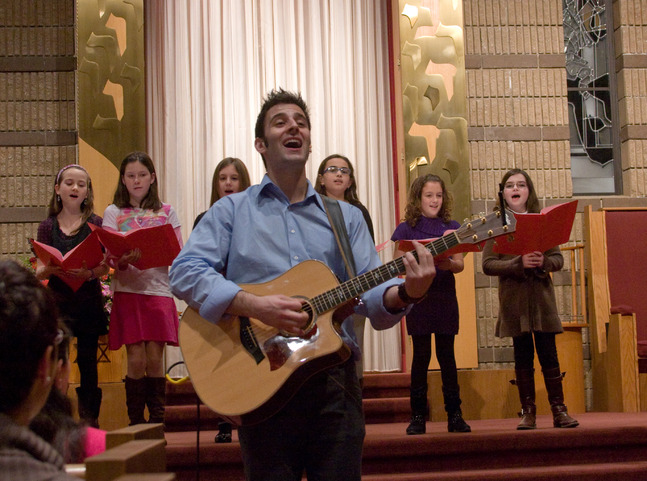
In many Reform synagogues, the bimah is placed at the front, nearer the Ark, and the rabbi faces the congregation. This arrangement can make the service feel more like a shared gathering led from the front. However, remember the key point: the bimah is still used for reading the Torah, so both traditions treat the Torah as central to worship.
Worship in the synagogue. Judaism Practices AQA GCSE Lesson 4
Watch Wise Revise’s “Worship in the synagogue” comparison for a quick visual recap of the different synagogue layouts and worship styles.
Watch the core comparison. Focus on the visual contrast between the position of the bimah, the seating arrangements, the language of worship, female rabbis in Reform communities, and instruments. Treat “mostly English” in the video as a broad summary: for a precise exam point, say that Reform worship commonly uses English alongside Hebrew.
Compare the approaches precisely
Use this table as a revision grid. The final column matters because it turns description into explanation.
| Area | Orthodox worship | Reform worship | What the contrast suggests |
|---|---|---|---|
| Services | Usually three daily services | Often focuses on Shabbat, festivals, and special occasions | Orthodox worship maintains a more traditional daily pattern; Reform worship may adapt practice to modern life. |
| Language | Hebrew | Hebrew and the national language, such as English in the UK | Orthodox worship stresses continuity with traditional Jewish prayer; Reform worship stresses understanding and accessibility as well. |
| Seating | Men and women sit separately | Men and women sit together | They hold different views about gender roles and concentration in worship. |
| Leadership | In the GCSE comparison, rabbis are male | Women may be rabbis | Reform Judaism emphasises equal participation in religious leadership. |
| Music | No musical instruments in services | Instruments may be used | Orthodox worship maintains traditional forms; Reform worship may use music to encourage participation. |
| Layout | Bimah is often central | Bimah is often at the front, near the Ark | Both centre the Torah, but their physical arrangements may express different styles of community worship. |
| Dress | Men commonly wear kippah, tallit, and sometimes tefillin | Practice varies; some Reform women may wear tefillin | Reform communities may extend traditional practices more equally. |
A useful way to avoid confusion is to remember:
Same purpose, different style.
Both communities worship God, pray, read the Torah, and gather as Jews. Orthodox worship generally prioritises continuity with traditional law and practice; Reform worship generally prioritises adapting worship so that the whole community can understand and participate.
Do not make these inaccurate statements:
-
“Reform Jews do not use Hebrew.”
Reform services commonly use both Hebrew and English in the UK. -
“Orthodox Jews do not sing.”
Orthodox prayer can be sung or chanted; the contrast is the use of instruments. -
“All synagogues have the same layout.”
Synagogue design varies. Use often, usually, or in many synagogues. -
“Reform Jews do not respect the Torah.”
Both traditions treat the Torah as sacred. Their disagreement concerns how Jewish law and worship should be applied today.
Turning knowledge into a GCSE comparison
A weak answer lists disconnected facts:
“Orthodox Jews sit separately. Reform Jews sit together. Orthodox Jews use Hebrew. Reform Jews use English.”
This may gain some credit, but it lacks explanation and misses the shared foundations.
A stronger comparison links each contrast to a religious reason:
“Both Orthodox and Reform Jews worship together in synagogues and read from the Torah. However, Orthodox services are usually held in Hebrew and men and women sit separately, reflecting an emphasis on traditional Jewish law and concentration during prayer. In contrast, Reform services often use English alongside Hebrew, and men and women sit together. This reflects the Reform aim of making worship understandable and allowing equal participation in the community.”
Notice the structure:
- Start with a similarity.
- Give a clear contrast using “however” or “whereas.”
- Add accurate evidence: Hebrew, seating, music, leadership, or service frequency.
- Explain what the difference shows about each tradition.
For quick revision, cover the middle two columns of the table and reconstruct each contrast from the final column. Then practise saying each comparison as a full sentence rather than as a single-word prompt.
Key takeaways
Orthodox and Reform Jews share core features of communal worship: they worship the one God, pray in synagogues, and treat the Torah as sacred.
The main contrasts are:
- Orthodox: usually three daily Hebrew services, separate seating for men and women, male rabbis in the GCSE comparison, and no instruments.
- Reform: commonly Shabbat-focused services, Hebrew alongside English in the UK, mixed seating, women may be rabbis, and instruments may be used.
- These differences reflect different approaches to tradition: Orthodox Judaism generally preserves established halakhic practice, while Reform Judaism adapts aspects of worship for modern participation and equality.
Next, you will focus on two prayers that can be heard in synagogue worship—the Shema and the Amidah—and explain why they are so significant to Jewish belief.
Can't find a good explanation? Sign up and we'll make it for you
Sign up