
Welcome. This course turns your existing bulk RNA-seq analysis into evidence of job-ready bioinformatics practice: a repository that makes its biological purpose, computational decisions, and results easy for another person to inspect.
Your first task is deceptively important: define exactly what your project is about. Before improving Bash automation, QC, DESeq2 code, or documentation, you need a precise statement of the biological question, the comparison, the organism and biological material, and the RNA-seq assay. These details are the contract that every later pipeline decision must satisfy.
By the end of this lesson, you will have a concise, evidence-backed project statement suitable for the top of a README, a report introduction, and an interview explanation.
Start with the study, not the pipeline
An RNA-seq pipeline can be technically flawless while answering the wrong—or an unstated—question. “I performed differential expression analysis” describes a method. It does not tell a reviewer:
- what biological system was studied;
- what changed between samples;
- what the intended comparison is;
- what RNA molecules were measured; or
- what conclusion the analysis can reasonably support.
A useful project definition has four connected parts:
| Component | What it answers | Example |
|---|---|---|
| Biological question | What is being investigated? | Does dexamethasone alter gene expression in airway smooth muscle cells? |
| Comparison | Which groups are compared, and in what direction? | Dexamethasone-treated versus untreated |
| Organism and material | In what species and biological system? | Homo sapiens, airway smooth muscle cells |
| RNA-seq assay | What measurement generated the data? | Bulk, stranded, paired-end poly(A)-selected RNA-seq |
These are not four independent facts. The assay defines what “expression” means operationally; the organism and material define biological scope; the comparison defines the quantity that will later become a log fold change; and the biological question determines whether that comparison is meaningful.
Consider the overall workflow below. The biological question is established at the experimental design stage. Everything after that converts molecules from those planned samples into quantitative evidence.
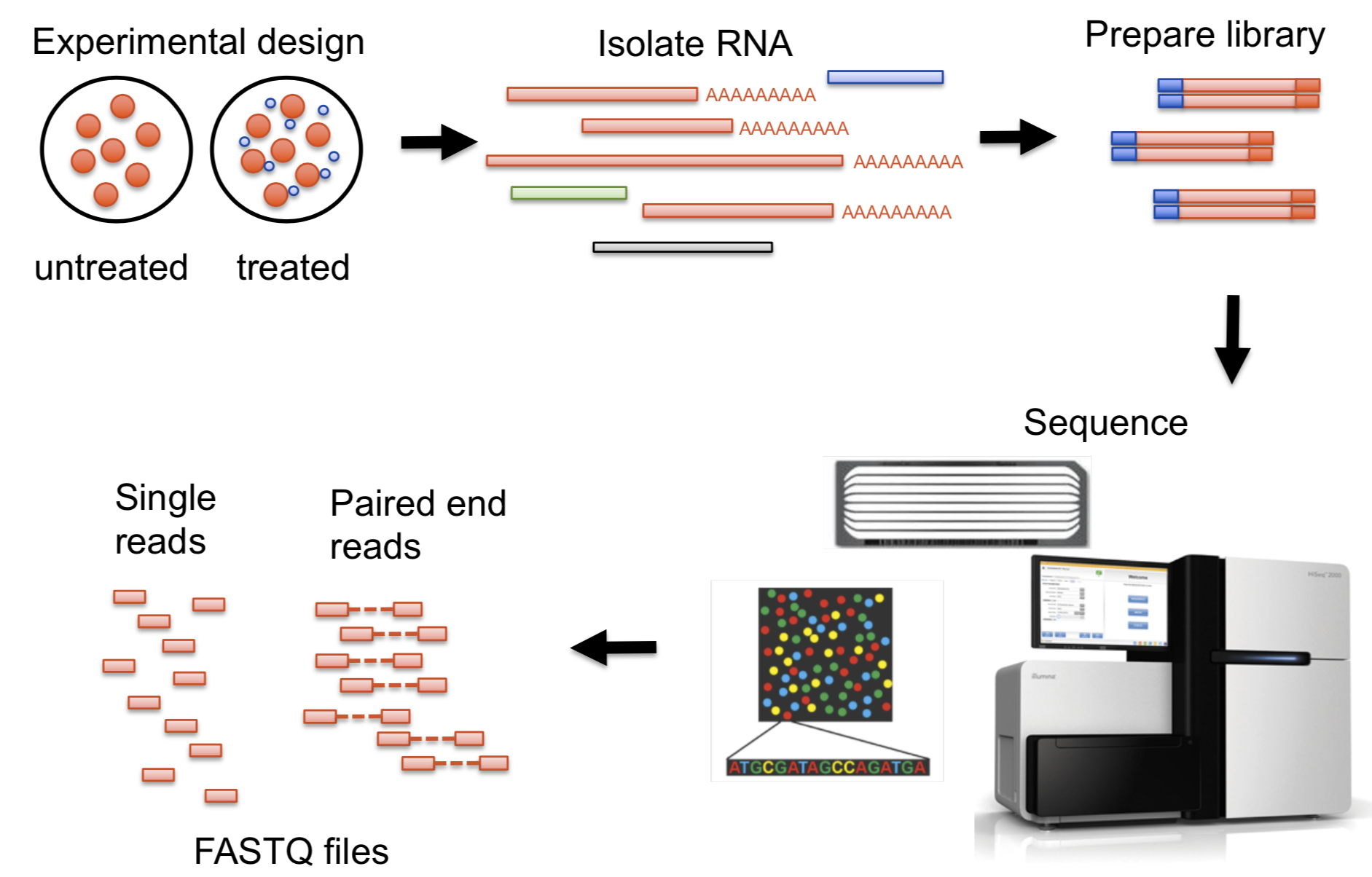
The figure also highlights an important limitation: FASTQ files alone do not fully describe an experiment. They can show you read layout and sequences, but they generally cannot reliably tell you whether RNA was poly(A)-selected or ribosomal-RNA-depleted, whether the experiment was randomized, or what treatment timing was used. Those facts belong in metadata, a publication’s methods, sequencing-facility documentation, or a study record.
A model project definition
Study this short real-world example from the Harvard Chan Bioinformatics Core. It demonstrates how a clear study description combines biological motivation, sample groups, biological material, library properties, sequencing platform, read layout, and replication.
Data Management and Project Organization | Introduction to RNA-seq using HPC
Read “Exploring the example dataset” from Harvard Chan Bioinformatics Core’s Introduction to RNA-seq using HPC. Notice how the authors distinguish the wider disease context from the specific RNA-seq experiment and its comparison.
In the section “Exploring the example dataset,” read the dataset description. Track four items as you read: the biological system, the experimental groups retained for analysis, the sequencing assay details, and the number of replicates. Do not treat the larger scientific motivation as identical to the analysis question.
The example’s broad motivation is Fragile X syndrome and RNA regulation. But the analyzable RNA-seq comparison is narrower: expression in HEK293F cells with a MOV10 transgene compared with cells receiving an irrelevant siRNA control. The study description also records that the data are stranded, use the TruSeq dUTP protocol, were sequenced as 100 bp single-end reads, and have three replicates per group.
That distinction is worth preserving in your own project:
- Scientific context: Why does this topic matter biologically or clinically?
- Biological question: What change in RNA abundance is your analysis testing?
- Statistical comparison: Which samples provide the reference and which provide the focal condition?
- Assay description: What data-generating process makes the comparison measurable?
A portfolio README often fails by including only the first item: for example, “Cancer is a major health burden.” That is context, not a project definition.
Write a question that can be answered from your data
For a standard bulk RNA-seq differential-expression project, the central question usually has this form:
In [biological system], how is gene expression associated with or altered by [condition or perturbation], compared with [reference condition], at [time point or relevant context]?
The wording should match the study design.
Interventional studies
If investigators deliberately applied a treatment, knocked out a gene, introduced a transgene, or exposed cells to a compound, language such as “effect of” or “response to” is often appropriate:
In Homo sapiens airway smooth muscle cells, what gene-expression changes occur after 18 hours of dexamethasone treatment relative to untreated cells?
The treatment is the focal condition; untreated samples are the reference. If the experimental structure supports it, the analysis estimates a treatment-associated expression difference while accounting for known sources of variation.
Observational studies
If samples were collected from pre-existing groups, avoid claiming a causal effect merely because the groups differ. Use “associated with” instead:
Which genes are differentially expressed in tumor tissue from patients with disease subtype A relative to subtype B?
Here, disease subtype was observed, not assigned experimentally. Differences may reflect subtype, cellular composition, clinical factors, processing differences, or other variables. The language should not overstate what the experiment establishes.
Descriptive studies
Some datasets are intended to characterize a tissue, developmental stage, or set of conditions rather than test a single treatment effect. In this case, name the intended descriptive comparison explicitly:
How does bulk gene expression differ across early, mid, and late developmental stages in Arabidopsis thaliana leaf tissue?
This is still an RNA-seq project, but the comparison is multi-group rather than a simple treatment-versus-control contrast.
Keep the question at the right level
Avoid writing a question that promises more than gene-level bulk RNA-seq can demonstrate.
| Too strong or vague | More defensible |
|---|---|
| “Which genes cause drug resistance?” | “Which genes show differential expression between drug-resistant and drug-sensitive samples?” |
| “How does treatment cure inflammation?” | “What transcriptional changes are associated with treatment in the sampled cells?” |
| “RNA-seq analysis of breast cancer” | “Which genes differ in bulk expression between SN1-knockout and wild-type triple-negative breast cancer cells?” |
Later, functional enrichment can help formulate biological hypotheses. It does not turn differential expression alone into proof of molecular mechanism or causation.
Define the comparison with enough precision to reproduce it
A comparison is more than two labels in filenames. It must specify the groups, their roles, and the unit of replication.
For each primary contrast, record:
- Focal level: the condition whose expression level appears in the numerator.
- Reference level: the baseline condition.
- Biological unit: what one sample represents, such as one donor, one culture, one animal, or one tissue specimen.
- Replicate count: the number of independent samples in each group.
- Important context: dose, time point, tissue, cell type, genotype, or other condition needed to interpret the contrast.
For example:
Primary comparison: 18-hour dexamethasone-treated airway smooth muscle cells versus matched untreated airway smooth muscle cells from the same four human cell lines.
This wording tells a reader that the samples are paired by cell line. A less precise statement—“treated versus untreated”—would hide a major feature of the design.
When you later inspect DESeq2 results, your comparison direction matters. A positive log2 fold change for “treated versus untreated” means higher estimated expression in treated samples; reversing the contrast reverses its sign. This lesson does not yet require you to write a design formula, but it establishes the information you will need to do that correctly in Module 5.
The following brief tutorial example shows how a clean knockout-versus-wild-type study is identified from an expression-atlas record and sample-level design information.
RNA-seq tutorial with DESeq2: Differential gene expression project
Watch “RNA-seq tutorial with DESeq2: Differential gene expression project” from OMGenomics for a compact example of turning a public study into a specific differential-expression comparison.
Watch study selection. Focus on how the presenter identifies the cell line and disease context, then narrows the study to the one controlled difference between groups: targeted gene deletion versus the comparison group.
A practical rule: a person unfamiliar with the project should be able to create a two-column sample table headed condition from your comparison statement alone. If they cannot tell which samples belong in each group, the statement needs revision.
Name the organism and the biological material
“Human RNA-seq” is incomplete. The species is Homo sapiens, but the biological material could be a tumor biopsy, peripheral blood, a primary cell culture, a cell line, or an organoid. Those are biologically and analytically different systems.
Record these separately:
| Field | Example | Why it matters |
|---|---|---|
| Organism | Homo sapiens | Determines the reference genome and annotation system. |
| Material | Airway smooth muscle cells | Defines the cellular context of detected expression. |
| Source or model | Four established cell lines | Clarifies whether samples represent donors, lines, animals, or cultures. |
| Tissue or disease context | Asthma-relevant airway model | Provides biological interpretation without overstating clinical relevance. |
For non-model organisms, include the strain, cultivar, isolate, or accession when known. For cancer datasets, retain both species and model context: for example, “Homo sapiens, triple-negative breast cancer cell line.” For tissue biopsies, include tissue and, when relevant, disease status.
This level of specificity is also essential for later upstream auditing. Genome assembly, annotation release, and gene identifiers must correspond to the correct organism. You will examine reference compatibility in Module 6.
What “assay” means in an RNA-seq portfolio project
The word assay means the experimental measurement method, not simply “RNA-seq.” For your project, write enough information for a technically literate reader to understand what molecules were captured and what type of reads entered your pipeline.
For a bulk RNA-seq project, capture the following where available:
| Assay attribute | Typical values | Why it changes interpretation or analysis |
|---|---|---|
| Scope | Bulk RNA-seq | Measurements are aggregated across all cells in each sample; they are not single-cell profiles. |
| RNA selection | Poly(A) selection; total RNA with rRNA depletion | Determines which RNA populations are enriched and affects expected coverage. |
| Library strandedness | Stranded; unstranded; reverse stranded | Must be propagated correctly during read counting. |
| Read layout | Single-end; paired-end | Determines whether each fragment produces one read or a read pair. |
| Read length | For example, 75 bp or 100 bp | Affects alignment and isoform-resolution potential. |
| Sequencing platform | For example, Illumina NovaSeq or HiSeq | Supports reproducibility and helps contextualize output. |
| Quantification target | Gene-level counts; transcript-level estimates | Determines the direct input and interpretation of downstream analysis. |
The assay does not need to be described with every reagent and instrument setting in the first paragraph of a README. But it must include the features that affect the computational workflow and biological claim.
For example:
This project analyzes bulk, stranded, poly(A)-selected RNA-seq libraries from Homo sapiens airway smooth muscle cells. Libraries were sequenced as 100 bp single-end reads and quantified as gene-level raw counts for differential-expression analysis.
If the study used rRNA depletion rather than poly(A) selection, state that instead. Do not infer this detail from a file extension or from the presence of non-coding genes in a count matrix. Mark unknown details as unknown until you locate an authoritative source.
The next resource gives a useful overview of the choices that should be documented when characterizing an RNA-seq assay.
Webinar #11 - Beginner's guide to bulk RNA-Seq analysis
Watch this section of “Webinar #11 – Beginner’s guide to bulk RNA-Seq analysis” from opar to consolidate the experimental features that distinguish one bulk RNA-seq assay from another.
Watch assay decisions. The discussion covers RNA fraction selection, strandedness, single-end versus paired-end sequencing, read length, depth, and replication. For this lesson, focus on identifying which of these properties are facts about your existing dataset and which remain undocumented.
Build an evidence-backed project statement
Now create a file called project_scope.md or add an equivalent section near the top of your repository README. Do not write from memory alone. Use the study accession, sample metadata, publication methods, lab notes, and sequencing-provider documentation available for your project.
Use this template, replacing every bracketed field only when you have evidence:
## Project scope

**Biological question:** In [organism and biological material], how does
[intervention, exposure, genotype, phenotype, or condition] relate to
gene-level expression relative to [reference condition] [at time point,
dose, or other essential context]?

**Primary comparison:** [focal condition] versus [reference condition].
The experimental unit is [donor / animal / culture / cell line / tissue
specimen], with [n] biological replicates in the focal group and [n] in
the reference group. [State pairing or repeated measurements if present.]

**Organism and material:** [scientific name; common name if useful];
[organ/tissue/cell type/cell line]; [disease state, strain, genotype, or
other relevant model detail].

**Assay:** Bulk [poly(A)-selected / rRNA-depleted / other] RNA-seq;
[strandedness if known]; [single-end or paired-end], [read length if
known]; [platform if known]. Reads were quantified as [gene-level raw
counts / other stated target].

**Evidence sources:** [study accession and sample metadata], [publication
methods or protocol], [sequencing or library documentation].

**Known unknowns:** [assay properties or sample facts that still need
verification].
Here is an abbreviated completed version based on the HBC example:
Biological question: In HEK293F cells, which genes differ in expression
between cells transfected with a MOV10 transgene and cells transfected
with an irrelevant siRNA control?

Primary comparison: MOV10 transgene versus irrelevant siRNA control,
with three replicates per group.

Organism and material: Homo sapiens; HEK293F cells.

Assay: Bulk stranded RNA-seq using the TruSeq dUTP method; 100 bp
single-end reads sequenced on an Illumina HiSeq-2500; gene-level raw
counts used for differential-expression analysis.
Notice what this statement does not say. It does not claim that MOV10 definitively regulates a particular pathway before analysis. It does not call reads “replicates.” And it does not silently substitute a vague label such as “control” for the actual control used in the experiment.
A quick evidence check before you finalize
Before treating your scope statement as authoritative, check each claim against a source.
| Claim | Best evidence source | Weak evidence that should not stand alone |
|---|---|---|
| Condition, dose, time point | Sample metadata; study record; methods | Filename fragments |
| Species and biological material | Study record; methods; sample annotations | Reference genome name alone |
| Replicates and pairing | Sample sheet; experiment design table | Number of FASTQ files |
| Library selection and strandedness | Library-prep methods; sequencing documentation | Assumptions copied from another pipeline |
| Read layout and length | Sequencing record; FASTQ inspection; methods | A generic pipeline default |
| Quantification target | Your scripts and count-generation logs | A plot filename |
Your existing automated pipeline may already contain values such as --stranded, paired-end handling, a genome reference, or condition labels. At this stage, treat those as claims to validate, not proof. In the next lessons, you will expose the assumptions embedded in filenames, directory layout, and metadata rather than allowing them to remain hidden in scripts.
Key takeaways
A defensible RNA-seq portfolio project begins with a concise scope statement:
- The biological question names the expression change being investigated without overstating causality.
- The comparison specifies focal and reference groups, context, and biological replication.
- The organism must be accompanied by the biological material or model system.
- The assay records the bulk RNA-seq features that affect interpretation and computational processing.
- Every claim should have an evidence source; uncertainty should be labeled rather than guessed.
Save your completed project-scope draft. It will become the anchor for your README, methods section, DESeq2 contrasts, and interview explanation.
Next, you will draw a data-flow diagram that links each RNA-seq pipeline stage to its inputs, outputs, and quality checks.
Can't find a good explanation? Sign up and we'll make it for you
Sign up