
Hi again. Last lesson was about getting the whole week out of your head and into one place: deadlines, tests, homework, and fixed commitments. That gives you the information you need. This lesson is about the next decision: what should you work on first when several things need doing?
You will use four signals to rank your tasks: deadline, importance, difficulty, and estimated effort. The aim is not to do everything today. It is to make a sensible choice about where your limited time will make the biggest difference.
Prioritising is a decision, not a longer to-do list
A task list tells you what exists. A priority list tells you what deserves attention now.
This matters because tasks can feel equally urgent even when they are not. Replying to a message, making notes look neat, and opening five homework tabs can make you busy without moving the most important work forward. Prioritising means accepting that some tasks will wait while you deal with the tasks that have the greatest consequences or need the most lead time.
Watch this short segment from How to CATCH UP ON SCHOOL WORK when you've fallen behind by Kharma Medic. It gives a useful reason to estimate tasks before ranking them: a vague cloud of work becomes a list you can actually make decisions about.
How to CATCH UP ON SCHOOL WORK when you've fallen behind
Watch this for a practical overview of making an inventory, estimating time, and then putting tasks in a sensible order. Although the examples are from university, the decision process works well for schoolwork.
Watch the inventory to see why broad items such as “study for the test” need to become smaller actions with time estimates. Then watch the ranking, focusing on the point that not all tasks deserve equal time and that a few quick jobs can sometimes be cleared without replacing the main priority.
A good rule is:
Prioritise the task whose delay would cause the biggest problem, especially if it also needs time to do properly.
That rule needs a little unpacking. “Biggest problem” is not only about the closest due date.
The four signals: deadline, importance, difficulty, effort
Take the tasks you captured last lesson and add four quick notes beside each one. You are making estimates, not trying to be perfectly accurate.
| Signal | Ask yourself | What it changes |
|---|---|---|
| Deadline | When is it due or assessed? Is there a fixed time? | Near deadlines rise up the list. |
| Importance | What happens if I do this well or badly? Does it strongly affect a grade, test, required skill, or group? | High-impact work may come before an easier but less meaningful task. |
| Difficulty | Do I understand how to start? Will I need help, concentration, or more than one attempt? | Difficult work needs earlier attention and often your best-energy time. |
| Estimated effort | How long will this take, including finding resources and checking it? | Long tasks need starting early; short tasks may fit into small gaps. |
1. Deadline: count the usable time, not just days
A task due Friday might sound as though you have four days. But if you have clubs on Tuesday, an appointment Wednesday, and a busy Thursday, you may only have one realistic study block before it is due.
Also, a test on Friday means revision should not begin Friday morning. The assessment date is the endpoint; your priority is the preparation work before it.
Use simple deadline labels:
- Today / tomorrow: deal with it first unless it is genuinely tiny or low-consequence.
- This week: decide when you will start it, especially if it needs more than one block.
- Next week or later: keep it visible, then start early if it is large, difficult, or important.
“Oldest” does not automatically mean “first.” An overdue low-stakes worksheet may still matter, but an important test tomorrow usually takes priority over it. If something is overdue, add it to your list honestly and, if necessary, check with the teacher what is still expected.
2. Importance: look at impact, not just annoyance
A task is important when it has a meaningful effect on your learning or outcome. For school, importance often comes from:
- a major assignment, controlled assessment, or test;
- a topic you need for later work;
- a task that is worth lots of marks or has a real late penalty;
- group work where other people are relying on your part;
- something you do not understand and need to fix before the class moves on.
Less important does not mean pointless. It means it should not steal time from something with larger consequences.
The Eisenhower Matrix is a quick way to separate urgent from important:
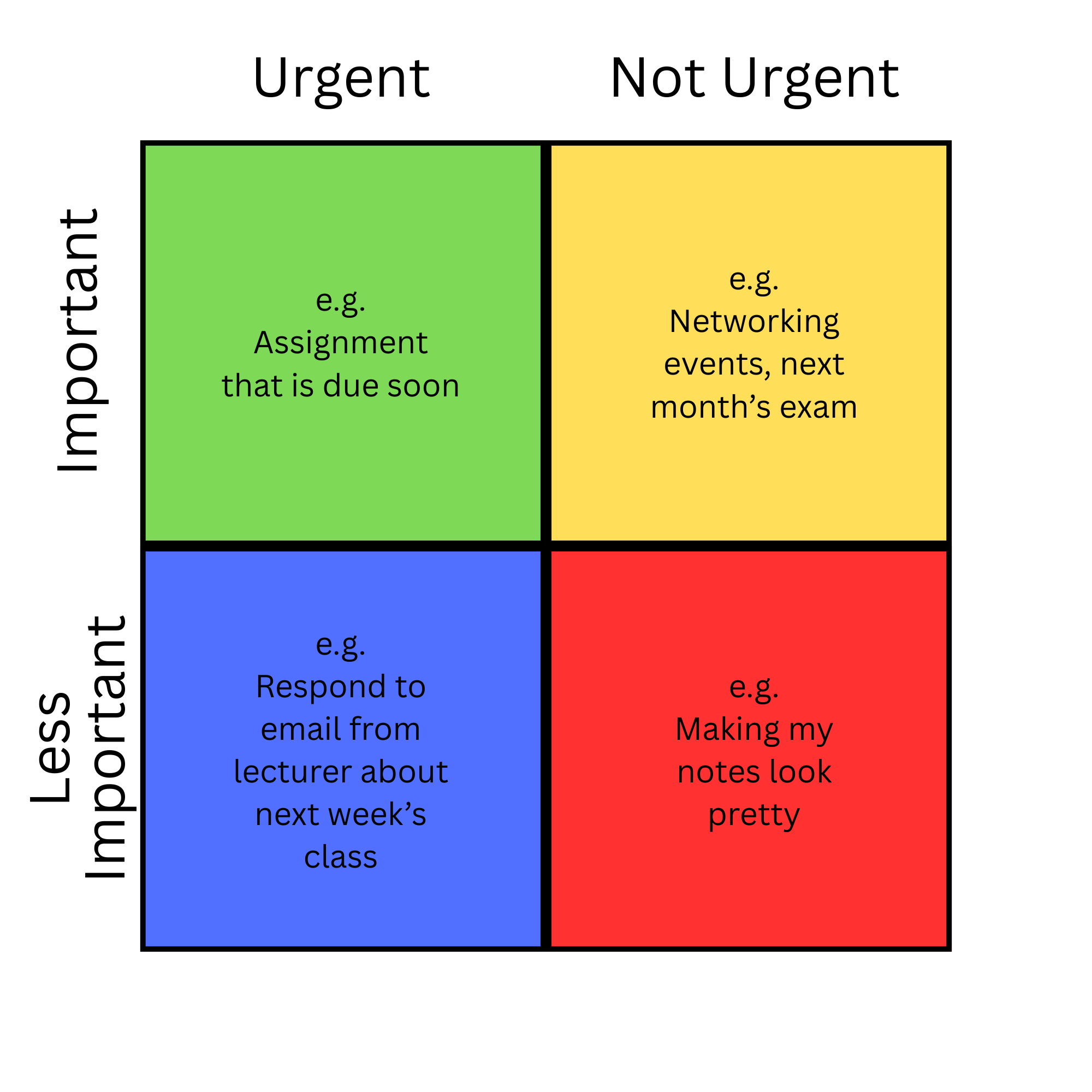
The useful school version is:
| Category | Meaning | Best response |
|---|---|---|
| Urgent and important | Deadline or test is close, and the task matters. | Do it or begin it in your next proper work block. |
| Important, not urgent | It matters but is far enough away to plan. | Schedule an early start. This is where steady revision and large projects belong. |
| Urgent, less important | It needs a quick response but has lower impact. | Keep it short; do it after the main task or in a spare gap. |
| Not urgent, less important | Little consequence if it waits. | Delay it, reduce it, or remove it if it is optional. |
The top-right quadrant is easily missed. Revising for a test next month is not urgent, but it is important. Starting it in small pieces prevents it from suddenly becoming an urgent panic.
3. Difficulty: difficult tasks need runway
Difficulty is about how much thinking, uncertainty, or support a task needs. “Finish chemistry questions” may take 25 minutes if you understand the method, or two hours if the first question makes no sense.
A difficult task often deserves an earlier start because it may reveal that you need to:
- reread the instructions;
- ask a teacher or classmate a question;
- find a missing resource;
- make a first attempt, correct it, then try again.
Do not automatically do the hardest task first every day. If an easy task is due tomorrow and takes ten minutes, finish it before it becomes a problem. But do not keep choosing easy jobs merely because they feel satisfying while a hard, important task gets closer.
4. Effort: estimate in blocks, not fantasies
Effort means the realistic amount of work remaining. Include setup time: opening the task, finding a book, logging in, and checking your answers all count.
Use rough ranges rather than pretending you can predict exactly:
- Quick: 5–15 minutes
- One block: 20–40 minutes
- Large: 45–90 minutes, or several blocks
- Project: needs breaking into stages before you can estimate it well
For example, “History essay due Monday” is too big to estimate as one item. At this stage you might write: understand question and choose evidence, plan paragraphs, draft, improve, and proofread. The next lesson will show you how to turn large work into clear next actions. For now, mark it as large and give it an early priority.
Read the short “Key Strategies to Prioritize Tasks” section in Prioritizing Tasks from Sheridan Library & Learning Services. It reinforces the same four ideas and adds one useful extra: match demanding work to the time of day when you normally have more focus.
Prioritizing Tasks - Time Management - All Guides at Sheridan Library & Learning Services
In Sheridan Library & Learning Services’ guide, the “Key Strategies to Prioritize Tasks” section gives a concise checklist for comparing school tasks rather than treating every item as equally important.
In the section “Key Stratgies to Prioritize Tasks,” skip the embedded video and read from the four strategies. Notice that effort and your energy level affect when you should tackle work, while deadlines and importance affect what should rise to the top.
A fast method for making your actual priority list
Do this with the weekly system you made last lesson. It should take around 10–15 minutes, not an hour.
Step 1: Write each task clearly
Make a temporary “this week” list. Give each task enough detail that you would know how to begin.
Instead of:
- Science revision
- English homework
- Geography
write:
- Science: answer 12 electricity practice questions for Friday quiz
- English: choose three quotes and annotate them for Thursday
- Geography: find two sources for the flood case study, due Monday
Clear task wording makes your estimate and priority more honest.
Step 2: Add four quick labels
Use a key like this beside each task:
- D: deadline: Today, Thu, Fri, Next Mon
- I: importance: High, Medium, Low
- H: difficulty: Hard, Medium, Easy
- E: effort: 15m, 30m, 60m, 2 blocks
Here is an example. The exact order is not produced by a formula; it comes from reading the whole picture.
| Task | Deadline | Importance | Difficulty | Effort | Sensible priority |
|---|---|---|---|---|---|
| Maths: upload completed worksheet | Tomorrow, 8:30 a.m. | Medium | Easy | 15 min | 1: finish today |
| Biology: revise cells for quiz | Friday | High | Hard | 2 blocks | 2: start today |
| English: annotate three quotations | Thursday | High | Medium | 40 min | 3: next available block |
| Art: improve title page | Next Tuesday | Low | Easy | 20 min | 5: later |
| Geography: find case-study sources | Next Monday | High | Hard | 1 block | 4: schedule an early start |
The maths task is first because it has a fixed deadline tomorrow and is quick. Biology begins early, even though Friday is not tomorrow, because it is important, difficult, and needs more than one block. Geography is not urgent yet, but it is important and hard enough that leaving it to Sunday would be risky.
Step 3: Choose a main priority and a backup
For your next study period, choose:
- One main priority: the task that should receive your proper focus.
- One backup task: a useful smaller task if you finish early, get stuck waiting for help, or have less time than expected.
For the example above:
- Main: Biology, complete and check six electricity questions.
- Backup: Upload the finished maths worksheet.
This is better than telling yourself, “I’ll do biology, English, maths, geography, and maybe some art.” A long list feels productive, but it makes it easy to jump around and finish none of the demanding work.
When the signals clash
Real priority decisions are not always obvious. Use these tie-breakers.
A near deadline versus a major future assessment
First, protect the near deadline if missing it has a real consequence and you can finish it in a reasonable amount of time. Then give the major assessment a planned block soon after.
However, if the small task is low-value and the assessment is tomorrow, do not spend your whole evening polishing the small task. Do the minimum required to submit it, then return to revision.
A long task versus several short tasks
Start the long task early if it is important or difficult. Large work becomes dangerous when you delay its first step because it gives you no information about how hard it really is.
A few short tasks are fine to clear when they:
- have immediate deadlines;
- genuinely take only a few minutes;
- remove a practical blocker, such as submitting a form or replying to a teacher.
They should not become a way to avoid your main work.
A task you dislike versus a task that matters more
Disliking a task is useful information: you may need to start it with a shorter, clearer first step. But dislike is not a priority category. Compare the actual deadline, impact, difficulty, and time needed.
If two tasks are similarly important, doing the more difficult or unpleasant one in your best-focus time can stop it hanging over the rest of the evening.
You have less time than the work requires
Be realistic. You cannot create extra hours by writing an impossible list. Rank the tasks, complete the highest-impact work first, and identify what needs a message to a teacher, a request for clarification, or a reduced-but-honest first step. Module 7 will return to this kind of schoolwork triage in more depth.
Keep improving your estimates
Your first time estimates will sometimes be wrong. That is normal. The point is to become a little more accurate each week.
When you finish a task, make a tiny note:
- estimated: 30 minutes;
- actual: 50 minutes;
- reason: spent 15 minutes finding the worksheet; needed to redo two questions.
Next time, you will know that similar maths work may need a 45-minute block, or that you should download the worksheet before starting. This is not evidence that you are bad at planning; it is how planning gets based on real evidence rather than wishful thinking.
For the rest of this week, use one simple routine after school:
- Look at the tasks due soon and the commitments already in your planner.
- Pick one main priority using the four signals.
- Pick one backup task.
- After working, update the task’s estimate or mark it complete.
Do not keep renumbering everything all day. Reprioritise when new homework appears, a deadline changes, or you learn that a task is much bigger than you thought.
Key takeaways
Prioritising means choosing what deserves attention first, not trying to treat every task as urgent. Compare each school task using:
- deadline: how soon it must be completed;
- importance: the consequence for learning, marks, or other people;
- difficulty: whether it needs focused thinking, help, or more than one attempt;
- estimated effort: how much realistic time remains.
Start urgent-and-important work promptly, but also schedule early starts for important work that is not urgent yet. Give yourself one clear main priority and a smaller backup, rather than an unrealistic list.
Next, you will turn these priorities into a flexible weekly schedule with focused study blocks and backup blocks.
Can't find a good explanation? Sign up and we'll make it for you
Sign up