
Welcome back. Last lesson established an important distinction: an infant can learn that an action produces an outcome, yet that does not automatically mean the action is a mature, automatic habit. With repetition in a stable setting, however, cues around an action can become increasingly powerful. The same framework now lets us examine something much more concrete: the routines your son encounters every day.
At 8–12 months, the most useful phrase is often early learned routine rather than “habit” in the adult sense. A familiar high chair, bib, bath, sleep sack, song, caregiver voice, or bedroom can begin to predict what comes next. These cues may organize attention, anticipation, emotion, and behavior. But they do not override hunger, tiredness, illness, teething, temperament, or a need for comfort.
This lesson focuses on two high-frequency settings—feeding and sleep—and on how to recognize learned cue–response patterns without mistaking them for defiance, manipulation, or a “bad habit.”
A practical model: state, cue, response, outcome
A useful way to observe early habit formation is to separate four components:
| Component | In an 8–12-month-old | Example at bedtime |
|---|---|---|
| Internal state | Hunger, satiety, sleep pressure, discomfort, curiosity | Tiredness after a stimulating day |
| Cue or context | Place, object, sequence, time, person, sensory signal | Dim lights, sleep sack, familiar song |
| Response | Looking, reaching, fussing, calming, vocalizing, settling | Quieting, cuddling in, protesting a change |
| Outcome | Food, social contact, relief, sleep, sensory event | Being fed, held, or eventually falling asleep |
The previous lesson’s habit model emphasized:
In infancy, however, it is better to keep the whole system in view:
For example, a hungry child may become excited when placed in a high chair because the chair has predicted food many times. That anticipation is evidence of learning. But if he has just eaten, is unwell, or is distracted, the same chair may not produce the expected eating behavior. His behavior remains strongly state-dependent.
This is why repetition should be predictable but responsive, not rigid. Predictability makes the environment intelligible; responsiveness keeps the routine aligned with the child’s current biological and emotional needs.
Feeding: learning a routine while protecting self-regulation
At eight months, feeding is not merely nutrition delivery. It is a recurring learning system involving bodily signals, sensory experiences, caregiver interpretation, and increasingly active participation.
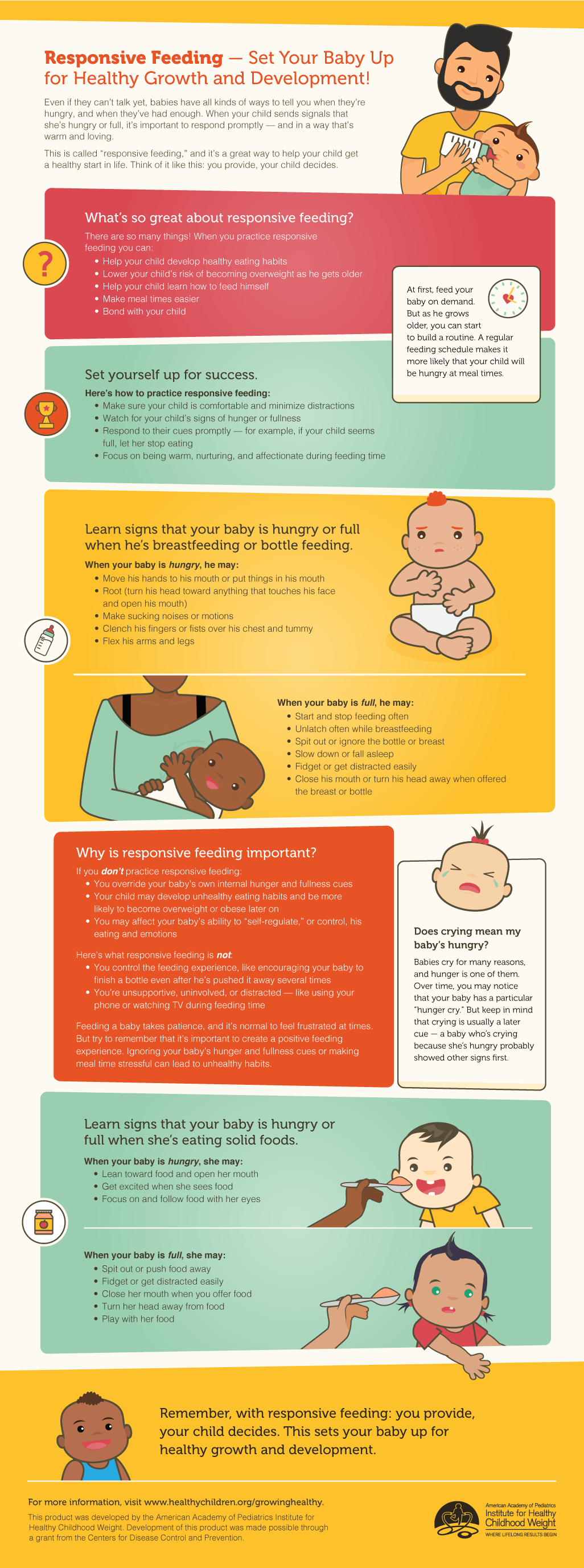
The World Health Organization defines responsive feeding for children aged 6–23 months as feeding that supports autonomous eating in response to physiological and developmental needs. Its underlying loop is simple:
- The child signals hunger or fullness through movement, facial expression, or vocalization.
- The caregiver recognizes the signal.
- The caregiver responds promptly, warmly, and appropriately.
- The child experiences that his signals have a predictable effect.
Read this section from the World Health Organization guideline to connect feeding routines with self-regulation rather than treating meals as simple conditioning.
In Section 3.7, “Responsive feeding,” begin where the three-step interaction is explained. Continue through the evidence summary. Focus on the difference between encouraging eating and pressuring eating, and note the guideline’s careful statement that the overall evidence varies in certainty across outcomes.
What early learned feeding patterns can look like
Here are several plausible examples of routine learning at this age.
Anticipation of the feeding context.
The high chair, bib, spoon, familiar bowl, or a caregiver preparing food can become cues that food is about to arrive. Your son may lean forward, vocalize, reach, open his mouth, or become impatient. These are not simply “food habits”; they can reflect a learned prediction combined with a genuine hunger state.
Learning that communication works.
When a child turns away, closes his mouth, pushes food away, slows down, or becomes interested in something else, these may be fullness or disengagement signals. If caregivers repeatedly pause or stop in response, he learns that communication is effective. This is a form of contingency learning: my state and signals affect what happens.
Growing participation in eating.
With safe, developmentally appropriate foods and close supervision, an infant may increasingly reach for food, bring it to his mouth, grasp a spoon, or explore textures. The goal is not neatness or immediate intake efficiency. It is practice coordinating perception, movement, and bodily feedback.
Taste familiarity through repeated exposure.
Repeated exposure can shape food acceptance. This is best thought of as preference learning, not a simple stimulus–response habit. An initially unfamiliar vegetable may require many calm, non-pressured exposures before it becomes familiar enough to be accepted.
The WHO guideline notes that repeated exposure to vegetables during infancy has been associated with later acceptance and intake.
This short passage adds an important example of how repeated experience can influence later food preference without force or reward pressure.
In the “Fruits and vegetables” section, read the repeated-exposure finding. Notice that the claim concerns improved acceptance over time, not guaranteed liking after one or two attempts.
Why “finish the bowl” is not the learning target
A predictable feeding routine can be helpful: wash hands, sit in the high chair, eat together, and finish calmly. But the child’s satiety cues should remain more important than completing a predetermined amount.
If a caregiver repeatedly overrides clear fullness signals, the routine can shift away from internal regulation toward external control: food continues until the adult decides it is enough. That is not the type of learning responsive feeding aims to support.
A helpful interpretation rule is:
Offer structure; let hunger and fullness influence intake.
This does not mean every refusal is fullness, or that a child should dictate the entire meal. It means observing patterns across meals rather than treating every mouth turn, pause, or protest as a behavioral problem.
Sleep: routines create predictions, not guarantees
Sleep routines are another powerful setting for cue learning. A predictable sequence can help mark a transition from daytime activity to a quieter state. Bathing, feeding, a short book, soft music, snuggling, and a goodnight kiss are common examples—but none is mandatory, and the best sequence is one your family can repeat calmly and flexibly.
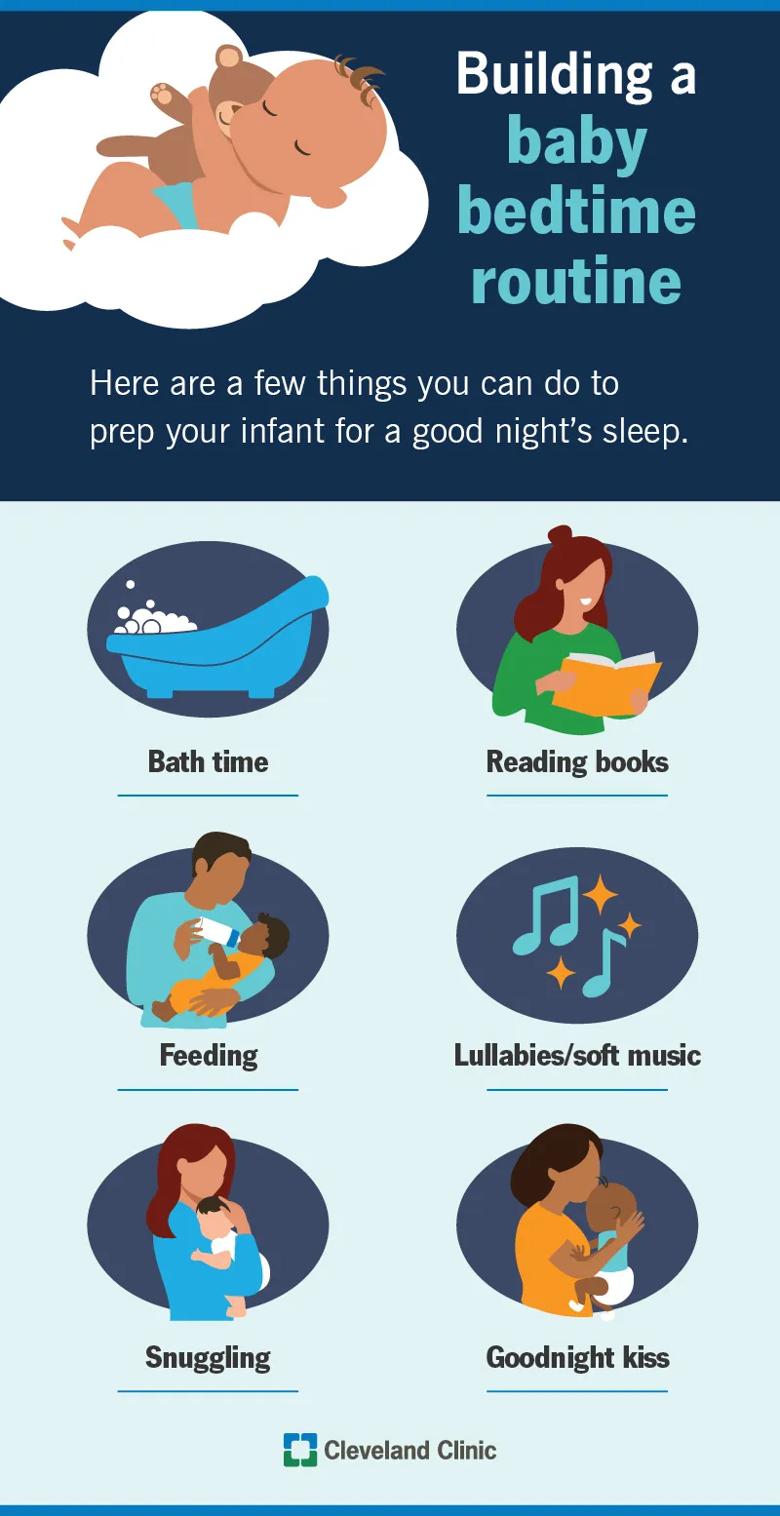
Over repeated evenings, the pattern may become:
The early learned part is not necessarily “the baby sleeps because of the song.” Rather, the cues may help the child predict: the active part of the day is ending; familiar caregiving and a transition to sleep are next.
Early sleep-cue learning: examples
A familiar sequence produces anticipation.
Your son may become calmer—or occasionally protest—when the sleep sack appears or when he is brought into the bedroom. Either reaction can be evidence that the cues have acquired meaning. A protest does not prove the routine is failing; it may reflect tiredness, separation distress, frustration at ending play, or a change in needs.
A particular condition becomes linked with sleep onset.
If a child regularly falls asleep while feeding, rocking, or being held, those conditions can become part of the learned sleep-onset context. This is often called a sleep association. It is not a moral failure by parent or child. Feeding and comforting are biologically and socially meaningful activities, and many families use them.
The practical question is not “Is this association bad?” but:
Does this pattern work for the child and family, including during ordinary night awakenings?
A child who initially fell asleep under particular conditions may sometimes seek those same conditions when moving between sleep cycles. Yet this tendency is variable, not deterministic.
Changes in cues can temporarily disrupt settling.
Travel, a different caregiver, illness, developmental progress, noise, or a disrupted schedule can alter sleep even if the old routine is still present. This fits what you learned from Rovee-Collier’s work: infant learning and memory can be context-dependent. A familiar cue can help retrieve a familiar behavioral pattern, but it does not control the entire situation.
What the sleep research says—and does not say
The curated sleep study examined associations among bedtime practices, temperament, and objectively measured sleep in a large group of infants. It compared patterns such as feeding to sleep, being held or rocked, and falling asleep without physical contact.
Read these results as evidence about associations between bedtime routines and sleep patterns, while paying close attention to the researchers’ discussion of temperament and bidirectional effects.
In “Bedtime routines and differences in temperament traits and sleep metrics,” start where the sleep-onset groups are introduced. Review Tables 2 and 3, then read the following subsection, “The role of parental bedtime involvement,” from the results through the balance statement. Focus on two ideas: the observed associations and why they cannot show that one parenting practice alone caused a sleep outcome.
The study found that infants who fell asleep while being fed or while being held or rocked showed, on average, shorter nighttime sleep duration, lower sleep efficiency, and more parent interventions than comparison groups. These findings are relevant because they are compatible with a learned sleep-onset association: specific forms of contact may become reliable parts of how some infants initiate sleep.
However, the study is cross-sectional, meaning it measured existing patterns rather than randomly assigning families to bedtime methods and following causal changes. Therefore, it cannot establish that feeding or rocking caused the sleep differences.
Several alternative explanations are plausible:
- Infants with more reactive or difficult-to-soothe temperaments may naturally receive more rocking or feeding support.
- Parents may increase support because their child already has fragmented sleep.
- Parent and infant behavior can create a feedback loop over time.
- Family culture, work schedules, living arrangements, illness, and many unmeasured factors can shape routines.
The researchers themselves emphasize that there is no universally perfect settling strategy. Some children genuinely need more support at certain developmental stages. This nuance matters: using a learning framework should improve observation and empathy, not turn normal caregiving into a problem to eliminate.
For sleep safety, always follow current guidance from your pediatrician and relevant local public-health authorities; habit science does not replace safe-sleep guidance.
How to identify an early learned routine without overinterpreting it
When you see a repeated behavior, use this short observational checklist.
1. Is there a stable cue?
Look for recurring environmental signals:
- high chair, bib, spoon, particular room;
- bath, pajamas, sleep sack, dim lights;
- a particular song, phrase, or caregiver action;
- a reliable time or transition in the day.
A cue is more likely to be meaningful when it consistently occurs just before the behavior or outcome.
2. Is the response anticipatory?
Anticipation may look like reaching, smiling, vocalizing, leaning forward, turning toward a familiar object, calming, or protesting a transition. The response often begins before the desired outcome occurs.
For example, excitement when the spoon appears before food reaches the mouth suggests that the spoon has become predictive.
3. Does the behavior still depend on internal state?
This is the essential safeguard against calling everything a habit. A child who reaches for food when hungry but turns away when full is not “being inconsistent”; he is integrating a learned routine with physiological feedback.
Similarly, a sleep routine may be effective on a typical evening but less effective when the child is ill, overtired, teething, or unusually stimulated.
4. What is the caregiver unintentionally reinforcing?
This question is not about blame. It asks what consequence reliably follows a behavior.
- If vocalizing in the high chair brings a spoonful or warm social interaction, vocalizing may increase.
- If a particular cry reliably leads to rocking, rocking becomes part of the child’s expected soothing sequence.
- If turning away consistently leads adults to pause, the child learns that turning away communicates something meaningful.
The aim is not to avoid reinforcing all behavior—social learning requires reliable responses. It is to make the responses you repeat ones that are safe, sustainable, and respectful of your child’s signals.
A father’s observational practice: a three-day routine map
For three ordinary days, briefly note one feeding routine and one bedtime routine. Do not try to change anything yet. Just record:
| Observe | Feeding example | Sleep example |
|---|---|---|
| State | Was he likely hungry, tired, distracted, or full? | Was he tired, overstimulated, unwell, or comfortable? |
| Cue | What appeared just before eating? | What began the transition toward bed? |
| Response | Reaching, mouth opening, turning away, fussing? | Calming, vocalizing, resisting, rubbing eyes? |
| Caregiver action | Offered food, paused, encouraged self-feeding? | Held, fed, sang, placed down, reassured? |
| Outcome | Continued eating, stopped, explored, became upset? | Settled, needed more support, woke soon after? |
The point is to identify patterns, not to grade your parenting or demand immediate consistency from your son. Over a few days, you may find that a behavior you first thought was a “habit” is mostly driven by hunger, tiredness, or stimulation. Or you may notice that one small, calm cue—such as a consistent phrase before sleep—has become especially meaningful.
Key takeaways
In the second half of the first year, infants are developing learned routines around recurring settings such as meals and bedtime. A high chair, spoon, sleep sack, song, or caregiver sequence can become a predictive cue, shaping anticipation and response.
Feeding routines should support self-regulation: the caregiver provides appropriate food, structure, and warm attention, while the child’s hunger and fullness cues influence how much is eaten. Repeated, non-pressured exposure can support later acceptance of foods.
Sleep routines can create useful expectations about a transition toward rest. Feeding, rocking, and contact may become sleep-onset associations, but these patterns are neither proof of a mature adult-like habit nor evidence of poor parenting. Research finds associations between active bedtime involvement and some sleep outcomes, but temperament and parent–child feedback loops prevent simple causal conclusions.
The next module turns from individual routines to the social system that makes them meaningful: attachment, stress regulation, and the responsive back-and-forth interactions through which caregiving helps shape developing brain architecture.
Can't find a good explanation? Sign up and we'll make it for you
Sign up