
Welcome back. In the previous lesson, we used Rovee-Collier’s mobile paradigm to establish the first link in the chain: infants can learn that a particular action produces a particular outcome. A kick makes the mobile move; with reliable feedback, kicking increases. That is the foundation of action–outcome learning.
This lesson asks what can happen after that foundation is repeatedly used. We will distinguish an action performed because its outcome is expected from a response that is increasingly triggered by a familiar situation. Then we will locate this transition in the basal ganglia, a set of deep brain circuits that help select, refine, and automate actions. The key caveat throughout: much of the strongest causal evidence comes from animal studies and adult human research. It provides a powerful framework for infancy, but it does not mean that every repeated behavior of an eight-month-old is already a fully formed habit.
A useful pace is about 35–40 minutes: 12 minutes for the reading, 4 minutes for the video, and the remainder for the explanations and the infant-development application.
From “I want that effect” to “this situation makes me do it”
The technical distinction introduced last time is central:
-
A goal-directed action is guided by an expected and currently valued outcome:
-
A stimulus–response habit is increasingly elicited by a cue or context associated with the response:
A goal-directed action is not necessarily slow or verbal. It simply remains sensitive to its consequence. If the outcome becomes less desirable, or if the action no longer causes it, behavior should change.
For example, imagine an adult learning a new coffee-machine interface. At first, they deliberately press a particular button because they expect coffee. If the machine stops dispensing coffee, they will soon stop pressing it. The response is controlled by the expected outcome.
After many mornings in the same kitchen, however, a familiar visual cue—the machine, the time of day, the end of breakfast—may start the sequence with little deliberation. The person may find their hand reaching for the button even when they have already had coffee. That tendency is more habit-like: the setting has gained control over the response.
A simple behavioral observation—“the action happens often”—cannot distinguish these two forms of control. Researchers instead use more demanding tests:
- Outcome devaluation: Make the outcome less desirable. If responding decreases, action remains goal-directed; if it persists, habitual control is more likely.
- Contingency degradation: Deliver the outcome independently of the action, so the action is no longer necessary. If responding decreases, the learner is tracking the action–outcome relationship.
This is similar to distinguishing correlation from causal influence in analytics. A repeated action following a cue does not by itself show what controls the action. Researchers change the value or causal reliability of the outcome to identify the controlling relationship.
Goal-directed and habitual control in the basal ganglia: implications for Parkinson’s disease
Read these selected sections of the review article Goal-directed and habitual control in the basal ganglia. It gives the formal definitions and the experimental evidence that separates goal-directed from habitual control.
Begin with the section “Dual systems for instrumental control.” Read the definition and tests, then continue through the examples of devaluation and contingency degradation. Next, in “Goal-directed or habit?”, focus on the discussion of repetition. Notice that repeated, consistent training is one influence among several; predictability, reinforcement schedule, and stress also affect which system governs behavior. Finally, read the full section “Goal-directed and habitual control in the basal ganglia,” paying particular attention to the human evidence and to the rodent lesion findings. Keep track of the distinction between associative and sensorimotor regions of the striatum.
The basal ganglia: circuits for selecting and automating actions
The basal ganglia are a group of interconnected structures deep beneath the cerebral cortex. They do not work as a solitary “habit center.” Instead, they form loops with the cortex and thalamus that help the brain select useful actions, suppress alternatives, learn from feedback, and make well-practiced sequences more efficient.
The striatum is the principal input region of the basal ganglia. It receives extensive signals from the cortex: information about the current setting, sensory cues, ongoing movement, and—especially in associative circuits—likely outcomes and their value. It sends signals through other basal-ganglia structures, including the globus pallidus and substantia nigra, which influence thalamic activity and ultimately feed back to cortex.
At a simplified level, this loop helps answer:
Given this situation, which action pattern should be permitted, strengthened, or withheld?
The diagram below uses rodent anatomy to show two partially distinct loops. It is useful because the experimental separation between goal-directed and habit-like control is especially clear in rodent work.
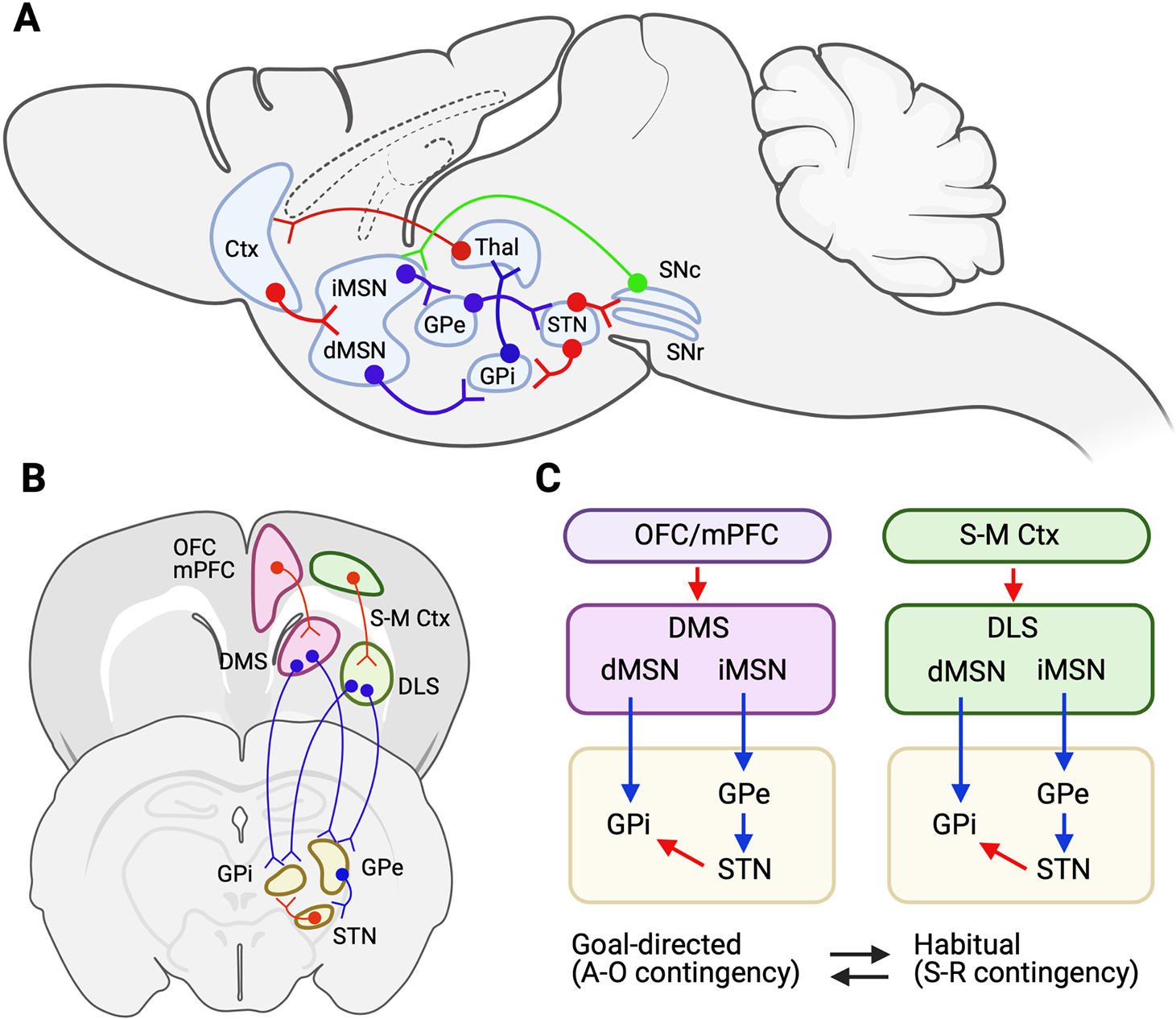
Two broad functional territories matter here:
| Functional territory | Dominant information | Main behavioral role supported by evidence |
|---|---|---|
| Associative / rostromedial striatum | Context, action plans, expected outcomes | Goal-directed, outcome-sensitive action |
| Sensorimotor / caudolateral striatum | Repeated sensory and motor patterns | Cue-linked, more automatic responding |
In rodents, these are commonly called the dorsomedial striatum (DMS) and dorsolateral striatum (DLS). In primates and humans, the anatomy is not a simple one-to-one map. Broadly, associative functions involve regions including the caudate and more rostral putamen, whereas sensorimotor habit-related functions involve more posterior portions of the putamen. The important point is functional: basal-ganglia loops connected with more associative cortex contribute strongly when an action is newly learned and outcome-sensitive; loops connected with sensorimotor cortex become increasingly influential as a response is repeated in stable circumstances.
The diagram also labels direct-pathway and indirect-pathway medium spiny neurons, abbreviated dMSNs and iMSNs. The classical simplified model says that direct-pathway activity helps facilitate a selected action, while indirect-pathway activity contributes to suppressing competing actions. Real behavior is more complex: both pathways can be active around action selection, and neither is simply an “on” or “off” switch. For this lesson, the key idea is that basal-ganglia circuitry is organized to learn which actions fit a situation and to regulate their expression.
Dopamine signals from the substantia nigra pars compacta (SNc) modulate plasticity in these corticostriatal circuits. Dopamine is not best understood as a generic “pleasure chemical.” In learning contexts, it is strongly involved in signaling that an outcome was better, worse, or different from what was expected—information that helps update which actions and cues are worth learning from.
Habits 101: The Neuroscience Behind Routine
Watch the selected portion of Habits 101: The Neuroscience Behind Routine from BrainFacts.org for a concise visual overview of corticostriatal habit circuitry. Treat its “shift of control” language as a useful high-level model; the following section adds the scientific nuance that both systems can remain active.
Watch the control shift, which contrasts deliberate prefrontal involvement in new actions with increasing dorsal-striatal involvement after repetition. Then watch dopamine and automaticity. Focus on the claim that repeated rewarding actions strengthen particular cortex–striatum pathways, rather than assuming that the cortex is literally switched off once a habit forms.
What repetition actually changes
It is tempting to describe habit formation as a single handover: first the prefrontal cortex chooses, then the basal ganglia take over. That is too neat.
A more accurate account is that goal-directed and habit-related circuits can be active at the same time, competing or cooperating for influence over behavior. With repeated practice in a stable setting, cue–response associations become stronger and faster to activate. The habitual system can then win control more often, particularly when rapid responding is useful or when attention is elsewhere.
The transition is gradual:
-
A new action is evaluated.
The learner acts because a specific effect is expected: pressing a button produces music; shaking a toy makes a sound. -
The action–outcome relation is repeated.
The consequence is reliable enough for the brain to learn that this action is useful in this setting. -
The setting becomes informative.
Features that regularly precede the action—the object, location, posture, time, or preceding event—begin to predict the response. -
The response becomes efficient and cue-linked.
Less moment-by-moment evaluation of the outcome is required. The response can be initiated more automatically when the familiar cue appears.
Thus, repetition matters not because a neural pathway is literally “worn in” like a physical path, but because repeated patterns modify synaptic strengths and coordinated activity across a circuit. The brain is learning a compact policy: in this familiar situation, this response is usually appropriate.
Evidence that the shift is real—and gradual
Several lines of research support this model.
Rodent lesion and inactivation studies provide causal evidence. When researchers disrupt the rodent dorsomedial striatum, animals become less able to use action–outcome information in devaluation and contingency tests. Conversely, after extensive training has induced outcome-insensitive responding, disrupting the dorsolateral striatum can restore more outcome-sensitive, goal-directed control. This double pattern is strong evidence that the two striatal territories make distinguishable contributions.
Monkey studies add a useful dissociation. Associative striatal areas are especially engaged while monkeys learn new movement sequences, whereas sensorimotor portions are more important for executing well-learned sequences.
Human brain-imaging studies cannot inactivate regions experimentally, but they converge with this pattern. In one free-operant learning study, people trained for one day reduced responding after a food outcome was devalued—consistent with goal-directed behavior. People given more extended training continued responding for the devalued food. Across training, cue-related activation increased in a posterior putamen/globus pallidus region, consistent with increasing sensorimotor-striatal influence.
The result is not “repetition destroys knowledge of the outcome.” A person may still know perfectly well that an outcome has changed while nevertheless performing the old response when a familiar cue appears. The cue-driven response has simply become highly competitive.
This also explains why repetition alone is not sufficient. A repeated behavior can stay goal-directed when the outcome remains important and actively evaluated. Other factors shape the balance:
- Consistency and predictability: Stable cue–response–outcome relations support automation.
- Attention and novelty: Unexpected changes tend to recruit more goal-directed control.
- Reinforcement schedule: Reliable action–outcome contingencies initially support action–outcome learning; certain variable arrangements can favor habit-like responding with extensive training.
- Stress or urgency: These can bias behavior toward fast, cue-driven responding. This is an adaptive short-term response, not evidence of a “weak” brain.
What this framework means for an eight-month-old
At eight months, your son is building an increasingly rich library of action–outcome relations. He is also encountering recurring situations: a high chair, a bath, a sleep routine, particular toys, familiar caregiver voices, and transitions between rooms or activities.
But the scientifically careful position is this:
A repeated infant behavior is not automatically a mature stimulus–response habit.
Infants’ motor control, attention, memory, needs, and social understanding are all changing rapidly. An infant may repeat an action because it is pleasurable, because it is new, because it practices a motor skill, because it produces an adult response, or because the cue genuinely predicts something he wants. In addition, formal devaluation tests—the standard evidence for habits—are difficult and often inappropriate to conduct with babies.
Still, the basal-ganglia framework helps you interpret routines without oversimplifying them. Consider a familiar bedtime sequence:
A dimmer room, a sleep sack, a song, and being held may become increasingly predictive through repetition. This does not mean those cues “make” a baby sleep, nor that he should be expected to respond identically each evening. Hunger, illness, teething, developmental leaps, and a need for connection can outweigh routine learning. Yet predictable, calm sequences can reduce uncertainty and give the developing brain repeated, intelligible structure.
A practical implication is to favor consistent but responsive repetition:
- Keep routine cues reasonably stable when they are helpful.
- Let your child produce safe actions with clear consequences during play.
- Notice whether a behavior is tied to the outcome, the setting, or both.
- Avoid interpreting a disrupted routine as defiance or a “bad habit.” It is often a signal that present biological or emotional needs differ from the usual pattern.
The goal is not to engineer automaticity in every part of his day. It is to provide reliable, safe patterns while allowing flexibility and responding to what he communicates.
Key takeaways
The basal ganglia, especially the striatum and its loops with cortex and thalamus, help the brain select actions and learn which actions fit particular contexts.
Goal-directed behavior is governed by an action’s expected, valued outcome. Habitual behavior is more strongly governed by a cue–response association and can persist even when the outcome has lost value. Outcome devaluation and contingency degradation are the key scientific tests that distinguish them.
Repetition in a stable context gradually strengthens sensorimotor cue–response control. It does not create an abrupt switch or erase goal knowledge: goal-directed and habit-related systems can operate in parallel, with their relative influence shifting across experience and circumstances.
For an infant, repeated routines and play contingencies are building blocks, not proof of adult-like habits. In the next lesson, we will use this distinction to identify likely early routine patterns around feeding and sleep in 8–12-month-olds—and to separate normal learned cues from claims that go beyond the evidence.
Can't find a good explanation? Sign up and we'll make it for you
Sign up